Quick Verdict: The Hybrid Land Cruiser Delivers Where It Counts
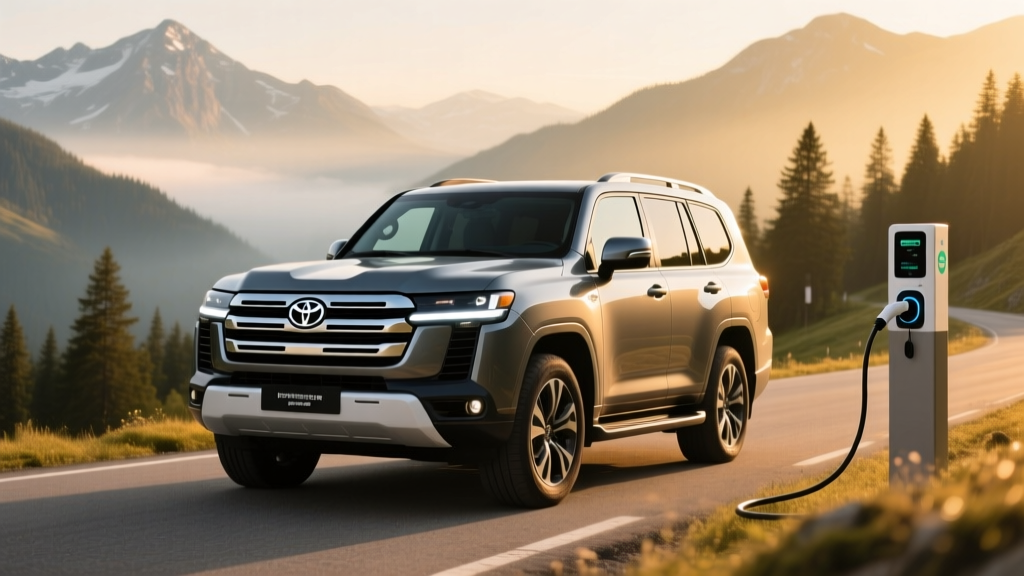
The 2026 Toyota Land Cruiser pairs a turbocharged 2.4-liter four-cylinder with an integrated electric motor in Toyota's i-FORCE MAX hybrid powertrain, producing 326 horsepower and 465 lb-ft of torque. It's a conventional hybrid (HEV), not a plug-in — no charging cord required. EPA-estimated at 23 MPG combined, it undercuts rivals like the Jeep Wrangler 4xe and Land Rover Defender in fuel consumption while retaining genuine off-road credibility. Starting at $58,450, it's positioned as a premium hybrid SUV for buyers who need towing, trail capability, and Toyota reliability without the complexity of plug-in charging infrastructure.
HEV vs PHEV: What the Land Cruiser Hybrid Actually Is
Before evaluating the Land Cruiser, it's critical to understand what type of hybrid it is — because Toyota sells both architectures across its lineup, and confusion here leads to buyer disappointment.
| Feature | Land Cruiser (HEV) | Plug-In Hybrid (PHEV) Example |
|---|---|---|
| Plug-in charging required? | No — regenerative braking + engine charges battery | Yes — Level 1/2 charging for EV range |
| Electric-only driving range | None (electric motor assists only) | Typically 20–40 miles EV-only |
| Battery size | ~1.87 kWh (small, nickel-metal hydride) | 15–25 kWh (lithium-ion) |
| Federal tax credit (§30D) | Not eligible | Up to $7,500 if eligible |
| Best for | Drivers without home charging access | Drivers with home/garage charging |
The Land Cruiser uses Toyota's i-FORCE MAX system: a 2.4L turbocharged inline-four mated to a 48-horsepower electric motor sandwiched between the engine and an 8-speed automatic transmission. A small 1.87 kWh nickel-metal hydride (NiMH) battery pack stores recaptured energy from regenerative braking and deceleration. The electric motor fills in torque at low RPMs — the exact scenario where turbocharged engines feel sluggish — giving the Land Cruiser immediate off-the-line response that belies its 4,950-pound curb weight.
This is the same powertrain architecture Toyota uses in the Tacoma i-FORCE MAX and 4Runner, adapted for the Land Cruiser's full-time four-wheel-drive system with a locking center differential and available rear locker.
EPA MPG vs Real-World Fuel Economy
The EPA rates the 2026 Land Cruiser hybrid at 23 MPG combined (22 city / 25 highway), according to fueleconomy.gov. For a body-on-frame SUV with a locking center diff, 326 hp, and a 6,000-pound towing capacity, that number is genuinely competitive.
| Driving Scenario | EPA Estimate | Real-World Expectation |
|---|---|---|
| City | 22 MPG | 21–24 MPG (hybrids often exceed EPA in stop-and-go) |
| Highway (70 mph) | 25 MPG | 22–24 MPG (aero drag + turbo boost at speed) |
| Combined | 23 MPG | 21–23 MPG |
| Towing (5,000 lb trailer) | Not rated | 12–15 MPG (expect 40–50% reduction) |
| Cold weather (below 30°F) | Not rated | 19–21 MPG (engine runs more for cabin heat) |
Real-world nuance: Toyota's hybrid system recovers energy most effectively in city driving with frequent braking. Owners doing 70%+ city commuting often report 24–25 MPG, slightly exceeding the EPA city figure. Highway-heavy drivers at sustained 75–80 mph speeds will see 21–22 MPG because the turbo engine works harder to overcome aerodynamic drag and the electric motor contributes less at steady-state cruising. Towing drops economy dramatically — plan fuel stops accordingly when pulling a trailer near the 6,000-lb max rating.
For context, the non-hybrid 2024 Jeep Wrangler with the 2.0L turbo achieves 22 MPG combined, and the Land Rover Defender 110 P400 mild-hybrid returns 19 MPG combined. The Land Cruiser hybrid's advantage is modest in absolute terms but meaningful over 15,000 annual miles — roughly $200–$350/year in fuel savings versus comparable non-hybrid competitors at current gas prices.
Powertrain Deep Dive: i-FORCE MAX Specs
| Specification | 2026 Toyota Land Cruiser |
|---|---|
| Engine | 2.4L turbocharged inline-4 |
| Electric Motor | 48 hp / 184 lb-ft (integrated in transmission) |
| Combined Output | 326 hp / 465 lb-ft |
| Transmission | 8-speed automatic (Direct Shift-8AT) |
| Drivetrain | Full-time 4WD, locking center diff, available rear locker |
| Hybrid Battery | 1.87 kWh NiMH (sealed, no plug) |
| 0–60 mph | ~6.5 seconds (est.) |
| Towing Capacity | 6,000 lbs (max, properly equipped) |
| Curb Weight | ~4,950 lbs |
| EPA Fuel Economy | 22 city / 25 highway / 23 combined MPG |
| Fuel Tank | 19.0 gallons |
| Total Driving Range | ~437 miles (EPA combined) |
The i-FORCE MAX system is engineered for torque density, not electric-only range. The electric motor sits between the engine and transmission, acting as a torque-fill device during turbo spool-up and as a generator during deceleration. At idle and very low speeds (parking lot crawling), the engine can shut off entirely and the motor can move the vehicle short distances — but this is measured in feet, not miles. There is no EV mode button and no plug port.
The 8-speed automatic is a conventional torque-converter design, not a CVT like Toyota's smaller hybrid systems (Prius, RAV4 Hybrid). This matters for towing and off-road use: a torque-converter automatic provides predictable low-speed control and engine braking on descents that CVTs struggle to replicate.
Pricing, Trims & Tax Credit Eligibility
The 2026 Toyota Land Cruiser hybrid starts at $58,450 (1958 trim, including $1,450 destination charge) and ranges up to approximately $64,500 for the fully loaded Land Cruiser trim with premium packages.
| Trim | MSRP (incl. destination) | Key Features |
|---|---|---|
| 1958 | $58,450 | Round LED headlights, 8" touchscreen, heated seats, 18" wheels |
| Land Cruiser | $62,450 | 12.3" touchscreen, leatherette, 20" wheels, front skid plate |
| Land Cruiser (w/ Premium Pkg) | ~$64,500 | JBL audio, head-up display, 360° camera, heated/ventilated front seats |
Federal tax credit: The Land Cruiser hybrid does not qualify for the IRS §30D clean vehicle credit. That credit applies only to battery electric vehicles (BEVs) and plug-in hybrids (PHEVs) meeting specific battery-sourcing and critical-mineral requirements. Conventional hybrids like the i-FORCE MAX Land Cruiser are excluded under current law.
Some states offer their own hybrid purchase incentives or reduced registration fees, but these vary widely by jurisdiction. Check your state's energy or DMV website for current programs — don't assume state credits mirror federal rules.
Battery Warranty, Reliability & Replacement Cost
Toyota Hybrid Battery Warranty
10 years / 150,000 miles (whichever comes first) — covers the hybrid battery against defects and capacity loss below a defined threshold. This applies to all 2026 Toyota hybrid models, including the Land Cruiser.
Powertrain warranty: 5 years / 60,000 miles
Bumper-to-bumper: 3 years / 36,000 miles
Toyota's hybrid reliability track record is among the strongest in the industry. The Prius, introduced in 2000, has demonstrated NiMH battery packs lasting 200,000+ miles with minimal capacity loss. The Land Cruiser's hybrid battery is small (1.87 kWh) and rarely cycles through deep discharge — it operates in a narrow state-of-charge window (roughly 40–80%), which dramatically extends cell life compared to the deep cycles a full EV or PHEV battery endures.
Replacement cost if out of warranty: Based on current Toyota hybrid battery pricing, a replacement NiMH pack for the Land Cruiser would likely cost $3,000–$4,500 installed at a dealership. Independent hybrid specialists often offer refurbished packs for $1,500–$2,500. Given the 10-year/150,000-mile warranty and Toyota's hybrid durability history, most original owners will never face this cost.
IIHS safety ratings for the 2026 Land Cruiser were not yet fully published at time of writing, but the TNGA-F platform (shared with the 4Runner and Tacoma) has performed well in crash testing across Toyota's body-on-frame lineup.
Who Should Buy the Land Cruiser Hybrid vs Alternatives
Choose the Land Cruiser Hybrid If:
- You need genuine off-road capability (locking diffs, crawl control, 8.7" ground clearance) without sacrificing daily drivability
- You don't have access to home or workplace charging — making a PHEV or BEV impractical
- You tow regularly (up to 6,000 lbs) and need a torque-dense powertrain
- You plan to own the vehicle 10+ years and value Toyota's long-term reliability and resale value
- You want a hybrid but don't want to change your fueling habits (no plugs, no apps, no range planning)
Consider a PHEV or Full EV Instead If:
- You have home charging and want to drive 25–40 miles daily on electricity alone (look at the Jeep Wrangler 4xe or Toyota RAV4 Prime)
- You want to qualify for the federal §30D tax credit (up to $7,500 for eligible BEVs/PHEVs)
- Your driving is primarily highway commuting without towing or off-road needs (a BEV like the Rivian R1S or Tesla Model X would be more efficient)
- You want the lowest possible per-mile fuel cost — electricity at $0.13/kWh costs roughly $0.04/mile vs. $0.16/mile for gas at 23 MPG and $3.60/gallon
Pros
- 326 hp / 465 lb-ft with no plug-in requirement
- Best-in-class fuel economy for body-on-frame SUVs
- 10-year / 150,000-mile hybrid battery warranty
- Proven i-FORCE MAX powertrain shared with Tacoma/4Runner
- 6,000-lb towing capacity
- Strong projected resale value (Toyota Land Cruiser heritage)
Cons
- No federal tax credit eligibility (HEV exclusion)
- 23 MPG combined is efficient for the class but still $2,400+/year in fuel
- Only two rows / 5-passenger seating (no 3-row option)
- Cargo space compromised by hybrid battery packaging
- No electric-only driving — even short trips burn gas
- Starting MSRP above $58K with limited trim availability
Frequently Asked Questions
How many MPG does the Toyota Land Cruiser hybrid get?
The EPA rates the 2026 Land Cruiser hybrid at 22 city / 25 highway / 23 combined MPG. Real-world results vary: city-heavy drivers may see 24–25 MPG thanks to regenerative braking efficiency, while sustained highway driving at 75+ mph typically returns 21–22 MPG. Towing drops economy to roughly 12–15 MPG depending on trailer weight and terrain.
Is the Land Cruiser hybrid a plug-in? Do I need to charge it?
No. The Land Cruiser is a conventional hybrid (HEV), not a plug-in hybrid (PHEV). There is no charging port. The small 1.87 kWh battery recharges through regenerative braking and the gasoline engine. You fuel it exactly like a conventional vehicle — at a gas station, with no behavioral changes required.
How far can the Land Cruiser drive on electric power alone?
It cannot. The electric motor assists the gasoline engine but cannot propel the vehicle at meaningful speeds or distances on its own. At very low speeds (parking lot crawling), the engine may shut off and the motor moves the vehicle a few feet, but this is not a usable electric-only driving mode. If electric-only range is a priority, consider a PHEV like the Toyota RAV4 Prime (42 miles EV) or a full BEV.
Does the Toyota Land Cruiser hybrid qualify for any tax credit?
No. Under current IRS §30D rules, only battery electric vehicles (BEVs) and plug-in hybrids (PHEVs) with qualifying battery sourcing are eligible for the federal clean vehicle credit. Conventional hybrids like the Land Cruiser i-FORCE MAX are excluded. Some states may offer separate hybrid incentives — check your state's energy department for current programs.
Is the Land Cruiser hybrid reliable? What does battery replacement cost?
Toyota's hybrid systems are among the most reliable in the automotive industry, with two decades of proven durability in the Prius and Camry Hybrid lineages. The Land Cruiser's hybrid battery is covered by a 10-year / 150,000-mile warranty. Out-of-warranty replacement is estimated at $3,000–$4,500 at a dealership, or $1,500–$2,500 through independent hybrid specialists. Given the shallow charge-discharge cycles and Toyota's engineering, most owners will never need a replacement.
How does the Land Cruiser hybrid compare to the 4Runner hybrid?
Both use the i-FORCE MAX 2.4L turbo hybrid powertrain producing 326 hp / 465 lb-ft, and both ride on the TNGA-F platform. The Land Cruiser is positioned as a more premium, globally-oriented vehicle with slightly more refined on-road manners and heritage styling. The 4Runner offers more off-road trim variants (TRD Pro, TRD Off-Road) and a slightly larger cargo area. EPA MPG figures are similar (23 combined for both). Choose the Land Cruiser for premium features and heritage; choose the 4Runner for maximum off-road trim selection.
Can I tow with the Land Cruiser hybrid without killing fuel economy?
You can tow up to 6,000 lbs, but fuel economy drops significantly — expect 12–15 MPG when pulling a 4,000–5,000 lb trailer on flat terrain, and potentially less in hilly areas. The hybrid system's torque fill helps with acceleration from stops while towing, but the small battery and turbo four-cylinder are working hard under load. For frequent heavy towing, plan fuel stops carefully and consider the 19-gallon tank's effective range of roughly 230–285 miles while towing.