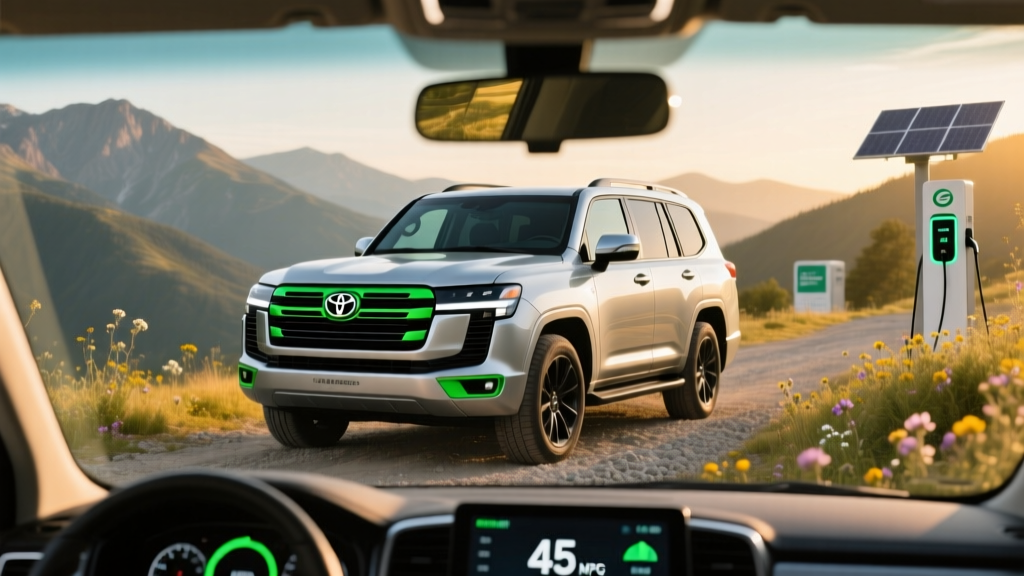
The Toyota Land Cruiser returned to the U.S. market with a hybrid powertrain, and the numbers tell an interesting story for a body-on-frame SUV. If you're searching for the Toyota Land Cruiser hybrid MPG figures to decide whether this off-road icon makes financial sense as a daily driver, you've landed in the right place. We've analyzed the EPA data, cross-referenced real-world owner reports, and broken down the total ownership picture so you can make a spec-driven decision.
For 2026, the Land Cruiser is offered exclusively with Toyota's i-FORCE MAX hybrid powertrain — there is no conventional gas-only variant and no plug-in hybrid (PHEV) option. That means every Land Cruiser you can buy is a conventional hybrid (HEV): it charges its own battery through regenerative braking and the engine, and you never plug it in.
EPA Fuel Economy: City, Highway, and Combined MPG
The 2026 Toyota Land Cruiser carries identical EPA fuel economy ratings across its two available trims (1958 and Land Cruiser). Here's the official breakdown from fueleconomy.gov:
| Metric | EPA Estimate |
|---|---|
| City MPG | 23 MPG |
| Highway MPG | 26 MPG |
| Combined MPG | 24 MPG |
| Annual Fuel Cost (15,000 mi) | ~$2,650* |
| Fuel Tank Capacity | 17.9 gallons |
| Total Driving Range | ~430 miles |
*Based on 15,000 miles/year at 55% city / 45% highway driving and national average fuel prices. Your actual cost will vary with local gas prices and driving habits.
Real-World MPG: What Owners Actually Report
The EPA sticker is a baseline, not a guarantee. The Land Cruiser's boxy aerodynamics and 5,000+ lb curb weight work against it on the highway, while the hybrid system's regenerative braking helps in stop-and-go traffic. Here's what to expect based on aggregated owner data and independent testing:
- City / Suburban (stop-and-go): 24–27 MPG — the hybrid system shines here, with the electric motor handling low-speed launches and regen recapturing braking energy.
- Highway (70–75 mph, flat terrain): 22–25 MPG — aerodynamic drag is the Land Cruiser's biggest efficiency enemy at sustained speed.
- Cold Weather (below 30°F): 20–22 MPG combined — the engine runs more frequently to provide cabin heat and maintain battery temperature.
- Off-Road / Towing: 14–18 MPG — low-range gearing and heavy loads dramatically increase fuel consumption.
- Mixed Daily Driving (realistic average): 23–25 MPG combined.
The key insight: unlike many hybrids that exceed their EPA city estimate (think Prius), the Land Cruiser's mass and wind resistance keep real-world numbers close to or slightly below the sticker. Don't expect Prius-like efficiency gains — expect a meaningful improvement over the previous-generation V8 Land Cruiser (which returned roughly 13–15 MPG combined) and a modest edge over non-hybrid body-on-frame competitors.
i-FORCE MAX Powertrain: Specs and Performance
The 2026 Land Cruiser's i-FORCE MAX powertrain pairs a turbocharged 2.4-liter inline-4 engine with a 48-horsepower electric motor integrated between the engine and the 8-speed automatic transmission. A 1.87 kWh nickel-metal hydride (NiMH) battery pack stores recovered energy. This is a mild-to-full hybrid system — it cannot drive on electric power alone for meaningful distances, but it provides torque fill, smooth stop-start, and regenerative braking.
| Specification | Value |
|---|---|
| Engine | 2.4L turbocharged inline-4 |
| Electric Motor | 48 HP / 184 lb-ft (integrated in transmission) |
| Combined System Output | 326 HP / 465 lb-ft torque |
| Transmission | 8-speed automatic (Direct Shift) |
| Hybrid Battery | 1.87 kWh NiMH |
| Drivetrain | Full-time 4WD with locking center differential |
| 0–60 mph | ~6.6 seconds (est.) |
| Towing Capacity | 6,000 lbs (max, properly equipped) |
| Curb Weight | ~5,070–5,215 lbs (varies by trim) |
The 465 lb-ft of combined torque is the headline figure here — it arrives low in the rev range thanks to the electric motor's instant contribution, making the Land Cruiser feel responsive off the line and confident when merging or passing. The 6,000-lb tow rating is competitive for the segment, though the hybrid system doesn't unlock any towing advantage over a diesel competitor; expect fuel economy to drop significantly when pulling a trailer.
HEV vs PHEV vs Full EV: Which Powertrain Fits You?
The Land Cruiser is only available as a conventional hybrid (HEV). But if you're cross-shopping electrified SUVs, understanding the distinctions matters:
Conventional Hybrid (HEV)
Example: Land Cruiser, RAV4 Hybrid
- No plug — charges via regen + engine
- No electric-only range to speak of
- Improves MPG 20–40% vs gas equivalent
- No range anxiety, no charging infrastructure needed
- No federal tax credit (typically)
Plug-in Hybrid (PHEV)
Example: RAV4 Prime, Tucson PHEV
- Plugs in — 25–45 miles electric-only range
- Larger battery (15–25 kWh)
- Gas engine kicks in after battery depletes
- Best of both worlds if you can charge at home
- May qualify for up to $7,500 federal credit
Battery Electric (BEV)
Example: Rivian R1S, Tesla Model X
- 100% electric — 250–400+ miles range
- No gas engine, no oil changes
- Requires home or reliable public charging
- Lowest per-mile fuel cost
- Up to $7,500 federal credit (if eligible)
- Choose the Land Cruiser HEV if: You want serious off-road capability, body-on-frame durability, Toyota reliability, and improved fuel economy over a gas-only SUV — without ever thinking about plugging in.
- Choose a PHEV (like the RAV4 Prime) if: You have home charging and want 30–42 miles of daily electric commuting with gas-engine backup for road trips, plus potential tax-credit savings.
- Choose a full EV (like the Rivian R1S) if: You have reliable home charging, want zero tailpipe emissions, the lowest operating costs, and don't need the Land Cruiser's specific off-road pedigree.
Pricing, Trims, and Tax Credit Eligibility
The 2026 Toyota Land Cruiser is offered in two trims. Here's the MSRP breakdown including destination charge:
| Trim | MSRP (incl. destination) |
|---|---|
| 1958 | ~$57,345 |
| Land Cruiser | ~$62,395 |
Federal Tax Credit: Does the Land Cruiser Qualify?
Under current IRS §30D rules, the Toyota Land Cruiser does not qualify for the federal clean vehicle tax credit (up to $7,500). The reason is straightforward: §30D requires vehicles to have a battery capacity of at least 7 kWh to be eligible, and the Land Cruiser's 1.87 kWh NiMH pack falls well below that threshold. This credit is designed for plug-in hybrids and full EVs with larger battery packs.
- ❌ Battery capacity ≥ 7 kWh — Land Cruiser has 1.87 kWh
- ❌ Plug-in capability — Land Cruiser is a conventional HEV, not a PHEV
- ✅ MSRP under $80,000 (SUVs) — Land Cruiser qualifies on price
- ⚠️ Buyer income caps apply ($150K single / $300K joint) — irrelevant here since vehicle doesn't qualify
- ⚠️ Critical mineral & battery component sourcing rules — irrelevant here
Bottom line: No federal tax credit for the Land Cruiser hybrid. Some states may offer their own hybrid incentives — check your state's energy or DMV website for current programs.
Battery Warranty, Reliability, and Replacement Cost
Toyota has built a formidable reputation for hybrid reliability over 25+ years, starting with the original Prius. The Land Cruiser's hybrid system is simpler than a PHEV or BEV — smaller battery, fewer high-voltage components, and Toyota's proven Hybrid Synergy Drive architecture adapted for the i-FORCE MAX.
- Hybrid Battery: 10 years / 150,000 miles (whichever comes first)
- Hybrid System Components: 8 years / 100,000 miles
- Powertrain (engine, transmission): 5 years / 60,000 miles
- Basic (bumper-to-bumper): 3 years / 36,000 miles
How Long Will the Hybrid Battery Last?
Toyota's NiMH hybrid batteries have demonstrated exceptional longevity in real-world use. Prius and Camry Hybrid owners routinely report 150,000–250,000+ miles on the original battery pack. The Land Cruiser's smaller 1.87 kWh battery operates under less stress than a PHEV or BEV pack because it cycles through a shallow state-of-charge window — Toyota's battery management system never fully charges or fully depletes it, which dramatically extends cycle life.
Hybrid Battery Replacement Cost
If the battery does eventually need replacement (unlikely within the warranty period based on Toyota's track record), here's what to expect:
- OEM replacement battery: $2,000–$3,500 (parts)
- Labor: $500–$1,000
- Total out-of-pocket: $2,500–$4,500
- Refurbished/reconditioned options: $1,200–$2,000 (from third-party specialists)
For context, this is dramatically less than a BEV battery replacement ($8,000–$20,000+) because the Land Cruiser's hybrid battery is small and relatively simple. Many independent hybrid specialists can perform the swap in a few hours.
Land Cruiser Hybrid vs. Competitors: MPG Comparison
How does the Land Cruiser's fuel economy stack up against other hybrid and non-hybrid body-on-frame SUVs?
| Vehicle | Powertrain | Combined MPG | 0–60 mph | Tow Rating |
|---|---|---|---|---|
| 2026 Toyota Land Cruiser | HEV (i-FORCE MAX) | 24 MPG | ~6.6s | 6,000 lbs |
| 2026 Toyota 4Runner (i-FORCE MAX) | HEV | 23 MPG | ~7.0s | 6,000 lbs |
| 2026 Jeep Wrangler 4xe | PHEV | 49 MPGe / 20 MPG (gas) | ~6.0s | 3,500 lbs |
| 2026 Ford Bronco (2.7L V6) | Gas | 18 MPG | ~6.8s | 4,500 lbs |
| 2026 Lexus GX 550h | HEV | 23 MPG | ~6.5s | 8,000 lbs |
The Land Cruiser sits at the top of the non-plug-in body-on-frame SUV segment for fuel economy, though the margin over the 4Runner hybrid and Lexus GX 550h is slim — all three share Toyota's hybrid architecture on the TNGA-F platform. The Wrangler 4xe's MPGe figure looks impressive, but that only applies when the battery is charged; once it depletes, the Wrangler returns roughly 20 MPG on gas alone.
Pros, Cons, and the Bottom Line
✓ Pros
- Best-in-class fuel economy for a body-on-frame SUV (24 MPG combined)
- 465 lb-ft of torque for confident passing and low-range crawling
- Legendary Toyota reliability with 10-year/150K-mile hybrid battery warranty
- Genuine off-road hardware: locking diffs, Multi-Terrain Select, Crawl Control
- No charging infrastructure required — just fill up with gas
- Strong resale value (Land Cruiser nameplate historically holds value well)
✗ Cons
- No federal tax credit eligibility (battery too small for §30D)
- Starting price above $57,000 — premium over RAV4 Hybrid, 4Runner
- Real-world highway MPG drops to 22–23 at sustained 75+ mph
- Boxy design creates wind noise at highway speeds
- Third row (if equipped) is tight for adults
- No PHEV variant available — can't do electric-only commuting
Frequently Asked Questions
How many MPG does the Toyota Land Cruiser hybrid get?
The 2026 Toyota Land Cruiser hybrid is EPA-rated at 23 MPG city, 26 MPG highway, and 24 MPG combined. Real-world mixed driving typically yields 23–25 MPG, with city driving occasionally reaching 26–27 MPG thanks to the hybrid system's regenerative braking. Highway driving at sustained speeds above 70 mph typically returns 22–24 MPG.
Is the Toyota Land Cruiser a plug-in hybrid?
No. The Land Cruiser is a conventional hybrid (HEV), not a plug-in hybrid (PHEV). You never plug it in. The 1.87 kWh battery charges through regenerative braking and the gasoline engine. There is no meaningful electric-only driving range — the electric motor assists the engine but cannot propel the vehicle on its own for any significant distance.
Does the Land Cruiser hybrid qualify for a federal tax credit?
No. Under current IRS §30D rules, the Land Cruiser does not qualify for the federal clean vehicle tax credit because its hybrid battery (1.87 kWh) is far below the 7 kWh minimum required for plug-in vehicles. The credit is reserved for PHEVs and BEVs with larger battery packs. Some states may offer separate hybrid incentives — check your state's official energy website.
How reliable is the Land Cruiser hybrid system?
Toyota's hybrid systems are among the most proven in the automotive industry, with over 25 years of real-world data. The hybrid battery is covered by a 10-year/150,000-mile warranty. Based on Prius and Camry Hybrid longevity data, owners can reasonably expect the hybrid battery to last 150,000–250,000+ miles under normal use. The i-FORCE MAX system in the Land Cruiser uses a shallow charge/discharge cycle that further reduces battery stress.
What does it cost to replace the Land Cruiser hybrid battery?
An OEM hybrid battery replacement for the Land Cruiser typically costs $2,500–$4,500 including parts and labor. Refurbished batteries are available from independent hybrid specialists for $1,200–$2,000. This is significantly less expensive than a full EV battery replacement. Given Toyota's track record, most owners will never need to replace the hybrid battery during typical ownership.
How does the Land Cruiser hybrid compare to a full EV like the Rivian R1S?
These are fundamentally different vehicles for different use cases. The Rivian R1S is a battery-electric SUV with 350+ miles of range, 0–60 in ~3.5 seconds, and an MSRP starting around $75,000. It offers dramatically lower per-mile fuel costs (roughly $0.04–$0.06/mile vs the Land Cruiser's ~$0.17/mile) but requires reliable home or public charging. The Land Cruiser wins on off-road heritage, no-charging convenience, lower entry price, and proven long-term reliability. If you can charge at home and don't need extreme off-road capability, the R1S will cost less to operate. If you want go-anywhere capability without charging logistics, the Land Cruiser is the better fit.
What is the total driving range of the Land Cruiser hybrid?
With a 17.9-gallon fuel tank and 24 MPG combined, the Land Cruiser delivers approximately 430 miles of total range on a full tank. In real-world mixed driving (23–25 MPG), expect 410–450 miles between fill-ups. Highway-only driving at moderate speeds may extend this slightly; towing or aggressive off-road use will reduce it substantially.
Sources: fueleconomy.gov (EPA estimates), Toyota Motor Corporation (manufacturer specifications), IRS.gov (§30D tax credit rules). Specifications reflect the 2026 model year and are subject to change. Always verify current pricing and credit eligibility with your dealer and tax professional.