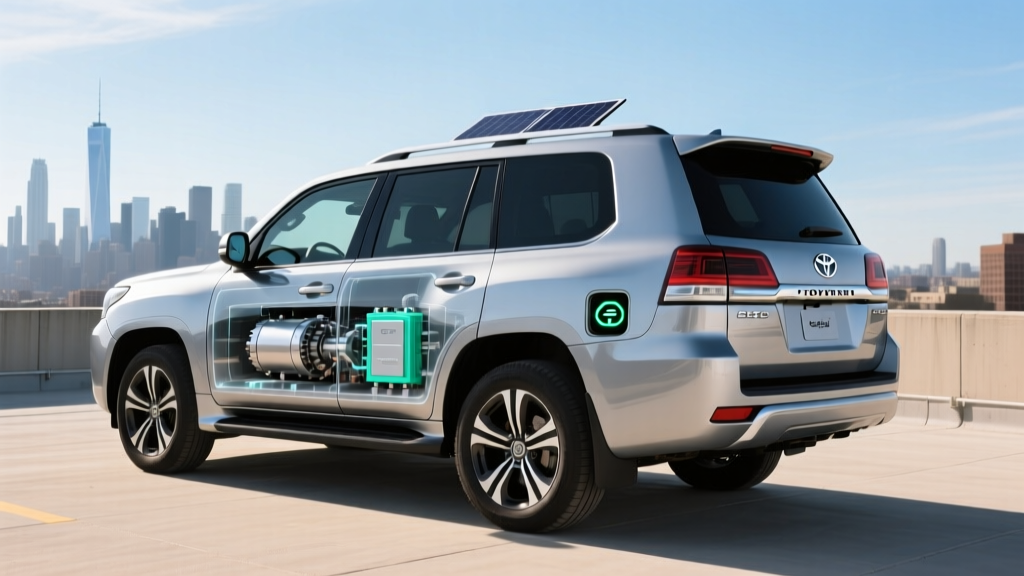
The Toyota Land Cruiser returned to the U.S. market with a smaller footprint, a turbocharged engine, and a hybrid system that prioritizes torque over outright speed. For 2026, the Land Cruiser continues with Toyota's i-FORCE MAX hybrid powertrain — a conventional hybrid (HEV) that requires no plug and charges its own small battery through regenerative braking and engine operation. If you've been searching for a Land Cruiser hybrid that balances off-road credibility with better fuel economy than a body-on-frame SUV has any right to deliver, this is the full breakdown.
Let's be clear up front: this is not a plug-in hybrid (PHEV) and not a full electric vehicle. The Land Cruiser hybrid is a self-charging HEV — you fuel it with gas and the hybrid system assists the engine to reduce consumption. That distinction matters enormously for tax credits, daily driving habits, and total cost of ownership.
HEV vs PHEV: Where the Land Cruiser Hybrid Fits
Toyota offers two distinct hybrid architectures across its lineup, and buyers frequently confuse them. Here's how the Land Cruiser's system compares:
| Feature | Land Cruiser (HEV) | Typical PHEV (e.g., RAV4 Prime) |
|---|---|---|
| Plug-in required? | No — self-charging | Yes — plug in for electric range |
| Electric-only range | ~1 mile at low speed | 25–42 miles typical |
| Battery size | 1.87 kWh (nickel-metal hydride) | 18–22 kWh (lithium-ion) |
| DC fast charging | Not applicable | Varies by model |
| Federal tax credit (§30D) | Not eligible | Up to $7,500 if eligible |
| Driving on electricity alone | Minimal (creep/parking) | Full highway-capable EV mode |
The Land Cruiser's hybrid system exists to boost torque, smooth acceleration, and trim fuel consumption — not to drive on electricity alone. If you want plug-in electric range from Toyota, you'll need to look at the RAV4 Prime or the upcoming bZ-series PHEVs. The Land Cruiser hybrid is engineered for a different buyer: one who wants body-on-frame capability without the fuel penalty of a traditional V8.
Powertrain Specs: i-FORCE MAX Hybrid Breakdown
The 2026 Land Cruiser uses Toyota's i-FORCE MAX hybrid system, which pairs a turbocharged gasoline engine with an electric motor integrated between the engine and transmission. Here are the exact figures:
| Specification | 2026 Toyota Land Cruiser |
|---|---|
| Engine | 2.4L turbocharged 4-cylinder |
| Electric motor | Integrated between engine and 8-speed auto |
| Combined horsepower | 326 hp |
| Combined torque | 465 lb-ft |
| Transmission | 8-speed automatic (Direct Shift) |
| Hybrid battery | 1.87 kWh NiMH |
| Drivetrain | Full-time 4WD with low range |
| 0–60 mph | ~6.5 seconds (est.) |
| Towing capacity | 6,000 lbs |
| Curb weight | ~5,090 lbs |
The 465 lb-ft of torque is the headline number. That's available low in the rev range thanks to the electric motor's instant torque delivery, which gives the Land Cruiser a responsive feel around town and strong low-speed crawl ability off-road. The turbo 4-cylinder lacks the character of the old 5.7L V8, but the hybrid system fills the torque gap convincingly.
Fuel Economy: EPA Ratings and Real-World MPG
For a 5,090-lb body-on-frame SUV with full-time 4WD and a low-range transfer case, the Land Cruiser hybrid's fuel economy is genuinely impressive relative to its predecessors. Here are the EPA figures:
| Driving Cycle | EPA Rating | Real-World Expectation |
|---|---|---|
| City | 22 MPG | 22–24 MPG (hybrids often beat EPA in city) |
| Highway | 25 MPG | 22–24 MPG (aerodynamic drag hurts at speed) |
| Combined | 23 MPG | 21–23 MPG |
How many MPG does the Land Cruiser hybrid get? The EPA rates it at 23 MPG combined. In real-world driving, expect that number to hold steady around 21–23 MPG for mixed use. City driving tends to favor hybrids because regenerative braking recaptures energy during stop-and-go traffic — you may see 24 MPG on urban commutes. Highway driving at 75+ mph pushes that down to 21–22 MPG due to the Land Cruiser's boxy aerodynamics and substantial weight.
For context, the previous-generation Land Cruiser with its 5.7L V8 returned roughly 14 MPG combined. The i-FORCE MAX hybrid represents a ~64% improvement in fuel economy while delivering comparable (and in some cases greater) torque output. That's the core value proposition of this powertrain.
According to fueleconomy.gov, the Land Cruiser's combined rating places it among the most efficient body-on-frame SUVs available, though unibody crossovers like the Toyota Highlander Hybrid (36 MPG combined) remain significantly more efficient for on-road-only use.
Range, Fuel Tank, and Total Distance
Since the Land Cruiser is a conventional HEV with no plug-in capability, its total range depends entirely on its fuel tank and MPG:
- Fuel tank: 17.9 gallons
- EPA combined range: ~412 miles per tank
- Real-world range: ~375–412 miles depending on driving conditions
- Off-road/low-speed range: Consumption drops significantly in 4Low; expect 10–14 MPG on technical trails
There is no electric-only range to discuss in a meaningful sense. The hybrid battery assists during acceleration and captures energy during braking, but the gasoline engine is always the primary power source. You will visit a gas station roughly every 375–400 miles under normal driving.
Pricing, Trims, and Tax Credit Eligibility
The 2026 Toyota Land Cruiser is offered in two primary trims:
| Trim | MSRP (est.) | Key Features |
|---|---|---|
| Land Cruiser 1958 | ~$57,950 | Heritage styling, cloth seats, 8-inch display, basic off-road package |
| Land Cruiser | ~$62,900 | SofTex seats, 12.3-inch display, Multi-Terrain Monitor, front stabilizer bar disconnect |
| Land Cruiser (with Premium pkg) | ~$67,500 | JBL audio, HUD, leather, heated/ventilated seats, 360° camera |
Does the Land Cruiser hybrid qualify for a federal tax credit? No. The IRS §30D Clean Vehicle Credit applies only to plug-in electric vehicles (BEVs and PHEVs) with a minimum battery capacity of 7 kWh. The Land Cruiser's 1.87 kWh NiMH battery does not meet this threshold. It is classified as a conventional hybrid, and no federal purchase incentive applies.
Some states may offer modest rebates for hybrid vehicles through local utility programs or air-quality districts, but these vary by jurisdiction and are typically $250–$1,000 — far below the $7,500 federal EV credit. Check your state's energy office or air-quality management district for current programs.
Battery Warranty, Reliability, and Replacement Cost
Hybrid battery longevity is the single most common concern among first-time hybrid buyers. Here's what Toyota provides:
Toyota Hybrid Battery Warranty
- Coverage: 10 years / 150,000 miles (whichever comes first)
- Applies to: Hybrid battery pack, hybrid control module, inverter
- Transferable: Yes — warranty transfers to subsequent owners
- Capacity threshold: Toyota warrants against defects and abnormal degradation; no specific SoH percentage published
Is the Land Cruiser hybrid reliable? Toyota's hybrid systems have an exceptional track record. The Prius, Camry Hybrid, and RAV4 Hybrid have demonstrated hybrid battery lifespans of 150,000–250,000+ miles with minimal degradation. The i-FORCE MAX system is newer and uses a different architecture (motor between engine and transmission rather than a power-split device), but the fundamental NiMH battery chemistry is proven and conservative.
NiMH batteries degrade more gracefully than lithium-ion — they lose capacity slowly and predictably rather than experiencing sudden cliff-drop failures. The trade-off is lower energy density, which is why the battery is small and provides only minimal electric-only assistance.
Battery replacement cost: If the hybrid battery fails outside warranty, expect a replacement cost of approximately $3,000–$4,500 (parts and labor at a Toyota dealer). Third-party refurbishers offer reconditioned NiMH packs for $1,500–$2,500. Given Toyota's 10-year/150,000-mile warranty and the proven durability of NiMH chemistry, out-of-pocket replacement during typical ownership is uncommon.
The powertrain (engine, transmission) carries Toyota's standard 5-year/60,000-mile warranty, and the basic vehicle warranty is 3 years/36,000 miles. NHTSA and IIHS safety ratings should be checked closer to the model year for crash-test results.
Land Cruiser Hybrid vs. Full EV vs. Gas SUV: Which Fits You?
The Land Cruiser hybrid occupies a specific niche. Here's a decision framework to determine whether it's the right powertrain for your situation:
Choose the Land Cruiser Hybrid (HEV) if:
- You need serious off-road capability (locking diffs, low range, 8.7" ground clearance)
- You cannot charge at home (no garage, apartment living, no panel capacity)
- You tow regularly (6,000-lb capacity)
- You want better fuel economy than a gas-only SUV without changing your fueling habits
- You plan to keep the vehicle 10+ years and value Toyota's reliability reputation
Choose a PHEV (e.g., Jeep Wrangler 4xe) if:
- You can charge at home and want 20–25 miles of electric-only daily commuting
- You want federal tax credit eligibility (§30D, up to $7,500)
- You still need off-road capability but drive mostly in the city on weekdays
Choose a full EV (e.g., Rivian R1S) if:
- You have reliable home Level 2 charging
- You want the lowest per-mile fuel cost (~$0.04–0.06/mi vs. ~$0.17/mi for the Land Cruiser)
- You prioritize acceleration and refinement over low-range gearing
- You rarely tow more than 5,000 lbs and don't need extreme off-road articulation
Pros and Cons at a Glance
Pros
- 465 lb-ft of torque from the hybrid system — excellent off-road and towing response
- 23 MPG combined is remarkable for a 5,090-lb body-on-frame SUV
- No plug-in required — zero lifestyle change from a gas vehicle
- Toyota's 10-year/150,000-mile hybrid battery warranty
- Proven full-time 4WD with locking center diff and available front stabilizer disconnect
- Significantly lower MSRP than comparable luxury off-roaders (Defender, G-Wagen)
Cons
- Not eligible for any federal tax credit
- Only two rows / 5-passenger seating (no third row unlike the 200-series predecessor)
- 1.87 kWh battery provides virtually no electric-only driving
- 23 MPG is efficient for its class but still costs ~$2,400/year in fuel at 15,000 miles
- Turbo 4-cylinder lacks the smoothness of a V6 or V8 at highway cruise
- Cargo space is modest for its exterior dimensions (~41 cu ft behind 2nd row)
Frequently Asked Questions
How many MPG does the Land Cruiser hybrid get?
The EPA rates the 2026 Toyota Land Cruiser hybrid at 22 MPG city, 25 MPG highway, and 23 MPG combined. In real-world mixed driving, owners typically see 21–24 MPG, with city-heavy commutes favoring the higher end of that range thanks to regenerative braking.
Is the Land Cruiser a plug-in hybrid?
No. The Land Cruiser uses a conventional hybrid (HEV) system. It charges its own 1.87 kWh battery through regenerative braking and engine operation. You never plug it in. It cannot drive meaningful distances on electricity alone.
How far can the Land Cruiser go on electric only?
Effectively zero miles at practical speeds. The hybrid system can propel the Land Cruiser at very low speeds (parking lots, creeping in traffic) for brief moments, but the gasoline engine engages almost immediately under any meaningful acceleration. This is by design — the hybrid system assists the engine; it doesn't replace it.
Does the Land Cruiser hybrid qualify for a tax credit?
No federal tax credit applies. The IRS §30D Clean Vehicle Credit requires a minimum 7 kWh battery and plug-in capability. The Land Cruiser's 1.87 kWh NiMH battery does not qualify. Some local utility or air-quality programs may offer small rebates ($250–$1,000), but these vary by jurisdiction.
Is the hybrid battery reliable, and what does replacement cost?
Toyota's hybrid battery systems have demonstrated excellent longevity, with many lasting 150,000–250,000+ miles. The battery is covered by a 10-year/150,000-mile warranty. Out-of-warranty replacement costs approximately $3,000–$4,500 at a dealer, or $1,500–$2,500 through third-party refurbishers.
How does the Land Cruiser hybrid compare to a diesel off-roader?
The Land Cruiser's 465 lb-ft of hybrid torque is competitive with diesel equivalents, and it runs on readily available 87-octane gasoline. Diesel SUVs (like the imported Land Cruiser 300 in other markets) may offer better highway fuel economy and range, but diesel fuel availability, DEF fluid, and higher maintenance costs are trade-offs. The hybrid system's instant torque delivery is particularly advantageous in technical off-road situations.
Can I tow with the Land Cruiser hybrid?
Yes. The 2026 Land Cruiser is rated to tow up to 6,000 lbs when properly equipped. The hybrid system's 465 lb-ft of torque provides strong low-speed pulling power. Expect fuel economy to drop to approximately 14–16 MPG while towing at highway speeds.