The 2025 Toyota Land Cruiser marks the nameplate's return to North America after a four-year absence, and it arrives exclusively as a hybrid. Built on the TNGA-F body-on-frame platform shared with the 4Runner and Tacoma, this midsize SUV pairs a turbocharged four-cylinder with an electric motor for robust torque and reasonable efficiency. But "hybrid" means different things to different buyers, and Toyota's approach here is deliberate: this is a conventional hybrid (HEV), not a plug-in. Let's break down exactly what that means for your fuel bill, your driveway, and your next road trip.
HEV vs PHEV: What the Land Cruiser Actually Is
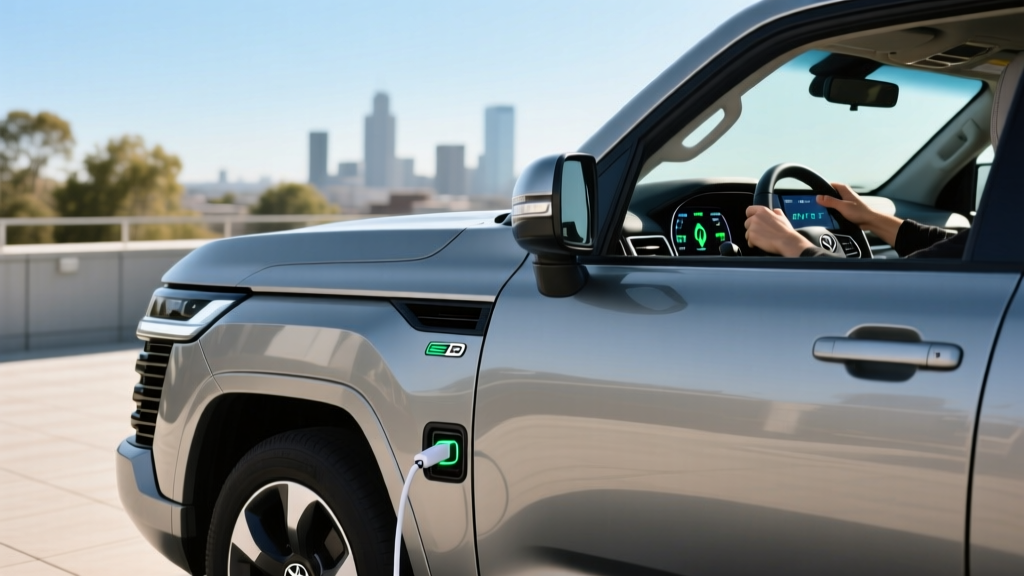
The 2025 Land Cruiser is a conventional hybrid (HEV). It charges its own battery through regenerative braking and the gasoline engine. You never plug it in. There is no electric-only driving mode and no external charging port.
Understanding the distinction matters because buyers sometimes assume "hybrid" means plug-in capability. Here's how the two architectures compare in practice:
| Feature | Conventional Hybrid (HEV) | Plug-In Hybrid (PHEV) |
|---|---|---|
| Plug in to charge? | No — self-charging | Yes — requires outlet or charger |
| Electric-only range | None (motor assists engine) | Typically 20–45 miles |
| Battery size | ~1–2 kWh (small buffer) | ~13–25 kWh usable |
| Federal tax credit (§30D) | Not eligible | Up to $7,500 (if requirements met) |
| Best for | No home charging access; wants simplicity | Home charging + short daily commutes |
The Land Cruiser's HEV setup prioritizes low-end torque and fuel reduction over electric-only range. If you want plug-in capability in a Toyota SUV, the RAV4 Prime (42 miles electric-only) is the closest alternative — though it's a very different vehicle in size and intent.
i-FORCE MAX Powertrain: Specs and Performance
The Land Cruiser uses Toyota's i-FORCE MAX hybrid powertrain, which integrates a 48-horsepower electric motor between the 2.4-liter turbocharged inline-four and the eight-speed automatic transmission. The result is seamless torque fill that makes the turbo lag nearly imperceptible.
| Specification | 2025 Toyota Land Cruiser |
|---|---|
| Engine | 2.4L turbocharged inline-4 + electric motor |
| Combined Horsepower | 326 hp |
| Combined Torque | 465 lb-ft |
| Transmission | 8-speed automatic |
| Drivetrain | Full-time 4WD with locking center differential |
| Hybrid Battery | ~1.87 kWh NiMH (sealed, self-charging) |
| Towing Capacity | 6,000 lbs |
| 0–60 mph (est.) | ~6.6 seconds |
| Curb Weight | ~5,070 lbs |
The 465 lb-ft of torque arrives low in the rev range thanks to the electric motor, which is exactly what you want for trail crawling, merging onto highways, or pulling a trailer. The powertrain feels considerably more muscular than the numbers suggest for a vehicle this heavy.
Fuel Economy: EPA Ratings and Real-World MPG
For a body-on-frame SUV weighing over 5,000 pounds with full-time 4WD, the Land Cruiser's fuel economy is respectable — though it won't rival a unibody crossover. Here's what the EPA reports, per fueleconomy.gov:
| Driving Cycle | EPA Rating |
|---|---|
| City | 22 MPG |
| Highway | 25 MPG |
| Combined | 23 MPG |
Real-World MPG Expectations: The Land Cruiser's HEV system shines in stop-and-go city driving, where regenerative braking recaptures energy. Expect 22–24 MPG in mixed suburban use. Highway cruising at 75+ mph may dip to 20–22 MPG due to the boxy aerodynamics and weight. Owners who tow should anticipate 14–17 MPG depending on trailer weight and terrain. Cold weather (below 30°F) typically reduces efficiency by 5–10% as the engine runs longer to heat the cabin and maintain battery temperature.
Compared to the previous-generation V8 Land Cruiser (which returned roughly 14 MPG combined), the i-FORCE MAX represents a significant efficiency gain — about 64% better combined fuel economy. Against competitors like the Jeep Wrangler 4xe (PHEV, ~49 MPGe but only 22 miles electric) or the Ford Bronco (non-hybrid, ~17–20 MPG combined), the Land Cruiser occupies a practical middle ground: no plug-in hassle, no range anxiety, and meaningfully better fuel economy than a conventional gas 4x4.
Pricing, Trims, and Tax Credit Eligibility
The 2025 Land Cruiser comes in two trims, both equipped with the i-FORCE MAX hybrid powertrain:
| Trim | Starting MSRP | Key Features |
|---|---|---|
| Land Cruiser 1958 | $57,345 | Heritage styling, round LED headlights, cloth seats, 8-inch touchscreen |
| Land Cruiser | $62,345 | Rectangular LED headlights, SofTex seats, 12.3-inch touchscreen, front stabilizer disconnect |
Destination charges add approximately $1,495 to these figures.
Federal Tax Credit: Not Eligible
Because the 2025 Land Cruiser is a conventional hybrid (HEV) rather than a plug-in hybrid (PHEV) or battery-electric vehicle (BEV), it does not qualify for the IRS §30D Clean Vehicle Credit. That credit — up to $7,500 — applies only to vehicles with plug-in capability and battery packs meeting specific capacity, critical-mineral sourcing, and battery-component manufacturing thresholds, as outlined on irs.gov.
Some states offer their own incentives for conventional hybrids, but these are typically modest ($250–$1,000 rebates in a handful of states). Check your state's energy or environmental agency for current programs. The Land Cruiser's value proposition rests on its capability and fuel efficiency rather than tax incentives.
Battery Warranty, Reliability, and Replacement Costs
Toyota Hybrid Battery Warranty: 10 years / 150,000 miles (whichever comes first) on the hybrid battery and all hybrid-system components. This applies to all 50 states. The general powertrain warranty covers 5 years / 60,000 miles, and the basic warranty covers 3 years / 36,000 miles.
Toyota's hybrid-system reliability is among the best-documented in the industry. The Prius has accumulated billions of real-world miles since 2000, and the company's NiMH and lithium-ion hybrid batteries routinely outlast their warranty periods. The Land Cruiser's ~1.87 kWh battery is small by EV standards and operates within a narrow state-of-charge window (roughly 40–80%), which significantly reduces degradation stress.
Battery Replacement Cost
If the hybrid battery does require replacement outside warranty coverage, expect to pay between $3,000 and $5,000 for a new OEM battery pack including labor. Third-party refurbished batteries are available for $1,500–$2,500. Given the battery's modest size and the proven longevity of Toyota's hybrid architecture, most owners will never face this expense. For context, many Prius taxis have exceeded 300,000 miles on their original hybrid batteries.
The Land Cruiser's body-on-frame construction and Toyota's off-road heritage also contribute to long-term durability expectations. This is a vehicle designed for 200,000+ mile service life with proper maintenance.
Who Should Buy the Land Cruiser Hybrid?
Choose the Land Cruiser HEV if:
- You want serious off-road capability (full-time 4WD, locking center diff, available front stabilizer disconnect) without sacrificing daily-driver fuel economy
- You don't have access to home or workplace charging and don't want to rely on public infrastructure
- You tow up to 6,000 lbs regularly and need the torque advantage of a hybrid powertrain
- You value Toyota's long-term reliability record and plan to keep the vehicle 10+ years
- You want a heritage-styled SUV that stands apart from the crossover crowd
Consider a PHEV or full EV instead if:
- You have home charging and a short commute — a PHEV like the RAV4 Prime (42 mi electric, 94 MPGe) or a BEV like the Rivian R1S would eliminate most of your gasoline use
- You want electric-only silent driving for neighborhood or trail use
- Federal tax credit eligibility ($7,500) is a decisive factor in your purchase math
- You prioritize acceleration and low center of gravity — battery-electric SUVs deliver both
Pros
- 465 lb-ft of torque from low RPM — excellent for towing and off-road
- 23 MPG combined is strong for a body-on-frame 4x4 SUV
- No plug-in required — works with any lifestyle or parking situation
- 10-year / 150,000-mile hybrid battery warranty
- 6,000-lb towing capacity
- Proven Toyota off-road durability and resale value
Cons
- No electric-only driving mode — always burns gasoline
- Not eligible for the $7,500 federal EV tax credit
- Highway MPG drops at sustained 75+ mph speeds
- Cargo space is tighter than unibody competitors (~42 cu ft behind second row)
- Starting price above $57,000 with limited trim selection
Frequently Asked Questions
How many MPG does the 2025 Toyota Land Cruiser hybrid get?
The EPA rates the 2025 Land Cruiser at 22 MPG city, 25 MPG highway, and 23 MPG combined. Real-world results vary: expect 22–24 MPG in mixed suburban driving, 20–22 MPG at sustained highway speeds above 75 mph, and 14–17 MPG when towing. Cold weather reduces these figures by roughly 5–10%.
Can I plug in the Land Cruiser to charge it?
No. The 2025 Land Cruiser is a conventional hybrid (HEV), not a plug-in hybrid (PHEV). It has no charging port. The hybrid battery charges itself through regenerative braking and the gasoline engine. You fuel it like any other gas vehicle.
Does the 2025 Land Cruiser qualify for any tax credits?
The Land Cruiser does not qualify for the federal §30D Clean Vehicle Credit, which requires plug-in capability and specific battery sourcing criteria. Some states offer small hybrid rebates — check your state energy office. The fueleconomy.gov tax incentive page maintains a current list of eligible vehicles.
Is the Land Cruiser hybrid reliable, and what does a battery replacement cost?
Toyota's hybrid systems have an extensive reliability track record spanning over two decades. The hybrid battery carries a 10-year / 150,000-mile warranty. Out-of-pocket replacement, if needed, runs $3,000–$5,000 for an OEM pack. Most Toyota hybrid batteries outlast their warranty period, and many exceed 200,000 miles without issue.
How does the Land Cruiser hybrid compare to a full EV like the Rivian R1S?
The Rivian R1S delivers 352 miles of EPA range, 0–60 in ~3.5 seconds, and zero tailpipe emissions, but starts around $79,900 and requires charging infrastructure. The Land Cruiser costs less upfront, needs no charging access, tows 6,000 lbs, and offers proven off-road hardware — but always burns gasoline and returns 23 MPG combined. The right choice depends entirely on your charging access, budget, and how you plan to use the vehicle.
What's the difference between the 1958 trim and the standard Land Cruiser trim?
The 1958 trim ($57,345) features heritage-inspired round LED headlights, cloth seating, and an 8-inch touchscreen. The standard Land Cruiser trim ($62,345) adds rectangular LED headlights, SofTex synthetic leather seats, a 12.3-inch touchscreen, and an available front stabilizer bar disconnect for improved off-road articulation. Both use the identical i-FORCE MAX hybrid powertrain and share the same EPA fuel economy ratings.