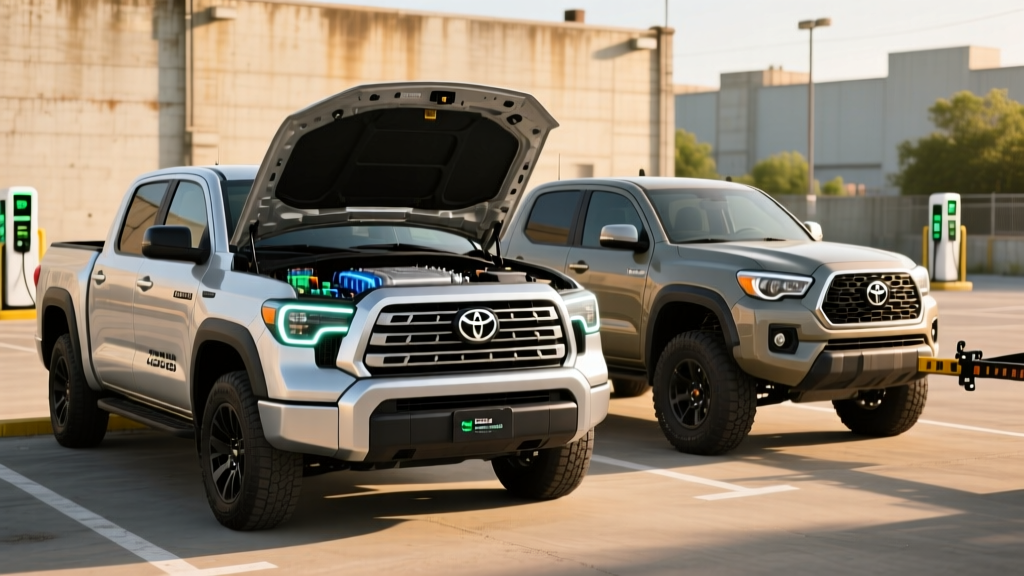
Toyota has gone all-in on hybrid powertrains for its truck lineup, and for good reason. The 2026 Toyota Tundra comes standard with the i-FORCE MAX hybrid across every trim, while the Tacoma now offers its own i-FORCE MAX hybrid option. Neither truck requires a plug — these are conventional hybrids (HEVs), not plug-in hybrids (PHEVs) — meaning you simply fuel up at any gas station and let the hybrid system recapture energy through regenerative braking. For truck buyers who need towing capability, don't have home charging access, or regularly drive long highway routes, Toyota's hybrid trucks occupy a practical middle ground between gas-only V6 competitors and fully electric pickups like the Ford F-150 Lightning or Rivian R1T.
This guide breaks down the real-world efficiency, powertrain specs, reliability outlook, and ownership economics for both Toyota hybrid trucks currently on sale.
Toyota's Hybrid Truck Lineup: Tundra vs Tacoma at a Glance
Before diving into specs, it's worth clarifying what Toyota means by "i-FORCE MAX." Despite the aggressive branding, this is Toyota's hybrid powertrain architecture for trucks — a twin-turbo V6 gasoline engine paired with an electric motor sandwiched between the engine and the 10-speed automatic transmission. The result is torque fill at low RPMs, improved fuel economy in stop-and-go driving, and a modest power bump over the non-hybrid i-FORCE engine (available on lower Tundra trims).
| Spec | 2026 Toyota Tundra i-FORCE MAX | 2026 Toyota Tacoma i-FORCE MAX |
|---|---|---|
| Powertrain | 3.4L Twin-Turbo V6 + electric motor | 2.4L Twin-Turbo I-4 + electric motor |
| Combined HP | 437 hp | 326 hp |
| Combined Torque | 583 lb-ft | 465 lb-ft |
| Transmission | 10-speed automatic | 8-speed automatic |
| EPA MPG (City/Hwy/Combined) | 20 / 24 / 22 (4x4 CrewMax) | 23 / 27 / 25 (4x2) |
| Max Towing Capacity | 11,175 lbs | 6,000 lbs |
| Hybrid Battery | ~1.87 kWh NiMH (sealed) | ~1.87 kWh NiMH (sealed) |
| Plug-in Required? | No (HEV) | No (HEV) |
| Starting MSRP | ~$57,000 (Limited trim) | ~$45,000 (TRD Sport) |
HEV vs PHEV — what's the difference here? Both Toyota trucks are conventional hybrids (HEVs). They charge their small battery packs through regenerative braking and the gasoline engine — you never plug them in. A plug-in hybrid (PHEV) like the Ford Maverick PHEV (if available) would offer 20-40 miles of electric-only range but requires a Level 2 home charger to realize those benefits. Toyota currently does not offer a PHEV truck in the US market. If you want electric-only driving in a truck, you'd need to look at a full BEV like the F-150 Lightning or Chevrolet Silverado EV.
Fuel Economy: EPA Numbers and Real-World MPG
The headline question for any hybrid buyer: how many MPG does it actually get? Here's the EPA-certified breakdown from fueleconomy.gov:
| Model / Drivetrain | City MPG | Highway MPG | Combined MPG |
|---|---|---|---|
| Tundra i-FORCE MAX 4x2 | 21 | 25 | 23 |
| Tundra i-FORCE MAX 4x4 | 20 | 24 | 22 |
| Tundra i-FORCE (non-hybrid) 4x4 | 17 | 23 | 19 |
| Tacoma i-FORCE MAX 4x2 | 23 | 27 | 25 |
| Tacoma i-FORCE MAX 4x4 | 22 | 25 | 23 |
| Tacoma i-FORCE (non-hybrid) 4x4 | 20 | 24 | 21 |
Real-World MPG: What to Expect Beyond the Sticker
Toyota's hybrid system shines in city and suburban driving, where frequent stops allow regenerative braking to recharge the battery and the electric motor handles low-speed acceleration. In real-world mixed driving, many Tundra owners report matching or slightly exceeding the EPA combined figure — 22-24 MPG is common in suburban commutes. However, highway-heavy road trips at sustained 75-80 MPH speeds tend to drop the Tundra to 19-21 MPG, as the hybrid system provides less benefit at constant velocity and the truck's aerodynamic profile works against it.
The Tacoma Hybrid, being smaller and lighter, tracks closer to its EPA numbers in most conditions. Expect 24-26 MPG combined in mixed driving, with highway-only trips yielding around 23-24 MPG. Cold weather typically reduces hybrid fuel economy by 1-3 MPG due to increased engine idle time for cabin heat and reduced battery efficiency — a smaller penalty than the 20-30% range loss EVs experience, but still worth noting for northern-climate buyers.
The key efficiency win is versus the non-hybrid powertrain: the Tundra i-FORCE MAX gains roughly 3 MPG combined over the standard i-FORCE V6, which translates to approximately 75-100 fewer gallons per year at 15,000 miles of driving — roughly $250-$350 in annual fuel savings depending on local gas prices.
Powertrain Deep Dive: How i-FORCE MAX Works
The i-FORCE MAX system in the Tundra pairs a 3.4-liter twin-turbo V6 (producing 389 hp on its own) with a 48-hp electric motor integrated into the bell housing between the engine and the 10-speed automatic transmission. Combined output is 437 hp and 583 lb-ft of torque. The electric motor provides instant torque from 0 RPM, which eliminates the lag typical of turbocharged engines off the line and makes the Tundra feel notably more responsive than its EPA numbers suggest. The 0-60 MPH time sits around 5.7 seconds — competitive with the V8-powered Ram 1500 and quicker than the non-hybrid Tundra.
The Tacoma's i-FORCE MAX uses a smaller 2.4-liter turbocharged inline-four paired with the same electric motor architecture, producing 326 hp and 465 lb-ft combined. It's paired with an 8-speed automatic. The Tacoma Hybrid is notably quicker than its non-hybrid counterpart (0-60 in roughly 6.8 seconds vs. ~7.5 seconds) and delivers a more linear power delivery that makes highway merging and hill climbs feel effortless.
Both systems use Toyota's proven nickel-metal hydride (NiMH) hybrid battery pack, sealed and mounted under the rear seat. The battery is small — approximately 1.87 kWh — because it's not designed for electric-only driving. It exists solely to buffer energy from regenerative braking and assist the gas engine during acceleration. You cannot plug either truck in, and neither offers an EV-only mode beyond very low-speed, short-distance creep (think: moving through a parking lot).
Reliability and Battery Warranty: What Truck Buyers Need to Know
Toyota Hybrid Battery Warranty: Toyota covers the hybrid battery and hybrid system components for 10 years or 150,000 miles (whichever comes first) on all 2026 models — an increase from the previous 8-year/100,000-mile coverage. This applies to the hybrid battery pack, inverter, converter, and associated control modules.
Powertrain Warranty: 5 years / 60,000 miles (engine, transmission, drivetrain).
Battery Replacement Cost (out of warranty): Based on current parts pricing and historical data from the Tundra and Tacoma platforms, a hybrid battery replacement runs approximately $3,000-$4,500 including labor at a Toyota dealership. Third-party refurbishment options may reduce this to $1,500-$2,500. For context, Toyota's hybrid batteries in the Prius and Camry Hybrid have demonstrated 200,000+ mile lifespans with minimal degradation — the truck applications use the same proven NiMH chemistry.
Toyota's hybrid system is among the most battle-tested in the industry. The Prius has accumulated billions of real-world miles since 2000, and the hybrid components in the Tundra and Tacoma share core architecture with Toyota's luxury division (Lexus LX 600 hybrid). The NiMH chemistry chosen for these trucks trades energy density for extreme thermal stability and cycle-life durability — these batteries don't degrade the way large lithium-ion EV packs can over time.
There is no liquid cooling system for the hybrid battery (unlike EV traction batteries), which means fewer failure points. The most common hybrid-system maintenance item is the inverter cooling system fluid, which Toyota recommends inspecting at standard service intervals. Overall, NHTSA and long-term owner data suggest the hybrid system adds negligible maintenance cost versus the conventional powertrain.
Pricing, Trims, and Tax Credit Eligibility
Here's where the math gets important. The i-FORCE MAX hybrid is standard on the Tundra from the Limited trim upward (it's optional on SR5 and not available on the base SR). For the Tacoma, the i-FORCE MAX is available on TRD Sport, TRD Off-Road, and above.
| Model | Trim (Hybrid Available) | Approx. MSRP | Hybrid Premium vs. Gas |
|---|---|---|---|
| Tundra i-FORCE MAX | Limited 4x4 CrewMax | $57,160 | ~$3,700 over i-FORCE SR5 |
| Tundra i-FORCE MAX | Platinum 4x4 | $66,805 | Hybrid standard |
| Tundra i-FORCE MAX | TRD Pro | $73,880 | Hybrid standard |
| Tacoma i-FORCE MAX | TRD Sport 4x2 | $45,185 | ~$2,500 over i-FORCE |
| Tacoma i-FORCE MAX | TRD Off-Road 4x4 | $49,500 | ~$2,500 over i-FORCE |
Does a Toyota Hybrid Truck Qualify for a Federal Tax Credit?
No. Under current IRS §30D rules, the federal Clean Vehicle Credit (up to $7,500) applies only to plug-in electric vehicles — battery-electric vehicles (BEVs) and plug-in hybrids (PHEVs) with a minimum battery capacity of 7 kWh. Because the Tundra and Tacoma i-FORCE MAX are conventional hybrids with ~1.87 kWh NiMH packs and no plug-in capability, they do not qualify for the federal EV tax credit or the point-of-sale transfer option.
Some states offer their own incentives for conventional hybrids, though these are increasingly rare as state programs shift focus to zero-emission vehicles. Check your state's energy office or department of environmental quality for current programs. For definitive federal credit rules, reference the IRS Clean Vehicle Credit page.
Who Should Buy a Toyota Hybrid Truck — And Who Shouldn't
Pros
- 3-4 MPG improvement over non-hybrid with no plug-in requirement
- Instant electric torque fill eliminates turbo lag — smoother acceleration
- Proven NiMH hybrid battery with 10yr/150k-mile warranty
- Full towing capability maintained (up to 11,175 lbs on Tundra)
- No range anxiety — fuel at any gas station nationwide
- Hybrid system adds minimal maintenance burden
Cons
- No federal tax credit eligibility (conventional hybrid)
- Hybrid premium of $2,500-$3,700 takes years to recoup via fuel savings
- No electric-only driving mode — not a zero-emission vehicle
- Highway MPG advantage over gas-only is modest (1-2 MPG)
- Hybrid battery adds ~200 lbs, slightly reducing payload capacity
- Not available on base Tundra SR trim
Hybrid vs PHEV vs Full EV: Which Truck Fits Your Needs?
The truck market now spans three electrification tiers, and choosing the right one depends on your driving pattern, charging access, and use case.
| Factor | HEV (Toyota Tundra/Tacoma) | PHEV (e.g., Ford Maverick PHEV) | Full EV (e.g., F-150 Lightning) |
|---|---|---|---|
| Plug-in Required? | No | Yes (for EV range) | Yes |
| Electric-Only Range | 0 miles | 20-40 miles (typical) | 230-320 miles (EPA) |
| Home Charging Needed? | No | Recommended (Level 2) | Essential (Level 2) |
| Fuel/Energy Cost (per mile) | ~$0.16-$0.20 | ~$0.06-$0.15 (varies) | ~$0.04-$0.08 |
| Federal Tax Credit | None | Up to $7,500 (if eligible) | Up to $7,500 (if eligible) |
| Towing Impact | Minimal | Range drops significantly | Range drops 40-50% when towing |
| Best For | No charger, long highway miles, towing | Short commute + home charger + road trips | Home charger, daily commuting, low tow needs |
Choose the Toyota Hybrid (HEV) if: You don't have access to home charging, you tow regularly, you drive long highway routes, you live in an area with unreliable public charging, or you simply want better fuel economy without changing your refueling habits.
Choose a PHEV truck if: You have a garage or driveway where you can install a Level 2 charger, your daily commute is under 30 miles round-trip (covering most driving on electric), but you still need the gas engine for weekend road trips or towing.
Choose a full EV truck if: You have reliable home Level 2 charging, your daily driving is under 200 miles, you rarely tow heavy loads (or accept the range penalty), and you want the lowest per-mile energy cost and zero tailpipe emissions.
Ownership Costs: 5-Year Breakdown
To put the hybrid premium in perspective, here's a simplified 5-year/75,000-mile cost comparison for the Tundra i-FORCE MAX 4x4 vs. the non-hybrid i-FORCE 4x4, assuming $3.50/gallon regular unleaded and 15,000 miles per year:
| Cost Category | Tundra i-FORCE MAX (HEV) | Tundra i-FORCE (Gas) |
|---|---|---|
| MSRP (Limited 4x4) | $57,160 | $53,460 (est. equivalent) |
| Fuel Cost (5 yrs, 75k mi) | ~$11,930 (22 MPG combined) | ~$13,815 (19 MPG combined) |
| Federal Tax Credit | $0 | $0 |
| Maintenance (est. 5 yrs) | ~$3,200 | ~$3,400 |
| Insurance (est. 5 yrs) | ~$9,500 | ~$9,200 |
| 5-Year Total | ~$81,790 | ~$79,875 |
| Cost Per Mile | ~$0.54 | ~$0.55 |
The hybrid premium of roughly $3,700 is only partially offset by fuel savings (~$1,885 over 5 years). The financial case for the Tundra hybrid rests more on the driving experience — smoother acceleration, better city manners, and reduced engine strain — than on pure payback. For the Tacoma, where the hybrid premium is smaller (~$2,500) and the MPG gap is wider (25 vs. 21 combined), the math tilts more favorably: roughly $1,700 in fuel savings over 5 years, approaching breakeven.
Frequently Asked Questions
How many MPG does the Toyota Tundra Hybrid get in real-world driving?
The EPA rates the 2026 Tundra i-FORCE MAX 4x4 at 20 city / 24 highway / 22 combined MPG. In real-world suburban and city-heavy driving, owners commonly report 22-24 MPG combined. Highway-only trips at 75+ MPH tend to yield 19-21 MPG. Cold weather and heavy cargo loads reduce these figures by 1-3 MPG.
How far can the Toyota Tacoma Hybrid go on electric only?
The Tacoma i-FORCE MAX cannot drive on electric power alone in any meaningful sense. It is a conventional hybrid (HEV), not a plug-in hybrid. The electric motor assists the gas engine during acceleration and enables very low-speed creep (parking lot speeds for a few hundred feet), but there is no EV-only mode and no plug-in capability. If electric-only range is a priority, you'd need a PHEV or full EV.
Is the Toyota hybrid truck system reliable? What does battery replacement cost?
Toyota's hybrid system is one of the most reliable powertrain technologies on the market, with over two decades and tens of millions of vehicles in service globally. The hybrid battery uses NiMH chemistry known for exceptional longevity — 200,000+ mile lifespans are common. Toyota covers the hybrid battery for 10 years or 150,000 miles. Out-of-warranty replacement costs approximately $3,000-$4,500 at a dealership.
Does the Toyota Tundra or Tacoma Hybrid qualify for the $7,500 federal tax credit?
No. Under current IRS §30D rules, the federal Clean Vehicle Credit applies only to plug-in vehicles (BEVs and PHEVs) with battery capacity of at least 7 kWh. Toyota's hybrid trucks use a ~1.87 kWh NiMH battery and cannot be plugged in, so they do not qualify. Some states may offer separate hybrid incentives — check your state energy office for details.
How does the Toyota hybrid truck compare to a full EV truck like the F-150 Lightning?
They serve fundamentally different use cases. The Toyota hybrid requires no charging infrastructure, tows up to 11,175 lbs without range penalty, and fuels in 5 minutes at any gas station — but still burns gasoline and produces tailpipe emissions. The F-150 Lightning offers ~230-320 miles of electric range, dramatically lower per-mile energy costs (~$0.05/mi vs. ~$0.18/mi), and zero tailpipe emissions — but requires home Level 2 charging, loses 40-50% range when towing, and costs more upfront. If you tow frequently or lack home charging, the Toyota hybrid is the pragmatic choice. If you commute daily with home charging and rarely tow, the EV delivers far greater savings.
Can I tow a trailer with the Toyota Tundra Hybrid without losing fuel economy?
Towing always reduces fuel economy, and the Tundra Hybrid is no exception. When towing near its 11,175-lb maximum, expect fuel economy to drop to roughly 10-13 MPG depending on trailer weight, terrain, and speed. The hybrid system's advantage while towing is the electric motor's instant torque, which reduces transmission hunting on grades and provides smoother acceleration from stops. However, unlike a full EV (which loses range dramatically under tow), the Tundra Hybrid can simply refuel at any truck stop — a significant practical advantage for long-distance towing.
For the latest EPA efficiency data, visit fueleconomy.gov. For safety ratings, check NHTSA and IIHS. Toyota's official specifications are available at toyota.com/trucks/tundra.