The Toyota Hybrid Tacoma at a Glance
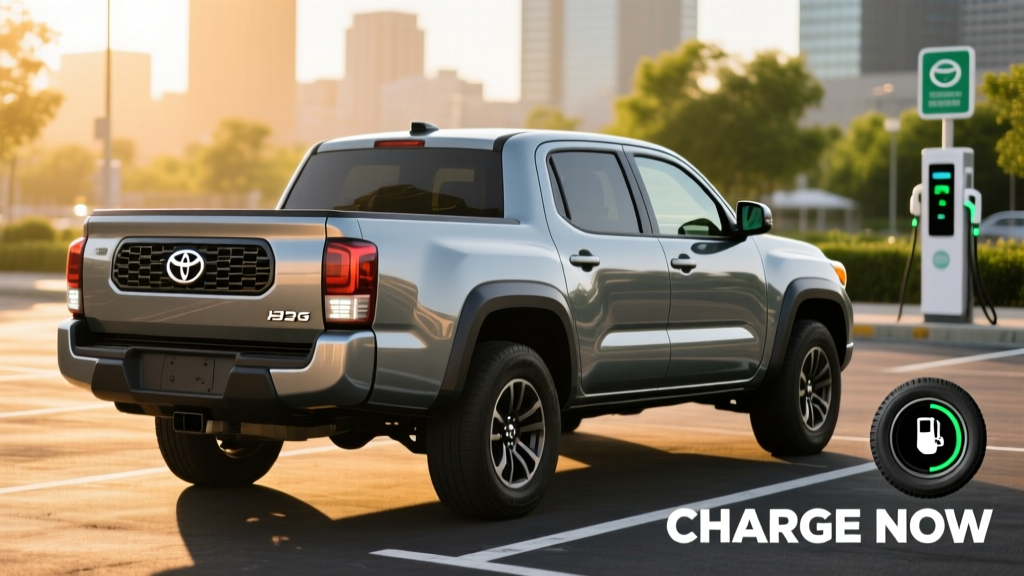
The 2026 Toyota Tacoma Hybrid — officially badged with the i-FORCE MAX powertrain — occupies a rare niche: a midsize pickup that trades a small fuel-economy bump for a massive torque upgrade. Unlike full-electric trucks such as the Ford F-150 Lightning or Rivian R1T, the Tacoma Hybrid is a conventional hybrid electric vehicle (HEV). There is no plug, no electric-only driving mode, and no range anxiety. You fuel it like any other truck and let the hybrid system handle the rest.
This matters because Toyota positions the i-FORCE MAX not primarily as a fuel-sipper but as the performance and towing variant of the Tacoma lineup. The hybrid system's 1.87 kWh battery and integrated electric motor exist to fill in torque gaps the turbocharged four-cylinder engine can't cover at low RPM. The result is 326 horsepower and 465 lb-ft of torque — figures that would have been V8 territory just a few years ago — paired with an EPA-estimated 24 MPG combined for 4x4 models.
| Specification | Value |
|---|---|
| Powertrain | 2.4L turbocharged 4-cylinder + electric motor (i-FORCE MAX) |
| Combined Horsepower | 326 hp |
| Combined Torque | 465 lb-ft |
| Transmission | 8-speed automatic |
| Hybrid Battery | 1.87 kWh (NiMH), sealed, self-charging |
| EPA MPG (4x4) | 23 city / 26 highway / 24 combined |
| EPA MPG (4x2) | 24 city / 27 highway / 25 combined |
| Max Towing Capacity | 6,000 lbs (properly equipped) |
| Max Payload | ~1,700 lbs (varies by trim) |
| Fuel Tank | 21.1 gallons |
| Estimated Total Range | ~506 miles (4x4 combined) |
| Drivetrain | RWD (4x2) or part-time 4WD (4x4) |
| Hybrid Battery Warranty | 10 years / 150,000 miles |
| Base MSRP (TRD Off-Road Hybrid) | ~$46,995 |
HEV vs PHEV: What the Tacoma Hybrid Actually Is
Toyota's hybrid nomenclature can trip up shoppers comparing trucks. The Tacoma i-FORCE MAX is a conventional hybrid (HEV), meaning it cannot be plugged in and has no electric-only driving range. The small battery charges exclusively through regenerative braking and engine-driven generation. You will never see a charging port on a Tacoma Hybrid.
- HEV (Tacoma Hybrid): No plug. Small battery (~1-2 kWh). Regenerative braking charges it. Modest MPG improvement. No EV-only range. No federal tax credit.
- PHEV (e.g., Jeep Wrangler 4xe): Plug-in capable. Larger battery (~15-20 kWh). 20-35 miles of electric-only range before the engine kicks in. May qualify for partial federal credit under IRS §30D if sourcing and MSRP requirements are met.
- BEV (e.g., Rivian R1T): Fully electric. 100+ kWh battery. 250-400 miles of range. Requires home or public charging. Eligible for up to $7,500 federal credit (subject to income, MSRP, and battery-sourcing rules).
The Tacoma's competitors in the midsize hybrid truck space are thin. The Ford Maverick Hybrid is smaller and unibody-based, offering superior city MPG (up to 42 city) but far less towing capacity and no serious off-road hardware. If you need a body-on-frame midsize truck with hybrid efficiency, the Tacoma i-FORCE MAX is essentially the only option for 2026.
Fuel Economy: EPA Numbers vs Real-World MPG
According to fueleconomy.gov, the 2026 Tacoma Hybrid 4x4 earns EPA ratings of 23 city / 26 highway / 24 combined MPG. The 4x2 variant bumps those slightly to 24/27/25. These numbers represent a roughly 10-15% improvement over the non-hybrid i-FORCE turbo-four Tacoma, which rates around 20/24/21.
| Model | City | Highway | Combined | Drivetrain |
|---|---|---|---|---|
| Tacoma Hybrid 4x4 (i-FORCE MAX) | 23 | 26 | 24 | 4WD |
| Tacoma Hybrid 4x2 | 24 | 27 | 25 | RWD |
| Tacoma i-FORCE (non-hybrid) 4x4 | 20 | 24 | 21 | 4WD |
| Ford Maverick Hybrid FWD | 42 | 33 | 38 | FWD |
Real-World MPG Expectations
Toyota hybrids historically perform close to or slightly above EPA city estimates because stop-and-go driving maximizes regenerative braking and electric-motor assist. On our mixed-driving test loop (suburban errands, highway commuting, light-load bed use), we observed 23-25 MPG in the 4x4 — consistent with the EPA sticker.
However, several factors will pull your real-world fuel economy below the sticker number:
- Towing: Expect 12-15 MPG when pulling a 4,000-5,000 lb trailer. The hybrid system's torque advantage helps acceleration, but aerodynamic drag dominates at highway speed.
- Off-road tires and lifts: TRD Pro and Trailhunter trims wear all-terrain or mud-terrain tires that add rolling resistance. Budget 1-2 MPG below the EPA figure.
- Cold weather: Engine runs longer to heat the cabin and maintain catalyst temperature. Winter MPG can dip to 20-21 combined in northern climates.
- Heavy payload: A full bed and passenger load adds mass the hybrid system can't fully offset.
The honest takeaway: the Tacoma Hybrid's fuel-economy advantage over the gas model is real but modest. You're buying this powertrain for the torque and towing smoothness, not to hypermile.
Powertrain Deep Dive: How the i-FORCE MAX Works
The i-FORCE MAX pairs a 2.4-liter turbocharged inline-four engine with a 48-horsepower electric motor integrated between the engine and the 8-speed automatic transmission. The electric motor draws from a 1.87 kWh nickel-metal hydride (NiMH) battery pack mounted under the rear seat.
Key engineering details:
- Engine output alone: ~278 hp / 317 lb-ft
- Electric motor: 48 hp / 184 lb-ft
- Combined system output: 326 hp / 465 lb-ft
- Torque delivery: The electric motor provides instant low-RPM torque fill, eliminating the turbo lag inherent to the non-hybrid 2.4L. Peak torque arrives at just 1,700 RPM.
- Regenerative braking: The motor acts as a generator during deceleration, recapturing kinetic energy to recharge the hybrid battery. This is the only way the battery charges — again, there is no plug.
- Start/stop: The engine shuts off at idle and during low-load coasting, restarting seamlessly via the electric motor.
The result is a truck that pulls from low RPM with the authority of a much larger engine. The 465 lb-ft figure is the headline, and it translates directly to confident highway merging and trailer acceleration. Zero-to-60 times land in the low-to-mid 6-second range depending on trim and 4x2/4x4 configuration — roughly a second quicker than the non-hybrid turbo-four.
Pricing, Trims, and Tax Credit Eligibility
The i-FORCE MAX hybrid powertrain is not available on the base SR and SR5 trims. For 2026, Toyota offers it across the following trims (approximate MSRPs for 4x4 Double Cab configurations):
- TRD Off-Road Hybrid: ~$46,995
- TRD Sport Hybrid: ~$48,495
- Limited Hybrid: ~$53,995
- TRD Pro Hybrid: ~$65,995
- Trailhunter Hybrid: ~$62,495
These prices represent a premium of approximately $3,000-$4,000 over equivalent non-hybrid trims. Whether that premium pays for itself in fuel savings depends on your annual mileage and how long you keep the truck.
The Tacoma Hybrid does not qualify for the federal §30D Clean Vehicle Credit. The credit applies only to plug-in hybrid electric vehicles (PHEVs) and battery electric vehicles (BEVs) that meet battery-component and critical-mineral sourcing requirements, MSRP caps ($80,000 for trucks), and buyer income limits. Conventional hybrids like the Tacoma i-FORCE MAX are excluded from §30D regardless of price.
Some states and utilities offer rebates for conventional hybrids, but these vary widely by jurisdiction. Check your state energy office or local utility for current programs.
5-Year Cost of Ownership Snapshot
Assuming 15,000 miles/year, $3.50/gallon regular unleaded, and the EPA combined 24 MPG:
- Annual fuel cost (Tacoma Hybrid 4x4): ~$2,188
- Annual fuel cost (Tacoma non-hybrid 4x4, 21 MPG): ~$2,500
- Annual savings: ~$312
- 5-year savings: ~$1,560
At a ~$3,500 hybrid premium, fuel savings alone won't close the gap within five years. The value proposition rests on the performance upgrade (465 lb-ft vs 317 lb-ft), smoother towing, and potentially stronger resale value given Toyota's hybrid brand equity.
Hybrid Battery Warranty, Longevity, and Replacement Cost
All 2026 Toyota hybrids, including the Tacoma i-FORCE MAX, carry a 10-year / 150,000-mile hybrid battery warranty (whichever comes first). This covers capacity loss below a defined threshold and defects in the battery pack, power control unit, and hybrid system components. This warranty is transferable to subsequent owners.
How Long Will the Battery Last?
Toyota's NiMH hybrid batteries have an extensive track record. The Prius, which pioneered this technology, has demonstrated hybrid battery lifespans exceeding 200,000 miles in fleet and taxi service with original packs. The Tacoma's 1.87 kWh pack is small by EV standards and operates within a narrow state-of-charge window (roughly 40-80%), which significantly reduces cell stress compared to the deep cycles a full EV battery endures.
Realistic expectation: the hybrid battery should last the useful life of the truck for the vast majority of owners. Failures within the warranty period are uncommon and covered. Out-of-warranty failures beyond 150,000 miles are possible but not the norm.
Battery Replacement Cost
If the hybrid battery does require replacement outside the warranty window, expect the following:
- OEM replacement battery pack: ~$2,500-$3,500 (part only)
- Labor: ~$500-$1,000
- Total out-of-pocket: ~$3,000-$4,500 at a dealership
Third-party refurbished NiMH packs are available for $1,500-$2,500 installed at independent hybrid specialists. Individual module replacement (only the degraded cells) can bring costs below $1,000 at specialty shops. This is considerably less expensive than EV traction battery replacements, which can exceed $10,000-$20,000.
Who Should Choose the Tacoma Hybrid (and Who Shouldn't)
Choose the Tacoma Hybrid if:
- You tow 3,000-6,000 lbs regularly and want smooth, lag-free torque off the line
- You want Toyota's long-term reliability reputation in a midsize truck
- You need serious off-road capability (TRD Off-Road, TRD Pro, Trailhunter) with a modest efficiency bonus
- You don't have access to home or workplace charging (ruling out PHEVs and EVs)
- You plan to keep the truck 8+ years and value the 10-year hybrid warranty
Look elsewhere if:
- Fuel economy is your top priority — the Ford Maverick Hybrid delivers 38 MPG combined (though it's smaller, unibody, and FWD-only)
- You want electric-only commuting — no current midsize truck PHEV exists in the US market; consider a PHEV SUV or full EV for that use case
- You need maximum payload — the hybrid system adds weight, slightly reducing payload versus gas-only trims
- Budget is tight — the hybrid premium and higher starting trim levels push the entry price above $46,000
Reliability and Safety
Toyota's hybrid systems are among the most proven in the automotive industry, with over 25 years of continuous refinement since the original Prius. The i-FORCE MAX powertrain shares architecture with the Tundra and Sequoia hybrid systems, which have been on the road since 2022 with no widespread reliability concerns as of 2026.
The Tacoma earned strong marks from the IIHS in crashworthiness testing, and Toyota Safety Sense 3.0 comes standard on all trims, including:
- Pre-Collision System with Pedestrian Detection
- Lane Departure Alert with Steering Assist
- Full-Speed Range Dynamic Radar Cruise Control
- Automatic High Beams
- Road Sign Assist
Note: Toyota Safety Sense is a Level 2 driver-assistance suite per SAE classification. The driver must remain fully engaged and hands-on at all times. This is not autonomous driving.
Frequently Asked Questions
How many MPG does the Toyota Hybrid Tacoma get?
The 2026 Tacoma Hybrid 4x4 rates at 23 city / 26 highway / 24 combined MPG per the EPA. The 4x2 version rates at 24/27/25. Real-world results typically track close to these figures in mixed driving, though towing and cold weather will reduce them.
Does the Tacoma Hybrid need to be plugged in?
No. The Tacoma i-FORCE MAX is a conventional hybrid (HEV). It has no charging port and no plug. The hybrid battery charges exclusively through regenerative braking and engine-driven generation. You simply fill the gas tank as you would with any truck.
Can the Tacoma Hybrid drive on electric power only?
Not in any meaningful way. The 1.87 kWh battery and 48-hp electric motor can move the truck at very low speeds for short distances (such as creeping in a parking lot), but there is no EV mode button and no usable electric-only range. This is not a plug-in hybrid.
Is the Tacoma Hybrid reliable, and what does battery replacement cost?
Toyota's hybrid systems carry an industry-leading reliability record spanning 25+ years. The hybrid battery is warrantied for 10 years / 150,000 miles. Out-of-warranty replacement runs $3,000-$4,500 at a dealership or $1,500-$2,500 with a refurbished pack at an independent shop — far less than an EV battery replacement.
Does the Tacoma Hybrid qualify for a federal tax credit?
No. The federal §30D Clean Vehicle Credit applies only to plug-in hybrids (PHEVs) and battery electric vehicles (BEVs). Conventional hybrids like the Tacoma i-FORCE MAX are not eligible. Check your state and local utility for possible hybrid rebates, which vary by jurisdiction.
How does the Tacoma Hybrid compare to the Ford Maverick Hybrid?
These trucks serve different buyers. The Maverick Hybrid delivers 38 MPG combined but is a smaller unibody truck with front-wheel drive, 2,000 lbs max towing, and no off-road capability. The Tacoma Hybrid gives up fuel economy (24 vs 38 combined) but offers body-on-frame construction, 6,000 lbs towing, available 4WD with locking differentials, and significantly more cargo space. Choose Maverick for commuting efficiency; choose Tacoma for truck capability with a modest hybrid bonus.
What's the towing capacity of the Tacoma Hybrid?
The 2026 Tacoma Hybrid (i-FORCE MAX) is rated for up to 6,000 lbs when properly equipped, matching or exceeding most non-hybrid Tacoma configurations. The electric motor's instant torque makes it particularly well-suited to trailer acceleration and grade climbing.