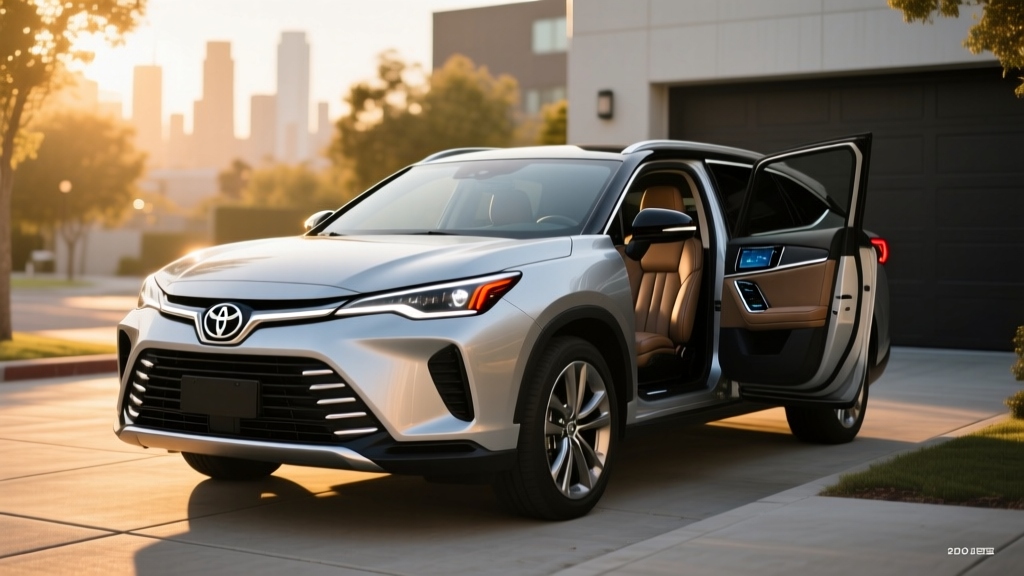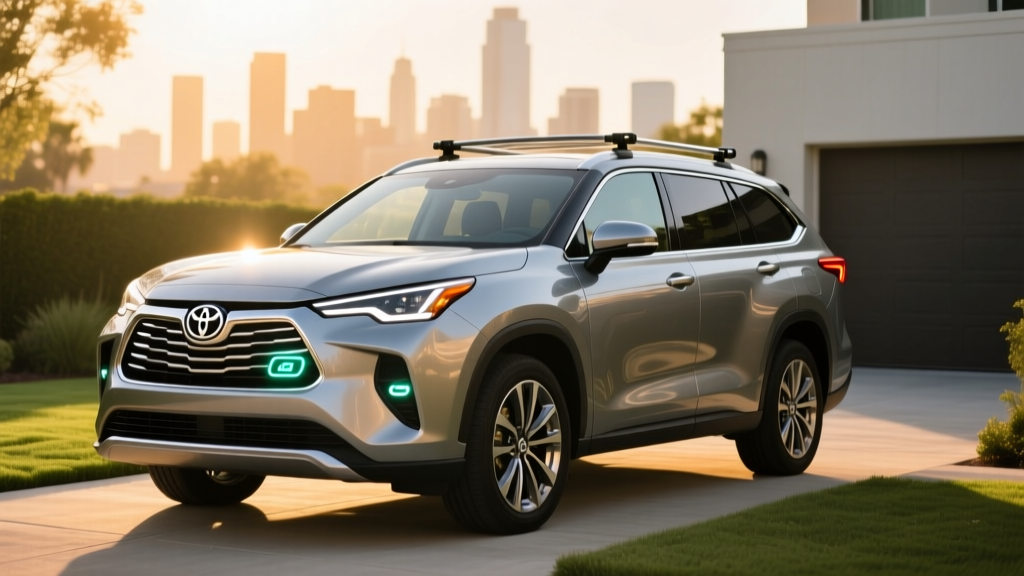
The Toyota Highlander has anchored the three-row family SUV segment for over two decades, and its hybrid variant has become the default choice for buyers who need passenger space without the fuel bill of a traditional V6. The 2026 Toyota Highlander Hybrid SUV continues that formula: a 2.5-liter four-cylinder paired with Toyota's fourth-generation hybrid system, standard electronic on-demand AWD on most trims, and EPA-estimated fuel economy that embarrasses many compact crossovers.
This is a conventional hybrid (HEV), not a plug-in. You never plug it in — the gasoline engine and regenerative braking handle all battery charging. If you want electric-only driving, you'll need to look at the RAV4 Prime or a full EV. But if your priority is a seven- or eight-seat SUV that returns 35 MPG in real-world mixed driving without changing any habits, the Highlander Hybrid is essentially without rival in its class.
Highlander Hybrid MPG: EPA Estimates and Real-World Results
The 2026 Highlander Hybrid's fuel economy varies slightly by trim and wheel size. Here is the full EPA breakdown as published on fueleconomy.gov:
| Configuration | City MPG | Highway MPG | Combined MPG |
|---|---|---|---|
| LE / XLE (18" wheels, FWD) | 36 | 35 | 36 |
| LE / XLE (18" wheels, AWD) | 35 | 35 | 35 |
| Limited / Platinum (20" wheels, AWD) | 35 | 34 | 35 |
Powertrain Specs: What's Under the Hood
The 2026 Highlander Hybrid uses Toyota's proven hybrid synergy drive, now in its fourth generation. The system pairs a naturally aspirated 2.5-liter inline-four engine with two front-mounted motor-generators and, on AWD models, a dedicated rear electric motor.
| Engine | 2.5L inline-4, Atkinson cycle |
| Engine Output | 186 hp / 173 lb-ft torque |
| Front Electric Motors | Two motor-generators (MG1, MG2) |
| Rear Electric Motor (AWD) | 40 kW (54 hp) independent rear drive |
| Net System Horsepower | 243 hp combined |
| Transmission | eCVT (planetary gearset, no belts) |
| Hybrid Battery | 1.87 kWh nickel-metal hydride (NiMH) |
| 0–60 mph | ~7.8 seconds (AWD) |
| Towing Capacity | 3,500 lbs (hybrid models) |
| Drivetrain | FWD standard on LE; AWD standard on XLE and above |
A few technical notes: the eCVT is not a traditional belt-driven CVT. It uses a planetary gearset to seamlessly blend engine and motor power — there are no rubber belts to wear out, which contributes to the system's long-term durability. The 1.87 kWh hybrid battery is small by EV standards, but that's intentional: it only needs to buffer energy for acceleration assist and regenerative capture, not to drive the vehicle independently for meaningful distances.
HEV vs PHEV: Why the Highlander Hybrid Is Not a Plug-In
A common question from shoppers is whether the Highlander Hybrid can plug in for electric-only driving. The answer is no — and understanding why matters for your purchase decision.
| Feature | Highlander Hybrid (HEV) | Typical PHEV (e.g., RAV4 Prime) |
|---|---|---|
| Plug-in charging | No — gasoline & regen only | Yes — Level 1/Level 2 AC |
| Electric-only range | ~1 mile at low speed | 25–42 miles typical |
| Hybrid battery size | 1.87 kWh (NiMH) | 14–18 kWh (lithium-ion) |
| Federal tax credit (§30D) | Not eligible | Up to $7,500 (if eligible) |
| Driving habit change | None — drive like any car | Must plug in nightly for max benefit |
| Price premium over gas | ~$1,500–$2,500 | ~$5,000–$8,000+ |
Toyota does not currently offer a Highlander Plug-In Hybrid in the U.S. market. If you need three rows and want PHEV capability, your options are limited to vehicles like the Kia Sorento PHEV or Mazda CX-90 PHEV — both of which trade some cargo space and third-row usability for electric-only commuting range.
Pricing, Trims, and Tax Credit Eligibility
The 2026 Highlander Hybrid is available across five trims. Pricing below reflects MSRP before destination charges:
| Trim | Drivetrain | MSRP |
|---|---|---|
| LE | FWD or AWD | $41,515 |
| XLE | AWD | $45,015 |
| XLE Nightshade | AWD | $46,315 |
| Limited | AWD | $49,515 |
| Platinum | AWD | $53,515 |
Federal tax credit: The Highlander Hybrid does not qualify for the IRS §30D Clean Vehicle Credit. That credit applies only to plug-in electric vehicles (BEVs and PHEVs) with sufficient battery capacity and compliant critical-mineral/battery-component sourcing. A conventional hybrid like the Highlander does not meet the statutory definition of a qualified plug-in vehicle. No federal purchase incentive applies.
State incentives: A handful of states offer rebates or HOV-lane access for hybrids, but these programs vary widely by jurisdiction and change frequently. Check your state's energy office or department of environmental quality for current programs. Some utility companies also offer modest rebates for hybrid purchases.
Hybrid Battery Warranty and Long-Term Reliability
Toyota's hybrid system has an exceptional reliability track record. The Prius, which shares the same fundamental architecture, has accumulated billions of real-world miles since 2000 with remarkably few hybrid-system failures. The Highlander Hybrid's NiMH battery is less energy-dense than a lithium-ion pack, but NiMH chemistry is extremely tolerant of the shallow charge-discharge cycles used in HEV operation — the battery typically cycles between 40% and 80% state of charge, never fully depleting or fully charging.
Battery replacement cost: If the hybrid battery fails outside warranty — uncommon before 200,000+ miles based on historical data — a new OEM replacement runs approximately $3,000–$4,500 including labor at a Toyota dealer. Refurbished/remanufactured packs are available from third-party suppliers for $1,500–$2,500. Given the 10-year/150,000-mile warranty and the system's proven longevity, battery replacement is a low-probability expense for most owners.
The eCVT transmission also contributes to reliability. Unlike conventional automatics with clutch packs and torque converters, or belt-driven CVTs with push-belts, Toyota's planetary-gearset eCVT has very few wear components. Failures are rare in the 200,000-mile ownership window.
Ownership Economics: Fuel Savings vs. a Gas Highlander
To put the Highlander Hybrid's efficiency in dollar terms, consider this comparison against the now-discontinued gas-only V6 Highlander (which returned roughly 24 MPG combined) and a typical body-on-frame three-row SUV averaging 20 MPG combined:
| Vehicle | Combined MPG | Gallons/Year | Annual Fuel Cost |
|---|---|---|---|
| Highlander Hybrid AWD | 35 | 429 | $1,500 |
| Previous-gen Highlander V6 AWD | 24 | 625 | $2,188 |
| Typical 3-row gas SUV | 20 | 750 | $2,625 |
The hybrid saves roughly $688 per year versus the previous gas Highlander and $1,125 per year versus a less efficient three-row SUV. Over a 5-year ownership period, that's $3,400–$5,600 in fuel savings — enough to offset the hybrid's modest price premium and then some. The savings compound further if gas prices rise above $3.50/gallon.
Highlander Hybrid vs. Full EV: Which Is Right for You?
- You need three rows and 3,500-lb towing in a single vehicle
- You cannot charge at home (apartment, street parking, no garage access)
- You regularly take road trips over 300 miles and don't want to plan around charging stops
- You want maximum fuel savings with zero change to your driving or fueling routine
- Long-term reliability and low maintenance cost are top priorities
- You can install a Level 2 home charger and most daily driving is under 50 miles
- You want zero tailpipe emissions and lower per-mile "fuel" cost (electricity vs. gas)
- You value instant torque, one-pedal driving, and minimal drivetrain maintenance
- You qualify for the §30D federal tax credit (up to $7,500 for eligible BEVs), which can close the price gap
The honest trade-off: a full-electric three-row SUV like the Kia EV9 offers lower operating costs and stronger acceleration, but at a significantly higher purchase price ($54,900+ base), reduced range in cold weather (20–30% loss below freezing), and the need to plan DC fast-charging stops on road trips exceeding ~250 miles. The Highlander Hybrid eliminates all of those friction points at the cost of higher per-mile fuel expense and continued gasoline dependence.
Pros and Cons at a Glance
- 35 MPG combined in a 7-seat AWD SUV — class-leading efficiency
- No plug-in required — zero lifestyle adjustment
- 10-year/150,000-mile hybrid battery warranty
- Proven, durable eCVT planetary gearset
- 3,500-lb towing capacity (adequate for light boat/trailer)
- Toyota Safety Sense 3.0 standard on all trims
- Third row is tight for adults on longer trips
- 243 hp feels adequate, not quick — highway merging requires planning
- No PHEV variant available (no electric-only commuting)
- Not eligible for the §30D federal EV tax credit
- Infotainment system lags behind rivals in responsiveness
- AWD system is reactive (rear motor engages after front slip detected), not predictive
Frequently Asked Questions
How many MPG does the Highlander Hybrid actually get?
The EPA rates the AWD Highlander Hybrid at 35 city / 35 highway / 35 combined. In real-world mixed driving, owners consistently report 34–36 MPG combined. City driving with frequent stops often yields 36–38 MPG thanks to the hybrid system's regenerative braking and electric-motor assist at low speeds. Sustained highway driving at 75+ mph drops to 31–33 MPG.
Does the Highlander Hybrid need to be plugged in?
No. The Highlander Hybrid is a conventional hybrid (HEV). The gasoline engine and regenerative braking system handle all battery charging. You fuel it like any other vehicle and never need to plug it in. There is no electric-only range to manage.
Is there a plug-in hybrid (PHEV) version of the Highlander?
Not in the U.S. market. Toyota offers the RAV4 Prime as a compact PHEV with 42 miles of electric-only range, but the Highlander lineup is limited to the conventional hybrid. If you need a three-row PHEV, the Kia Sorento PHEV (32 miles electric-only) and Mazda CX-90 PHEV (26 miles) are the closest alternatives.
Is the Highlander Hybrid reliable, and what does a battery replacement cost?
Toyota's hybrid system has an outstanding reliability record spanning over 25 years of production. The hybrid battery is covered for 10 years or 150,000 miles. Out-of-warranty replacement costs $3,000–$4,500 for an OEM pack, though failures before 200,000 miles are uncommon based on historical data across Toyota's hybrid lineup.
Does the Highlander Hybrid qualify for any federal tax credit?
No. The IRS §30D Clean Vehicle Credit applies only to plug-in electric vehicles (BEVs and PHEVs) that meet battery-sourcing and MSRP requirements. The Highlander Hybrid, as a conventional hybrid that cannot be plugged in, does not qualify. Check your state's energy office for any state-level hybrid incentives, which vary by jurisdiction.
How does the AWD system work on the Highlander Hybrid?
AWD models use a dedicated 40 kW electric motor on the rear axle — there is no mechanical driveshaft connecting the front and rear wheels. The rear motor engages automatically when the system detects front-wheel slip or when additional traction is needed during acceleration. It's an on-demand system, not full-time AWD, and it's designed for rain, light snow, and gravel rather than serious off-road use.