The Case for the 2025 Toyota Highlander Hybrid
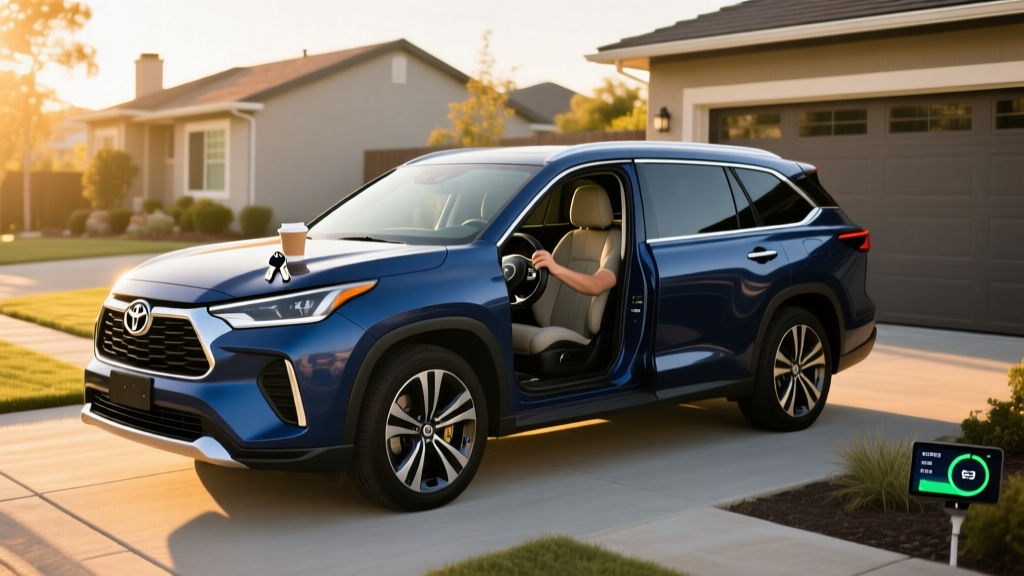
Three-row SUV buyers face a familiar dilemma in 2026: go full EV and deal with charging logistics, stick with gas and absorb rising fuel costs, or split the difference with a conventional hybrid. The 2025 Toyota Highlander Hybrid occupies a compelling middle ground — delivering 35 MPG combined in a family hauler that seats up to eight, requires no plug, and carries Toyota's long-standing hybrid reliability reputation. With a starting MSRP around $40,970 and no range anxiety to manage, it's a pragmatic choice for households not yet ready to commit to battery-electric ownership.
But does the real-world fuel economy match the EPA sticker? What does long-term battery reliability look like? And how does it stack up against plug-in hybrid alternatives or full EVs like the Kia EV9? We break down every number that matters.
HEV vs. PHEV: What the Highlander Hybrid Actually Is
The Toyota Highlander Hybrid is a conventional hybrid (HEV), not a plug-in hybrid (PHEV). This distinction matters because it dictates how you fuel it, what you can expect in electric-only driving, and whether you qualify for federal tax incentives.
| Feature | Conventional Hybrid (HEV) | Plug-In Hybrid (PHEV) |
|---|---|---|
| Plugs in to charge? | No — charges via regenerative braking and engine | Yes — Level 1/Level 2 charging |
| Electric-only range | ~1 mile or less at low speed | 20-50+ miles (model dependent) |
| Battery size | Small (~1-2 kWh) | Larger (~13-30+ kWh) |
| Federal tax credit (§30D) | Not eligible | Up to $7,500 if requirements met |
| Driving experience | Seamless gas+electric, no behavior change needed | EV-like daily commuting, gas for longer trips |
The Highlander Hybrid uses Toyota's series-parallel hybrid system — the same architecture proven over decades in the Prius and RAV4 Hybrid. You never plug it in. The 1.6 kWh nickel-metal hydride (NiMH) traction battery charges itself through regenerative braking and the gasoline engine. You drive it exactly like a conventional vehicle; the hybrid system simply makes it significantly more efficient.
Fuel Economy: EPA Ratings and Real-World MPG
Fuel economy is the Highlander Hybrid's headline advantage over its gas-only counterpart. Here's how the EPA rates it:
| Metric | City | Highway | Combined |
|---|---|---|---|
| EPA Rating | 35 MPG | 35 MPG | 35 MPG |
| Real-World Expectation | 36-39 MPG | 30-33 MPG | 33-36 MPG |
Source: fueleconomy.gov
Compared to the gas-only 2025 Highlander (24 MPG combined with the turbocharged 2.4L four-cylinder), the hybrid saves roughly 3.5 gallons per 100 miles — translating to approximately $500-$700 in annual fuel savings for a driver covering 15,000 miles per year at $3.50/gallon.
Powertrain Specs: Engine, Motors, and Performance
The 2025 Highlander Hybrid pairs a 2.5-liter inline-four Atkinson-cycle engine with two front electric motors and an additional rear motor for electronic on-demand AWD. Here's the full powertrain breakdown:
| Combined Net Horsepower | 243 HP |
| Gasoline Engine | 2.5L 4-cyl Atkinson-cycle, 186 HP / 175 lb-ft |
| Front Electric Motors | 2 motors, 134 kW combined |
| Rear Electric Motor | 40 kW (electronic AWD) |
| Traction Battery | ~1.6 kWh NiMH (sealed, self-charging) |
| Transmission | eCVT (electronically controlled continuously variable) |
| Drivetrain | AWD (standard on all hybrid trims) |
| 0-60 mph | ~7.6 seconds (est.) |
| Towing Capacity | 3,500 lbs |
The 243 combined horsepower is adequate for family driving — merging, passing, and loaded highway climbs are handled without drama. The eCVT eliminates traditional shift shock, delivering smooth linear acceleration. However, this is not a performance SUV; the eCVT's drone under hard acceleration reminds you that efficiency, not sportiness, is the priority.
One practical note: the hybrid's 3,500-lb towing capacity is lower than the gas-only Highlander's 5,000-lb rating. If you regularly tow a boat or large trailer, the gas model or a body-on-frame alternative may serve you better.
Pricing, Trims, and Tax Credit Eligibility
The 2025 Highlander Hybrid is offered across multiple trims, all with standard AWD:
| Trim | Starting MSRP |
|---|---|
| LE | ~$40,970 |
| XLE | ~$44,070 |
| Limited | ~$48,070 |
| Platinum | ~$51,570 |
Prices include destination charge. Verify with your local dealer as pricing can vary.
Battery Warranty, Reliability, and Replacement Costs
Battery longevity is consistently the top concern among first-time hybrid buyers. Toyota addresses this with one of the strongest hybrid battery warranties in the industry:
- Coverage: 10 years / 150,000 miles (whichever comes first)
- What's covered: Hybrid battery pack, hybrid control module, and related hybrid system components
- Transferable: Yes — warranty transfers to subsequent owners at no cost
- Applies to: 2020 and newer Toyota hybrid models (prior years: 8 years / 100,000 miles)
Toyota's hybrid system is among the most proven in the automotive industry. The Prius, which uses a fundamentally similar architecture, has demonstrated hybrid battery lifespans routinely exceeding 200,000 miles with minimal degradation. The Highlander Hybrid's NiMH battery is less energy-dense than the lithium-ion packs in full EVs, but NiMH chemistry is exceptionally stable and tolerant of the shallow charge-discharge cycles that characterize hybrid operation.
Out-of-warranty replacement cost: If the hybrid battery does fail after the warranty period, a new OEM replacement typically runs $3,000-$5,000 including labor. Third-party reconditioned batteries are available for $1,500-$2,500. However, based on real-world data from Toyota's hybrid fleet spanning two decades, premature hybrid battery failure is rare — most units outlast the vehicle's useful economic life.
For overall vehicle reliability, Toyota consistently ranks at or near the top in long-term dependability surveys, and the Highlander nameplate carries a strong resale value reputation. The hybrid variant adds minimal mechanical complexity beyond the standard powertrain — there's no traditional starter motor, no alternator, and the eCVT has no belts, pulleys, or conventional friction clutches to wear out.
Highlander Hybrid vs. PHEV vs. Full EV: Which Fits You?
Choosing between a conventional hybrid, plug-in hybrid, and full electric SUV depends on your daily driving pattern, charging access, and budget. Here's a decision framework:
- You lack reliable home or workplace charging access
- You want maximum simplicity — no plugs, no apps, no charging planning
- Your annual mileage is high (15,000+ miles) and fuel savings compound
- You need three rows and AWD but want to minimize fuel costs
- Budget is $40K-$52K and you don't want to stretch for an EV
- Your daily commute is under 40 miles round-trip and you can charge at home
- You want electric-only weekday driving with gas flexibility for weekend road trips
- You qualify for the §30D federal tax credit (check income/MSRP/sourcing rules)
- You have reliable Level 2 home charging (240V / 30-50A circuit)
- Your typical trips fall within 250-300 miles or you're comfortable with DC fast-charging stops
- You want the lowest per-mile energy cost (~$0.04-$0.06/mile on home electricity vs. $0.14-$0.18/mile for the hybrid at 35 MPG)
- You're eligible for the full $7,500 federal credit plus state incentives
The Highlander Hybrid makes the most sense for buyers who want immediate fuel savings with zero lifestyle adjustment. It asks nothing of you — just fill up with gas and drive. The trade-off is that you'll always spend more per mile than a plugged-in EV owner, and you miss out on the §30D tax credit that can make some EVs and PHEVs more affordable on a total-cost basis.
Pros and Cons at a Glance
- 35 MPG combined — excellent for a 3-row AWD SUV
- No plug-in required; zero behavior change from gas cars
- 10-year / 150,000-mile hybrid battery warranty
- Strong Toyota reliability and resale value
- Standard AWD across all hybrid trims
- Smooth eCVT with seamless gas-electric transitions
- Seats up to 8 passengers
- No federal tax credit eligibility (HEV, not PHEV/BEV)
- 3,500-lb towing capacity (vs. 5,000 lbs for gas model)
- eCVT drone under hard acceleration
- Third row is tight for adults on long trips
- Higher starting price than gas-only Highlander (~$4K premium)
- No electric-only driving beyond very low-speed creep
- Infotainment system lags behind competitors in responsiveness
Frequently Asked Questions
How many MPG does the 2025 Toyota Highlander Hybrid get?
The EPA rates the 2025 Highlander Hybrid AWD at 35 MPG city, 35 MPG highway, and 35 MPG combined. In real-world driving, owners commonly report 36-39 MPG in city conditions and 30-33 MPG on sustained highway trips. The hybrid system excels in stop-and-go traffic where regenerative braking recovers the most energy.
Does the Highlander Hybrid need to be plugged in?
No. The Highlander Hybrid is a conventional HEV, not a plug-in hybrid. Its small traction battery charges through regenerative braking and the gasoline engine. You fuel it exclusively at the gas pump — there is no charging port, no plug, and no electric-only range to manage.
Does the 2025 Highlander Hybrid qualify for any tax credit?
No. Under current IRS §30D rules, the federal clean vehicle credit applies only to plug-in electric vehicles (BEVs and PHEVs). Conventional hybrids like the Highlander Hybrid are not eligible. Some states may offer small incentives for hybrid purchases — consult your state energy office or the Alternative Fuels Data Center for local programs.
How long will the Highlander Hybrid battery last?
Toyota covers the hybrid battery for 10 years or 150,000 miles. Based on two decades of Toyota hybrid data (Prius, Camry Hybrid, RAV4 Hybrid), most hybrid batteries last well beyond 200,000 miles with minimal degradation. NiMH chemistry is inherently stable, and the hybrid system's shallow charge cycles are gentle on battery cells. Out-of-warranty replacement, while rare, costs $3,000-$5,000 for an OEM unit.
Is the Highlander Hybrid better than the gas-only Highlander?
For most buyers, yes — if you can absorb the ~$4,000 price premium. The hybrid delivers 35 MPG combined versus 24 MPG for the gas model, saving roughly $500-$700 annually in fuel. The payback period is typically 5-7 years depending on mileage and gas prices. You also gain smoother low-speed driving, standard AWD, and better long-term resale value. The trade-off is reduced towing capacity (3,500 vs. 5,000 lbs) and slightly less passing power at highway speeds.
How does the Highlander Hybrid compare to a full EV like the Kia EV9?
The Kia EV9 offers more interior space, faster acceleration, and dramatically lower per-mile energy costs (~$0.05/mile on home electricity vs. ~$0.16/mile for the hybrid). It also qualifies for up to $7,500 in federal tax credits (subject to eligibility). However, the EV9 requires home Level 2 charging infrastructure ($500-$2,000 installation), has a 270-300 mile range that requires planning on long trips, and starts at a higher MSRP. The Highlander Hybrid is the lower-friction choice for families who can't or don't want to adapt to EV charging logistics.