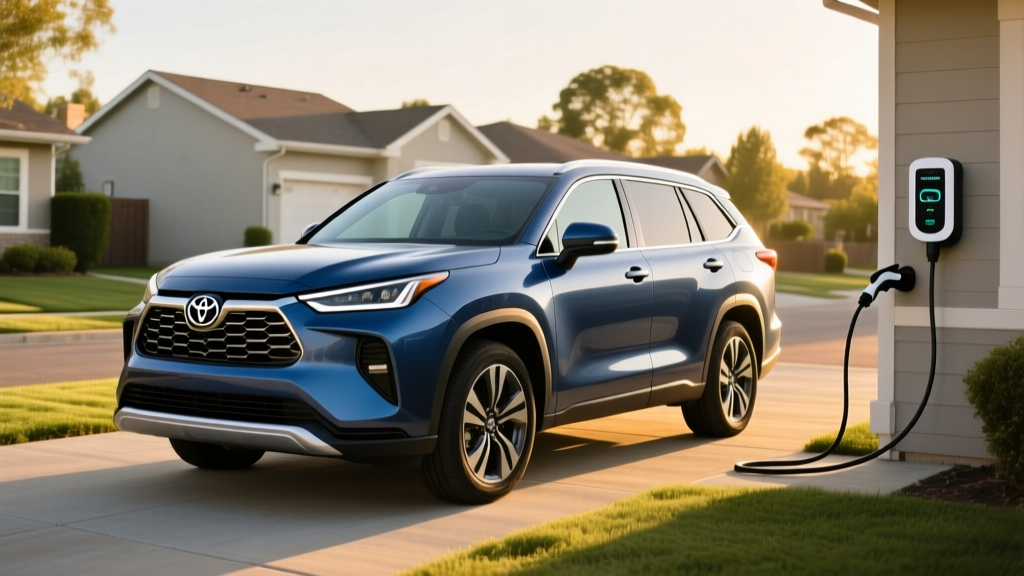
Three-row SUVs that don't guzzle gas are a short list, and the 2024 Toyota Highlander Hybrid sits near the top. Toyota pairs a 2.5-liter four-cylinder with two electric motors (three on AWD trims) to deliver a family hauler that sips fuel in school-drop-off traffic while offering the cargo space and towing utility buyers in this segment demand. But with Toyota discontinuing the V6 gas Highlander for 2024, the hybrid is now the default choice — which raises questions about power, reliability, and whether you should look at a plug-in hybrid or full EV instead.
This guide covers the 2024 Highlander Hybrid's EPA fuel economy, real-world MPG expectations, powertrain details, battery longevity, pricing, and how it stacks up against electrified alternatives like the Kia Sorento PHEV and Hyundai Ioniq 9.
2024 Highlander Hybrid MPG: EPA Ratings and Real-World Numbers
The headline number for any hybrid buyer is fuel economy. The 2024 Highlander Hybrid delivers strong figures for a 4,500-pound, three-row SUV, particularly in city driving where its regenerative braking and electric-motor assist shine.
| Drivetrain | City MPG | Highway MPG | Combined MPG |
|---|---|---|---|
| FWD (LE, XLE, Limited, Platinum) | 36 | 35 | 36 |
| AWD (all trims available) | 35 | 35 | 35 |
Source: EPA Fuel Economy
The FWD trims (LE, XLE, Limited, Platinum) achieve the best numbers, while adding the electronic AWD system — which uses a separate rear-mounted electric motor rather than a mechanical driveshaft — costs only 1 MPG combined. That's a remarkably small penalty for all-weather traction.
HEV vs PHEV vs EV: Where the Highlander Hybrid Fits
Before diving deeper into specs, it's critical to understand what the Highlander Hybrid is — and what it isn't. Toyota offers the Highlander as a conventional hybrid (HEV), not a plug-in hybrid. This distinction matters enormously for your daily routine and expectations.
HEV vs PHEV — Key Differences
| Feature | Conventional Hybrid (HEV) | Plug-In Hybrid (PHEV) |
|---|---|---|
| Plug-in charging? | No — never needs to be plugged in | Yes — plugs into Level 1 or Level 2 |
| Electric-only range | ~1 mile at low speed | 20–45 miles typical |
| Battery size | 1–2 kWh (small) | 13–25 kWh (larger) |
| Federal tax credit | Not eligible | Up to $7,500 (if eligible) |
| Fueling | Gasoline only | Gasoline + electricity |
| Best for | No home charging, simple ownership | Home charging access, short commutes |
The Highlander Hybrid is a conventional HEV. It charges its small battery through regenerative braking and the gasoline engine. You never plug it in. You simply fill it with gas and drive — the hybrid system works invisibly in the background to boost fuel economy.
If you want a three-row plug-in hybrid with electric-only driving, you'll need to look at competitors like the Kia Sorento PHEV (32 miles electric-only, ~$50,000) or the Jeep Grand Cherokee 4xe (25 miles electric-only). Toyota does not currently offer a Highlander PHEV in the US market, though the larger Grand Highlander Hybrid is available (also HEV-only).
Powertrain Specs: Horsepower, Engine, and Motors
| Engine | 2.5L DOHC 4-cylinder (Atkinson cycle) |
| Engine horsepower | 186 HP @ 6,000 RPM |
| Front electric motor | 134 HP |
| Rear electric motor (AWD only) | 54 HP |
| Net combined system horsepower | 243 HP |
| Transmission | Electronic Continuously Variable (eCVT) |
| 0–60 MPH | ~7.8 seconds (FWD), ~7.5 seconds (AWD) |
| Drivetrain | FWD or electronic AWD (AWD-i) |
| Towing capacity | 3,500 lbs (all trims) |
| Fuel tank | 17.1 gallons |
| Total driving range (est.) | ~600–615 miles |
Source: Toyota Highlander Hybrid Specifications
The 243 combined horsepower is adequate for family hauling, highway merging, and loaded road trips — but it won't feel quick. The eCVT prioritizes smoothness and efficiency over sportiness, and the four-cylinder engine can sound strained under hard acceleration or when climbing grades with a full cabin and cargo. If you're coming from the now-discontinued V6 gas Highlander (295 HP), expect a noticeable step down in passing power, offset by a significant step up in fuel economy (35–36 MPG combined vs the V6's 24 MPG combined).
The AWD-i system is worth noting: it uses a dedicated rear electric motor rather than a mechanical connection to the front axle. This means AWD engagement is seamless and instant, with no parasitic drivetrain loss when AWD isn't needed — explaining the minimal 1 MPG penalty.
Hybrid Battery: Size, Warranty, and Replacement Cost
Hybrid battery longevity is the number-one concern among first-time hybrid buyers. Here's what you need to know about the 2024 Highlander Hybrid's battery system.
2024 Highlander Hybrid Battery Warranty & Lifespan
- Battery type: Lithium-ion (Li-ion), replacing the NiMH pack used in earlier model years
- Battery capacity: ~1.9 kWh (small — designed for hybrid assist, not electric-only driving)
- Hybrid battery warranty: 10 years / 150,000 miles (whichever comes first), transferable to subsequent owners
- Hybrid system components warranty: 8 years / 100,000 miles (inverter, control module, etc.)
- Expected lifespan: Toyota hybrid batteries commonly last 150,000–200,000+ miles based on fleet data from Prius, Camry Hybrid, and RAV4 Hybrid platforms
- Replacement cost (out of warranty): $3,000–$5,000 for a new OEM battery pack; refurbished options available for $1,500–$2,500
Toyota's hybrid battery warranty was extended from 8 years/100,000 miles to 10 years/150,000 miles starting with 2020 model-year vehicles — one of the longest in the industry.
The lithium-ion pack in the 2024 Highlander Hybrid is a mature design shared across Toyota's hybrid lineup. Unlike full EV batteries that cycle through deep discharge/charge events daily, hybrid batteries operate in a narrow state-of-charge window (roughly 40–80% SoC), which dramatically reduces degradation. This is why 200,000-mile Prius taxis with original batteries are common — the shallow-cycling strategy is proven.
If the battery does fail outside warranty, independent hybrid shops now offer cell-level reconditioning for significantly less than a full pack replacement. However, with the 10-year/150,000-mile coverage, most original owners will never face this cost.
Pricing, Trims, and Tax Credit Eligibility
| Trim | Drivetrain | MSRP (incl. destination) |
|---|---|---|
| LE | FWD | $40,720 |
| LE | AWD | $42,320 |
| XLE | FWD | $44,170 |
| XLE | AWD | $45,770 |
| Limited | FWD | $49,075 |
| Limited | AWD | $50,675 |
| Platinum | FWD | $52,475 |
| Platinum | AWD | $53,575 |
Federal Tax Credit Status
The 2024 Highlander Hybrid is a conventional hybrid (HEV), not a plug-in hybrid. Under IRS §30D rules, only plug-in electric vehicles (BEVs and PHEVs) with sufficient battery capacity and qualifying battery sourcing are eligible for the federal clean vehicle credit. The Highlander Hybrid does not qualify for any federal tax credit.
Some states may offer minor incentives for hybrid purchases (check your state's energy or DMV website), but these are uncommon and typically small compared to the $7,500 federal credit available for qualifying PHEVs and EVs. See the IRS clean vehicle credit page for current federal eligibility rules.
Highlander Hybrid vs PHEV and EV Alternatives
If you're cross-shopping the Highlander Hybrid, here's how it compares to the main electrified three-row alternatives in 2024.
| Vehicle | Type | Combined MPG / MPGe | Electric-Only Range | Starting MSRP | Federal Credit |
|---|---|---|---|---|---|
| Toyota Highlander Hybrid | HEV | 35–36 MPG | N/A | $40,720 | None |
| Kia Sorento PHEV | PHEV | 79 MPGe / 34 MPG (gas) | 32 miles | $50,290 | Up to $7,500* |
| Toyota Grand Highlander Hybrid | HEV | 35–36 MPG | N/A | $45,020 | None |
| Kia EV9 | BEV | 83–88 MPGe | 230–304 miles | $54,900 | Up to $7,500* |
*Federal credit eligibility depends on MSRP caps, buyer income limits, battery sourcing requirements, and point-of-sale transfer rules. Verify at IRS.gov.
Decision Framework: Which Powertrain Fits You?
Choose the Highlander Hybrid (HEV) if:
- You don't have access to home or workplace Level 2 charging
- You want zero lifestyle change — just fill up with gas and go
- You prioritize Toyota's long-term reliability reputation and resale value
- You need proven 3,500-lb towing in a fuel-efficient three-row SUV
Choose a PHEV (like Sorento PHEV) if:
- You have Level 2 home charging and a commute under 30 miles
- You want electric-only daily driving with gas backup for road trips
- You qualify for the federal tax credit, narrowing the price gap
Choose a full EV (like Kia EV9) if:
- You have reliable home charging and your trips rarely exceed 250 miles
- You want the lowest per-mile fuel cost and zero tailpipe emissions
- You're willing to plan around DC fast charging on road trips
Reliability, Safety Ratings, and Ownership Costs
Toyota's hybrid powertrain is among the most proven in the automotive industry. The fourth-generation hybrid system in the 2024 Highlander has been deployed across millions of Toyota vehicles globally, and the platform carries forward a strong reliability record.
For the 2024 model year, the Highlander earned top safety marks:
- IIHS: Top Safety Pick+ (highest rating) — see full report
- NHTSA: 5-Star Overall Safety Rating
- Toyota Safety Sense 2.5+: Standard on all trims — includes pre-collision braking, full-speed adaptive cruise control, lane tracing assist, and automatic high beams
On the ownership-cost side, the Highlander Hybrid's 35–36 MPG combined translates to roughly $1,400–$1,700 in annual fuel costs (15,000 miles/year at $3.50/gallon), compared to ~$2,300 for a comparable gas-only three-row SUV at 22 MPG combined. That's a $600–$900 annual fuel savings — meaning the hybrid premium over a gas equivalent (when one was available) typically pays for itself within 2–3 years of average driving.
Pros and Cons
✓ Pros
- 36 MPG combined in a three-row SUV is exceptional
- Proven Toyota hybrid reliability with 10yr/150k-mile battery warranty
- Standard AWD availability with minimal MPG penalty (1 MPG)
- Strong resale value — Highlander Hybrids hold value well
- Top Safety Pick+ from IIHS
- No plug-in needed — zero lifestyle change from a gas car
- 3,500-lb towing capacity across all trims
✗ Cons
- 243 HP feels modest for a 4,500-lb SUV; engine drones under load
- No plug-in hybrid option available from Toyota
- No federal tax credit eligibility (HEV, not PHEV)
- Third row is tight for adults — Grand Highlander is better for regular 7-passenger use
- Infotainment system is functional but dated vs competitors
- Starting price above $40K; well-equipped Limited/Platinum exceed $50K
Frequently Asked Questions
How many MPG does the 2024 Highlander Hybrid get?
The EPA rates the FWD Highlander Hybrid at 36 city / 35 highway / 36 combined MPG. AWD trims are rated at 35/35/35 MPG. In real-world mixed driving, most owners report 32–37 MPG, with city-heavy driving sometimes exceeding the EPA city estimate and sustained highway speeds reducing it to 30–33 MPG.
Does the 2024 Highlander Hybrid need to be plugged in?
No. The Highlander Hybrid is a conventional hybrid (HEV), not a plug-in hybrid. It charges its small battery internally through regenerative braking and the gasoline engine. You never plug it in — just fill it with gasoline like a traditional vehicle.
Is the Highlander Hybrid available as a plug-in hybrid (PHEV)?
No. Toyota does not offer a plug-in hybrid version of the Highlander in the US market. If you want a three-row PHEV, look at the Kia Sorento PHEV (32 miles electric-only range) or the Mitsubishi Outlander PHEV (38 miles electric-only, though third-row space is very limited).
How long will the hybrid battery last, and what does replacement cost?
Toyota covers the hybrid battery for 10 years or 150,000 miles. Based on fleet data from other Toyota hybrids, the battery commonly lasts 150,000–200,000+ miles before needing replacement. If replacement is needed out of warranty, expect $3,000–$5,000 for a new OEM pack, or $1,500–$2,500 for a refurbished unit.
Does the 2024 Highlander Hybrid qualify for any tax credit?
No. Because it's a conventional hybrid (not a plug-in), the Highlander Hybrid is not eligible for the federal §30D clean vehicle credit. That credit is reserved for plug-in vehicles (BEVs and PHEVs) that meet battery sourcing, MSRP, and buyer income requirements. Some states may offer small hybrid incentives — check your state's energy office for details.
How does the Highlander Hybrid compare to the Grand Highlander Hybrid?
The Grand Highlander Hybrid is larger, offering genuinely usable third-row space for adults and more cargo room. Both use similar hybrid powertrains with comparable 35–36 MPG combined ratings. The Grand Highlander starts ~$4,300 higher and is better if you regularly carry adults in the third row. The standard Highlander Hybrid is more maneuverable in tight urban settings and slightly less expensive.