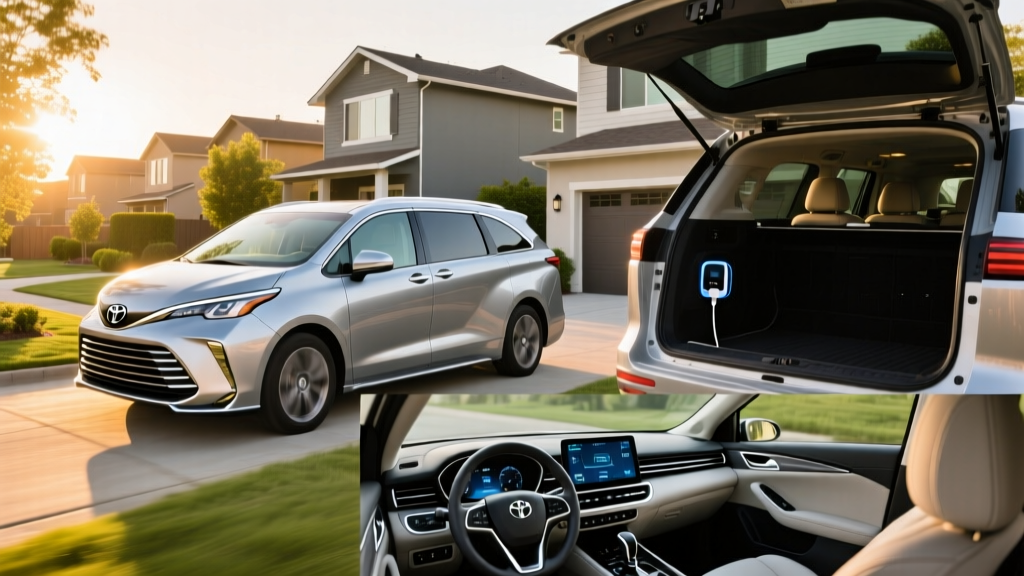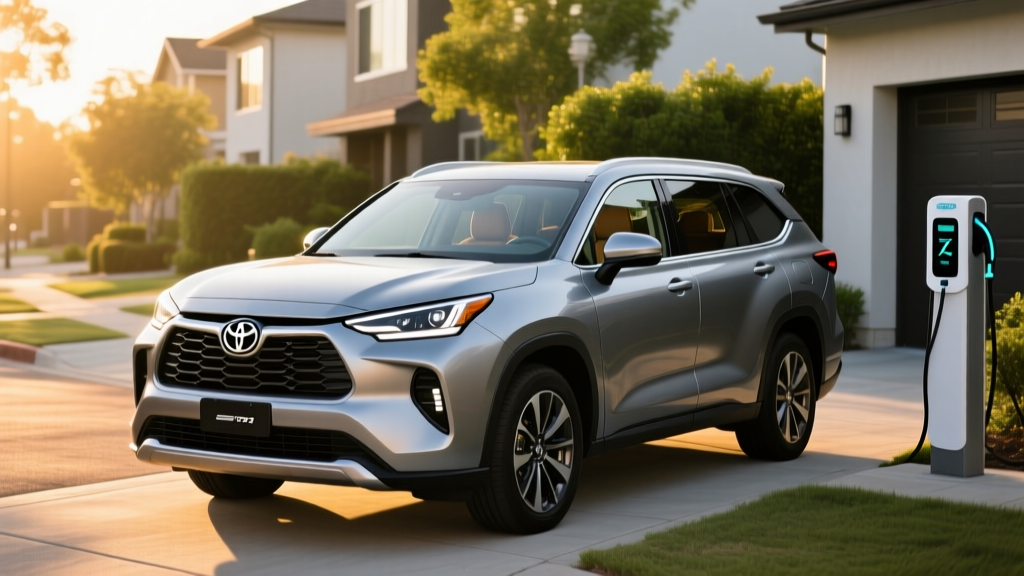
The 2022 Toyota Highlander Hybrid occupies a narrow but valuable lane: a three-row family hauler that sips fuel without requiring a plug, a charging routine, or any change in driving habits. While fully electric SUVs grab headlines, the Highlander Hybrid quietly delivers 35 MPG combined across a vehicle that seats up to eight — a combination that still matters in 2026 for buyers who lack home charging access or regularly drive routes where public charging infrastructure remains sparse.
This guide breaks down the 2022 Highlander Hybrid's powertrain, real-world fuel economy, battery longevity, ownership costs, and where it fits against plug-in hybrids and battery-electric alternatives. Whether you're shopping the used market or comparing it against newer models, the numbers below tell you exactly what to expect.
HEV vs PHEV: What the Highlander Hybrid Actually Is
Before diving into specs, it's essential to distinguish the Highlander Hybrid's powertrain type, because confusion between hybrid categories leads to wrong purchase decisions.
Conventional Hybrid (HEV) — Highlander Hybrid
- No plug required. The battery charges through regenerative braking and the gasoline engine.
- No electric-only driving range beyond brief low-speed assist (typically under 1 mile at very low speeds).
- No federal EV tax credit eligibility under IRS §30D, which applies only to plug-in vehicles.
- Always ready — fuel it like any gas car and drive.
Plug-In Hybrid (PHEV) — Example: Toyota RAV4 Prime
- Requires plugging in to access its full electric range (typically 20–42 miles depending on model).
- Has a larger battery (13–18 kWh typical) and can charge from a wall outlet or Level 2 charger.
- May qualify for federal tax credits if battery capacity and sourcing rules are met.
- Reverts to hybrid mode once the electric range is depleted.
The 2022 Highlander Hybrid is strictly a conventional HEV. Toyota does not offer a Highlander plug-in hybrid in the US market. If you want Toyota PHEV capability in a larger vehicle, you'd need to look at the Sienna (minivan, also HEV-only in the US) or step outside Toyota to competitors like the Chrysler Pacifica Hybrid.
Powertrain Specs and Performance
| Specification | 2022 Toyota Highlander Hybrid |
|---|---|
| Powertrain Type | Conventional Hybrid (HEV) |
| Engine | 2.5L 4-cylinder Atkinson-cycle |
| Electric Motors | Front + rear (e-AWD standard on most trims) |
| Combined System Horsepower | 243 hp |
| Transmission | Electronically controlled CVT (eCVT) |
| Drivetrain | Electronic On-Demand AWD (standard) |
| Hybrid Battery | 1.6 kWh nickel-metal hydride (NiMH) |
| Towing Capacity | 3,500 lbs |
| Seating Capacity | 7 or 8 (bench vs captain's chairs) |
| Cargo Volume (behind 3rd row) | 16.1 cu ft |
| Cargo Volume (all rows folded) | 84.3 cu ft |
The 2.5-liter four-cylinder engine produces 186 hp on its own, supplemented by front and rear electric motors that bring the total system output to 243 hp. The rear motor enables electronic all-wheel drive without a mechanical driveshaft — a hallmark of Toyota's hybrid AWD system. The result is confident acceleration for merging and passing, though 0–60 mph takes approximately 8.0 seconds, which is adequate rather than quick for a vehicle of this size.
Fuel Economy: EPA Ratings vs Real-World MPG
The headline number for the 2022 Highlander Hybrid is its EPA-estimated fuel economy, which significantly outperforms the gas-only Highlander's 24 MPG combined.
| Driving Condition | EPA Estimate | Real-World Expectation |
|---|---|---|
| City | 35 MPG | 34–38 MPG (hybrids excel in stop-and-go) |
| Highway | 35 MPG | 30–33 MPG (aerodynamic drag, sustained speed) |
| Combined | 35 MPG | 31–35 MPG (mixed driving) |
Source: fueleconomy.gov — 2022 Toyota Highlander Hybrid AWD
Here's what the EPA sticker doesn't tell you: conventional hybrids like the Highlander Hybrid often exceed their EPA city estimate in real-world stop-and-go traffic. The electric motor handles low-speed propulsion where gasoline engines are least efficient, and regenerative braking recaptures energy that a gas car would waste as heat. In city-heavy commutes, owners frequently report 36–38 MPG.
Highway driving tells a different story. At sustained 70–80 mph speeds, the aerodynamic penalty of a large three-row SUV dominates, and the hybrid system provides less benefit. Expect 30–33 MPG on long highway trips — still better than the gas model, but not the 35 MPG the sticker promises.
Cold weather further reduces efficiency. In sub-freezing temperatures, the engine runs more frequently to provide cabin heat and maintain battery temperature, dropping real-world MPG to roughly 28–32 combined until the powertrain warms up.
Annual Fuel Cost Estimate
At 15,000 miles/year and $3.50/gallon average fuel cost, the Highlander Hybrid costs approximately $1,500/year in fuel — roughly $600 less annually than the gas-only Highlander (rated at 24 MPG combined). Over a typical 7-year ownership period, that's about $4,200 in fuel savings.
Hybrid Battery Longevity, Warranty, and Replacement Cost
The top concern among hybrid buyers — especially those shopping used 2022 models — is battery lifespan and replacement cost. Here's the data.
Warranty: Toyota covers the hybrid battery on the 2022 Highlander Hybrid for 10 years or 150,000 miles, whichever comes first. This applies to the original owner and is transferable to subsequent owners. Toyota increased its hybrid battery warranty from 8 years/100,000 miles to 10 years/150,000 miles starting with 2020 model-year vehicles, so the 2022 model carries the longer coverage.
Battery Chemistry: The Highlander Hybrid uses a nickel-metal hydride (NiMH) battery pack, not lithium-ion. NiMH is a mature, proven chemistry in Toyota's hybrid lineup with decades of real-world data. It's heavier and less energy-dense than lithium-ion, but for a 1.6 kWh pack that only needs to buffer regenerative energy and provide brief motor assist, the trade-off favors durability.
Real-World Lifespan: Toyota hybrid batteries routinely last well beyond warranty. Data from fleet operators and long-term owner reports show NiMH packs in Camry, Prius, and Highlander Hybrids commonly reaching 180,000–250,000 miles before significant degradation. Complete failure before 150,000 miles is uncommon.
Replacement Cost: If the battery does eventually need replacement out of warranty, a new OEM hybrid battery for the Highlander Hybrid costs approximately $3,000–$4,500 including labor at a Toyota dealer. Independent hybrid specialists and refurbished/reconditioned packs can reduce this to $1,500–$2,500. Individual cell modules can sometimes be replaced for under $1,000 if only a subset has degraded.
Pricing, Trims, and Tax Credit Eligibility
The 2022 Highlander Hybrid was offered in five trims, all with standard electronic AWD:
| Trim | Original MSRP | Key Features |
|---|---|---|
| LE | $40,270 | 8-passenger seating, Toyota Safety Sense 2.5+, 8" touchscreen |
| XLE | $43,270 | SofTex seats, 7-passenger (captain's chairs), power liftgate |
| XSE | $44,670 | Sport-tuned suspension, 20" wheels, black exterior accents |
| Limited | $47,870 | Leather, panoramic roof, 12.3" touchscreen, JBL audio |
| Platinum | $50,470 | Head-up display, 360° camera, ventilated front seats |
Federal Tax Credit: The 2022 Toyota Highlander Hybrid does not qualify for the IRS §30D Clean Vehicle Credit. That credit applies only to plug-in electric vehicles (BEVs and PHEVs) with battery capacities of at least 7 kWh. The Highlander Hybrid's 1.6 kWh NiMH pack is far below that threshold, and as a conventional HEV, it cannot be plugged in. This has always been the case for Toyota's non-plug-in hybrids.
Used Market Pricing (2026): As of early 2026, used 2022 Highlander Hybrids typically list between $30,000–$40,000 depending on trim, mileage, and condition. Lower-mileage Limited and Platinum trims command premiums near the top of that range.
State Incentives: Some states offer rebates or HOV lane access for hybrids, but these vary widely and many have sunset or shifted focus to plug-in vehicles. Check your state's energy or DMV website for current programs.
Highlander Hybrid vs PHEV vs EV: Which Fits You?
The three-row family SUV segment now offers genuine choices across all three electrification levels. Here's a decision framework based on your actual driving situation.
Choose the Highlander Hybrid (HEV) if:
- You lack access to home or workplace charging (apartment, street parking, no garage).
- You regularly tow (3,500 lb capacity; most EVs in this class tow less or not at all).
- You take frequent long road trips where charging infrastructure adds unwanted time.
- You want a proven, low-risk powertrain with minimal maintenance changes vs a gas car.
- Your budget is $30K–$45K on the used market.
Choose a Plug-In Hybrid (PHEV) if:
- You have home charging and most daily trips are under 30 miles (covering electric-only range).
- You want to drive mostly on electricity but need gas flexibility for longer trips.
- You want potential federal tax credit eligibility (up to $7,500, subject to income, MSRP, and battery sourcing rules under current IRS §30D).
- Examples: Chrysler Pacifica Hybrid (32 mi electric), Kia Sorento PHEV (32 mi electric).
Choose a Battery-Electric Vehicle (BEV) if:
- You have reliable Level 2 home charging and your daily driving is under 250 miles.
- You want zero tailpipe emissions and the lowest per-mile fuel cost (electricity vs gas).
- You want minimal drivetrain maintenance (no oil changes, no transmission fluid).
- You're comfortable planning charging stops on road trips or rarely drive over 250 miles in a day.
- Examples: Kia EV9 (300 mi EPA, 3-row), Tesla Model X (335 mi EPA, 3-row).
Ownership Costs: 5-Year Breakdown
| Cost Category | Highlander Hybrid (HEV) | Gas Highlander (AWD) | Comparable BEV (est.) |
|---|---|---|---|
| Purchase Price (avg) | $36,000 (used) | $33,000 (used) | $48,000 (new, after credit) |
| Fuel/Energy (5 yr / 75K mi) | $7,500 | $10,500 | $3,750 |
| Maintenance (5 yr) | $3,000 | $3,500 | $1,800 |
| Insurance (5 yr avg) | $9,000 | $8,500 | $10,500 |
| Estimated Depreciation | $12,000 | $13,000 | $16,000 |
| 5-Year Total | $67,500 | $68,500 | $80,050 |
The Highlander Hybrid's advantage is clear: near-identical total ownership cost to the gas model, with substantially lower fuel spend and no behavioral changes required. A comparable three-row BEV offers lower fuel and maintenance costs but carries a higher purchase price and steeper depreciation curve, making it more expensive over five years unless you drive significantly more than 15,000 miles annually.
Pros and Cons
Pros
- 35 MPG combined EPA — class-leading for a three-row SUV
- No plug needed; zero charging infrastructure required
- 10-year / 150,000-mile hybrid battery warranty
- Standard AWD across all trims
- Proven Toyota reliability with deep service network
- 3,500-lb towing capacity
- Toyota Safety Sense 2.5+ standard (adaptive cruise, lane tracing, auto emergency braking)
Cons
- Modest 243 hp — adequate but not quick for a 4,500-lb vehicle
- Third row is tight for adults on longer trips
- 16.1 cu ft cargo behind third row is limited for the segment
- No federal tax credit eligibility
- Highway MPG drops to ~30–33 in real-world sustained-speed driving
- Infotainment interface dated vs newer competitors (2022 model year)
- NiMH battery is older chemistry (proven but heavier than lithium-ion)
Frequently Asked Questions
How many MPG does the 2022 Toyota Highlander Hybrid get?
The EPA rates it at 35 MPG city, 35 MPG highway, and 35 MPG combined. In real-world driving, expect 34–38 MPG in city conditions and 30–33 MPG on the highway. Cold weather and heavy cargo loads will reduce these figures by 2–4 MPG.
Does the Highlander Hybrid need to be plugged in?
No. The 2022 Highlander Hybrid is a conventional hybrid (HEV). Its 1.6 kWh battery charges exclusively through regenerative braking and the gasoline engine. You fuel it exactly like a standard gas car — no charging cable, no plug, no charging station visits required.
How far can the Highlander Hybrid drive on electric power alone?
Effectively less than 1 mile at very low speeds (under 25 mph). The hybrid system uses the electric motor for low-speed assist and to supplement acceleration, but the battery is too small to provide meaningful electric-only range. This is by design — the system optimizes fuel efficiency, not electric driving distance.
Is the 2022 Highlander Hybrid reliable?
Yes. Toyota's hybrid powertrain is among the most proven in the industry, with over two decades of production data. The NiMH battery pack is conservative and durable. Toyota's 10-year/150,000-mile hybrid battery warranty provides long-term protection. The Highlander Hybrid consistently earns above-average reliability ratings from sources including Consumer Reports and J.D. Power.
What does a Highlander Hybrid battery replacement cost?
A new OEM replacement battery costs approximately $3,000–$4,500 installed at a Toyota dealer. Refurbished or reconditioned packs from independent hybrid specialists run $1,500–$2,500. However, most Toyota hybrid batteries last 180,000+ miles, and the 10-year/150,000-mile warranty covers premature failure.
Does the 2022 Highlander Hybrid qualify for any tax credit?
No. The IRS §30D Clean Vehicle Credit applies only to plug-in vehicles (battery-electric and plug-in hybrid). The Highlander Hybrid is a conventional HEV with no plug-in capability and a 1.6 kWh battery — far below the 7 kWh minimum threshold. Some states may offer minor incentives for hybrids, but no federal credit applies. Check IRS.gov for current clean vehicle credit rules.
Hybrid vs PHEV vs EV — which should I buy?
If you can't charge at home, choose the HEV (Highlander Hybrid). If you can charge at home and most trips are under 30 miles, a PHEV gives you electric commuting with gas backup. If you have home charging and rarely exceed 250 miles daily, a BEV offers the lowest running costs. The right answer depends entirely on your charging access and driving patterns — not on which technology is "best" in the abstract.
How does the Highlander Hybrid compare to the gas-only Highlander?
The gas-only 2022 Highlander AWD is rated at 24 MPG combined (21 city / 28 highway). The hybrid delivers 35 MPG combined — a 46% improvement. The hybrid costs roughly $2,000–$3,000 more on the used market but saves approximately $600/year in fuel, reaching payback in 3–5 years. The hybrid also provides smoother low-speed acceleration thanks to electric motor torque fill.