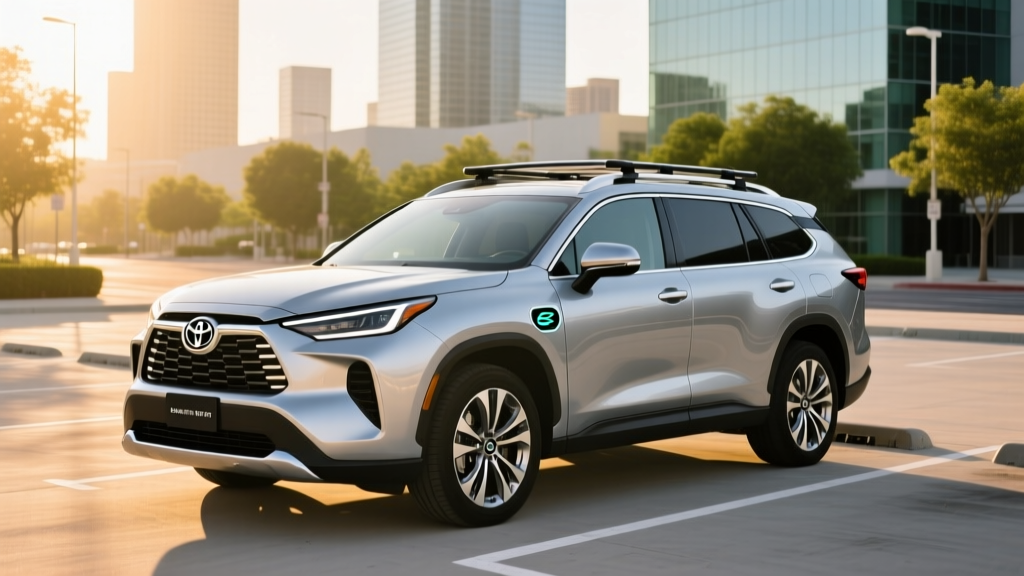
For families who need three usable rows of seating but don't want to pay the fuel penalty of a traditional V6 SUV, the 2026 Toyota Grand Highlander Hybrid has become the default answer. The mid-tier XLE trim, in particular, strikes the balance most buyers actually want: premium comfort features without the Limited or Platinum price premium. This review covers exactly what the Grand Highlander XLE Hybrid delivers in real-world driving, what it costs to own, and whether it's the right electrified choice versus a PHEV or full EV alternative.
Quick Verdict: Who the Grand Highlander XLE Hybrid Is For
The 2026 Toyota Grand Highlander XLE Hybrid is a conventional hybrid electric vehicle (HEV). It does not plug in. You fuel it like any other gasoline car, and the hybrid system recovers energy through regenerative braking to assist the 2.5-liter four-cylinder engine. The result is an EPA-rated 36 MPG combined in a three-row SUV that seats up to eight — a figure that would have seemed impossible for a vehicle this size just five years ago.
If you need a three-row family hauler, want minimal ownership complexity, and don't have reliable access to plug-in charging at home, this is the powertrain to get. If you can charge at home and want electric-only commuting, you should also evaluate PHEV options like the Kia Sorento Plug-In Hybrid or wait for Toyota's future PHEV variants.
Fuel Economy: EPA Ratings vs Real-World MPG
Toyota's fourth-generation hybrid system pairs a 2.5-liter Dynamic Force four-cylinder engine with two electric motors (front) or three motors (with the available E-Four AWD system). The XLE Hybrid comes standard with front-wheel drive; all-wheel drive is a $1,600 option that drops fuel economy slightly.
| Drivetrain | City MPG | Highway MPG | Combined MPG |
|---|---|---|---|
| FWD | 37 | 34 | 36 |
| AWD (E-Four) | 36 | 32 | 35 |
Source: fueleconomy.gov
Toyota hybrids consistently outperform their EPA city ratings in stop-and-go driving because regenerative braking recovers energy that a gas-only car wastes as heat. Expect 38-40 MPG in urban and suburban driving. Highway fuel economy tends to land closer to or slightly below the EPA sticker — plan on 31-33 MPG at sustained 70-75 mph speeds, particularly with roof cargo or a full load of passengers. In cold weather (below 30°F), expect a 2-4 MPG drop as the engine runs more frequently to maintain cabin heat and battery temperature.
For context, the non-hybrid Grand Highlander with the turbocharged 2.4-liter engine rates at 24 MPG combined. Over 15,000 miles per year at $3.50/gallon fuel, the hybrid saves roughly $700-$900 annually in fuel costs.
Hybrid vs PHEV vs EV: Understanding the Difference
Buyers shopping the Grand Highlander often encounter plug-in hybrid (PHEV) and battery electric vehicle (BEV) alternatives. Here's the critical distinction:
Conventional Hybrid (HEV)
This is what the Grand Highlander XLE Hybrid is. A small battery (1.6 kWh in this case) is charged entirely by the engine and regenerative braking. You never plug it in. The electric motor assists the gas engine but cannot drive the vehicle on electricity alone for meaningful distances. The benefit is simple: dramatically better fuel economy with zero behavior change.
Plug-In Hybrid (PHEV)
A larger battery (typically 12-18 kWh) that you do plug in, giving 25-40 miles of electric-only range for daily commuting. Once the battery depletes, it operates as a conventional hybrid. Examples: Toyota RAV4 Prime, Kia Sorento PHEV. Requires home or workplace charging access to justify the price premium.
| Factor | HEV (Grand Highlander Hybrid) | PHEV | Full EV (BEV) |
|---|---|---|---|
| Plug in required? | No | Yes (for EV range) | Yes (always) |
| Electric-only range | ~1 mile (low-speed assist) | 25-40 miles typical | 200-350+ miles |
| Home charging needed? | No | Recommended | Essential |
| Fuel/energy cost per mile | ~$0.10 | ~$0.04 (electric) / $0.10 (gas) | ~$0.04-$0.06 |
| Three-row availability | Yes (8 seats) | Limited (Kia Sorento PHEV) | Rivian R1S, Tesla Model X |
| Tax credit eligible? | No federal credit | Up to $7,500 (§30D) | Up to $7,500 (§30D) |
Powertrain and Performance Specifications
| Engine | 2.5L Dynamic Force 4-cylinder |
| Electric Motors | 2 (FWD) or 3 (AWD with rear motor) |
| Combined Horsepower | 245 hp |
| Hybrid Battery | 1.6 kWh lithium-ion (sealed NiMH in prior gens) |
| Transmission | eCVT (electronically controlled) |
| 0-60 mph | ~7.8 seconds (FWD) |
| Towing Capacity | 3,500 lbs |
| Drivetrain | FWD standard; E-Four AWD optional |
| Fuel Tank | 17.1 gallons |
| Total Range | ~615 miles (FWD, EPA combined) |
| Seats | 7 (captain's chairs) or 8 (bench 2nd row) |
The 245 combined horsepower is adequate for highway merging and passing but won't feel quick in a vehicle that weighs over 4,600 pounds. The eCVT is smooth and avoids the gear-hunting feel of traditional automatics, though some drivers notice the engine drone under hard acceleration — a characteristic of Toyota's planetary-gear hybrid system holding the engine at optimal RPM. The E-Four AWD system uses a dedicated 40 kW rear electric motor that engages on demand, providing traction without the mechanical losses of a traditional driveshaft.
Pricing, Trims, and Tax Credit Eligibility
| Trim | MSRP (FWD) | AWD Add-On |
|---|---|---|
| LE Hybrid | $43,215 | +$1,600 |
| XLE Hybrid | $46,515 | +$1,600 |
| Limited Hybrid | $50,855 | +$1,600 |
| Platinum Hybrid | $54,590 | +$1,600 |
The XLE Hybrid adds SofTex-trimmed heated and ventilated front seats, a power liftgate, wireless phone charging, a 12.3-inch infotainment display, and Toyota's Smart Key system with push-button start over the LE. It's the trim where most buyers stop — the Limited's premium comes primarily from leather, a panoramic roof, and a 360-degree camera.
The Toyota Grand Highlander Hybrid is a conventional HEV, not a plug-in vehicle. It does not qualify for the IRS §30D Clean Vehicle Credit (up to $7,500 for new PHEVs and BEVs). Conventional hybrids are excluded from this credit under current law. Some states may offer minor incentives for hybrid purchases — check your state energy office or the AFDC state incentives database for specifics. The Hybrid's fuel savings typically offset the lack of a federal credit within 3-5 years of ownership compared to the non-hybrid turbo model.
Battery Warranty, Reliability, and Replacement Cost
10 years or 150,000 miles (whichever comes first), transferable to subsequent owners. This covers the hybrid traction battery and all hybrid-system components including the inverter, electric motors, and control modules. Source: Toyota Warranty Guide.
Toyota's hybrid reliability record is the strongest in the industry. The Prius, Camry Hybrid, and RAV4 Hybrid have collectively accumulated billions of real-world miles, and the fourth-generation hybrid system in the Grand Highlander uses proven components. The lithium-ion hybrid battery is far smaller (1.6 kWh) than a full EV battery and operates in a narrow state-of-charge window — typically between 40% and 80% — which minimizes degradation stress. Toyota's battery management system is deliberately conservative to maximize longevity.
Battery replacement cost: If the hybrid battery fails outside warranty, replacement runs approximately $3,000-$5,000 including labor at a Toyota dealer. Independent hybrid specialists often offer refurbished battery packs for $1,500-$2,500. However, failure before 200,000+ miles is uncommon in Toyota's current-generation systems. The 12V auxiliary battery (a standard automotive battery that powers electronics when the hybrid system is off) typically needs replacement every 4-6 years at $150-$250.
Interior, Cargo, and Family Practicality
The Grand Highlander's defining advantage over the standard Highlander is third-row usability. Adults can sit in the third row for trips of an hour or more without significant discomfort, and the second row slides forward on rails for easier access. Cargo volume behind the third row is 20.6 cubic feet — enough for a full set of grocery runs or two carry-on bags per passenger. Fold the third row and you get 57.9 cubic feet; fold both rear rows for 97.5 cubic feet.
The XLE trim's SofTex synthetic leather holds up well to child seats and spills. The standard 12.3-inch touchscreen runs Toyota's latest multimedia system with wireless Apple CarPlay and Android Auto. Six USB-C ports are distributed across all three rows. The available 11-speaker JBL audio system is a $1,060 upgrade on XLE that most families will appreciate on long trips.
Pros and Cons at a Glance
Pros
- 36 MPG combined in a genuine 8-passenger SUV
- 615+ mile total range — fewer fill-ups on road trips
- Proven hybrid reliability with 10-year/150k battery warranty
- No plug-in required — zero behavior change from a gas car
- Usable adult-sized third row
- Strong resale value (Toyota hybrids historically depreciate slowly)
Cons
- No federal tax credit (HEV exclusion)
- 245 hp feels adequate, not quick, for a 4,600+ lb vehicle
- Engine drone under hard acceleration (eCVT characteristic)
- XLE lacks the Limited's panoramic roof and premium audio standard
- No electric-only driving — you'll always use some gasoline
- AWD drops MPG to 35 combined
Frequently Asked Questions
How many MPG does the Toyota Grand Highlander XLE Hybrid actually get?
The EPA rates it at 37 city / 34 highway / 36 combined for front-wheel drive. In real-world driving, expect 38-40 MPG in city and suburban conditions and 31-33 MPG at sustained highway speeds. Cold weather and heavy cargo reduce these figures by 2-4 MPG.
Does the Grand Highlander Hybrid need to be plugged in?
No. This is a conventional hybrid (HEV), not a plug-in hybrid. The battery charges through regenerative braking and the gasoline engine. You simply fill it with regular unleaded fuel as you would any other car.
Is the hybrid battery expensive to replace?
Toyota covers the hybrid battery for 10 years or 150,000 miles. Out-of-warranty replacement costs $3,000-$5,000 at a dealer or $1,500-$2,500 through an independent hybrid specialist. In practice, Toyota hybrid batteries commonly last 200,000+ miles before significant degradation.
Does the Grand Highlander Hybrid qualify for any tax credit?
No federal tax credit applies to conventional hybrids under current IRS §30D rules — only plug-in hybrids and full EVs qualify. Check your state's energy office for any local hybrid incentives, though these are uncommon.
Should I buy the hybrid or wait for a plug-in hybrid Grand Highlander?
Toyota has not announced a Grand Highlander Prime (PHEV) variant as of early 2026. If you need a three-row PHEV today, the Kia Sorento Plug-In Hybrid offers 32 miles of electric-only range but is smaller inside. If home charging isn't available to you, the Grand Highlander Hybrid is the best three-row option currently on sale.
How does the Grand Highlander Hybrid compare to the non-hybrid turbo model?
The turbo 2.4-liter Grand Highlander produces 265 hp (20 more than the hybrid) but rates at just 24 MPG combined — a 12 MPG penalty. The hybrid costs roughly $2,000 more at the XLE trim but recoups that difference in fuel savings within 2-3 years for most drivers. The hybrid also delivers smoother, quieter low-speed driving thanks to electric motor assist.