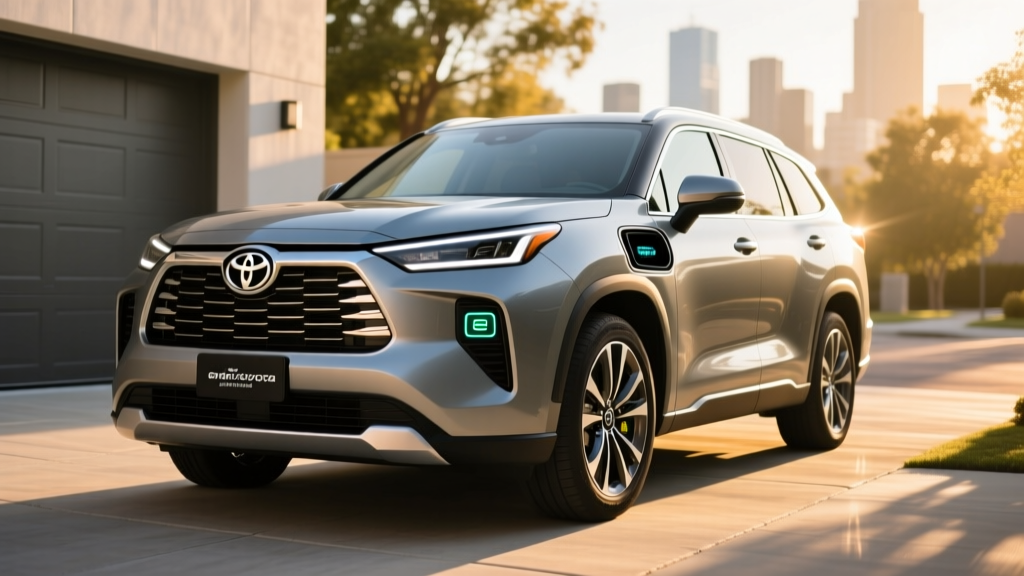
If you need three-row family hauling with the towing muscle of a V6 but refuse to swallow the fuel bills of a body-on-frame SUV, the 2026 Toyota Grand Highlander Hybrid MAX occupies a rare sweet spot. It pairs a turbocharged 2.4-liter four-cylinder with electric motors to deliver V6-rivaling output — 362 horsepower and 400 lb-ft of torque — while returning EPA estimates that embarrass many compact crossovers. This is the V6 hybrid alternative the midsize SUV segment has been waiting for.
Below, we break down everything a buyer needs: real-world MPG versus EPA stickers, the Hybrid versus Hybrid MAX trade-off, battery warranty coverage, tax-credit eligibility under current IRS §30D rules, and whether this three-row hauler makes more sense for your driveway than a full EV or a conventional gas SUV.
HEV vs PHEV: Where the Grand Highlander Fits
Before diving into specs, it is essential to distinguish the two hybrid architectures Toyota sells, because buyers frequently confuse them:
| Attribute | HEV (Grand Highlander Hybrid) | PHEV (e.g., RAV4 Prime) |
|---|---|---|
| Plug-in charging? | No — self-charging via regen & engine | Yes — plug in for electric-only miles |
| Battery size | ~1.4 kWh (small buffer) | 18–22 kWh typical |
| Electric-only range | <1 mile at low speed | 30–42 miles typical |
| Federal tax credit | Not eligible under §30D | Up to $7,500 if sourcing/income rules met |
| Best for | Drivers without home charging access | Drivers with home charging & short commutes |
The 2026 Grand Highlander is offered exclusively as a conventional hybrid (HEV). There is no plug-in variant in Toyota's current three-row lineup. If you need PHEV electric-only commuting in a Toyota, you would look at the RAV4 Prime or the Prius Prime — neither of which offers three rows.
Powertrain Specs: The V6 Hybrid Replacement
Toyota offers two hybrid powertrains in the Grand Highlander for 2026. The standard Hybrid uses a 2.5-liter naturally aspirated four-cylinder paired with front and rear electric motors. The Hybrid MAX — the performance-oriented V6 hybrid substitute — swaps in a turbocharged 2.4-liter inline-four with a more powerful electric assist and a six-speed automatic transmission instead of the eCVT found in the standard Hybrid.
| Spec | Hybrid (2.5L) | Hybrid MAX (2.4L Turbo) |
|---|---|---|
| Engine | 2.5L I4 + 2 electric motors | 2.4L turbo I4 + electric motor |
| Combined horsepower | 245 HP | 362 HP |
| Combined torque | 176 lb-ft (engine) | 400 lb-ft |
| Transmission | eCVT | 6-speed automatic |
| Drivetrain | AWD (e-motor rear axle) | AWD (e-motor rear axle) |
| 0–60 mph | ~7.6 seconds | ~5.6 seconds |
| Towing capacity | 3,500 lbs | 5,000 lbs |
| Battery type | Nickel-metal hydride / Li-ion | Lithium-ion |
| Battery capacity | ~1.4 kWh (buffer) | ~1.4 kWh (buffer) |
The Hybrid MAX is the clear V6 hybrid replacement. Its 362 HP and 400 lb-ft of torque exceed what Toyota's retired 3.5-liter V6 produced in the previous-generation Highlander (295 HP / 263 lb-ft), while delivering substantially better fuel economy. The 5,000-pound towing capacity also matches what most V6 midsize SUVs offer, making this viable for boat or camper trailers.
Fuel Economy: EPA Estimates vs Real-World MPG
Here is where the Grand Highlander Hybrid earns its keep. Both powertrains post numbers that defy the vehicle's 4,700-pound curb weight.
| Powertrain | City MPG | Highway MPG | Combined MPG |
|---|---|---|---|
| Hybrid (2.5L) AWD | 36 | 32 | 34 |
| Hybrid MAX AWD | 27 | 28 | 27 |
Data sourced from fueleconomy.gov.
The standard 2.5L Hybrid's 34 MPG combined is achievable in mixed suburban driving. In city-heavy routes with frequent stops, Toyota's hybrid system excels — expect 36–38 MPG because regenerative braking does the heavy lifting. On sustained highway trips at 75+ mph, plan for 30–31 MPG as aerodynamic drag overwhelms the electric assist. In cold weather (below 30°F), the engine runs more often for cabin heat, dropping observed economy to roughly 30–32 MPG combined until the powertrain reaches operating temperature.
The Hybrid MAX trades some efficiency for performance. Real-world mixed driving typically yields 25–27 MPG. Highway cruising nets around 26–28 MPG. City driving with aggressive throttle input can dip to 22–23 MPG. If your priority is maximum fuel savings over acceleration, the standard Hybrid is the clear winner.
How Far Can It Go on a Tank?
With a 17.9-gallon fuel tank, the range math is straightforward:
- Hybrid (2.5L): 17.9 gal × 34 MPG combined = ~608 miles per tank (real-world: 540–620 mi depending on conditions)
- Hybrid MAX: 17.9 gal × 27 MPG combined = ~483 miles per tank (real-world: 430–490 mi)
Neither powertrain offers electric-only driving beyond trivial low-speed maneuvers in a parking lot. This is a self-charging hybrid — there is no plug, no electric-only commute mode, and no kWh to manage. You simply fill up with gasoline and drive.
Battery Warranty, Reliability, and Replacement Cost
- Coverage: 10 years / 150,000 miles (whichever comes first)
- What's covered: Hybrid battery pack, hybrid control module, inverter
- Applies to: All 50 states (California-emissions states get identical hybrid battery coverage as of 2020+)
Toyota's hybrid battery track record is among the strongest in the industry. The Prius, now in its fifth generation, has demonstrated hybrid battery packs routinely lasting 150,000–200,000+ miles before any degradation-related replacement is needed. The Grand Highlander's hybrid battery is far smaller than a full EV pack (~1.4 kWh usable vs. 70–100 kWh in a BEV), which means lower thermal stress and lower replacement cost.
Replacement cost if out of warranty: A Toyota hybrid battery replacement typically runs $2,000–$4,000 depending on the specific pack and labor rates. Refurbished or reconditioned packs are available from third-party suppliers for $1,000–$2,000. Compare this to a full EV battery replacement at $10,000–$20,000+, and the hybrid's long-term risk profile looks considerably more manageable.
The hybrid system itself — the eCVT, electric motors, and power-control electronics — has proven remarkably durable across Toyota's lineup. Independent reliability surveys from Consumer Reports consistently rank Toyota hybrids among the most dependable powertrains on the market.
Pricing and Tax Credit Eligibility
The 2026 Grand Highlander Hybrid starts at approximately $46,000 MSRP for the XLE trim and climbs to roughly $58,000 for a fully loaded Hybrid MAX Platinum. Destination charges add approximately $1,350.
| Trim | Powertrain | Approx. MSRP |
|---|---|---|
| XLE | Hybrid (2.5L) | $46,000 |
| Limited | Hybrid (2.5L) | $50,500 |
| Limited MAX | Hybrid MAX | $53,000 |
| Platinum MAX | Hybrid MAX | $58,000 |
Federal tax credit status: The Grand Highlander Hybrid does not qualify for the IRS §30D Clean Vehicle Credit. That credit applies only to plug-in electric vehicles (BEVs and PHEVs) with battery capacities of at least 7 kWh and meeting critical-mineral and battery-component sourcing requirements. Because the Grand Highlander Hybrid is a conventional HEV with a sub-2 kWh battery and no plug, it is ineligible.
There is currently no federal tax credit specifically for conventional hybrids. Some states or local utilities may offer minor rebates for hybrid purchases — check your state energy office or utility provider for current programs. Toyota's official Grand Highlander Hybrid page lists any active incentive programs by region.
Who Should Choose This V6 Hybrid vs a Full EV or Gas SUV?
Choose the Grand Highlander Hybrid if:
- You need three rows and 34+ MPG combined without plugging in
- You lack reliable home or workplace charging access
- You tow up to 3,500–5,000 lbs and cannot risk EV range loss under load
- You want proven Toyota hybrid reliability with a 10-year battery warranty
- Road trips into charging-desert regions (rural West, parts of the Midwest) are routine
Choose a full EV (e.g., Kia EV9, Rivian R1S) if:
- You have Level 2 home charging and want $0 gasoline spend
- Your daily driving is under 250 miles and you want 300+ miles of range
- You want the $7,500 federal tax credit (subject to IRS §30D eligibility rules)
- You prioritize instant torque, one-pedal driving, and lower maintenance costs
Choose a conventional gas V6 SUV (e.g., Mazda CX-90, VW Atlas) if:
- Upfront purchase price is your primary constraint (gas models start $8,000–$12,000 lower)
- You drive fewer than 8,000 miles per year, minimizing the hybrid fuel-cost payback
- You prefer a traditional powertrain with no hybrid-system complexity
For the specific buyer who wants V6-class power and towing in a three-row package but drives 15,000+ miles per year, the Grand Highlander Hybrid MAX pays for its price premium over a gas-only competitor within roughly four to five years through fuel savings alone. At 15,000 miles annually and $3.40/gallon, the difference between 20 MPG (a typical gas V6 three-row) and 27 MPG (Hybrid MAX) saves approximately $1,330 per year in fuel costs.
Pros and Cons
- 34 MPG combined (2.5L Hybrid) in a 4,700-lb three-row SUV
- Hybrid MAX delivers 362 HP and 5,000-lb towing — genuine V6 replacement
- No plug-in required — works for apartment dwellers and street parkers
- 10-year / 150,000-mile hybrid battery warranty
- Proven Toyota hybrid reliability with low long-term battery replacement cost
- 600+ miles of real-world range per tank (standard Hybrid)
- No federal tax credit eligibility (HEV, not PHEV)
- Hybrid MAX drops to 27 MPG combined — meaningful gap vs standard Hybrid
- $46,000+ starting price is steep for the segment
- No electric-only driving mode — all miles burn some gasoline
- Third row is tight for adults on long trips
- eCVT in the standard Hybrid can drone under hard acceleration
Frequently Asked Questions
How many MPG does the Grand Highlander V6 Hybrid get?
The standard 2.5L Hybrid achieves an EPA-estimated 36 city / 32 highway / 34 combined MPG. The Hybrid MAX, which provides V6-class performance, is rated at 27 city / 28 highway / 27 combined. Real-world city driving in the standard Hybrid often exceeds the EPA city estimate due to aggressive regenerative braking in stop-and-go traffic.
Does the Grand Highlander Hybrid need to be plugged in?
No. The Grand Highlander Hybrid is a conventional hybrid (HEV). It charges its small battery pack through regenerative braking and the gasoline engine. There is no charging port, no plug, and no electric-only commute range to manage. You refuel with gasoline like any other car.
Is the Grand Highlander Hybrid reliable, and what does battery replacement cost?
Toyota's hybrid systems have a two-decade track record of exceptional durability. The hybrid battery is covered for 10 years or 150,000 miles. If replacement is needed out of warranty, expect to pay $2,000–$4,000 for a new pack, or $1,000–$2,000 for a refurbished unit — a fraction of full EV battery replacement costs.
Does the Grand Highlander Hybrid qualify for any tax credit?
No. The IRS §30D Clean Vehicle Credit applies only to plug-in vehicles (BEVs and PHEVs) with at least 7 kWh of battery capacity. The Grand Highlander Hybrid's sub-2 kWh battery and lack of a plug make it ineligible for the federal credit. Check your state energy office for any local hybrid rebate programs.
Hybrid vs PHEV vs EV — which is right for a three-row family SUV?
If you have home Level 2 charging, drive under 250 miles daily, and want the lowest per-mile cost, a three-row EV like the Kia EV9 (379 miles EPA, eligible for §30D credit) makes sense. If you want electric-only commuting with gas backup for road trips but only need two rows, a PHEV like the RAV4 Prime (42 miles electric-only) works. If you need three rows, tow regularly, lack home charging, or frequently drive into areas with sparse charging infrastructure, the Grand Highlander Hybrid is the most practical electrified option currently available.
Can the Hybrid MAX really replace a V6 for towing?
Yes, within its rated capacity. The Hybrid MAX produces 400 lb-ft of torque — more than most naturally aspirated V6 engines in this class — and carries a 5,000-pound tow rating. That covers most boat trailers, small campers, and utility trailers. Note that towing will reduce fuel economy significantly, likely into the 17–20 MPG range depending on trailer weight and terrain.