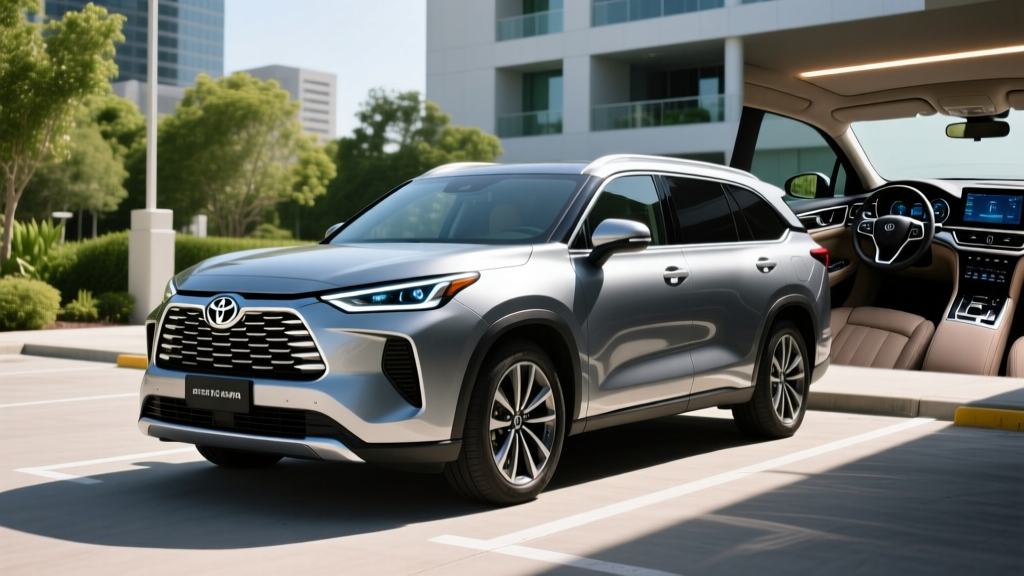
The Toyota Grand Highlander Hybrid occupies a narrow but valuable lane: a three-row family hauler that sips fuel without requiring a plug, a charging routine, or any change in daily habits. For buyers weighing this SUV against a full EV or a conventional gas three-row, the question isn't whether it's electrified — it's whether Toyota's hybrid system delivers enough efficiency gain to justify the price premium over the gas-only Grand Highlander, and how it stacks up against plug-in rivals like the Kia Sorento PHEV.
This 2026 Toyota Grand Highlander Hybrid review breaks down every number that matters: EPA fuel economy by trim, the Hybrid MAX performance variant, real-world MPG expectations, warranty coverage, tax-credit eligibility, and who should actually buy this over a battery-electric alternative.
HEV vs PHEV: What the Grand Highlander Hybrid Actually Is
The Grand Highlander Hybrid is a conventional hybrid electric vehicle (HEV). It pairs a gasoline engine with electric motors and a small battery that recharges through regenerative braking and engine operation. You never plug it in. There is no electric-only driving range to manage, no home charger to install, and no range anxiety in cold weather.
| Feature | Grand Highlander Hybrid (HEV) | Plug-In Hybrid (e.g., Sorento PHEV) | Battery Electric (e.g., EV9) |
|---|---|---|---|
| Plug-in required? | No | Yes (Level 1 or 2) | Yes (Level 2 recommended) |
| Electric-only range | None (EV mode is low-speed, short distance) | ~30–35 miles | 250–300+ miles |
| Battery size | ~1.4 kWh (self-charging buffer) | ~13.8 kWh usable | 77–100+ kWh |
| Home charger needed? | No | Recommended | Essential |
| Federal tax credit (§30D) | Not eligible | Up to $7,500 (if sourcing/income/MSRP rules met) | Up to $7,500 (if sourcing/income/MSRP rules met) |
This distinction matters because many shoppers conflate "hybrid" with "plug-in." The Grand Highlander Hybrid recovers energy you'd otherwise waste as heat during braking and uses it to assist the engine or power low-speed crawling. The result is dramatically better city fuel economy with zero behavioral change.
Fuel Economy: EPA Ratings and Real-World MPG
The Grand Highlander Hybrid comes in two distinct powertrain flavors, and the fuel economy difference between them is significant.
| Powertrain | Drivetrain | EPA City | EPA Highway | EPA Combined |
|---|---|---|---|---|
| 2.5L 4-cyl Hybrid | FWD | 37 MPG | 34 MPG | 36 MPG |
| 2.5L 4-cyl Hybrid | AWD (eAWD) | 36 MPG | 32 MPG | 34 MPG |
| Hybrid MAX (2.4L turbo) | AWD | 27 MPG | 28 MPG | 27 MPG |
Source: fueleconomy.gov — verify exact figures for your model year and trim, as EPA ratings can shift slightly with equipment changes.
Real-World MPG: What Owners Actually See
The standard 2.5L hybrid system is one of the rare powertrains where real-world city driving often matches or exceeds the EPA city estimate. Toyota's hybrid synergy drive excels in stop-and-go traffic, where the electric motor handles launches and the engine operates only at its most efficient RPM range. Owners reporting on fuel-tracking platforms consistently log 34–38 MPG in mixed suburban driving with the FWD powertrain.
Highway driving tells a different story. At sustained 75–80 MPH speeds, aerodynamic drag dominates, and the hybrid system's advantages diminish. Expect 30–32 MPG on flat interstate runs with the AWD model, dropping to 28–29 MPG in mountainous terrain or when fully loaded with passengers and cargo. Cold weather (below 30°F) reduces fuel economy by roughly 5–8% as the engine runs longer to heat the cabin and bring the catalytic converter to operating temperature.
The Hybrid MAX, tuned for 362 combined horsepower, sacrifices efficiency for acceleration. Real-world mixed driving lands in the 24–26 MPG range. It's still better than the non-hybrid turbo Grand Highlander, but the gap narrows considerably.
Powertrain Specs: Two Very Different Hybrids
| Specification | 2.5L Hybrid | Hybrid MAX (2.4L Turbo) |
|---|---|---|
| Engine | 2.5L inline-4 Atkinson cycle | 2.4L turbocharged inline-4 |
| Combined system horsepower | 245 HP | 362 HP |
| Combined system torque | 175 lb-ft (engine) + motor torque | 400 lb-ft |
| Transmission | eCVT (planetary gearset) | 6-speed automatic |
| Drivetrain | FWD or eAWD (rear motor) | AWD standard (mechanical + rear motor) |
| 0–60 MPH (est.) | ~7.8 seconds | ~5.8 seconds |
| Towing capacity | 3,500 lbs | 5,000 lbs |
| Hybrid battery | ~1.4 kWh NiMH / Li-ion (model-year dependent) | ~1.4 kWh Li-ion |
The eAWD system on the standard hybrid uses a separate rear-mounted electric motor (no mechanical driveshaft) that engages on acceleration and low-traction surfaces. It's not a rock-crawling system, but it handles snow, rain, and light gravel confidently. The Hybrid MAX uses a more robust AWD setup with a mechanical rear connection supplemented by the electric motor, giving it genuine towing and passing authority.
Pricing, Trims, and Tax-Credit Eligibility
The 2026 Grand Highlander Hybrid lineup spans from the LE base trim to the Platinum and Hybrid MAX Limited trims. Pricing reflects Toyota's positioning of this as a premium family vehicle:
- Hybrid LE (FWD): ~$45,000 MSRP
- Hybrid XLE (AWD): ~$48,500 MSRP
- Hybrid Limited (AWD): ~$53,000 MSRP
- Hybrid MAX Limited (AWD): ~$58,000+ MSRP
Pricing is approximate and subject to destination charges, dealer adjustments, and model-year revisions. Confirm with Toyota's official configurator.
Federal Tax Credit: The Hard Truth
The Grand Highlander Hybrid does NOT qualify for the §30D federal clean vehicle tax credit. Under current IRS rules, the §30D credit applies only to plug-in electric vehicles (BEVs and PHEVs) that meet battery-sourcing, critical-mineral, MSRP cap, and buyer income requirements. Conventional hybrids like this one are excluded regardless of price or efficiency.
Some states offer separate hybrid incentives or rebates, but these are uncommon and vary by jurisdiction. Check your state's energy office or department of environmental quality for current programs. A tax professional can confirm whether any local incentives apply to your purchase.
Reliability and Battery Warranty: What to Expect
Toyota's hybrid systems have an extensive track record — the company has sold over 25 million hybrids globally since the Prius launched in 1997. The Grand Highlander uses a mature, well-proven hybrid architecture shared across the Toyota/Lexus lineup.
| Coverage | Duration |
|---|---|
| Hybrid battery warranty | 10 years / 150,000 miles (whichever comes first) |
| Hybrid system components | 8 years / 100,000 miles |
| Powertrain warranty (engine, transmission) | 5 years / 60,000 miles |
| Basic bumper-to-bumper | 3 years / 36,000 miles |
Source: Toyota's official warranty guide. Confirm specifics for your model year, as terms can be updated annually.
Hybrid Battery Replacement Cost
If the hybrid battery fails outside warranty coverage, replacement cost typically ranges from $2,000 to $4,000 depending on whether you use a new OEM pack, a refurbished unit, or an independent hybrid specialist. Given the 10-year/150,000-mile warranty and Toyota's demonstrated battery longevity (many Prius and Camry Hybrid packs last 200,000+ miles with minimal degradation), out-of-pocket replacement during typical ownership is uncommon.
The hybrid battery in this vehicle is small (~1.4 kWh) and operates within a narrow state-of-charge window managed by the vehicle's computer. Unlike a full EV battery, it's never deeply discharged or charged to 100%, which significantly extends cycle life. Degradation manifests as slightly reduced fuel economy over many years, not sudden failure.
Who Should Buy the Grand Highlander Hybrid?
Choose the Grand Highlander Hybrid if:
- You need three rows and cargo space but want to minimize fuel costs without changing your routine
- You live in an apartment or lack home-charging access, making a PHEV or EV impractical
- You drive primarily in city/suburban traffic where hybrid efficiency shines (36+ MPG)
- You plan to own the vehicle 8–12 years and value Toyota's reliability reputation
- You tow occasionally (3,500 lbs standard hybrid; 5,000 lbs Hybrid MAX)
Look at a PHEV or full EV instead if:
- You have home Level 2 charging and a short commute — a PHEV like the Sorento PHEV can run purely on electricity for daily driving
- You want to access HOV lanes, state EV rebates, or the federal §30D tax credit (up to $7,500 for qualifying plug-in vehicles)
- You drive fewer than 30 miles daily and want zero tailpipe emissions on most trips
- You're ready for a full EV like the Kia EV9 or Tesla Model X and have reliable charging access
The Grand Highlander Hybrid's competitive advantage is frictionless efficiency. You fuel it like any gas car, maintain it on standard intervals (oil changes every 10,000 miles with synthetic), and gain 8–10 MPG over the non-hybrid Grand Highlander without a single compromise in seating, cargo, or drivability.
Pros and Cons at a Glance
Pros
- 36 MPG combined (FWD) in a genuine three-row SUV with adult-capable third row
- No plug-in required — zero infrastructure or behavioral change
- 10-year/150,000-mile hybrid battery warranty
- Hybrid MAX variant offers 362 HP and 5,000-lb towing for buyers who need power
- Strong resale value trajectory consistent with Toyota hybrid models
- Standard Toyota Safety Sense 3.0 suite (pre-collision, lane tracing, adaptive cruise)
Cons
- No federal tax credit eligibility — the §30D credit requires a plug
- Hybrid MAX drops to 27 MPG combined, narrowing the efficiency advantage
- Starting price ~$45,000 is a significant premium over non-hybrid three-row competitors
- eAWD rear motor provides traction, not off-road capability
- Third row is usable but not class-leading in legroom compared to minivans
- No DC fast charging capability (not applicable to HEVs, but relevant if comparing to PHEVs)
Grand Highlander Hybrid vs. the Alternatives
The competitive set depends on what you prioritize:
- vs. Gas-only Grand Highlander (2.4L turbo): The hybrid adds ~$2,500–$3,000 in MSRP but saves roughly $500–$700/year in fuel at 15,000 miles driven annually (assuming $3.50/gallon). Payback takes 4–6 years. If you keep the vehicle longer, the hybrid wins on total cost.
- vs. Kia Sorento PHEV: The Sorento PHEV offers ~32 miles of electric-only range and qualifies for up to $7,500 in federal tax credits (subject to IRS §30D sourcing and income rules). However, it's smaller — the third row is tight for adults, and cargo space behind the third row is limited. The Sorento PHEV also requires home charging to realize its efficiency advantage.
- vs. Toyota Sienna (hybrid minivan): The Sienna is hybrid-only and achieves 36 MPG combined with far more cargo volume and third-row comfort. If you don't need SUV styling or ground clearance, the Sienna is the more practical family vehicle at a similar price point.
- vs. Kia EV9 (full EV): The EV9 offers three rows, ~300 miles of EPA range, and DC fast charging up to 236 kW. It qualifies for the federal tax credit and eliminates fuel costs entirely. But it starts around $55,000, requires home charging infrastructure ($500–$2,000 for Level 2 installation), and demands route planning on road trips beyond 250 miles.
Frequently Asked Questions
How many MPG does the Grand Highlander Hybrid get?
The FWD 2.5L Hybrid achieves an EPA-estimated 37 city / 34 highway / 36 combined MPG. The AWD version drops slightly to 36/32/34 MPG. The Hybrid MAX variant, which prioritizes performance with 362 HP, returns 27 MPG combined. Real-world city driving with the standard hybrid often matches or exceeds the EPA city figure; highway driving at 75+ MPH typically yields 30–32 MPG.
Does the Grand Highlander Hybrid need to be plugged in?
No. This is a conventional hybrid (HEV), not a plug-in hybrid (PHEV). The small hybrid battery recharges automatically through regenerative braking and engine operation. You fuel it exclusively at gas stations.
How far can it go on electric only?
The Grand Highlander Hybrid cannot drive on electric power alone at meaningful speeds or distances. It uses EV mode for very low-speed crawling (parking lots, traffic creep) for roughly a mile or less before the engine engages. If electric-only commuting is a priority, you need a PHEV or a full BEV.
Is the hybrid battery reliable and what does replacement cost?
Toyota's hybrid batteries are among the most proven in the industry, with millions of units operating well past 150,000 miles. The Grand Highlander Hybrid's battery is covered by a 10-year/150,000-mile warranty. Out-of-warranty replacement typically costs $2,000–$4,000, though the need for replacement during normal ownership windows is uncommon given the narrow state-of-charge operating window that preserves battery health.
Does the Grand Highlander Hybrid qualify for any tax credit?
It does not qualify for the federal §30D clean vehicle credit, which is reserved for plug-in vehicles (BEVs and PHEVs) meeting battery-sourcing, MSRP, and buyer-income requirements. Some states may offer separate hybrid incentives — check your state energy office. A tax professional can confirm eligibility for any local programs.
Hybrid vs PHEV vs EV — which is right for me?
Choose the Grand Highlander Hybrid (HEV) if you want better fuel economy with zero routine changes and no charging access. Choose a PHEV if you have home charging, a short commute, and want electric-only daily driving with gas-engine backup for road trips — plus potential federal tax credits. Choose a full EV if you have reliable home charging, want zero tailpipe emissions, and are comfortable planning charging stops on longer trips.
How does the Hybrid MAX compare to the standard hybrid?
The Hybrid MAX swaps the 2.5L naturally aspirated engine for a 2.4L turbocharged unit, raising output to 362 HP and 400 lb-ft of torque. Towing capacity jumps from 3,500 to 5,000 lbs, and 0–60 drops to roughly 5.8 seconds. The tradeoff is fuel economy: 27 MPG combined versus 34–36 MPG. It's available only in higher trims with AWD and starts near $58,000.