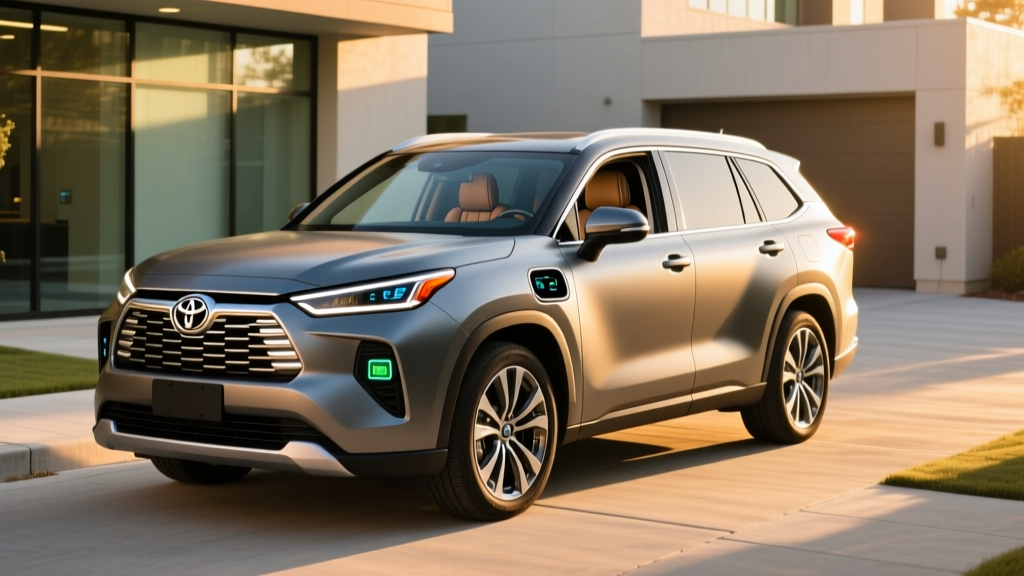
The 2024 Toyota Grand Highlander Hybrid Limited sits at a crossroads that many three-row SUV buyers face: you want the cargo space and passenger room of a full-size family hauler, but you don't want to burn through $300 a month in fuel. The Grand Highlander Hybrid delivers on that promise with an EPA-rated 35 MPG combined — a figure that would have seemed impossible for a vehicle this size just five years ago. But how does it stack up against plug-in hybrid alternatives and full battery-electric SUVs? And does the Limited trim justify its premium? This guide breaks down every spec that matters.
HEV vs PHEV: What the Grand Highlander Hybrid Actually Is
Before examining the numbers, it's critical to understand what you're buying. The Grand Highlander Hybrid is a conventional hybrid electric vehicle (HEV). It does not plug in. It has no electric-only driving range. It charges its own small battery through regenerative braking and the gasoline engine. You fuel it exactly like a gas car — at the pump — and the hybrid system works behind the scenes to slash consumption.
This is fundamentally different from a plug-in hybrid (PHEV) like the Toyota RAV4 Prime or the Chrysler Pacifica Hybrid, which carry larger batteries (typically 15-20 kWh), offer 30-45 miles of electric-only range, and must be plugged into a wall outlet or charger to access those benefits.
HEV vs PHEV: Key Differences at a Glance
| Feature | HEV (Grand Highlander Hybrid) | PHEV (e.g., RAV4 Prime) |
|---|---|---|
| Plugs in? | No | Yes (Level 1/2) |
| Electric-only range | 0 miles (EV mode limited to ~1 mi at low speed) | 30-42 miles typical |
| Battery size | ~1.6 kWh (nickel-metal hydride) | 18.1 kWh (lithium-ion) |
| Federal tax credit | Not eligible | Up to $7,500 (§30D, if eligible) |
| Fueling | Gas pump only | Gas pump + electric outlet/charger |
Fuel Economy: EPA Ratings and Real-World MPG
The 2024 Grand Highlander Hybrid uses Toyota's fourth-generation hybrid system paired with a 2.5-liter inline-four engine. The Limited trim comes exclusively with all-wheel drive (AWD), which slightly affects efficiency compared to the FWD-only lower trims.
| Metric | EPA Rating | Real-World Expectation |
|---|---|---|
| City | 36 MPG | 37-40 MPG (hybrids excel in stop-and-go) |
| Highway | 32 MPG | 29-31 MPG (aerodynamic drag at 70+ mph) |
| Combined | 35 MPG | 33-37 MPG depending on driving mix |
According to fueleconomy.gov, the AWD Grand Highlander Hybrid achieves 36 city / 32 highway / 35 combined. These are strong numbers for a three-row SUV with over 150 cubic feet of passenger volume.
Real-world note: Toyota hybrids consistently exceed their EPA city ratings in actual urban driving because regenerative braking recovers energy that gas cars waste as heat. Highway driving is where you'll see a slight shortfall — the Grand Highlander's boxy shape creates aerodynamic drag that the hybrid system can't fully offset at sustained 75-80 mph speeds. In cold weather (below 30°F), expect a 5-10% drop across the board as the engine runs more frequently to provide cabin heat.
Powertrain Specs: What's Under the Hood
| Specification | 2024 Grand Highlander Hybrid Limited (AWD) |
|---|---|
| Engine | 2.5L DOHC 4-cylinder + 3 electric motors |
| Combined horsepower | 245 hp (net system output) |
| Transmission | eCVT (electronically controlled continuously variable) |
| Drivetrain | AWD (electronic rear motor, no mechanical driveshaft) |
| 0-60 mph | ~7.5 seconds (estimated) |
| Towing capacity | 3,500 lbs |
| Fuel tank | 17.1 gallons |
| Total range (est.) | ~598 miles per tank |
| Battery type | Nickel-metal hydride (NiMH), ~1.6 kWh |
| Cargo volume (behind 3rd/2nd/1st row) | 20.6 / 57.9 / 97.5 cu ft |
The 245-horsepower output isn't going to win drag races, but it's adequate for merging, passing, and hauling a full load of passengers and cargo. The eCVT provides seamless acceleration without the shift-shock of a traditional automatic. The electronic AWD system uses a dedicated rear electric motor — there's no mechanical driveshaft connecting the front and rear axles, which reduces weight and drivetrain losses.
One important distinction: the Grand Highlander also offers a Hybrid MAX powertrain on higher trims (not the Limited) that pairs a turbocharged 2.4L engine with a hybrid system for 362 hp, but that variant drops to 27 MPG combined. The standard hybrid on the Limited is the efficiency play.
Pricing and Tax Credit Eligibility
The 2024 Toyota Grand Highlander Hybrid Limited carries a starting MSRP of approximately $49,670 (including destination charge). Fully loaded with options like panoramic roof, premium audio, and advanced parking assist, expect to land in the $52,000-$54,000 range.
Federal Tax Credit: Not Eligible
The Grand Highlander Hybrid is a conventional HEV — it does not plug in. Under IRS §30D rules, only plug-in electric vehicles (BEVs and PHEVs with at least 7 kWh of battery capacity) qualify for the federal clean vehicle credit. This hybrid does not qualify for the $7,500 federal tax credit.
Some states offer their own hybrid incentives (e.g., California's CVRP previously included hybrids but has shifted focus to zero-emission vehicles). Check your state's energy office for current programs.
For comparison, the non-hybrid Grand Highlander gas model starts about $5,000 less but returns only 24 MPG combined (AWD). The hybrid premium pays for itself in roughly 4-5 years for a driver covering 15,000 miles annually at $3.50/gallon fuel prices.
Battery Warranty, Reliability, and Replacement Cost
Toyota Hybrid Battery Warranty
- Coverage: 10 years / 150,000 miles (whichever comes first)
- Applies to: Hybrid battery pack and all hybrid-system components (inverter, motors, control module)
- Transferable: Yes — transfers to subsequent owners automatically
- Capacity threshold: Toyota warrants against defects and abnormal loss of capacity; no specific SoH percentage published
Toyota's hybrid reliability track record is arguably the strongest in the industry. The Prius has been in production since 1997, and the hybrid synergy drive system in the Grand Highlander is a mature, well-proven architecture. The nickel-metal hydride (NiMH) battery chemistry used in Toyota's conventional hybrids is less energy-dense than lithium-ion but extremely durable — it tolerates thousands of shallow charge-discharge cycles without significant degradation.
Battery replacement cost: If the hybrid battery fails outside warranty, a replacement from Toyota runs approximately $3,000-$4,500 including labor. Third-party refurbished NiMH packs are available for $1,500-$2,500. However, based on historical data from millions of Toyota hybrids on the road, battery failure before 200,000 miles is uncommon. Many Prius taxis have exceeded 300,000 miles on the original hybrid battery.
The Grand Highlander earned an IIHS Top Safety Pick designation for the 2024 model year, reinforcing its family-hauler credentials.
Grand Highlander Hybrid vs PHEV vs Full EV: Which Fits You?
Choosing between a conventional hybrid, a plug-in hybrid, and a battery-electric SUV depends on your driving patterns, home charging access, and budget. Here's a practical decision framework:
Choose the Grand Highlander Hybrid (HEV) If:
- You have no access to home or workplace charging (apartment, street parking)
- You regularly take long road trips and don't want to plan around charging stops
- You want three rows and strong cargo volume with minimal complexity
- You prefer the lowest upfront cost among electrified three-row options
Choose a PHEV (e.g., Toyota Sienna PHEV if available, Kia Sorento PHEV) If:
- You can install a Level 2 charger at home and your daily commute is under 35 miles
- You want to drive mostly on electricity during the week but need gas flexibility for weekends
- You want to reduce fuel consumption by 60-80% without range anxiety
Choose a Full BEV (e.g., Kia EV9, Tesla Model X) If:
- You have reliable home Level 2 charging
- Your typical trips are under 250 miles, or you're comfortable with DC fast-charging stops
- You want zero tailpipe emissions and the lowest per-mile fuel cost (~$0.04-$0.06/mi on home electricity)
- You want to claim the $7,500 federal tax credit (subject to IRS eligibility rules)
For three-row SUV buyers in 2024, the full-EV options remain limited and expensive. The Kia EV9 starts around $55,000 and the Tesla Model X above $80,000. The Grand Highlander Hybrid Limited at ~$49,670 fills a practical middle ground: dramatically better fuel economy than a gas-only SUV, with none of the charging infrastructure requirements of a BEV.
Ownership Costs: Fuel Savings vs Gas-Only Grand Highlander
| Annual Cost (15,000 mi/yr, $3.50/gal) | Gas AWD (24 MPG) | Hybrid AWD (35 MPG) | Annual Savings |
|---|---|---|---|
| Fuel cost | $2,188 | $1,500 | $688/year |
| 5-year fuel cost | $10,938 | $7,500 | $3,438 |
The hybrid commands a roughly $5,000 premium over the gas AWD Grand Highlander at similar trim levels. At current fuel prices, the payback period is approximately 7 years. However, the hybrid also tends to hold its value better — Toyota hybrids consistently rank among the strongest resale performers in their segments.
Pros and Cons of the Grand Highlander Hybrid Limited
✅ Pros
- 35 MPG combined in a three-row SUV — class-leading efficiency
- 10-year/150,000-mile hybrid battery warranty
- Spacious third row and 97.5 cu ft max cargo volume
- No charging infrastructure needed — fuel at any gas station
- Proven Toyota hybrid reliability with decades of track record
- Standard AWD on Limited trim with electronic rear motor
❌ Cons
- No federal tax credit eligibility (HEV, not PHEV/BEV)
- 245 hp feels adequate but not quick for a 4,700-lb vehicle
- ~$5,000 price premium over the gas-only model
- Highway MPG drops below EPA estimate at sustained 75+ mph
- Cannot drive on electric power alone (except brief low-speed EV mode)
- Limited trim starts near $50K — options push it past $54K
Frequently Asked Questions
How many MPG does the 2024 Grand Highlander Hybrid Limited actually get?
The EPA rates it at 36 city / 32 highway / 35 combined. In real-world city driving, many owners report 37-40 MPG thanks to aggressive regenerative braking. Highway-only driving at 75+ mph typically yields 29-31 MPG. Cold weather reduces efficiency by roughly 5-10%.
Does the Grand Highlander Hybrid plug in?
No. It is a conventional hybrid (HEV), not a plug-in hybrid (PHEV). You never need to plug it in. The hybrid battery recharges through regenerative braking and the gasoline engine. There is no electric-only driving range beyond brief low-speed EV-mode crawling (under 1 mile at parking-lot speeds).
Does it qualify for any federal tax credit?
No. Under current IRS §30D rules, only plug-in vehicles with a battery capacity of at least 7 kWh qualify for the federal clean vehicle credit. The Grand Highlander Hybrid's ~1.6 kWh NiMH battery does not meet this threshold. No federal tax credit is available for conventional hybrids. Check your state for any local hybrid incentives.
How reliable is the Grand Highlander Hybrid, and what does a battery replacement cost?
Toyota's hybrid system is among the most reliable powertrains in the automotive industry, backed by a 10-year/150,000-mile hybrid component warranty. NiMH battery replacement runs $3,000-$4,500 at a dealer, or $1,500-$2,500 for a refurbished unit. Based on historical Toyota hybrid data, battery failure before 200,000 miles is rare.
Should I buy the hybrid or wait for a PHEV three-row SUV?
If you need a three-row SUV today and lack home charging, the Grand Highlander Hybrid is the best fuel-economy option available. If you have home Level 2 charging and your daily driving is under 35 miles, a PHEV like the Kia Sorento PHEV (266 hp, 32 miles electric-only range, eligible for partial federal credit) might save more fuel — but it sacrifices some cargo and third-row space. For maximum three-row EV range, the Kia EV9 (300 miles EPA, $7,500 credit eligible) is the BEV benchmark, but it starts above $55,000.
What is the towing capacity of the Grand Highlander Hybrid?
The hybrid powertrain supports up to 3,500 pounds of towing capacity — adequate for a small boat, motorcycle trailer, or lightweight camper. The Hybrid MAX variant (not available on the Limited trim) increases this to 5,000 lbs but sacrifices fuel economy.