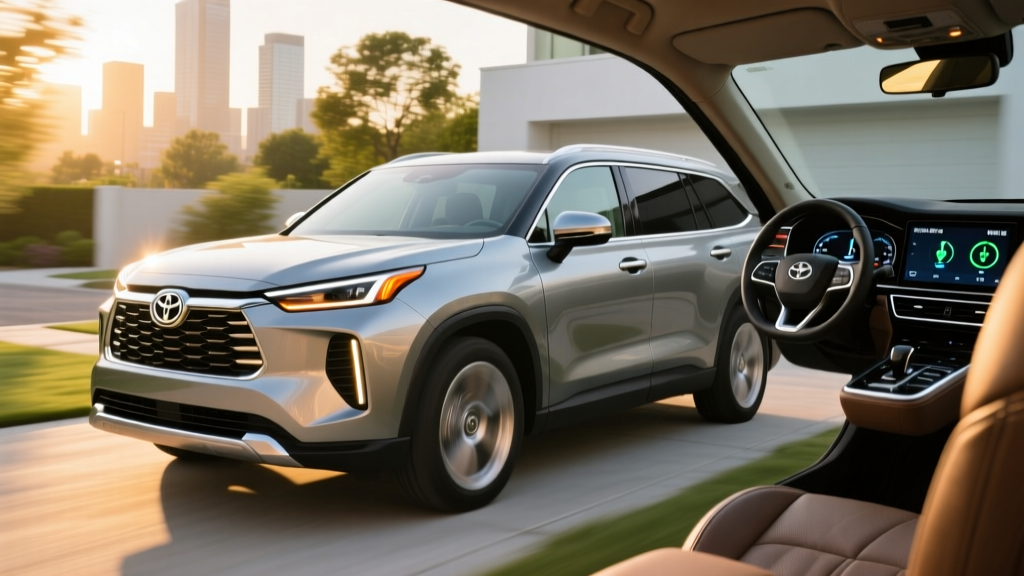
The 2026 Toyota Grand Highlander Hybrid remains one of the few three-row SUVs that pairs genuine family hauling capability with mid-30s fuel economy. Unlike the regular Highlander, the Grand Highlander stretches its wheelbase to unlock usable third-row space and cargo volume that actually accommodates adults and luggage simultaneously. For buyers weighing a three-row electrified vehicle against full EVs like the Kia EV9 or gas-only competitors like the Honda Pilot, the Grand Highlander Hybrid occupies a pragmatic middle ground: no plug required, no range anxiety, and a powertrain backed by one of the longest-running hybrid reliability track records in the industry.
This guide breaks down the 2026 Grand Highlander Hybrid's two distinct powertrains — the efficiency-focused standard Hybrid and the performance-oriented Hybrid MAX — along with real-world MPG expectations, ownership costs, battery longevity, and how it stacks up against plug-in hybrids and full EVs in the three-row segment.
Standard Hybrid vs. Hybrid MAX: Two Very Different Powertrains
Toyota offers the 2026 Grand Highlander Hybrid in two fundamentally different configurations. Understanding the distinction is critical because the powertrain you choose dictates not just performance, but fuel economy, drivetrain layout, and pricing.
| Specification | Standard Hybrid (HEV) | Hybrid MAX (HEV) |
|---|---|---|
| Engine | 2.5L 4-cylinder + 2 electric motors | 2.4L turbocharged 4-cyl + electric motor |
| Combined Horsepower | 245 hp | 362 hp |
| Drivetrain | AWD (electronic rear motor) | AWD (torque-vectoring rear motor) |
| Transmission | eCVT | 6-speed automatic |
| EPA City MPG | 36 | 26 |
| EPA Highway MPG | 32 | 27 |
| EPA Combined MPG | 34 | 27 |
| 0-60 mph (est.) | ~7.8 sec | ~5.6 sec |
| Towing Capacity | 3,500 lbs | 5,000 lbs |
| Requires Plug-In? | No | No |
The standard Hybrid uses Toyota's well-proven fourth-generation hybrid system: a 2.5-liter Atkinson-cycle four-cylinder paired with front and rear electric motors through an electronically controlled continuously variable transmission (eCVT). The rear motor provides electronic on-demand AWD without a mechanical driveshaft. This is the efficiency play — it sips fuel and delivers adequate acceleration for daily driving.
The Hybrid MAX swaps in a 2.4-liter turbocharged engine paired with a more powerful electric motor and a traditional 6-speed automatic transmission. The result is 362 combined horsepower and genuinely brisk acceleration, but fuel economy drops into the mid-20s. Think of it as Toyota's answer to buyers who want hybrid torque and AWD capability without sacrificing passing power. It's available exclusively on Limited and Platinum trims.
Real-World MPG: What to Actually Expect
The EPA rates the standard Grand Highlander Hybrid AWD at 36 city / 32 highway / 34 combined MPG. But hybrid fuel economy behaves differently than gas-only vehicles in real-world conditions, and the Grand Highlander's three-row, 4,700-pound curb weight influences where it excels and where it falls short.
| Driving Scenario | Expected MPG | Notes |
|---|---|---|
| City / stop-and-go | 35–38 MPG | Regenerative braking shines; often exceeds EPA city estimate |
| Suburban mixed | 33–36 MPG | Sweet spot for hybrid efficiency |
| Highway (70-75 mph) | 28–31 MPG | Aerodynamic drag and weight reduce electric-motor assist benefit |
| Cold weather (below 30°F) | 28–32 MPG combined | Engine runs more often for cabin heat; battery less efficient |
| Mountain / steep grades | 24–28 MPG uphill | Regen recovers significant energy on descents |
The key insight for hybrid buyers: city driving is where the Grand Highlander Hybrid earns its keep. The electric motors handle low-speed propulsion and regenerative braking recaptures energy that gas-only SUVs waste as heat. On a 200-mile highway road trip at 75 mph, expect the trip computer to read closer to 29-30 MPG. That's still excellent for a three-row SUV, but it's not the 34 MPG combined sticker figure.
For Hybrid MAX buyers, real-world fuel economy typically lands between 24-26 MPG in mixed driving. The turbocharged engine and performance tuning prioritize responsiveness over efficiency. If you choose Hybrid MAX, you're buying acceleration and towing capability — not maximum fuel savings.
HEV vs. PHEV vs. Full EV: Which Three-Row SUV Fits You?
The 2026 Grand Highlander Hybrid is a conventional hybrid (HEV). It generates its own electricity through regenerative braking and the gasoline engine — you never plug it in. Toyota does not currently offer a plug-in hybrid (PHEV) version of the Grand Highlander, which distinguishes it from competitors like the Jeep Grand Cherokee 4xe or the Mazda CX-90 PHEV.
| Factor | HEV (Grand Highlander Hybrid) | PHEV (e.g., CX-90 PHEV) | Full EV (e.g., Kia EV9) |
|---|---|---|---|
| Plug-in required? | No | Yes (for EV range) | Yes (always) |
| Electric-only range | None (EV assist only) | ~26 mi (CX-90) | 279–304 mi (EV9) |
| Home charging needed? | No | Recommended (Level 2) | Essential (Level 2) |
| Combined MPG / MPGe | 34 MPG | 25 MPG + 87 MPGe | 88 MPGe |
| Starting MSRP | $42,910 | $51,425 (CX-90) | $54,900 (EV9) |
| Federal tax credit | Not eligible (§30D) | Up to $7,500* | Up to $7,500* |
| Best for | No home charging, road trips | Short commutes + home charging | Home charging + daily driving |
*Tax credit eligibility subject to IRS §30D rules including buyer income caps, MSRP limits, and battery sourcing requirements. Verify at irs.gov.
The decision framework is straightforward:
- Choose the Grand Highlander Hybrid (HEV) if you lack reliable home charging access, frequently take long road trips, want maximum third-row and cargo space, and prioritize low running costs without lifestyle changes.
- Choose a PHEV three-row SUV if you have home Level 2 charging, a commute under 30 miles round-trip, and want electric-only daily driving with gas-engine backup for longer trips.
- Choose a full EV three-row SUV if you have home charging, want the lowest per-mile fuel cost, value instant torque and quiet operation, and your typical trips fall within the vehicle's range (or you're willing to plan DC fast-charging stops).
Pricing, Trims, and Tax Credit Eligibility
The 2026 Toyota Grand Highlander Hybrid starts at $42,910 for the LE trim (including destination charge) and tops out near $55,000 for the Hybrid MAX Platinum. Here's how the lineup breaks down:
| Trim | Powertrain | MSRP |
|---|---|---|
| LE | Standard Hybrid AWD | $42,910 |
| XLE | Standard Hybrid AWD | $45,660 |
| Limited | Standard Hybrid or Hybrid MAX | $50,555 / $53,090 |
| Platinum | Hybrid MAX AWD | $55,070 |
Federal tax credit status: The standard Grand Highlander Hybrid (HEV) does not qualify for the IRS §30D Clean Vehicle Credit. That credit applies exclusively to plug-in electric vehicles (BEVs and PHEVs) meeting specific battery sourcing, MSRP, and buyer income requirements. Conventional hybrids are ineligible regardless of price or efficiency.
Some states offer separate rebates or HOV lane access for hybrids, and certain utility companies provide incentives for any electrified vehicle. Check your state energy office and local utility for region-specific programs. A tax professional can confirm eligibility for any applicable credits.
Battery Warranty, Reliability, and Replacement Costs
Toyota Hybrid Battery Warranty
Coverage: 10 years / 150,000 miles (whichever comes first)
What's covered: Hybrid battery pack, hybrid control module, inverter, and related hybrid system components
Capacity threshold: Toyota warrants the battery against defects and abnormal degradation; there is no published minimum capacity retention percentage (unlike EV warranties that guarantee 70% SoH). If the hybrid system fails to function properly, Toyota replaces or repairs under warranty.
Transferable: Yes — warranty transfers to subsequent owners automatically
Toyota's hybrid system reliability is among the most thoroughly validated in the automotive industry. The Prius has accumulated over two decades of real-world data, and the core hybrid architecture in the Grand Highlander shares fundamental components with that lineage. The hybrid battery in a conventional Toyota HEV is relatively small (approximately 1.6 kWh nickel-metal hydride or lithium-ion, depending on model year) and operates within a narrow state-of-charge window — typically between 40% and 80%. This shallow cycling dramatically reduces degradation compared to full EV batteries that regularly cycle from 10% to 90%.
Real-world longevity data: Toyota hybrid batteries routinely last 150,000-200,000+ miles before requiring replacement. Taxi fleets using Toyota hybrids have logged 300,000+ miles on original battery packs. The 10-year/150,000-mile warranty provides substantial coverage, and out-of-warranty replacement costs for a Toyota hybrid battery typically range from $2,000 to $4,000 including labor — a fraction of EV battery replacement costs.
Reliability track record: Toyota consistently ranks at or near the top in IIHS safety ratings and long-term dependability studies. The Grand Highlander earned IIHS Top Safety Pick+ designation. The hybrid system adds complexity (electric motors, inverter, regenerative braking) but eliminates other failure points — there's no traditional starter motor, no alternator, and the eCVT has no physical gears or bands to wear.
Who Should Buy the 2026 Grand Highlander Hybrid?
Buy It If:
- You need three rows of seating with genuine adult-capable third-row space
- You lack access to home or workplace EV charging
- Your annual mileage is high (15,000+ miles) and fuel cost matters
- You want AWD capability without the fuel penalty of a traditional gas AWD SUV
- You prioritize long-term reliability and low maintenance costs
- You take regular road trips where charging infrastructure is sparse
Look Elsewhere If:
- You have home Level 2 charging and a short commute (a PHEV or EV saves more)
- You want electric-only driving for daily school runs or errands
- You need more than 5,000 lbs of towing capacity (Hybrid MAX maxes at 5,000 lbs)
- You want the instant acceleration of a full EV (the standard Hybrid is adequate, not quick)
- You qualify for the full $7,500 federal tax credit on a competing PHEV/EV and want to maximize incentives
Ownership Costs: 5-Year Projection
Comparing the Grand Highlander Hybrid against a gas-only three-row competitor reveals where the hybrid premium pays off. Using 15,000 miles/year, $3.50/gallon regular unleaded, and the EPA combined MPG figures:
| Vehicle | Combined MPG | Gallons Used | 5-Year Fuel Cost |
|---|---|---|---|
| Grand Highlander Hybrid AWD | 34 MPG | 2,206 gal | $7,721 |
| Gas-only 3-row SUV (22 MPG avg) | 22 MPG | 3,409 gal | $11,932 |
| Fuel savings (Hybrid) | — | — | $4,211 |
The ~$4,200 fuel savings over five years offsets a meaningful portion of the hybrid's price premium over gas-only alternatives. Factor in the hybrid's typically lower brake wear (regenerative braking reduces pad consumption) and Toyota's strong resale values, and the total cost of ownership becomes compelling for high-mileage families.
Frequently Asked Questions
How many MPG does the 2026 Grand Highlander Hybrid actually get?
The EPA rates the standard Hybrid AWD at 36 city / 32 highway / 34 combined MPG. In real-world driving, expect 35-38 MPG in city conditions, 28-31 MPG on the highway at 70-75 mph, and roughly 30-34 MPG in mixed suburban driving. The Hybrid MAX delivers significantly less — approximately 24-26 MPG combined in real-world use — but provides 362 hp and 5,000 lbs of towing capacity. Source: fueleconomy.gov.
Does the Grand Highlander Hybrid need to be plugged in?
No. The Grand Highlander Hybrid is a conventional hybrid (HEV), not a plug-in hybrid (PHEV). It charges its small battery through regenerative braking and the gasoline engine. You fuel it exactly like a gas-only vehicle. Toyota does not offer a PHEV variant of the Grand Highlander as of the 2026 model year.
Is the hybrid battery reliable and what does replacement cost?
Toyota's hybrid battery systems have an exceptional reliability record spanning 20+ years. The battery is covered by a 10-year/150,000-mile warranty. Real-world data shows Toyota hybrid batteries commonly lasting 150,000-200,000+ miles. Out-of-warranty replacement typically costs $2,000-$4,000 including labor — substantially less than EV battery replacement.
Does the Grand Highlander Hybrid qualify for any federal tax credit?
No. The IRS §30D Clean Vehicle Credit applies only to plug-in electric vehicles (BEVs and PHEVs). Conventional hybrids like the Grand Highlander Hybrid are not eligible for the federal credit regardless of price or efficiency. Some states and utilities offer separate hybrid incentives — check your local programs.
Hybrid vs. PHEV vs. EV — which three-row SUV should I choose?
Choose the Grand Highlander Hybrid (HEV) if you lack home charging, drive long distances regularly, or want maximum simplicity with no plug-in requirement. Choose a PHEV three-row SUV if you have home charging and a short daily commute you can cover on electric-only miles. Choose a full EV three-row SUV if you have reliable home charging, want the lowest per-mile cost, and your driving patterns fit within the vehicle's EPA range. For a detailed breakdown, see our HEV vs. PHEV vs. EV buying guide.
What's the difference between the standard Hybrid and Hybrid MAX?
The standard Hybrid (245 hp) prioritizes fuel efficiency with 34 MPG combined and a $42,910 starting price. The Hybrid MAX (362 hp) pairs a turbocharged 2.4L engine with a more powerful electric motor and 6-speed automatic for stronger acceleration, 5,000-lb towing, and 27 MPG combined — but starts at $53,090 on the Limited trim. The standard Hybrid uses an eCVT; the MAX uses a conventional automatic.
How does the Grand Highlander Hybrid compare to the regular Highlander Hybrid?
The Grand Highlander rides on a stretched wheelbase, adding approximately 6 inches of overall length. That translates to a genuinely usable third row (adults can sit comfortably for longer trips) and significantly more cargo volume behind the third row — 20.6 cu ft vs. the regular Highlander Hybrid's 16.1 cu ft. If you regularly carry six or seven passengers, the Grand Highlander is the more practical choice. The regular Highlander Hybrid is slightly lighter and marginally more efficient (35 MPG combined) but sacrifices interior space.