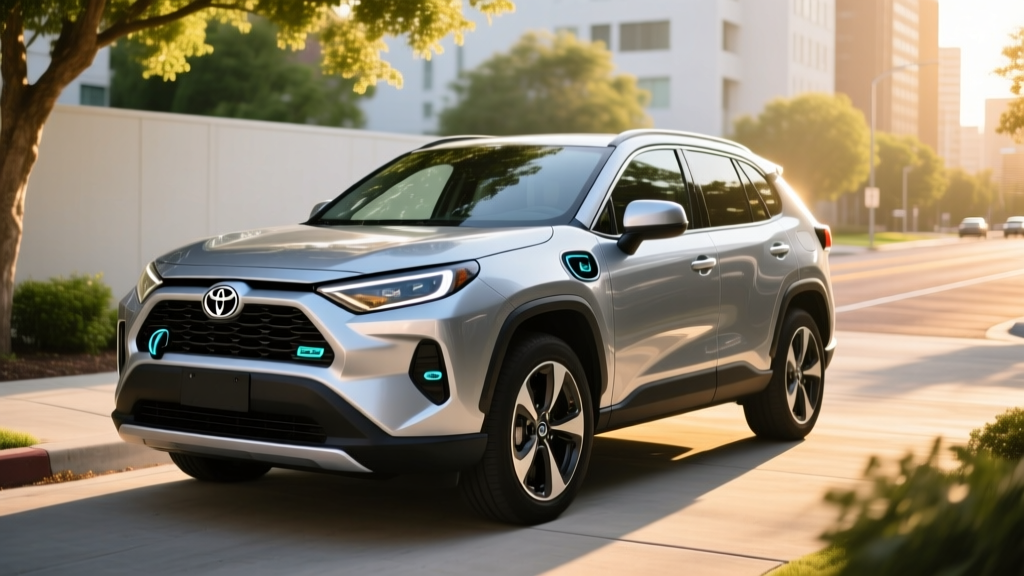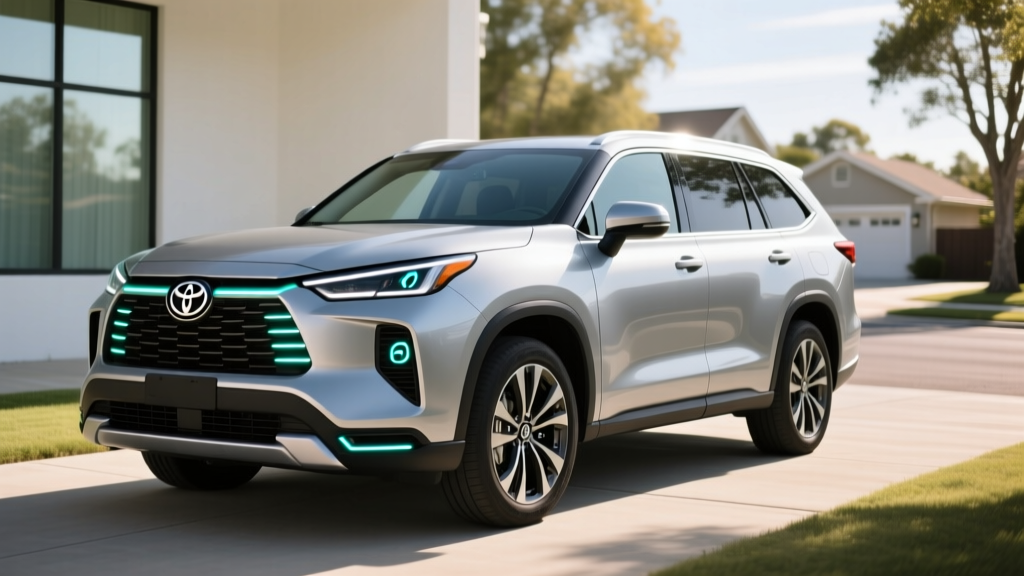
The 2025 Toyota Grand Highlander Hybrid targets families who need three usable rows of seating but want to keep fuel costs closer to a midsize sedan than a full-size SUV. Unlike a plug-in hybrid or battery-electric vehicle, this is a conventional hybrid (HEV) — meaning it charges its own battery through regenerative braking and the gas engine. You never plug it in.
Below, we cover every efficiency figure, powertrain detail, and ownership cost you need to evaluate whether this is the right electrified family hauler for your driveway — or whether a PHEV or full EV better fits your routine.
HEV vs PHEV: What the Grand Highlander Hybrid Actually Is
Toyota offers the Grand Highlander in two hybrid flavors for 2025, and confusing them is the most common buyer mistake:
Hybrid (HEV) — Standard Hybrid & Hybrid MAX
- No plug required — the battery self-charges via regen and engine
- No electric-only driving range — motor assists the gas engine at all times
- 34–36 MPG combined depending on powertrain and drivetrain
- No federal tax credit under §30D (new clean vehicle credit requires plug-in capability)
Plug-In Hybrid (PHEV) — Not Offered for 2025
- Toyota does not offer a Grand Highlander PHEV variant for the 2025 model year
- The smaller RAV4 Prime and Prius Prime are Toyota's current PHEV options
- If a Grand Highlander PHEV arrives in future model years, expect ~30–40 miles of electric-only range and §30D credit eligibility
Bottom line: The 2025 Grand Highlander Hybrid is a self-charging HEV. If you're looking for plug-in electric-only commuting, this isn't the vehicle — and no PHEV variant exists in the current lineup.
Fuel Economy: EPA MPG and Real-World Numbers
The 2025 Grand Highlander Hybrid comes with two distinct powertrains, each with different efficiency profiles. Here's the complete EPA data from fueleconomy.gov:
| Powertrain | Drivetrain | City MPG | Highway MPG | Combined MPG |
|---|---|---|---|---|
| Hybrid (2.5L 4-cyl) | FWD | 37 | 34 | 36 |
| Hybrid (2.5L 4-cyl) | AWD (Electronic) | 36 | 32 | 34 |
| Hybrid MAX (2.4L Turbo) | AWD | 26 | 27 | 27 |
Real-World MPG: What to Actually Expect
The standard Hybrid powertrain with FWD is the efficiency star here. In mixed real-world driving, Toyota's hybrid system tends to match or slightly exceed EPA city figures because regenerative braking recaptures more energy in stop-and-go traffic. Expect:
- City/suburban driving: 35–38 MPG (regen-heavy routes favor hybrids)
- Highway cruising at 70+ mph: 30–33 MPG (aerodynamic drag dominates; hybrids lose their city advantage)
- Cold weather (below 32°F): 28–32 MPG combined (engine runs more to heat the cabin and warm the catalytic converter)
- Hybrid MAX: 24–27 MPG real-world — this is a performance-oriented turbo hybrid, not an efficiency play
For a three-row SUV weighing over 4,500 lbs, the standard Hybrid's 36 MPG combined is exceptional. A comparable gas-only midsize SUV averages 21–24 MPG combined — the hybrid cuts fuel consumption by roughly 35–40%.
Powertrain Specs: Two Hybrid Systems Compared
| Specification | Hybrid (2.5L) | Hybrid MAX (2.4L Turbo) |
|---|---|---|
| Engine | 2.5L inline-4 Atkinson cycle | 2.4L turbocharged inline-4 |
| Combined Horsepower | 245 hp | 362 hp |
| Combined Torque | 173 lb-ft (engine) + electric motor torque | 400 lb-ft |
| Electric Motors | Front + rear (AWD) or front only (FWD) | Front + rear |
| Transmission | eCVT (planetary gearset) | 6-speed automatic |
| 0–60 mph | ~7.9 sec (est.) | ~5.6 sec |
| Towing Capacity | 3,500 lbs | 5,000 lbs |
| Drivetrain | FWD or Electronic AWD | AWD standard |
The standard Hybrid prioritizes efficiency with Toyota's proven eCVT — a planetary gearset (not a belt-driven CVT) that's earned a reputation for durability. The Hybrid MAX sacrifices ~9 MPG combined to deliver 362 hp and a 5,000-lb tow rating, aimed at buyers who want near-V6 power with hybrid torque fill.
Neither powertrain has a plug. The hybrid battery (approximately 1.6 kWh usable in the standard Hybrid, ~1.9 kWh in the MAX) is charged exclusively by the engine and regenerative braking. This is a critical distinction: you cannot charge this vehicle externally, and it has no electric-only driving mode beyond very low-speed creep.
Pricing, Trims, and Tax Credit Eligibility
The 2025 Grand Highlander Hybrid lineup spans four trims with the standard Hybrid and two with the Hybrid MAX:
| Trim | Powertrain | MSRP (approx.) |
|---|---|---|
| XLE (FWD/AWD) | Hybrid 2.5L | ~$47,500–$49,100 |
| Limited (FWD/AWD) | Hybrid 2.5L | ~$52,000–$53,600 |
| Limited (AWD) | Hybrid MAX | ~$55,500 |
| Platinum (AWD) | Hybrid MAX | ~$59,500 |
Does the Grand Highlander Hybrid Qualify for a Tax Credit?
No. The federal §30D New Clean Vehicle Credit (up to $7,500) requires the vehicle to have plug-in capability — specifically, a battery capacity of at least 7 kWh and the ability to be recharged from an external power source. Since the Grand Highlander Hybrid is a conventional HEV with a ~1.6 kWh battery that self-charges, it does not qualify for the federal EV tax credit.
Some states may offer small incentives for hybrid purchases, but these vary widely by jurisdiction. Check your state's energy or environmental agency for current programs. For federal rules, the IRS §30D guidance is the authoritative source.
Battery Warranty, Reliability, and Replacement Cost
Toyota Hybrid Battery Warranty
Coverage: 10 years / 150,000 miles (whichever comes first)
What's covered: Hybrid battery pack and hybrid system components (inverter, electric motors, control modules)
Capacity threshold: Toyota warrants the hybrid battery against defects and abnormal capacity loss — though unlike full EVs, there's no published minimum State of Health percentage since the battery is small and constantly cycled in a shallow range.
Transferability: Fully transferable to subsequent owners
Is the Grand Highlander Hybrid Reliable?
Toyota's hybrid synergy drive system is among the most proven electrified powertrains on the road. The Prius has accumulated over two decades of real-world data, and the same fundamental architecture (planetary eCVT, nickel-metal-hydride or small lithium-ion pack) underpins the Grand Highlander Hybrid. Key reliability points:
- Hybrid battery longevity: Toyota's hybrid batteries routinely last 150,000–200,000+ miles before meaningful degradation. Because the system keeps the battery in a narrow state-of-charge window (roughly 40–80%), deep-cycle wear is minimal.
- eCVT durability: The planetary gearset has no belts, pulleys, or clutch packs to wear. Failures are rare compared to conventional automatic or belt-CVT transmissions.
- Brake wear: Regenerative braking reduces mechanical brake usage — many Toyota hybrid owners report original brake pads lasting 80,000–100,000 miles.
Hybrid Battery Replacement Cost
If the hybrid battery does fail outside warranty, replacement costs for Toyota's midsize hybrid battery packs typically range from $2,000 to $4,000 for the battery module itself, plus $500–$1,000 in labor. This is dramatically less than a full EV battery replacement ($10,000–$20,000+) because the hybrid battery is small (~1.6 kWh vs 70–100+ kWh in a BEV). Refurbished or aftermarket modules can reduce costs further.
For context, the NHTSA has not issued major recalls specific to the Grand Highlander Hybrid's powertrain as of early 2025.
Who Should Choose This Hybrid vs a PHEV or Full EV?
Choose the Grand Highlander Hybrid If:
- You need three rows and can't charge at home (apartment, street parking, no garage outlet)
- You regularly drive 400+ miles between fuel stops and don't want to plan around charging
- You tow occasionally (3,500 lbs standard Hybrid, 5,000 lbs MAX)
- You want EV-like city efficiency without changing any habits — just gas up and go
- You prioritize long-term reliability track record over cutting-edge EV tech
Choose a PHEV Instead If:
- You have home charging and a commute under 30 miles round-trip (a PHEV like the Kia Sorento PHEV offers ~32 miles electric-only)
- You want some electric-only driving for daily errands while keeping gas flexibility for road trips
- You want to potentially qualify for the §30D tax credit (PHEVs with 7+ kWh batteries may qualify, subject to income, MSRP caps, and sourcing rules)
Choose a Full EV Instead If:
- You have reliable Level 2 home charging and your daily driving is under 250 miles
- You want zero tailpipe emissions and the lowest per-mile "fuel" cost (electricity at ~$0.04–$0.06/mile vs gas at ~$0.12–$0.16/mile)
- You want the full §30D $7,500 credit and your income/vehicle choice qualifies
- Three rows aren't essential, or you can accept a 3-row EV like the Kia EV9 or Rivian R1S (at significantly higher MSRP)
Real-World Ownership: Fuel Savings vs a Gas SUV
Here's what the hybrid efficiency premium actually buys you over five years, compared to a gas-only midsize 3-row SUV averaging 22 MPG combined:
| Metric | Grand Highlander Hybrid (34 MPG) | Gas 3-Row SUV (22 MPG) |
|---|---|---|
| Annual miles | 15,000 | 15,000 |
| Gallons per year | 441 | 682 |
| Annual fuel cost ($3.50/gal) | $1,544 | $2,386 |
| 5-year fuel cost | $7,718 | $11,932 |
| 5-year savings | ~$4,200 | |
That ~$4,200 in fuel savings over five years partially offsets the hybrid's higher MSRP versus a gas-only competitor. Factor in reduced brake wear and the hybrid's strong resale value (Toyota hybrids historically depreciate slower than gas counterparts), and the total cost of ownership equation favors the hybrid for most high-mileage family buyers.
Pros
- 36 MPG combined (FWD) is class-leading for a 3-row SUV
- No charging infrastructure needed — works with existing gas station habits
- 10-year/150,000-mile hybrid battery warranty
- Proven eCVT reliability with minimal maintenance
- Standard Hybrid MAX offers 5,000-lb towing
- Strong Toyota resale value
Cons
- No PHEV variant — can't drive on electric-only for commutes
- No federal tax credit eligibility
- Hybrid MAX drops to 27 MPG combined for performance gains
- AWD reduces efficiency to 34 MPG combined
- Higher MSRP than gas-only Grand Highlander (~$3,000–$5,000 premium)
- No DC fast charging (not applicable — but means no future plug-in upgrade path)
Frequently Asked Questions
How many MPG does the 2025 Toyota Grand Highlander Hybrid get?
The standard Hybrid with FWD achieves an EPA-estimated 37 city / 34 highway / 36 combined MPG. With AWD, it drops slightly to 36/32/34 MPG. The performance-oriented Hybrid MAX rates 26/27/27 MPG. In real-world city driving, expect the standard Hybrid to match or slightly exceed its EPA city figure.
Does the Grand Highlander Hybrid need to be plugged in?
No. This is a conventional hybrid (HEV), not a plug-in hybrid (PHEV). The battery charges itself through regenerative braking and the gasoline engine. There is no charging port and no electric-only driving range.
Is there a plug-in hybrid (PHEV) version of the Grand Highlander?
Not for the 2025 model year. Toyota currently offers PHEV versions of the RAV4 (RAV4 Prime) and Prius (Prius Prime), but the Grand Highlander is available only as a conventional hybrid. If a PHEV variant arrives in future years, it would likely offer 30–40 miles of electric-only range and potential §30D tax credit eligibility.
Is the hybrid battery reliable, and what does replacement cost?
Toyota's hybrid battery systems are among the most durable in the industry, routinely lasting 150,000–200,000+ miles. The battery is covered by a 10-year/150,000-mile warranty. Out-of-warranty replacement runs approximately $2,000–$4,000 for parts plus $500–$1,000 labor — far less than a full EV battery swap.
Does the Grand Highlander Hybrid qualify for any tax credit?
No. The federal §30D New Clean Vehicle Credit requires plug-in capability and a battery of at least 7 kWh. The Grand Highlander Hybrid's ~1.6 kWh self-charging battery does not meet these requirements. Check your state's environmental agency for any local hybrid incentives, which vary by jurisdiction.
How does the Grand Highlander Hybrid compare to a full EV for family use?
The hybrid wins on flexibility — no range anxiety, no charging planning, 500+ mile total range on a single tank. A full EV (like the Kia EV9) wins on per-mile fuel cost, zero tailpipe emissions, and potential tax credits, but requires reliable home charging and route planning on longer trips. For families without home charging access, the hybrid is the pragmatic electrified choice.