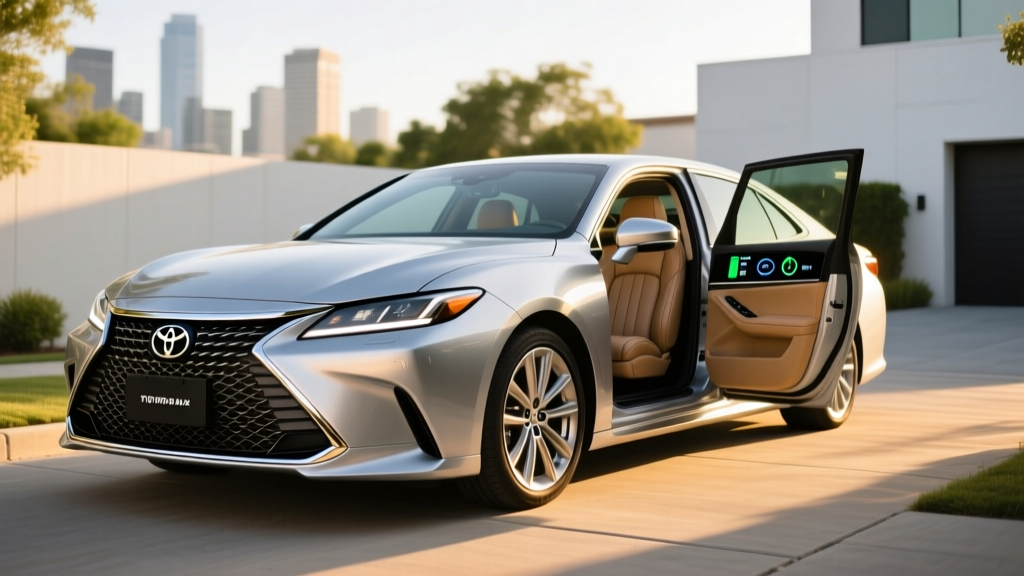
The Toyota Crown has always been Toyota's answer to the question: "What if a sedan had the presence of an SUV and the efficiency of a hybrid?" The Hybrid MAX powertrain takes that concept and adds genuine performance credentials. For the 2026 model year, the Crown Hybrid MAX pairs a turbocharged 2.4-liter inline-four with a high-output electric motor to produce 340 combined horsepower — enough to hit 60 mph in roughly 5.1 seconds — while still returning an EPA-estimated 28 MPG combined. It's a performance hybrid that doesn't ask you to choose between passing power and fuel savings.
But the Hybrid MAX is only half the Crown story. Toyota also offers a standard Hybrid powertrain that prioritizes efficiency over acceleration, returning up to 41 MPG combined. Understanding which Crown powertrain fits your driving pattern — and how both compare to a plug-in hybrid or full battery-electric vehicle — is the key to making the right purchase. Here's everything you need to know.
Hybrid MAX vs. Standard Hybrid: Two Very Different Crowns
Before diving into specs, it's critical to understand that the 2026 Toyota Crown is a conventional hybrid (HEV), not a plug-in hybrid (PHEV). You never plug it in. The gasoline engine and regenerative braking recharge the hybrid battery automatically. This is a fundamental distinction from PHEVs like the Toyota RAV4 Prime, which offer 30–40 miles of electric-only driving before the gas engine engages.
| Attribute | Crown Hybrid (HEV) | PHEV (e.g., RAV4 Prime) | Full EV (e.g., Tesla Model 3) |
|---|---|---|---|
| Plug in to charge? | No | Yes (Level 1/2) | Yes (Level 2 / DC fast) |
| Electric-only range | None (motor assists engine) | ~35–42 mi | 250–360 mi (full battery) |
| Gas engine? | Yes | Yes | No |
| Fuel/energy cost per mile | ~$0.11 (at $3.50/gal) | ~$0.04 electric / $0.11 gas | ~$0.04 (at $0.14/kWh) |
| Federal tax credit (§30D) | No | Possibly (varies by sourcing) | Up to $7,500 (income/MSRP rules apply) |
The Hybrid MAX is the performance variant, available exclusively on the Crown Limited trim. The standard Hybrid system is available across XLE, Limited, and Nightshade trims. Both are self-charging hybrids — no plug, no range anxiety, no charging infrastructure dependency.
Powertrain Specs: 340 HP and Standard AWD
The Hybrid MAX powertrain is Toyota's most potent hybrid system short of the Tundra i-FORCE MAX. Here's how the hardware breaks down:
| Engine | 2.4L turbocharged inline-4 |
| Engine output | 264 HP / 310 lb-ft torque |
| Electric motor | High-output permanent magnet, integrated in 6-speed automatic |
| Combined system output | 340 HP / 400 lb-ft torque |
| Transmission | 6-speed automatic (Direct Shift) |
| Drivetrain | Full-time electronic AWD |
| 0–60 mph | 5.1 seconds (Toyota est.) |
| Hybrid battery | ~1.1 kWh (nickel-metal hydride), self-charging |
| Towing capacity | Not rated |
Unlike the standard Crown Hybrid, which uses a continuously variable transmission (eCVT), the Hybrid MAX employs a traditional 6-speed automatic. This gives it a more direct, engaging driving feel — you feel distinct gear shifts rather than the rubber-band sensation some drivers associate with CVTs. The full-time electronic AWD system uses a rear-mounted electric motor to send torque to the rear wheels when needed, improving traction in rain and light snow without the mechanical drag of a conventional driveshaft.
Fuel Economy: EPA Ratings and Real-World MPG
The performance-oriented Hybrid MAX sacrifices some efficiency for its extra power. Here's how both Crown powertrains stack up according to EPA data from fueleconomy.gov:
| Powertrain | City MPG | Highway MPG | Combined MPG |
|---|---|---|---|
| Hybrid MAX (Limited AWD) | 26 | 32 | 28 |
| Standard Hybrid (XLE/Limited AWD) | 42 | 41 | 41 |
Real-World MPG: What to Actually Expect
Toyota hybrids have a well-documented tendency to exceed their EPA city estimates in real-world driving. The hybrid system recovers significant energy through regenerative braking in stop-and-go traffic, where gas-only vehicles are least efficient. In mixed suburban and city driving, Crown Hybrid MAX owners commonly report 27–30 MPG — right around the EPA combined figure or slightly above.
On sustained highway trips at 70–80 mph, expect the Hybrid MAX to return closer to 29–31 MPG. The turbocharged engine works harder at highway speeds than the naturally aspirated 2.5L in the standard Hybrid, which is why the highway gap between the two powertrains (32 vs. 41 MPG) is significant.
Cold-weather note: Hybrid fuel economy typically drops 5–10% in sub-freezing temperatures. The engine runs more frequently to maintain cabin heat and keep the hybrid battery at optimal operating temperature. Expect roughly 25–26 MPG combined from the Hybrid MAX in winter conditions — still competitive with non-hybrid midsize sedans that average 22–25 MPG combined.
Pricing, Trims, and Tax Credit Eligibility
The Hybrid MAX is offered exclusively on the Crown Limited trim. For the 2026 model year, pricing breaks down as follows:
| Trim | Powertrain | MSRP |
|---|---|---|
| XLE | Standard Hybrid | $42,350 |
| Nightshade | Standard Hybrid | $44,050 |
| Limited | Standard Hybrid or Hybrid MAX | $48,350 |
| Limited (Hybrid MAX) | Hybrid MAX | $48,350 |
Does the Crown Hybrid MAX Qualify for a Federal Tax Credit?
No. The Toyota Crown — in both Hybrid and Hybrid MAX configurations — is a conventional hybrid (HEV), not a plug-in vehicle. The federal §30D Clean Vehicle Credit applies exclusively to battery-electric vehicles (BEVs) and plug-in hybrids (PHEVs) with battery capacities of at least 7 kWh. The Crown's ~1.1 kWh hybrid battery does not qualify.
Some states offer their own incentives for conventional hybrids, though these are increasingly rare as incentive programs shift toward zero-emission vehicles. Check your state's energy office or department of environmental quality for current programs. A few utilities also offer rebates for hybrid purchases, but amounts and availability vary significantly by jurisdiction.
Battery Warranty, Lifespan, and Replacement Cost
Hybrid battery longevity remains one of the most common concerns among first-time hybrid buyers. Toyota has built a strong track record here — the Prius has been in production since 1997, and many early examples are still running on original or single-replacement batteries well past 200,000 miles.
2026 Toyota Crown Hybrid Battery Warranty
- Hybrid battery: 10 years / 150,000 miles (whichever comes first)
- Hybrid system components: 8 years / 100,000 miles
- Powertrain (engine, transmission): 5 years / 60,000 miles
- Basic bumper-to-bumper: 3 years / 36,000 miles
The 10-year/150,000-mile hybrid battery warranty applies in all 50 states. If the battery fails within this window, Toyota covers full replacement at no cost to the owner.
How Long Will the Hybrid Battery Actually Last?
Toyota's hybrid batteries use nickel-metal hydride (NiMH) chemistry in the Hybrid MAX, which is less energy-dense than the lithium-ion packs in full EVs but extremely durable and thermally stable. Real-world data from Toyota's hybrid fleet suggests most hybrid batteries last 150,000–200,000+ miles before significant degradation. Unlike EV batteries, hybrid batteries operate in a narrow state-of-charge window (roughly 40–80%), which dramatically reduces cycle wear.
Battery Replacement Cost (Out of Warranty)
If the hybrid battery needs replacement after the warranty period, expect to pay between $2,000 and $4,000 for a new OEM battery pack, including labor. Refurbished or reconditioned packs are available for $1,000–$2,000. Individual battery modules can sometimes be replaced for a few hundred dollars if only a single cell has failed. These costs are significantly lower than EV traction battery replacements, which can exceed $10,000–$20,000.
Reliability and Long-Term Ownership
Toyota consistently ranks at or near the top of major reliability surveys, and the Crown's powertrain benefits from two decades of hybrid system refinement. The Hybrid MAX's turbocharged 2.4L engine is shared with the Grand Highlander and Tacoma, giving it a broad parts and service network.
Key reliability considerations:
- Turbo engine maintenance: The 2.4L turbo requires synthetic oil changes at recommended intervals (every 10,000 miles or 12 months). Turbo longevity depends on consistent oil quality.
- Brake pad life: Regenerative braking significantly reduces mechanical brake wear. Many Toyota hybrid owners report 80,000–100,000+ miles on original brake pads.
- No plug-in complexity: Unlike PHEVs and EVs, there's no onboard charger, charge port, or high-voltage DC system to maintain. The hybrid system is mechanically simpler than a full EV powertrain.
Insurance costs for the Crown Hybrid MAX are moderate — typically 5–15% higher than the standard Hybrid due to the higher horsepower and Limited trim pricing, but generally lower than comparable luxury performance sedans from BMW or Audi.
Who Should Choose the Crown Hybrid MAX?
Choose the Crown Hybrid MAX If:
- You want a sedan with genuine passing power (340 HP, 5.1s 0–60) without dropping below 28 MPG
- You need standard AWD for rain or snow but don't want an SUV
- You have no access to home or workplace charging, making a PHEV or EV impractical
- You value Toyota's reliability reputation and 10-year hybrid battery warranty
- You prefer a traditional 6-speed automatic over a CVT
Look Elsewhere If:
- Maximum fuel economy is your priority — the standard Hybrid returns 41 MPG combined (13 MPG more)
- You want electric-only driving for short commutes — consider a PHEV like the RAV4 Prime or a full EV
- You want to qualify for the federal §30D tax credit (up to $7,500) — only BEVs and eligible PHEVs qualify
- You need cargo space — the Crown is a sedan with a conventional trunk (~15.2 cu ft), not a hatchback or SUV
- You want the lowest per-mile energy cost — home-charged EVs cost roughly $0.04/mile vs. $0.11/mile for the Hybrid MAX
Hybrid MAX vs. Full EV: The Practical Decision
If you have reliable Level 2 charging at home and your daily commute is under 40 miles, a full EV like the Tesla Model 3 or Hyundai Ioniq 6 will deliver dramatically lower fuel costs, instant torque, and zero tailpipe emissions. The trade-off is charging dependency on road trips and a higher purchase price (though the $7,500 federal credit narrows the gap).
The Crown Hybrid MAX makes the most sense for drivers who want performance and efficiency without any charging obligation. If you live in an apartment without charging access, frequently drive long distances in rural areas with sparse charging infrastructure, or simply don't want to think about charging, the Hybrid MAX eliminates that friction entirely while still cutting fuel consumption by 20–30% versus a comparable non-hybrid performance sedan.
Frequently Asked Questions
How many MPG does the Toyota Crown Hybrid MAX get?
The EPA rates the 2026 Crown Hybrid MAX at 26 city / 32 highway / 28 combined MPG. In real-world mixed driving, most owners report 27–30 MPG. Highway cruising at 70–80 mph yields approximately 29–31 MPG.
Is the Toyota Crown Hybrid MAX a plug-in hybrid?
No. The Crown Hybrid MAX is a conventional hybrid (HEV). It does not plug in. The gasoline engine and regenerative braking recharge the small hybrid battery automatically. If you want plug-in capability with electric-only range, look at PHEVs like the Toyota RAV4 Prime or Hyundai Tucson PHEV.
Does the Toyota Crown Hybrid MAX qualify for any tax credit?
It does not qualify for the federal §30D Clean Vehicle Credit, which is limited to plug-in vehicles (BEVs and PHEVs). Some states and utilities may offer modest hybrid incentives, but these vary by location. Check your state's energy office for current programs.
How long will the Crown Hybrid MAX battery last?
Toyota's hybrid batteries typically last 150,000–200,000+ miles. The Crown's hybrid battery is covered by a 10-year/150,000-mile warranty. Out-of-warranty replacement costs $2,000–$4,000 for a new OEM pack.
Is the Hybrid MAX faster than the standard Crown Hybrid?
Significantly. The Hybrid MAX produces 340 HP and reaches 60 mph in approximately 5.1 seconds. The standard Hybrid produces 236 HP and hits 60 mph in about 7.2 seconds. The Hybrid MAX also uses a 6-speed automatic instead of a CVT for a sportier driving feel.
Can the Crown Hybrid MAX run on electric power alone?
Only at very low speeds (under ~25 mph) for short distances, such as creeping through a parking lot. It cannot sustain highway speeds on electric power alone. The electric motor's primary role is to assist the gas engine during acceleration and to recover energy during braking — not to replace the engine for extended driving.
How does the Crown Hybrid MAX compare to the Hyundai Sonata Hybrid?
The Sonata Hybrid (up to 52 MPG combined, ~200 HP) prioritizes efficiency over performance and costs roughly $8,000–$10,000 less. The Crown Hybrid MAX offers significantly more power, standard AWD, and a more premium interior, but returns 28 MPG combined. They serve different buyer priorities: the Sonata Hybrid is an efficiency play, the Crown Hybrid MAX is a performance-luxury hybrid.
The 2026 Toyota Crown Hybrid MAX occupies a narrow but compelling niche: a self-charging performance sedan that doesn't require you to install a charger, plan road trips around charging stations, or sacrifice passing power for efficiency. At $48,350 for the Limited trim, it's priced competitively against luxury sport sedans that can't match its fuel economy. If your driving life involves a mix of highway commuting, inclement weather, and the occasional spirited on-ramp merge — and you'd rather spend time driving than charging — the Hybrid MAX is one of the most well-rounded sedans Toyota has built.