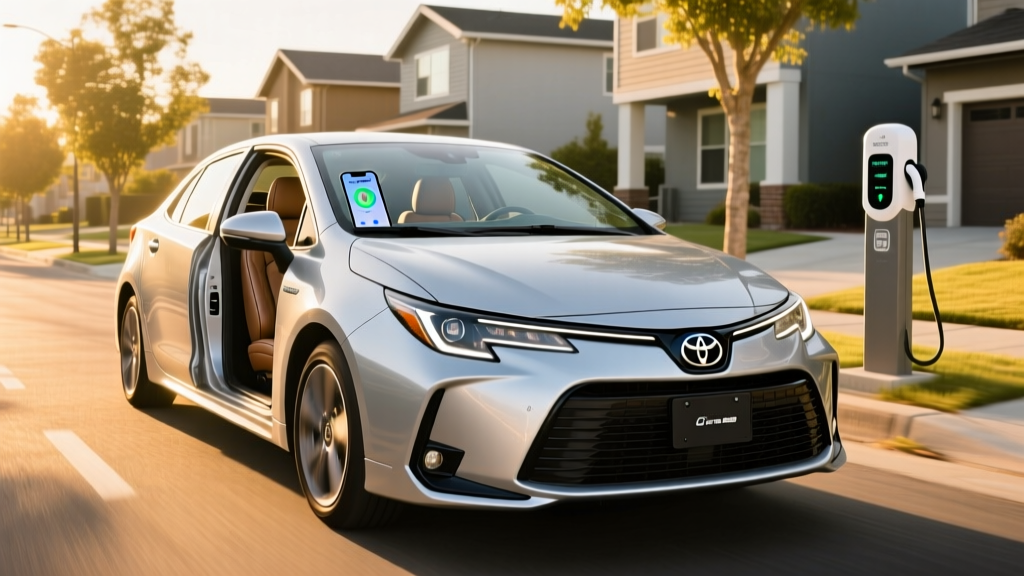
The 2026 Toyota Corolla Hybrid SE sits in a sweet spot for buyers who want electrified efficiency without plugging in. As a conventional hybrid (HEV), it regenerates its own electricity through braking and engine cycling—no charging cable required. With an EPA-estimated 50 MPG combined and a sport-tuned suspension that separates it from the softer LE trim, the SE targets drivers who commute long distances and want a compact sedan that sips fuel while looking and feeling a bit more aggressive than the typical econobox.
This guide covers everything a spec-driven buyer needs: exact EPA and real-world MPG, powertrain output, battery warranty specifics, pricing by trim context, and how the Corolla Hybrid SE stacks up against plug-in hybrids and full EVs in 2026.
Corolla Hybrid SE Fuel Economy: EPA Numbers vs. Real-World MPG
The headline number is 50 MPG combined, but city and highway splits tell a more useful story for your specific commute pattern.
| Cycle | EPA MPG |
|---|---|
| City | 53 MPG |
| Highway | 46 MPG |
| Combined | 50 MPG |
Source: fueleconomy.gov
- City/suburban driving: 50–56 MPG — hybrids excel here because regenerative braking recaptures energy at every stop.
- Highway cruising (70–80 mph): 42–47 MPG — the engine runs more continuously at speed, reducing the hybrid system's advantage.
- Cold weather (below 30°F): 40–45 MPG combined — the engine runs longer to heat the cabin and warm the catalytic converter, reducing electric-only operation.
- Hilly terrain: 44–48 MPG — downhill regen partially offsets uphill consumption, but net efficiency drops vs. flat ground.
The Corolla Hybrid's 53 MPG city rating isn't marketing fluff. Toyota's Hybrid Synergy System runs the electric motor solo at low speeds and under light loads, only engaging the gasoline engine when demand exceeds what the battery can supply. In stop-and-go traffic, many owners report exceeding the EPA city figure—real-world logs on fuel-tracking apps frequently show 54–56 MPG on urban routes.
Highway efficiency drops because the 1.8-liter Atkinson-cycle engine must sustain output without the stop-start advantages of city driving. At 75 mph on a flat interstate, expect 44–46 MPG. Push to 80+ mph or face sustained headwinds, and 42 MPG is realistic.
Powertrain: How the Hybrid System Makes 138 HP
The Corolla Hybrid SE pairs a 1.8-liter four-cylinder Atkinson-cycle gasoline engine with two motor-generators (MG1 and MG2) and a 1.31 kWh nickel-metal hydride (NiMH) traction battery. Combined system output is 138 horsepower.
| Specification | Value |
|---|---|
| Engine | 1.8L 4-cyl Atkinson-cycle |
| Engine HP | 96 hp @ 5,200 rpm |
| Electric Motor (MG2) | 94 hp (70 kW) |
| Combined System Output | 138 hp |
| Combined Torque | 134 lb-ft (engine) / 120 lb-ft (motor) |
| Transmission | eCVT (planetary gearset) |
| Drivetrain | Electronic On-Demand AWD |
| Traction Battery | 1.31 kWh NiMH |
| 0–60 mph | ~9.0 seconds (est.) |
| Fuel Tank | 11.4 gallons |
| Total Driving Range | ~570 miles (EPA combined) |
The SE trim adds a rear-mounted electric motor (40 hp) that provides electronic on-demand all-wheel drive. This motor engages automatically during acceleration from a stop and when the front wheels lose traction. Unlike mechanical AWD systems, there's no driveshaft or center differential—just a compact motor on the rear axle drawing from the same hybrid battery.
The eCVT is not a belt-driven CVT like those in some competitors. Toyota uses a planetary gearset that blends engine and motor power seamlessly. There are no fixed gear ratios and no rubber-band feeling under acceleration, though the engine does drone at high RPMs during hard highway merges.
HEV vs. PHEV vs. EV: Which Fits Your Driving Pattern?
The Corolla Hybrid SE is a conventional hybrid (HEV). It does not plug in. Some buyers confuse it with a plug-in hybrid—let's clarify the distinction.
| Factor | HEV (Corolla Hybrid) | PHEV (e.g., Prius Prime) | BEV (e.g., Tesla Model 3) |
|---|---|---|---|
| Plug-in required? | No | Yes (Level 1/2) | Yes (Level 2/DCFC) |
| Electric-only range | ~1 mile (low speed) | 35–44 miles | 250–360+ miles |
| Total range | ~570 miles | ~440 miles combined | 250–360+ miles |
| Best fuel economy scenario | City driving | Short commutes within EV range | All driving (zero tailpipe) |
| Home charging install | None needed | Level 2 recommended ($500–$2,000) | Level 2 required ($800–$2,500) |
| Federal tax credit (§30D) | Not eligible | Up to $7,500 (if eligible) | Up to $7,500 (if eligible) |
| Starting MSRP (2026) | $26,995 | $33,445 (Prius Prime) | $38,990 (Model 3 RWD) |
Choose the Corolla Hybrid SE (HEV) if: You lack reliable home or workplace charging access, your commute exceeds 40 miles daily, you want maximum range without planning stops, or you want the lowest upfront price among electrified vehicles.
Choose a PHEV (like the Prius Prime) if: You can charge at home nightly, your daily commute is under 40 miles (covering most trips on electricity alone), and you still want a gas engine for long road trips without range planning.
Choose a full BEV if: You have dependable Level 2 home charging, your daily driving is under 250 miles, you want zero tailpipe emissions, and you're comfortable with public DC fast charging for road trips.
Pricing, Trims, and Tax Credit Reality
The 2026 Toyota Corolla Hybrid SE starts at $26,995 (MSRP, including destination). Key pricing context:
- Corolla Hybrid LE (base): ~$24,395 — softer suspension, fewer sport features
- Corolla Hybrid SE: $26,995 — sport-tuned suspension, 16-inch alloy wheels, paddle shifters, smart key
- Corolla Hybrid XLE: ~$29,000 — SofTex seats, heated front seats, upgraded infotainment
No. Under IRS §30D rules, the federal clean vehicle credit applies only to plug-in electric vehicles (PHEVs and BEVs) with a battery capacity of at least 7 kWh. The Corolla Hybrid's 1.31 kWh NiMH battery does not meet this threshold. This vehicle is not eligible for the $7,500 federal EV tax credit or the point-of-sale transfer.
Some states offer hybrid-specific incentives, but these vary by jurisdiction. Check your state energy office or department of revenue for current programs. A tax professional can confirm eligibility for any local credits.
The lack of a federal credit is offset by the Corolla Hybrid's lower purchase price. A similarly equipped BEV with 300+ miles of range still costs $10,000–$15,000 more before incentives, and a PHEV like the Prius Prime starts $6,000+ higher.
Real-World Ownership: 5-Year Cost Breakdown
With no plug-in requirement and Toyota's hybrid reliability record, the Corolla Hybrid SE is one of the cheapest electrified vehicles to own long-term.
| Category | Corolla Hybrid SE | Gas Corolla SE (2.0L) | BEV (avg. compact) |
|---|---|---|---|
| Purchase Price (MSRP) | $26,995 | $24,495 | $38,990 |
| Fuel/Energy (75k mi) | $5,250 (50 MPG, $3.50/gal) | $7,875 (33 MPG, $3.50/gal) | $3,000 ($0.15/kWh avg.) |
| Maintenance (5 yr) | $2,200 | $3,000 | $1,500 |
| Insurance (5 yr avg.) | $8,500 | $7,800 | $9,200 |
| Federal Tax Credit | $0 | $0 | Up to -$7,500 |
| Estimated Depreciation | $10,800 (40%) | $11,000 (45%) | $17,500 (45%) |
| Net 5-Year Cost | $32,145 | $32,170 | $35,190 |
The hybrid nearly breaks even with the gas Corolla over five years despite a $2,500 higher sticker price, thanks to ~$2,600 in fuel savings and slightly better resale value. Against a BEV, the hybrid wins on upfront cost and avoids home charging installation, but the BEV pulls ahead on per-mile energy cost if you qualify for the full $7,500 credit.
Battery Warranty, Lifespan, and Replacement Cost
- Coverage: 10 years / 150,000 miles (whichever comes first)
- What's covered: Hybrid battery assembly, battery control module, inverter with converter
- Capacity threshold: Toyota warrants against defects and abnormal degradation; there is no published minimum capacity retention percentage (unlike BEV warranties that guarantee 70% SoH)
- Transferability: Fully transferable to subsequent owners
Toyota's hybrid battery longevity record is among the best in the industry. The 1.31 kWh NiMH pack in the Corolla Hybrid is far smaller and less stressed than a BEV battery—it never deep-cycles (Toyota's battery management keeps it between roughly 40% and 80% state of charge at all times). This shallow cycling dramatically extends cell life.
Real-world lifespan data: Independent fleet data and owner reports show Toyota hybrid batteries routinely lasting 150,000–200,000+ miles before needing replacement. Failures before 100,000 miles are rare. The Prius, which shares the same Hybrid Synergy architecture, has documented cases of original batteries exceeding 300,000 miles in taxi service.
Replacement cost if out of warranty: A new OEM hybrid battery pack for the Corolla Hybrid runs approximately $2,500–$3,500 installed at a Toyota dealer. Refurbished packs are available for $1,500–$2,200. Individual cell modules can be replaced by independent hybrid specialists for $800–$1,500 if only a few cells have degraded.
This is a fraction of BEV battery replacement costs ($10,000–$20,000+), which is a meaningful consideration for buyers planning to keep the vehicle past the warranty period.
Driving Impressions and Practical Considerations
The SE trim's sport-tuned suspension firms up the ride compared to the LE, reducing body roll in corners without making the car punishing over rough pavement. The steering is weighted heavier than in the LE, giving a more confident feel on highway lane changes. It's not a sports sedan—138 hp and a ~9-second 0–60 time keep expectations grounded—but it's noticeably more engaging than the base hybrid.
Cargo space: The hybrid battery sits under the rear seat, preserving trunk volume at 13.1 cubic feet—identical to the gas Corolla. This is a practical advantage over some competitors that lose cargo room to battery placement.
Technology: The SE includes an 8-inch touchscreen with wireless Apple CarPlay and Android Auto, a 7-inch digital driver display, Toyota Safety Sense 3.0 (pre-collision, lane departure, lane tracing, dynamic radar cruise control), and blind-spot monitoring with rear cross-traffic alert.
Noise levels: At highway speeds, the Corolla Hybrid SE is reasonably quiet, though the engine note becomes intrusive during hard acceleration. The eCVT keeps engine RPM steady rather than letting it hunt through gears, which some drivers find monotonous on long merges.
Pros
- 53 MPG city — real-world urban driving often exceeds EPA
- No charging infrastructure needed — works for apartment dwellers
- 10-year/150,000-mile hybrid battery warranty
- AWD included standard on the SE trim
- ~570-mile total range — fewer fill-ups than any gas competitor
- Low maintenance costs (no transmission fluid changes, regenerative braking saves pad wear)
- Strong Toyota reliability and resale value track record
Cons
- No federal tax credit eligibility
- 9-second 0–60 time — underpowered for confident highway merging
- Highway MPG drops to 42–46 in real-world driving
- Engine drone under hard acceleration
- Small 1.31 kWh battery limits electric-only operation to low-speed crawling
- Rear seat space is tight for tall adults (38.0 inches of legroom)
- No spare tire — tire inflator kit only
Frequently Asked Questions
How many MPG does the Toyota Corolla Hybrid SE get?
The EPA rates the 2026 Corolla Hybrid SE at 53 MPG city, 46 MPG highway, and 50 MPG combined. In real-world city driving, many owners report 50–56 MPG. Highway cruising at 75 mph typically yields 42–46 MPG. Cold weather can reduce combined efficiency to 40–45 MPG.
Does the Corolla Hybrid SE need to be plugged in?
No. The Corolla Hybrid is a conventional hybrid (HEV), not a plug-in hybrid (PHEV). It charges its 1.31 kWh battery entirely through regenerative braking and engine-driven generation. You fuel it like any other gasoline car—just less often thanks to 50 MPG combined and an 11.4-gallon tank giving ~570 miles of range.
How far can the Corolla Hybrid drive on electric power alone?
Under 1 mile at very low speeds (under 25 mph) with a light foot. The battery is too small (1.31 kWh) to sustain meaningful electric-only driving. This is normal for conventional hybrids—if you want 35–44 miles of electric-only range, you need a plug-in hybrid like the Toyota Prius Prime.
Is the Corolla Hybrid SE reliable, and what does battery replacement cost?
Toyota's hybrid system has two decades of proven reliability. The hybrid battery is warranted for 10 years/150,000 miles and routinely lasts 150,000–200,000+ miles in practice. If replacement is needed out of warranty, expect $2,500–$3,500 for a new OEM pack or $1,500–$2,200 for a refurbished unit. This is far cheaper than BEV battery replacement.
Does the Corolla Hybrid SE qualify for any tax credit?
The Corolla Hybrid SE does not qualify for the federal §30D clean vehicle tax credit, which requires a plug-in vehicle with at least 7 kWh of battery capacity. Some states may offer hybrid-specific rebates or HOV lane access—check your state's energy office. The Prius Prime (PHEV) and full EVs like the Tesla Model 3 may qualify for up to $7,500 federally, subject to income, MSRP, and battery-sourcing requirements per IRS guidelines.
How does the Corolla Hybrid SE compare to the Prius?
The Corolla Hybrid SE is a compact sedan with a traditional trunk, 138 hp, and 50 MPG combined. The 2026 Prius offers a hatchback design (more cargo versatility), up to 196 hp, and 57 MPG combined—but starts around $29,445. The Corolla Hybrid is the budget pick; the Prius is the efficiency and performance pick within Toyota's hybrid lineup.
Is the AWD system always active?
The electronic on-demand AWD engages the rear electric motor automatically during acceleration from a stop and when front-wheel slip is detected. It's not a permanent AWD system—it disengages at steady cruising speeds to maximize efficiency. Think of it as traction insurance for rain, snow, and gravel rather than a performance AWD system.
The Verdict: Who Should Buy the Corolla Hybrid SE?
Buy the Corolla Hybrid SE if: You want 50+ MPG without changing your fueling habits, you live in an apartment or lack home charging access, your annual mileage is high (15,000+ miles where fuel savings compound quickly), or you want AWD security in a compact sedan under $28,000.
Look elsewhere if: You want meaningful electric-only driving range (consider the Prius Prime PHEV), you prioritize acceleration (the 9-second 0–60 is leisurely), or you want to fully eliminate gasoline from your driving (a BEV like the Chevrolet Equus EV or Hyundai Ioniq 6 makes more sense if you can charge at home).
The 2026 Corolla Hybrid SE is a rational, data-backed choice for high-mileage commuters who value simplicity. No charging apps, no plug-in logistics, no range planning—just 570 miles between fill-ups and a 10-year battery warranty backing the system that makes it all work. For the buyer who wants electrification without the lifestyle change, it's one of the strongest options on the market.