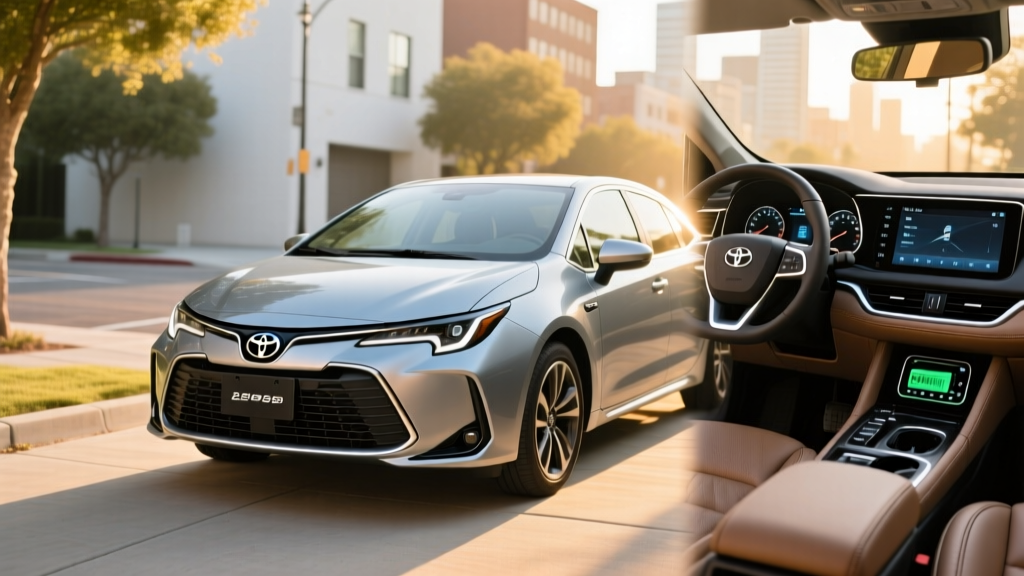
The Toyota Corolla Hybrid occupies a specific niche in the electrified vehicle market: maximum efficiency with zero lifestyle change. No plugs, no range anxiety, no charging apps — just a gasoline-electric powertrain that sips fuel at a rate that embarrasses vehicles costing twice as much. For 2026, the Corolla Hybrid remains one of the most accessible ways to cut fuel costs without committing to a battery-electric vehicle (BEV) or managing the logistics of home charging.
But the EPA sticker is only part of the story. Real-world Corolla Hybrid MPG varies based on driving style, climate, and route profile — and understanding those variables is the difference between a satisfied owner and a disappointed one. This guide breaks down the exact numbers, the powertrain engineering behind them, and who should (and shouldn't) choose this hybrid over a PHEV or full EV.
2026 Toyota Corolla Hybrid MPG: The Official Numbers
The 2026 Toyota Corolla Hybrid is available exclusively with all-wheel drive (AWD), which slightly impacts efficiency compared to the older FWD-only configuration. Here are the EPA-rated figures straight from fueleconomy.gov:
| Trim | City MPG | Highway MPG | Combined MPG | Annual Fuel Cost* |
|---|---|---|---|---|
| LE AWD | 47 | 41 | 44 | ~$1,050 |
| SE AWD | 47 | 41 | 44 | ~$1,050 |
| XLE AWD | 47 | 41 | 44 | ~$1,050 |
*Based on 15,000 miles/year, 55% city / 45% highway, and $3.30/gallon regular unleaded. Your actual costs will vary with local fuel prices.
The city-biased MPG split (47 city vs. 41 highway) is characteristic of Toyota's series-parallel hybrid system. At low speeds and in stop-and-go traffic, the electric motor does the heavy lifting while the gasoline engine either shuts off entirely or operates in its most efficient range. Highway driving relies more on the engine directly, which is why the highway number drops.
Real-World MPG vs. EPA: What Owners Actually See
EPA estimates are standardized laboratory tests — useful for comparison, but not a guarantee. Based on aggregated owner data and independent testing, here's what to expect in real-world conditions:
- City / suburban driving: 48–54 MPG (hybrids frequently exceed EPA city ratings in moderate climates)
- Highway cruising (65–75 mph): 38–43 MPG (aerodynamic drag and sustained engine load reduce efficiency)
- Mixed daily commute: 43–48 MPG (most owners land here)
- Cold weather (below 30°F): 37–42 MPG (engine runs more often for cabin heat, battery efficiency drops)
- Hot weather with A/C: 42–46 MPG (climate load reduces electric-only operation)
The Corolla Hybrid's real-world advantage shows up most dramatically in urban environments. Drivers with short, stop-heavy commutes in mild climates routinely report 50+ MPG. The penalty comes on long highway road trips, where the hybrid system provides less benefit and the car's 1.8-liter engine operates under sustained load.
One practical note: the Corolla Hybrid's 10.6-gallon fuel tank yields a real-world range of approximately 430–500 miles depending on conditions. That's competitive with many BEVs and eliminates any range-anxiety concern entirely.
Powertrain Deep Dive: How the Hybrid System Works
The 2026 Corolla Hybrid uses Toyota's fifth-generation hybrid system, a series-parallel architecture that's been refined over two decades. Here are the exact specifications:
| Component | Specification |
|---|---|
| Engine | 1.8L 4-cylinder Atkinson-cycle |
| Engine Output | 96 hp / 105 lb-ft torque |
| Front Electric Motor | 94 hp / 139 lb-ft |
| Rear Electric Motor (AWD) | 40 hp / 38 lb-ft |
| Net Combined System Output | 138 hp |
| Transmission | Electronically controlled CVT (eCVT) |
| Hybrid Battery | ~1.0 kWh lithium-ion (sealed NiMH on some trims) |
| Drivetrain | Electronic On-Demand AWD |
| 0–60 mph | ~9.2 seconds |
The Atkinson-cycle engine is key to understanding the efficiency. Unlike a conventional Otto-cycle engine, the Atkinson cycle keeps the intake valve open longer during the compression stroke, effectively reducing pumping losses and improving thermal efficiency. The trade-off is lower peak power — but the electric motors fill that gap during acceleration.
The eCVT is not a belt-driven continuously variable transmission like those in some competitors. It's a planetary gearset that seamlessly blends power from the engine and motors with no fixed gear ratios and no belt to slip or wear. This is a major reliability advantage.
HEV vs. PHEV vs. BEV: Which Powertrain Fits Your Life?
The Corolla Hybrid is a conventional hybrid (HEV) — it has no plug and cannot be charged from an external source. The small battery recharges through regenerative braking and the gasoline engine. This is fundamentally different from a plug-in hybrid (PHEV) like the Toyota Prius Prime, and from a full battery-electric vehicle (BEV).
| Factor | HEV (Corolla Hybrid) | PHEV (Prius Prime) | BEV (e.g., Chevy Bolt EV) |
|---|---|---|---|
| Plug Required? | No | Yes (for EV range) | Yes (always) |
| Electric-Only Range | ~1 mile at low speed | ~44 miles | 200–350+ miles |
| Total Range | ~450 miles | ~440 miles (EV + gas) | 200–350 miles |
| Fueling | Gas station only | Gas station + plug | Plug only |
| Home Charging Needed? | No | Recommended | Essential |
| Maintenance | Oil changes + standard | Oil changes + standard | Minimal (no oil, fewer fluids) |
| Federal Tax Credit (§30D) | Not eligible | Up to $3,750* | Up to $7,500* |
| Best For | No charging access, long trips | Home charging + short commutes | Home charging + moderate trips |
*Federal tax credit amounts under IRS §30D vary by battery sourcing, MSRP caps, and buyer income limits. Verify eligibility at irs.gov before purchasing.
The decision framework is straightforward: if you lack access to home or workplace charging, the Corolla HEV is the correct choice. It delivers 70–80% of a PHEV's fuel savings in city driving with none of the infrastructure requirements. If you have a garage and a short commute, a PHEV or BEV will save more money over time — but at a higher purchase price.
2026 Pricing, Trims, and Tax Credit Eligibility
The 2026 Corolla Hybrid is positioned as an entry point into electrified driving, and the pricing reflects that:
| Trim | MSRP (incl. destination) | Key Features |
|---|---|---|
| LE | ~$24,550 | 8" touchscreen, Toyota Safety Sense 3.0, wireless CarPlay/Android Auto, LED headlights |
| SE | ~$26,550 | Sport-tuned suspension, 18" alloy wheels, sport seats, paddle shifters |
| XLE | ~$28,800 | SofTex seats, 10.5" display, wireless charging, heated front seats, ambient lighting |
Federal tax credit: The Corolla Hybrid does not qualify for the §30D New Clean Vehicle Credit. That credit applies only to plug-in vehicles (PHEVs and BEVs) with battery capacities of at least 7 kWh. The Corolla Hybrid's ~1 kWh battery falls well below that threshold.
Some states and localities offer rebates or HOV lane access for conventional hybrids, but these programs are increasingly shifting focus to plug-in vehicles. Check your state energy office for current programs.
Battery Warranty, Lifespan, and Replacement Cost
Hybrid battery longevity is consistently the top concern among first-time hybrid buyers. Toyota addresses this with one of the strongest warranties in the industry:
- Coverage: 10 years / 150,000 miles (whichever comes first)
- Applies to: Hybrid battery pack, hybrid control module, inverter
- Transferable: Yes, to subsequent owners
- Capacity threshold: Toyota warrants against defects and abnormal loss of capacity; there is no published minimum kWh retention percentage (unlike BEV warranties)
Real-world lifespan: Toyota's hybrid batteries have demonstrated exceptional longevity in practice. Data from fleet operators and long-term owners shows that first-generation Prius batteries (2001–2003) regularly exceeded 200,000 miles before needing replacement. The lithium-ion packs in current models are more durable still. Independent hybrid specialists report that catastrophic battery failure before 150,000 miles is uncommon.
Replacement cost if out of warranty: A new OEM hybrid battery for the Corolla Hybrid runs approximately $2,000–$3,500 including labor at a Toyota dealer. Refurbished/reconditioned batteries from independent hybrid shops are available for $1,000–$1,800. Individual cell replacement (only failed modules, not the full pack) can bring costs down to $500–$1,000 at specialist shops.
For context, this is a fraction of BEV battery replacement costs, which typically range from $8,000 to $20,000+. The Corolla Hybrid's small battery is both cheaper to replace and less likely to need it.
Who Should Buy the Corolla Hybrid — and Who Shouldn't
✅ Choose the Corolla Hybrid If:
- You don't have access to home or workplace charging
- Your commute is city-heavy or suburban with lots of stops
- You want low fuel costs without changing any habits
- You regularly take long road trips and don't want to plan around chargers
- You want a sub-$30,000 vehicle with proven reliability
- You live in an area with extreme cold where BEV range loss is a concern
❌ Look Elsewhere If:
- You have home charging and a short commute (a PHEV saves more fuel)
- You want electric-only, zero-tailpipe-emission driving (consider a BEV)
- Performance is a priority — 138 hp and a 9.2-second 0–60 won't excite
- You need more than 13.1 cu ft of cargo space (it's a compact sedan)
- You want to qualify for the federal EV tax credit
- You drive mostly highway miles (the hybrid advantage shrinks to ~5 MPG over the gas Corolla)
Corolla Hybrid vs. Competitors: Quick MPG Comparison
| Vehicle | City MPG | Highway MPG | Combined MPG | Base MSRP | AWD Available? |
|---|---|---|---|---|---|
| Toyota Corolla Hybrid | 47 | 41 | 44 | ~$24,550 | Standard |
| Hyundai Elantra Hybrid | 51 | 58 | 54 | ~$26,500 | No |
| Honda Civic Hybrid | 50 | 47 | 49 | ~$29,300 | No |
The Elantra Hybrid leads on paper with 54 MPG combined, but it lacks AWD — a dealbreaker in snow-belt states. The Civic Hybrid is more refined and powerful but starts nearly $5,000 higher. The Corolla Hybrid's value proposition is standard AWD, Toyota's reliability reputation, and a sub-$25K starting price.
Frequently Asked Questions
How many MPG does the Toyota Corolla Hybrid actually get?
The EPA rates the 2026 Corolla Hybrid at 47 city / 41 highway / 44 combined MPG. In real-world driving, most owners see 43–48 MPG mixed, with city-heavy drivers occasionally exceeding 50 MPG. Highway-only driving at 75+ mph drops efficiency to the high 30s.
Does the Corolla Hybrid need to be plugged in?
No. The Corolla Hybrid is a conventional hybrid (HEV), not a plug-in. Its small battery recharges automatically through regenerative braking and the gasoline engine. You fuel it exclusively at gas stations, exactly like a conventional car.
Is the Corolla Hybrid reliable? What about battery replacement?
Toyota's hybrid system is among the most proven in the automotive industry, with over 20 years of real-world data. The hybrid battery is warranted for 10 years/150,000 miles. Out-of-warranty replacement costs $2,000–$3,500 at a dealer, though many batteries last well beyond 200,000 miles. The eCVT planetary gearset has no belt or clutch to wear, contributing to long-term durability.
Does the Corolla Hybrid qualify for any tax credits?
The Corolla Hybrid does not qualify for the federal §30D New Clean Vehicle Credit, which requires a minimum 7 kWh battery and plug-in capability. The Corolla Hybrid's ~1 kWh battery does not meet this threshold. Some state-level hybrid incentives may apply — check your state energy office for current programs.
Should I get the Corolla Hybrid or the Prius instead?
The Toyota Prius (57 MPG combined, FWD) is more efficient and offers a PHEV variant (Prius Prime, ~44 miles electric-only). But it starts around $29,000 and lacks the Corolla's conventional sedan styling. If maximum MPG is your goal and budget allows, the Prius wins on paper. If you want AWD and a lower price, the Corolla Hybrid is the practical pick.
How does cold weather affect Corolla Hybrid MPG?
In sustained temperatures below 30°F, expect a 5–8 MPG drop from rated figures (roughly 37–42 MPG combined). The gasoline engine runs more frequently to provide cabin heat and maintain battery temperature. This is less severe than BEV range loss in cold weather (typically 20–30%), but it's noticeable on the trip computer.