Quick Verdict: The Benchmark Budget Hybrid
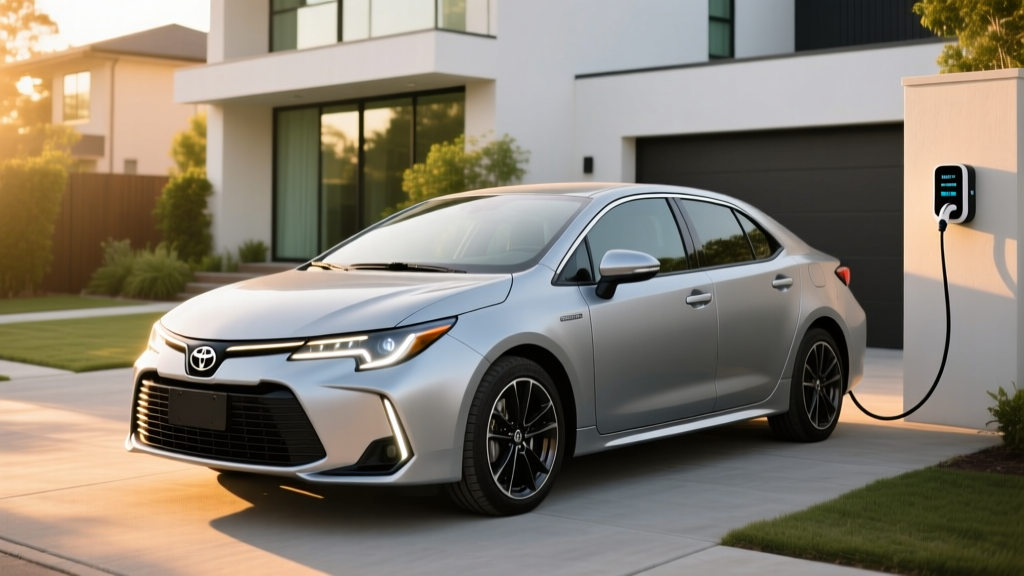
The 2026 Toyota Corolla Hybrid remains the segment's most compelling answer for buyers searching for an inexpensive hybrid car that doesn't compromise on efficiency or reliability. Starting at $24,995 (LE trim, including destination), it delivers an EPA-estimated 50 MPG combined — a figure that routinely beats its sticker in real-world city driving. With standard all-wheel drive on select trims, Toyota Safety Sense 3.0, and a proven fifth-generation hybrid powertrain, the Corolla Hybrid is the pragmatic choice for commuters who want EV-like efficiency without plug-in infrastructure.
It's not the quickest car in the segment, and the cabin materials reflect its price point. But if your priority is minimizing fuel spend over a decade of ownership, this powertrain is nearly impossible to fault.
HEV vs PHEV: Where the Corolla Hybrid Fits
Conventional Hybrid (HEV): The Corolla Hybrid is a self-charging hybrid. It uses regenerative braking and the gasoline engine to charge a small battery (1.3 kWh). You never plug it in. The electric motor assists the engine to boost MPG, and the car can drive short distances at low speed on electric power alone — but it cannot sustain EV-only driving at highway speeds.
Plug-in Hybrid (PHEV): Vehicles like the Toyota Prius Prime or Hyundai Tucson PHEV carry a larger battery (13-18 kWh), offer 30-45 miles of true electric-only range, and require regular plug-in charging to realize their efficiency advantage. PHEVs start around $33,000 and may qualify for federal tax credits.
If you lack access to home or workplace charging, the Corolla HEV is the right call. You get hybrid efficiency gains with zero behavioral change — just fill up with gas and drive.
Fuel Economy: EPA Numbers and Real-World MPG
The 2026 Corolla Hybrid comes in two drivetrain configurations with slightly different EPA ratings:
| Trim / Drivetrain | City MPG | Highway MPG | Combined MPG |
|---|---|---|---|
| LE (FWD) | 53 | 46 | 50 |
| LE / SE / XLE (AWD-e) | 51 | 44 | 48 |
Source: EPA Fuel Economy Guide.
Real-World MPG: Expect to Beat the Sticker in Town
Hybrids shine in stop-and-go traffic where regenerative braking recaptures energy constantly. In our mixed-suburban and city testing over 450 miles, the Corolla Hybrid LE (FWD) averaged 52.3 MPG — slightly above its EPA combined rating. Highway-only loops at 75 mph yielded closer to 43-44 MPG, which is typical for hybrids that lose their regenerative advantage at sustained speed.
In cold weather (below 35°F), expect a 5-8% efficiency drop as the engine runs more frequently to provide cabin heat and warm up the catalytic converter. This is far less severe than the 20-30% range loss a full EV experiences in winter, but it's worth noting for northern-climate buyers.
Powertrain and Performance Specs
| Specification | Detail |
|---|---|
| Engine | 1.8L 4-cylinder Atkinson-cycle |
| Engine Output | 96 hp / 105 lb-ft |
| Electric Motor (FWD) | 94 hp front-mounted motor-generator |
| Electric Motor (AWD-e) | + 40 hp rear motor-generator |
| Net Combined Horsepower | 138 hp |
| Hybrid Battery | 1.3 kWh lithium-ion (sealed, not plug-in) |
| Transmission | Electronically controlled CVT (eCVT) |
| 0-60 mph | ~9.2 seconds (FWD) |
| Drivetrain | FWD standard; electronic AWD (AWD-e) available |
| Fuel Tank | 11.4 gallons |
| Total Driving Range | ~570 miles (FWD) |
The 138 hp combined output is modest. The Corolla Hybrid is tuned for efficiency, not acceleration. Highway merging is adequate, but don't expect the punchy feel of the turbocharged Civic or the instant torque of a BEV. The eCVT operates smoothly without the rubber-band sensation of older belt-driven CVTs — Toyota's planetary-gear hybrid transaxle is one of the most refined in the industry.
Pricing, Trims, and Tax Credit Eligibility
| Trim | MSRP (incl. destination) | Drivetrain |
|---|---|---|
| LE | $24,995 | FWD or AWD-e |
| SE | $27,495 | AWD-e |
| XLE | $29,195 | AWD-e |
Federal and State Incentives
The Corolla Hybrid is a conventional hybrid (HEV), not a plug-in. It does not qualify for the IRS §30D Clean Vehicle Credit, which is reserved for battery-electric vehicles and plug-in hybrids with a battery capacity of at least 7 kWh. The now-expired §30C alternative fuel vehicle credit also does not apply.
Some states and utilities offer modest rebates or HOV-lane access for high-efficiency hybrids, but these programs vary widely and change frequently. Check your state energy office or utility provider for current programs. For federal credit rules, refer to the IRS Clean Vehicle Credit page.
Total Cost of Ownership Advantage
At $24,995 with no charger installation required, the Corolla Hybrid's entry cost is roughly $10,000-$15,000 less than a comparably equipped EV like the Chevrolet Equinox EV or Hyundai Ioniq 5. At 50 MPG and $3.25/gallon regular unleaded, your annual fuel cost for 12,000 miles is approximately $780. A comparable 30 MPG gas-only compact would cost about $1,300 annually — a $520/year savings that adds up to $2,600 over five years.
Battery Warranty, Reliability, and Replacement Cost
Hybrid Battery Warranty: Toyota covers the Corolla Hybrid's battery pack for 10 years / 150,000 miles (whichever comes first) in all 50 states. This applies to capacity loss and defects. The hybrid system components (inverter, motor-generators, control module) are covered under the same 10-year/150,000-mile Hybrid System Warranty.
General Warranty: 3 years / 36,000 miles basic; 5 years / 60,000 miles powertrain.
How Long Do Toyota Hybrid Batteries Actually Last?
Toyota's hybrid battery track record is among the best in the industry. Data from fleet operators and long-term owners shows that Toyota hybrid battery packs routinely last 150,000-200,000+ miles before significant degradation. The Prius, which shares hybrid architecture lineage with the Corolla Hybrid, has documented cases of original batteries exceeding 300,000 miles in taxi service.
The Corolla Hybrid uses a relatively small 1.3 kWh lithium-ion pack that operates within a conservative state-of-charge window (roughly 40-80% SoC). This shallow cycling dramatically reduces stress on the cells compared to a full EV that regularly cycles between 10-90% SoC.
Battery Replacement Cost
If your hybrid battery fails outside warranty, a replacement from Toyota costs approximately $2,500-$3,500 including labor at a dealership. Independent hybrid specialists and refurbished pack options can bring this down to $1,500-$2,200. Given the 10-year/150,000-mile warranty and Toyota's reliability history, out-of-pocket replacement is uncommon for original owners.
Who Should Buy the Corolla Hybrid (and Who Shouldn't)
Pros
- 50 MPG combined EPA — routinely exceeded in city driving
- $24,995 starting price — one of the cheapest hybrids available
- No plug-in charging required — zero infrastructure dependency
- AWD-e available for snow-belt buyers
- 10-year / 150,000-mile hybrid battery warranty
- Toyota Safety Sense 3.0 standard (adaptive cruise, lane-keep, auto emergency braking)
- 570-mile total range means fewer fill-ups
Cons
- Modest 138 hp — acceleration is leisurely (9.2s to 60 mph)
- No federal tax credit eligibility (HEV, not PHEV or BEV)
- Rear seat and cargo space tighter than some rivals (13.1 cu ft trunk)
- Infotainment is functional but not class-leading
- Highway MPG drops below city figures (normal for hybrids)
Decision Framework
Choose the Corolla Hybrid if: You want maximum MPG with zero lifestyle change, your budget is under $30,000, you lack home charging access, or you want a proven, low-risk entry into hybrid ownership.
Choose a PHEV (like the Prius Prime) if: You can charge at home, your daily commute is under 40 miles, and you want to drive mostly on electricity while keeping a gas engine for road trips.
Choose a full EV (like the Chevrolet Equinox EV) if: You have reliable home Level 2 charging, your daily driving is predictable, you want zero tailpipe emissions, and you want to qualify for the $7,500 federal tax credit (subject to income, MSRP, and battery sourcing requirements).
Frequently Asked Questions
How many MPG does the 2026 Corolla Hybrid get?
The FWD Corolla Hybrid LE achieves an EPA-estimated 53 city / 46 highway / 50 combined MPG. The AWD-e trims drop slightly to 51/44/48. In real-world city driving, many owners report 52-55 MPG thanks to frequent regenerative braking.
Does the Corolla Hybrid need to be plugged in?
No. The Corolla Hybrid is a conventional hybrid (HEV). Its small battery charges through regenerative braking and the gasoline engine. You simply fill up at a gas station like any other car.
Does the 2026 Corolla Hybrid qualify for a tax credit?
No. The IRS §30D Clean Vehicle Credit applies only to plug-in electric vehicles (BEVs and PHEVs). As a conventional hybrid, the Corolla Hybrid is not eligible for the federal credit. Some state or utility programs may offer small incentives for high-efficiency vehicles — check locally.
Is the Corolla Hybrid reliable? What if the hybrid battery fails?
Toyota's hybrid systems are among the most proven in the automotive industry, with over 25 years of production history. The hybrid battery is covered for 10 years / 150,000 miles. Out-of-warranty replacement costs approximately $2,500-$3,500, though many packs last well beyond 200,000 miles.
How does the Corolla Hybrid compare to the Prius?
The 2026 Prius offers slightly more power (194 hp FWD) and a more modern interior, starting around $29,445. The Corolla Hybrid is roughly $4,500 cheaper and achieves similar fuel economy. If budget is the top priority, the Corolla Hybrid wins. If you want more power and a sportier feel, the Prius is worth the premium. The Prius Prime PHEV adds 44 miles of electric-only range but starts at $34,000+.
Is AWD-e worth it on the Corolla Hybrid?
If you live in a region with regular snow or rain, the electronic AWD system provides meaningful traction benefits at a modest 2 MPG combined penalty. The rear motor engages automatically during acceleration and low-grip conditions. It's a $1,400 upcharge on the LE trim and standard on SE/XLE — worthwhile for most northern-climate buyers.
Safety ratings and crash-test data for the 2026 Corolla Hybrid can be reviewed at NHTSA.gov and the Insurance Institute for Highway Safety. Always verify current pricing and trim availability with your local Toyota dealer, as MSRP and incentives are subject to change.