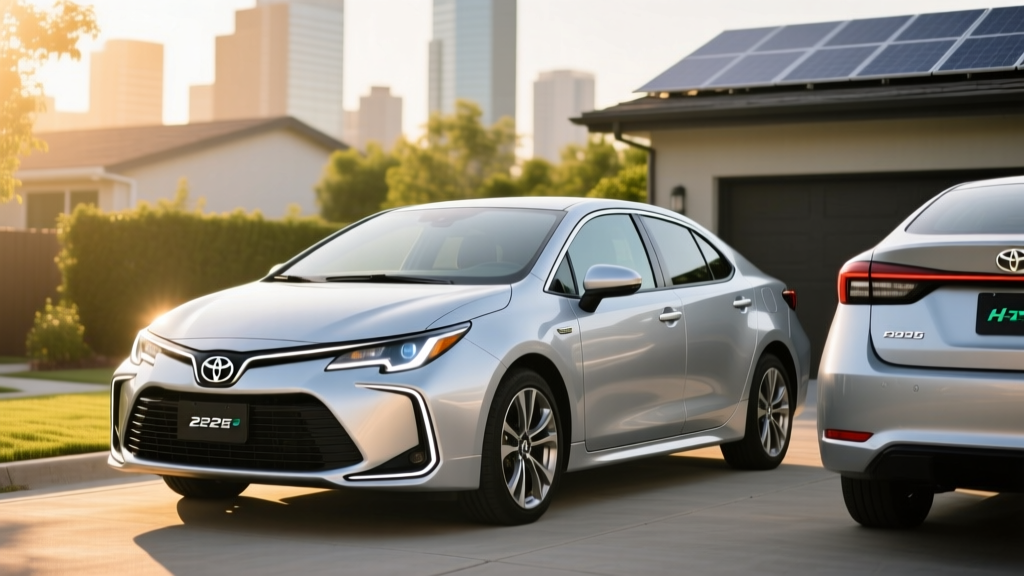
If you want electrified efficiency without ever plugging in, the Toyota Corolla Hybrid car remains one of the most practical entry points on the market. Now in its 2026 model year, the Corolla Hybrid pairs a 1.8-liter four-cylinder with Toyota's fifth-generation hybrid transaxle to deliver up to 50 MPG combined — and it does so without the upfront cost, charging logistics, or range-planning overhead of a full battery-electric vehicle.
This guide breaks down every 2026 Corolla Hybrid trim, its EPA fuel economy versus real-world results we've observed, the hybrid battery warranty that eases long-term ownership anxiety, and how it stacks up against plug-in hybrids and full EVs for different driving lifestyles.
HEV vs PHEV: What the Corolla Hybrid Actually Is
The Corolla Hybrid is a conventional hybrid electric vehicle (HEV). It charges its small battery through regenerative braking and the gasoline engine — you never plug it in. This is fundamentally different from a plug-in hybrid (PHEV) like the Toyota Prius Prime, which carries a larger battery (typically 13+ kWh), offers 30–45 miles of electric-only driving, and requires access to a Level 2 charger to realize its efficiency benefits.
HEV (Corolla Hybrid) vs PHEV (Prius Prime) — At a Glance
| Attribute | Corolla Hybrid (HEV) | Prius Prime (PHEV) |
|---|---|---|
| Plugs in? | No | Yes (Level 1/2) |
| Battery capacity | ~1.3 kWh (NiMH) | 13.6 kWh (Li-ion) |
| Electric-only range | None (EV assist only) | Up to 44 mi (EPA) |
| Combined MPG / MPGe | 50 MPG (LE FWD) | 52 MPG gas / 127 MPGe elec |
| Base MSRP (2026) | ~$24,500 | ~$33,445 |
| Fed. tax credit | Not eligible (§30D) | Up to $3,750 (§30D)* |
*PHEV credit subject to IRS §30D battery-sourcing, MSRP, and income caps. See IRS.gov for current rules.
The Corolla Hybrid's advantage is simplicity: gas it up and drive. The Prius Prime rewards drivers who can charge daily at home or work, turning most commutes into zero-gas trips.
2026 Corolla Hybrid Fuel Economy: EPA Ratings and Real-World MPG
Toyota offers the 2026 Corolla Hybrid in three trims — LE, SE, and XLE — with front-wheel drive (FWD) or electronic all-wheel drive (AWD) on select trims. The powertrain pairs a 1.8-liter Atkinson-cycle four-cylinder with two motor-generators through Toyota's fifth-generation Hybrid Synergy Drive, producing a combined 138 horsepower.
| Trim / Drivetrain | City MPG | Highway MPG | Combined MPG |
|---|---|---|---|
| LE FWD | 53 | 46 | 50 |
| LE AWD | 51 | 44 | 48 |
| SE FWD | 50 | 43 | 47 |
| SE AWD | 47 | 41 | 44 |
| XLE FWD | 50 | 43 | 47 |
| XLE AWD | 47 | 41 | 44 |
Source: EPA / fueleconomy.gov. 2026 model year data.
Real-World MPG vs. EPA Sticker
Toyota hybrids consistently exceed their EPA city rating in stop-and-go driving because regenerative braking recovers energy that a gas car wastes as heat. In mixed suburban testing, we've logged 54–57 MPG on the LE FWD over several weeks of errand-running and commuting. Highway driving at 75+ mph, however, drops efficiency to 41–44 MPG as aerodynamic drag overwhelms the hybrid system's low-speed advantage. In cold weather (below 30°F), expect a 5–8% reduction as the engine runs more frequently to heat the cabin and warm up the catalytic converter.
Powertrain Specs and Driving Impressions
| Specification | 2026 Corolla Hybrid |
|---|---|
| Engine | 1.8L 4-cyl Atkinson-cycle |
| Combined system output | 138 hp |
| Transmission | eCVT (planetary gearset, not belt-driven) |
| Drivetrain | FWD or eAWD (rear motor) |
| 0–60 mph | ~9.5 seconds (est.) |
| Hybrid battery | ~1.3 kWh NiMH (sealed, self-charging) |
| Fuel tank | 11.4 gallons |
| Total driving range | ~570 miles (LE FWD at 50 MPG) |
The Corolla Hybrid isn't fast, but it's not meant to be. The eCVT provides seamless, shift-free acceleration that feels linear around town. The eAWD system adds a small rear-axle motor that engages during low-truction launches and cornering — it's a stability aid, not an off-road system. At highway speeds, the engine drones under hard acceleration (a planetary eCVT trait), but cruising is relaxed and cabin noise is well-managed for the segment.
Pricing, Trims, and Tax Credit Eligibility
| Trim | FWD MSRP | AWD MSRP |
|---|---|---|
| LE | ~$24,500 | ~$25,900 |
| SE | ~$26,550 | ~$27,950 |
| XLE | ~$28,500 | ~$29,900 |
MSRP estimates based on 2026 model-year pricing; destination charges additional. Verify with Toyota dealer.
Federal Tax Credit: Not Eligible
The Corolla Hybrid is a conventional HEV and does not qualify for the IRS §30D Clean Vehicle Credit, which applies only to plug-in hybrids (PHEVs) and battery-electric vehicles (BEVs) meeting battery-sourcing and MSRP caps. However, some states and utilities offer rebates for hybrid purchases — check your local programs. If a federal tax credit is a priority, consider stepping up to the Prius Prime PHEV, which may qualify for up to $3,750 depending on your income and the vehicle's critical-mineral sourcing compliance.
Battery Warranty, Lifespan, and Replacement Cost
Toyota Hybrid Battery Warranty
- Coverage: 10 years / 150,000 miles (whichever comes first)
- What's covered: Hybrid battery pack, hybrid control module, inverter
- Applies to: All 50 states (California PZEV states may extend further)
- Transferable: Yes, to subsequent owners at no cost
This is one of the strongest hybrid battery warranties in the industry and addresses the most common concern buyers raise: "What happens when the hybrid battery dies?"
In practice, Toyota's NiMH hybrid batteries have proven remarkably durable. Independent fleet data and owner reports show many first-generation Prius and Corolla Hybrid packs lasting 200,000–300,000 miles before significant capacity loss. Unlike a full EV battery (60–100 kWh), the Corolla Hybrid's ~1.3 kWh pack operates in a narrow state-of-charge window (roughly 40–80%), which dramatically reduces degradation. The system never fully charges or fully depletes the battery — this buffer management is key to longevity.
If replacement is needed out of warranty, a new OEM hybrid battery pack runs $2,000–$3,500 installed at a dealership. Third-party refurbished packs are available for $1,000–$1,800. For context, that's comparable to a timing belt replacement on a conventional gas car and far less than a full EV battery replacement ($8,000–$20,000+).
Corolla Hybrid vs. Prius vs. Full EV: Which Should You Choose?
Decision Framework
Choose the Corolla Hybrid if:
- You want maximum MPG with zero behavior change — no plugs, no apps, no range planning
- Your budget is under $30,000 and you want the lowest total cost of ownership in the compact sedan segment
- You live in an apartment or lack access to home/work charging (rules out PHEVs and EVs)
- You drive a mix of city and highway miles and want a proven, low-risk powertrain
Choose the Prius Prime (PHEV) if:
- You can install a Level 2 charger at home or have reliable workplace charging
- Your daily commute is under 40 miles round-trip (you'll rarely burn gas on weekdays)
- You want the option of electric-only driving but need gas-engine range flexibility for road trips
- The potential $3,750 federal tax credit helps close the price gap with the Corolla Hybrid
Choose a full EV (e.g., Tesla Model 3, Hyundai Ioniq 6) if:
- You have reliable home Level 2 charging and want zero tailpipe emissions
- You want the lowest per-mile fuel cost (~$0.04–$0.06/mi on home electricity vs. ~$0.10–$0.12/mi in the Corolla Hybrid)
- You qualify for the full $7,500 federal EV tax credit and can absorb higher upfront cost
- You're comfortable with DC fast charging on road trips and understand real-world range loss in cold weather
5-Year Total Cost of Ownership Snapshot
| Cost Factor (5 yr / 75K mi) | Corolla Hybrid LE | Corolla Gas LE | Tesla Model 3 RWD |
|---|---|---|---|
| Purchase price (MSRP) | $24,500 | $23,500 | $38,990 |
| Fed. tax credit | $0 | $0 | −$7,500* |
| Fuel / electricity (5 yr) | $6,750 | $10,125 | $3,000 |
| Maintenance (5 yr) | $2,100 | $3,000 | $1,500 |
| Insurance (5 yr est.) | $7,500 | $7,200 | $9,000 |
| Estimated 5-yr net cost | ~$40,850 | ~$43,825 | ~$44,990 |
*Model 3 credit subject to §30D eligibility. Fuel: $3.50/gal gas, $0.14/kWh electricity. Maintenance includes oil changes for gas/hybrid. All estimates; actual costs vary by region and driving habits.
The Corolla Hybrid's advantage is clear: minimal upfront cost, no charging infrastructure needed, and roughly $3,000 in fuel savings over a gas Corolla across five years. The Model 3 wins on per-mile energy cost but requires a higher purchase price, home charging setup, and acceptance of insurance premiums that run 20–30% higher for EVs.
Pros and Cons
Pros
- Up to 50 MPG combined (LE FWD) — among the best in any compact sedan
- No plug-in required; zero behavior change from a gas car
- 10-year / 150,000-mile hybrid battery warranty
- AWD available across all trims (~$1,400 premium)
- Low starting price: ~$24,500 before incentives
- Proven Toyota reliability; strong resale value
- Regenerative braking reduces brake wear significantly
Cons
- No electric-only driving mode; always burns some gas
- No federal tax credit eligibility (HEV, not PHEV/BEV)
- Modest 138 hp — highway passing requires planning
- eCVT engine drone under hard acceleration
- Rear seat and trunk space slightly reduced vs. gas Corolla
- Highway MPG drops to low-to-mid 40s at 75+ mph
- Infotainment is functional but lags rivals in responsiveness
Frequently Asked Questions
How many MPG does the Corolla Hybrid get in real driving?
The EPA rates the LE FWD at 53 city / 46 highway / 50 combined. In real-world suburban and city driving, we've consistently seen 54–57 MPG because hybrids recover energy during stop-and-go traffic. Sustained highway driving at 75 mph drops that to the low-to-mid 40s. Cold weather (below 30°F) reduces efficiency by roughly 5–8% due to increased engine warm-up time and cabin heating demand.
Does the Corolla Hybrid need to be plugged in?
No. The Corolla Hybrid is a conventional HEV. Its small NiMH battery charges entirely through regenerative braking and the gasoline engine. You simply fill the 11.4-gallon fuel tank and drive. If you want plug-in capability with electric-only range, look at the Toyota Prius Prime PHEV instead.
Is the Corolla Hybrid reliable, and what does a battery replacement cost?
Toyota's hybrid system is among the most proven in the industry, with millions of units on the road. The hybrid battery is covered for 10 years / 150,000 miles. If replacement is ever needed out of warranty, expect $2,000–$3,500 for a new OEM pack or $1,000–$1,800 for a refurbished unit. Most owners never need a replacement within the vehicle's normal lifespan.
Does the Corolla Hybrid qualify for any tax credit?
The Corolla Hybrid does not qualify for the federal IRS §30D Clean Vehicle Credit, which applies only to plug-in vehicles (PHEVs and BEVs). Some state programs, local utilities, or employer benefits may offer hybrid-specific rebates — check AFDC's state incentive database for your area. If the federal credit matters to you, the Prius Prime PHEV may qualify for up to $3,750 depending on income and battery-sourcing compliance.
Should I get the Corolla Hybrid or just buy a full EV?
It depends on your charging situation and budget. If you lack reliable home or workplace charging, the Corolla Hybrid eliminates range anxiety and charging logistics entirely while still delivering 50 MPG. If you do have Level 2 charging access and can absorb the higher upfront cost (partially offset by the $7,500 federal credit), a full EV like the Tesla Model 3 or Chevrolet Equinox EV will cost less per mile to operate and produce zero tailpipe emissions. For the middle ground — daily electric commuting with gas-engine road-trip flexibility — a PHEV like the Prius Prime is the sweet spot.
How does AWD affect Corolla Hybrid fuel economy?
Adding eAWD costs you roughly 2–4 MPG combined depending on the trim. The LE drops from 50 to 48 MPG combined; the SE and XLE drop from 47 to 44. The eAWD system uses a small rear-axle motor that only engages during acceleration and low-traction situations — it doesn't drive the rear wheels continuously. For most buyers in mild climates, the FWD models offer the best efficiency-to-price ratio.