The Toyota Corolla Cross Hybrid occupies a narrow but valuable lane: a subcompact crossover that delivers genuine hybrid efficiency without the premium price of a RAV4 Hybrid or the range anxiety of a full EV. For 2026, it remains one of the most fuel-efficient all-wheel-drive crossovers you can buy, and its interior has matured past the budget feel that plagued early Corolla Cross model years. This review covers the cabin, the powertrain, the real-world MPG you can expect, and whether this HEV makes more sense for your garage than a plug-in hybrid or battery-electric vehicle.
Toyota Corolla Cross Hybrid Interior: Materials, Space, and Tech
The keyword on your mind — the Toyota Corolla Cross Hybrid interior — deserves an honest assessment. Toyota upgraded several touchpoints for the 2026 model year, but this is still a vehicle that reveals its sub-$32,000 starting price in places.
Front Cabin and Dashboard
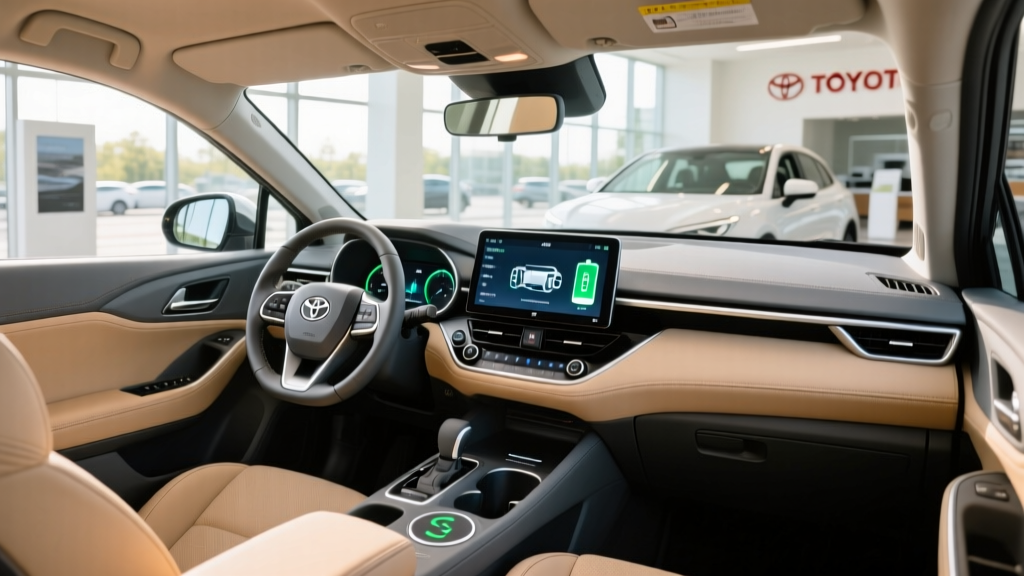
The dashboard uses a layered design with a prominent 8.0-inch touchscreen (upgraded to a 10.5-inch unit on XLE and XSE trims) running Toyota's latest Audio Multimedia interface. Soft-touch materials cover the upper dash and door armrests, but hard plastics dominate the lower door panels and center console sides — a common trade-off in this segment. The steering wheel is leather-trimmed on XLE and above, and physical knobs for climate control remain, which is a win for usability over the touch-capacitive controls some competitors have adopted.
Seating and Comfort
Front seats are well-bolstered and comfortable for long drives, with SofTex synthetic leather standard on XLE and XSE trims. Heated front seats are standard on XLE. Rear seat space is adequate for adults under 5'10" but tight for taller passengers on longer trips — legroom measures 37.8 inches in the rear, which trails the Honda HR-V and Mazda CX-50. The rear seatback recline is fixed, a missed opportunity for cargo flexibility.
Cargo and Practicality
Behind the rear seats, the Corolla Cross Hybrid offers approximately 25.5 cubic feet of cargo space — competitive with the Honda HR-V (24.4 cu ft) but less than the Subaru Crosstrek (27.6 cu ft). Fold the 60/40 split rear seats flat and you get roughly 56.0 cubic feet. The hybrid battery is mounted under the rear seat, so cargo volume is identical to the gas-only Corolla Cross. A hands-free power liftgate is available on the XLE Premium package.
Infotainment and Connectivity
Wireless Apple CarPlay and Android Auto are standard across all trims. The XLE and XSE feature a 10.5-inch display with native navigation. A 7.0-inch digital driver information display replaces the analog gauges, showing hybrid energy flow, battery state of charge, and trip data. A Qi-compatible wireless charging pad is standard on XLE and above. Six USB-C ports (two front, two rear, plus two in the cargo area on higher trims) keep devices powered.
Powertrain and Performance Specs
The Corolla Cross Hybrid uses Toyota's fifth-generation hybrid system — a conventional hybrid (HEV), not a plug-in hybrid. You never plug it in. The system recovers energy through regenerative braking and the gasoline engine to recharge its small battery pack automatically.
| Specification | Value |
|---|---|
| Powertrain Type | Conventional Hybrid (HEV), AWD standard |
| Engine | 2.0L 4-cylinder DOHC + 3 electric motor-generators |
| Combined Horsepower | 196 hp |
| Drivetrain | Electronic AWD (rear motor-driven) |
| Transmission | eCVT (planetary gearset) |
| Hybrid Battery | ~1.0 kWh lithium-ion (sealed NiMH on prior years; Li-ion for 2026) |
| 0–60 mph | ~7.8 seconds |
| Towing Capacity | Not rated for towing |
| EPA Fuel Economy | 46 city / 43 highway / 42 combined MPG (S trim); 45/38/42 (XLE/XSE) |
| Fuel Tank | 10.6 gallons |
| Total Driving Range | ~445 miles (S trim) |
| Base MSRP | $29,990 (S) / $32,290 (XLE) / $34,590 (XSE) |
| Hybrid Battery Warranty | 10 years / 150,000 miles |
The electronic AWD system uses a dedicated rear-axle electric motor (41 hp) that engages automatically when the front wheels slip or during hard acceleration. It's not designed for off-roading, but it provides confident traction in rain and light snow without the fuel-economy penalty of a mechanical AWD system.
How Many MPG Does the Corolla Cross Hybrid Actually Get?
The EPA rates the 2026 Corolla Cross Hybrid S trim at 46 city / 43 highway / 42 combined MPG. The heavier XLE and XSE trims drop slightly to 45 city / 38 highway / 42 combined, per fueleconomy.gov.
| Trim | City | Highway | Combined |
|---|---|---|---|
| S | 46 MPG | 43 MPG | 42 MPG |
| XLE | 45 MPG | 38 MPG | 42 MPG |
| XSE | 45 MPG | 38 MPG | 42 MPG |
Real-World MPG vs. EPA Estimates
Toyota's hybrid system excels in stop-and-go city driving, where regenerative braking and electric-only low-speed operation maximize efficiency. In real-world testing, owners frequently report 44–48 MPG in city driving, exceeding the EPA city estimate. Highway driving at 75+ mph tends to yield 36–40 MPG, slightly below the EPA highway number, because the small 2.0L engine works harder at sustained high speeds and the aerodynamic profile of a crossover creates more drag than a sedan.
In cold weather (below 32°F), expect a 5–10% drop in fuel economy as the engine runs more frequently to provide cabin heat and maintain battery temperature. This is far less severe than the 20–30% range loss a full EV experiences in winter, making hybrids practical year-round in cold climates without behavioral changes.
HEV vs. PHEV vs. EV: Which Fits Your Driving Pattern?
The Corolla Cross Hybrid is a conventional HEV — it has no plug, no electric-only range to speak of (under 1 mile at very low speeds), and no eligibility for the federal EV tax credit. Understanding the distinctions matters before you cross-shop.
HEV vs. PHEV vs. BEV — Quick Comparison
| Feature | HEV (Corolla Cross Hybrid) | PHEV (e.g., RAV4 Prime) | BEV (e.g., Tesla Model Y) |
|---|---|---|---|
| Plug-in Required? | No | Yes (Level 2 recommended) | Yes (Level 2 or DC fast) |
| Electric-Only Range | ~0.5 mi at low speed | 25–42 mi (model-dependent) | 250–330 mi (model-dependent) |
| Total Range | ~445 mi | ~550–600 mi | 250–330 mi |
| Federal Tax Credit (§30D) | Not eligible | Up to $7,500 (if eligible) | Up to $7,500 (if eligible) |
| Home Charging Needed | No | Recommended for EV range | Essential |
| Best For | No home charging access; long highway commutes | Short daily commute + road trip flexibility | Home charging + mostly under 250 mi/day |
Choose the Corolla Cross Hybrid (HEV) if: You don't have access to home or workplace charging, you drive a mix of city and highway miles, you want maximum simplicity (no plugs, no apps, no charging planning), and you want to spend under $35,000.
Consider a PHEV (like the RAV4 Prime or Prius Prime) if: You can install a Level 2 charger at home, your daily commute is under 40 miles round-trip (so you'd drive mostly on electricity), but you still want a gas engine for road trips.
Consider a full BEV if: You have reliable home charging, your daily driving is under 200 miles, you want the lowest per-mile fuel cost, and you qualify for the federal §30D tax credit to offset the higher purchase price.
Pricing, Trims, and Tax Credit Eligibility
The 2026 Corolla Cross Hybrid starts at $29,990 for the S trim (including destination), making it one of the most affordable AWD hybrid crossovers on the market. Here is the trim breakdown:
- S ($29,990): 8.0-inch touchscreen, wireless CarPlay/Android Auto, Toyota Safety Sense 3.0, 17-inch alloy wheels, LED headlights
- XLE ($32,290): 10.5-inch touchscreen, SofTex seats, heated front seats, wireless charging, 18-inch wheels, blind-spot monitoring
- XSE ($34,590): Sport-tuned suspension, XSE-specific styling, heated steering wheel, ambient lighting, JBL 9-speaker audio (with Premium package)
Does the Corolla Cross Hybrid Qualify for Any Tax Credit?
No. The Corolla Cross Hybrid is a conventional HEV, not a plug-in vehicle. The federal §30D New Clean Vehicle Credit applies only to battery-electric vehicles (BEVs) and plug-in hybrids (PHEVs) that meet battery-sourcing, MSRP, and buyer income requirements. Conventional hybrids like this one do not qualify for the $7,500 federal credit or the point-of-sale transfer.
Some states offer modest rebates for conventional hybrids (typically $250–$500), but these vary by jurisdiction and change frequently. Check your state's energy office or department of environmental quality for current programs. The fuel savings alone — approximately $600–$900 per year compared to a gas-only Corolla Cross AWD (28 MPG combined) — partially offset the hybrid's ~$2,000 price premium over the gas model at current fuel prices.
Reliability and Battery Warranty: What Owners Should Know
Hybrid Battery Warranty — Toyota Coverage
Duration: 10 years / 150,000 miles (whichever comes first)
Coverage: Defects in materials/workmanship and capacity below 60% of original
Hybrid System Components: Inverter, electric motor-generators, and control electronics covered for 8 years / 100,000 miles
Transferable: Yes — warranty transfers to subsequent owners, which supports resale value
How Long Will the Hybrid Battery Last?
Toyota's hybrid batteries have an exceptional longevity track record. Data from Prius fleets and high-mileage Toyota hybrid owners consistently shows hybrid battery packs lasting 150,000–200,000+ miles before significant degradation, with many units exceeding 250,000 miles. The Corolla Cross Hybrid uses a relatively small ~1.0 kWh lithium-ion pack that operates in a narrow state-of-charge window (roughly 40–80%), which is the gentlest operating range for lithium cells and minimizes calendar degradation.
Battery Replacement Cost
If the hybrid battery does fail outside warranty, replacement costs for a Toyota compact hybrid battery pack currently range from $2,500 to $4,000 (parts and labor at a dealership). Independent hybrid specialists often offer refurbished packs for $1,500–$2,500. Given the 10-year/150,000-mile warranty and the proven longevity of Toyota's hybrid systems, unplanned battery replacement is a low-probability event during typical ownership.
Overall Reliability
Toyota consistently ranks at or near the top of long-term reliability surveys from J.D. Power and Consumer Reports. The Corolla Cross Hybrid's powertrain shares core components with the Prius and Corolla Hybrid, both of which have multi-year track records. The eCVT transmission uses a planetary gearset with no belts, clutches, or bands to wear out — it's fundamentally simpler than a conventional automatic or a belt-driven CVT. Per NHTSA, the Corolla Cross has earned strong crash-test ratings, and Toyota Safety Sense 3.0 (pre-collision braking, lane departure alert, adaptive cruise control, lane tracing) is standard on every trim.
Pros and Cons: The Honest Verdict
Pros
- 42 MPG combined EPA — best-in-class for AWD subcompact crossovers
- Standard AWD with no fuel-economy penalty vs. FWD
- Starting under $30,000 — strong value proposition
- 10-year/150,000-mile hybrid battery warranty
- Toyota Safety Sense 3.0 standard on every trim
- Real-world city MPG often exceeds EPA estimates
- No plug-in charging required — works for apartment dwellers
Cons
- Rear seat legroom is tight for tall adults (37.8 in)
- Highway MPG drops noticeably at 75+ mph (real-world ~36-40)
- No plug-in hybrid variant available — no EV-only commuting
- No federal tax credit eligibility
- Cargo space (25.5 cu ft) trails some competitors
- Base S trim uses a smaller 8.0-inch screen
- Not rated for towing
Frequently Asked Questions
Is the Toyota Corolla Cross Hybrid a plug-in hybrid?
No. The Corolla Cross Hybrid is a conventional hybrid (HEV). It charges its battery through regenerative braking and the gasoline engine. You never plug it in. Toyota does not currently offer a plug-in hybrid (PHEV) version of the Corolla Cross.
How many MPG does the Corolla Cross Hybrid get in real-world driving?
The EPA rates it at 42 MPG combined (46 city / 43 highway for the S trim). In real-world conditions, city drivers often see 44–48 MPG thanks to Toyota's regenerative braking system. Highway driving at sustained high speeds typically yields 36–40 MPG. Cold weather reduces efficiency by roughly 5–10%.
Does the Corolla Cross Hybrid qualify for the $7,500 federal tax credit?
No. The federal §30D New Clean Vehicle Credit applies only to plug-in vehicles (BEVs and PHEVs) that meet specific battery-sourcing, MSRP, and buyer income requirements. The Corolla Cross Hybrid is a conventional HEV and does not qualify. Check the IRS guidance for the full list of eligible vehicles.
How long will the hybrid battery last and what does replacement cost?
Toyota's hybrid battery packs typically last 150,000–200,000+ miles based on long-term Prius and Corolla Hybrid data. The battery is covered by a 10-year/150,000-mile warranty. Out-of-warranty replacement costs $2,500–$4,000 at a dealership, or $1,500–$2,500 for a refurbished pack from an independent specialist.
How does the Corolla Cross Hybrid compare to the RAV4 Hybrid?
The RAV4 Hybrid is larger (37.6 cu ft cargo vs. 25.5), more powerful (219 hp vs. 196 hp), and rated for 39 MPG combined. It starts around $34,500 — roughly $4,500 more than the Corolla Cross Hybrid S. If you need more cargo space, rear-seat room, or towing capability (1,750 lbs), the RAV4 Hybrid justifies the premium. If your priority is maximum fuel economy and a lower purchase price, the Corolla Cross Hybrid is the better choice.
Should I buy the Corolla Cross Hybrid or a full EV?
If you have reliable home charging (a garage or driveway where you can install a Level 2 charger), drive under 250 miles daily, and qualify for the federal tax credit, a BEV like the Hyundai Ioniq 5 or Tesla Model Y will deliver lower per-mile operating costs and zero tailpipe emissions. If you lack home charging access, regularly drive long highway distances, live in an area with sparse public charging infrastructure, or want to stay under $35,000, the Corolla Cross Hybrid is the more practical and lower-risk choice.
Is the Corolla Cross Hybrid interior worth the price?
For the price point ($29,990–$34,590), the interior is competitive but not class-leading. The XLE and XSE trims with the 10.5-inch screen, SofTex seats, and wireless charging feel appropriately premium for the cost. The base S trim's 8.0-inch screen and cloth seats are functional but plain. Compared to a Mazda CX-30's upscale cabin, the Corolla Cross Hybrid trades material luxury for 10+ MPG of additional fuel economy and a lower starting price.