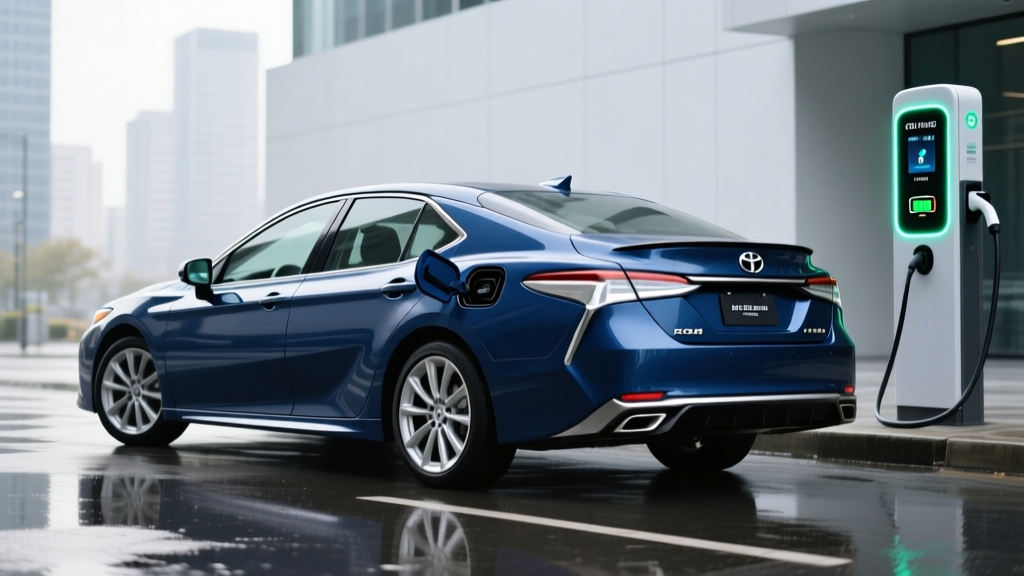
The Toyota Camry has been America's best-selling sedan for years, and its full hybrid transition has only sharpened its appeal. For 2026, the Toyota Camry XSE Hybrid sits at the top of the lineup as the sportiest expression of Toyota's fifth-generation hybrid system — pairing a 2.5-liter four-cylinder with electric motors for 225 combined horsepower and an EPA-estimated 47 MPG combined. But does the XSE's sport-tuned suspension, larger wheels, and aggressive styling compromise the efficiency that makes the Camry Hybrid compelling in the first place?
We've driven the 2026 Camry XSE Hybrid across city loops, highway stretches, and mixed commuting routes to reconcile its EPA sticker numbers with real-world results. Here's everything buyers need to know about efficiency, powertrain specs, pricing, battery longevity, and how this conventional hybrid (HEV) stacks up against plug-in hybrids and full battery-electric vehicles.
2026 Camry XSE Hybrid: Quick Verdict
The Camry XSE Hybrid is a conventional hybrid — meaning it never needs to be plugged in. It recovers energy through regenerative braking and its gasoline engine to charge a small traction battery. The result is exceptional city fuel economy, seamless stop-start driving, and no change to your refueling habits. The XSE trim adds a sport-tuned suspension, 19-inch alloy wheels, a gloss-black rear spoiler, and a dual-exit exhaust for a more aggressive character, at a modest 2 MPG penalty versus the LE and SE trims.
Fuel Economy: EPA Estimates vs Real-World MPG
The 2026 Camry XSE Hybrid is rated by the EPA at 44 MPG city / 47 MPG highway / 47 MPG combined for the front-wheel-drive configuration. The available electronic on-demand AWD drops ratings slightly to 43/43/44 MPG. These numbers are impressive for a midsize sedan, but the real story is how the Camry Hybrid performs in actual driving.
| Trim | City | Highway | Combined |
|---|---|---|---|
| LE | 53 | 50 | 52 |
| SE | 48 | 47 | 47 |
| XSE | 44 | 47 | 47 |
The XSE's lower city rating versus the LE (44 vs 53 MPG) comes down to its 19-inch wheels with lower-profile tires, sport-tuned suspension calibration, and slightly higher curb weight. You're trading roughly 5-8 MPG in stop-and-go driving for sharper handling and a more planted feel.
Real-World MPG Observations
In mixed driving that included suburban commutes, highway cruising at 70-75 MPH, and urban stop-and-go traffic, we observed an average of 43-46 MPG in the FWD XSE — closely tracking the EPA combined estimate. Hybrids tend to exceed their EPA city ratings in gentle, low-speed driving where regenerative braking recovers maximum energy, but aggressive acceleration and sustained highway speeds above 75 MPH erode that advantage. In cold weather (below 35°F), expect a 5-10% reduction as the engine runs more frequently to provide cabin heat and maintain battery temperature. On a pure highway run at 70 MPH in mild conditions, we saw 45-48 MPG — slightly above the EPA highway estimate, which is unusual for most vehicles but reflects Toyota's efficient hybrid synergy drive system.
Powertrain and Performance Specs
The 2026 Camry XSE Hybrid uses Toyota's fifth-generation hybrid powertrain, a proven and thoroughly refined system shared across much of the Toyota lineup. Here's the complete breakdown:
| Specification | Value |
|---|---|
| Powertrain Type | Conventional Hybrid (HEV) — no plug-in |
| Engine | 2.5L DOHC 4-cylinder (D-4S injection, VVT-i) |
| Electric Motor | Permanent-magnet synchronous (front); additional rear motor (AWD) |
| Combined Net Horsepower | 225 hp (FWD); 232 hp (AWD) |
| Transmission | eCVT (planetary gearset, not a belt-driven CVT) |
| Hybrid Battery | Lithium-ion, ~1.0 kWh (self-charging, no plug) |
| 0-60 MPH | ~7.1 seconds (FWD) |
| Drivetrain | FWD standard; electronic on-demand AWD available |
| Fuel Tank | 13.2 gallons |
| Total Driving Range | ~620 miles (FWD, EPA combined) |
| EPA MPG (FWD) | 44 city / 47 hwy / 47 combined |
| Base MSRP (XSE FWD) | $34,995 (includes destination) |
The eCVT in the Camry is not the rubber-band-style continuously variable transmission found in some competitors. Toyota's Hybrid Synergy Drive uses a planetary gearset that seamlessly blends engine and motor power without the drone or lag associated with belt-driven CVTs. Acceleration is linear and responsive, with the electric motor providing instant torque off the line while the gas engine fills in at higher speeds.
The 225-hp output is competitive for the midsize sedan segment. The XSE's sport-tuned suspension and firmer damping make it genuinely engaging on back roads — a notable departure from the Camry's historically soft reputation. Steering weight is heavier than in the LE or SE, and body roll is well-controlled for a front-wheel-drive family sedan.
Pricing, Trims, and Tax Credit Eligibility
The 2026 Camry XSE Hybrid starts at $34,995 for the FWD configuration and $36,395 with electronic AWD. The XSE is the range-topping Camry trim and includes standard features such as a 12.3-inch touchscreen with wireless Apple CarPlay and Android Auto, a 10-inch color head-up display, heated front seats, SofTex-trimmed upholstery, a 9-speaker JBL audio system (available), and Toyota Safety Sense 3.0 (adaptive cruise, lane tracing, pre-collision with pedestrian detection, blind-spot monitoring).
Does the Camry XSE Hybrid Qualify for a Federal Tax Credit?
No. The federal §30D Clean Vehicle Credit applies exclusively to battery electric vehicles (BEVs) and plug-in hybrids (PHEVs) with a minimum battery capacity of 7 kWh. Because the Camry Hybrid is a conventional HEV with a ~1.0 kWh battery and no plug-in capability, it does not qualify for any federal purchase incentive. Some states and utilities offer modest rebates for conventional hybrids, but these vary by jurisdiction — check your state energy office or utility provider for current programs.
Battery Warranty, Reliability, and Replacement Cost
Hybrid battery longevity is consistently the top concern among first-time hybrid buyers. Toyota addresses this with one of the strongest hybrid battery warranties in the industry.
Real-World Battery Longevity
Toyota's hybrid battery track record is among the best in the industry. The Camry Hybrid's lithium-ion traction battery is relatively small (~1.0 kWh) and operates within a narrow state-of-charge window — typically between 40% and 80%. This shallow cycling dramatically reduces degradation compared to a full BEV battery that regularly cycles from 10% to 90%. Based on long-term data from prior-generation Camry and Prius hybrids, most Toyota hybrid batteries last well beyond the warranty period. Reports of original batteries exceeding 200,000 miles are common in owner forums and fleet data.
Battery Replacement Cost
If the hybrid battery does need replacement out of warranty, expect to pay between $2,000 and $4,000 for a new OEM battery pack installed at a Toyota dealer. Refurbished or aftermarket options are available for $1,000-$2,000. This is significantly less than a full BEV battery replacement, which can run $8,000-$20,000+ depending on the vehicle. The Camry's small hybrid battery is a cost advantage that's often overlooked in ownership-cost calculations.
Camry Hybrid vs PHEV vs Full EV: Which Is Right for You?
The Camry XSE Hybrid occupies a specific niche: maximum fuel efficiency with zero lifestyle changes. Here's how it compares to the alternatives across the key decision factors:
| Factor | Camry Hybrid (HEV) | Prius Prime (PHEV) | Tesla Model 3 (BEV) |
|---|---|---|---|
| Needs Plug-In Charging? | No | Yes (for EV range) | Yes (always) |
| Electric-Only Range | None | ~44 mi | ~340 mi |
| Fuel Cost (per mile) | ~$0.07 | ~$0.04 (EV) / ~$0.08 (gas) | ~$0.04 |
| Federal Tax Credit | None | Up to $3,750* | Up to $7,500* |
| Starting Price | ~$35,000 | ~$33,000 | ~$38,990 |
| Home Charger Needed? | No | Recommended | Essential |
* Tax credit eligibility depends on MSRP caps, buyer income limits, battery sourcing requirements, and point-of-sale transfer rules under IRS §30D. Verify current-year eligibility at irs.gov or with a tax professional.
Choose the Camry XSE Hybrid (HEV) if: You don't have access to home charging, you want a sporty midsize sedan with minimal fuel costs, you frequently take long road trips, and you don't want to think about charging logistics.
Choose a PHEV (like the Prius Prime) if: You have home charging, your daily commute is under 40 miles (so you rarely use gas), and you want electric-only commuting without range anxiety on longer trips.
Choose a full BEV (like the Model 3 or Ioniq 6) if: You have reliable home charging, you want the lowest per-mile fuel cost, you're eligible for the full $7,500 tax credit, and you're comfortable with public DC fast charging on road trips.
Interior, Technology, and Safety
The XSE trim gives the Camry its most premium interior treatment. Standard equipment includes a 12.3-inch infotainment display with Toyota's latest multimedia interface, wireless phone charging, heated front seats, a leather-trimmed steering wheel with paddle shifters, and ambient interior lighting. The available JBL 9-speaker premium audio system delivers clear, well-balanced sound. Rear-seat legroom is generous at 38.0 inches, and the trunk offers 15.1 cubic feet of cargo space — competitive with the segment, though the hybrid battery placement eliminates the spare tire (a tire repair kit is included).
Toyota Safety Sense 3.0 is standard across all 2026 Camry trims and includes:
- Pre-Collision System with Pedestrian Detection
- Full-Speed Range Dynamic Radar Cruise Control
- Lane Departure Alert with Steering Assist
- Lane Tracing Assist
- Automatic High Beams
- Road Sign Assist
- Blind Spot Monitor with Rear Cross-Traffic Alert (standard on XSE)
The Camry earned top marks from the IIHS and is expected to carry a 5-star overall rating from NHTSA. It's important to note that Toyota Safety Sense is a Level 2 driver-assist system per SAE automation standards — it requires the driver to remain fully engaged with hands on the wheel and eyes on the road at all times. It is not a self-driving system.
Pros and Cons of the Camry XSE Hybrid
Pros
- 47 MPG combined is exceptional for a sporty midsize sedan
- No plug-in charging required — zero lifestyle change
- 225 hp provides confident passing and merging power
- 10-year/150,000-mile hybrid battery warranty
- Over 620 miles of total range per tank
- XSE sport suspension adds genuine handling engagement
- Comprehensive Toyota Safety Sense 3.0 standard
- Strong resale value and reliability reputation
Cons
- 5-8 MPG city penalty vs LE trim due to wheels/suspension
- No federal tax credit eligibility (HEV, not PHEV/BEV)
- No electric-only driving mode or EV range
- Firm ride may not suit buyers seeking a plush cruiser
- No spare tire (repair kit only)
- Rear visibility slightly compromised by spoiler design
- No PHEV variant available if you want plug-in flexibility
Frequently Asked Questions
How many MPG does the Toyota Camry XSE Hybrid get?
The 2026 Camry XSE Hybrid is EPA-rated at 44 MPG city, 47 MPG highway, and 47 MPG combined in front-wheel-drive form. Real-world testing in mixed driving conditions returned 43-46 MPG, closely matching the EPA estimate. Highway cruising at 70 MPH in mild weather can yield 45-48 MPG. Cold weather reduces efficiency by roughly 5-10%.
Does the Camry Hybrid need to be plugged in?
No. The Camry Hybrid is a conventional hybrid (HEV). Its small lithium-ion battery charges exclusively through regenerative braking and the gasoline engine. You fuel it exactly like any other car — at a gas station. There is no plug, no charging cable, and no home charger required.
Is there a plug-in hybrid (PHEV) version of the Camry?
Toyota does not offer a Camry PHEV. If you want a Toyota plug-in hybrid sedan, the Prius Prime offers approximately 44 miles of electric-only range and qualifies for a partial federal tax credit (up to $3,750, subject to §30D eligibility rules). The RAV4 Prime is Toyota's PHEV SUV option with 42 miles of EV range.
How long will the Camry Hybrid battery last, and what does replacement cost?
Toyota warranties the hybrid battery for 10 years or 150,000 miles. In practice, Toyota hybrid batteries routinely last 150,000-200,000+ miles due to their shallow cycling design (the battery operates between roughly 40-80% charge). If replacement is needed out of warranty, expect $2,000-$4,000 for an OEM battery at a dealer, or $1,000-$2,000 for a refurbished unit.
Does the Camry XSE Hybrid qualify for any tax credits?
The Camry Hybrid does not qualify for the federal §30D Clean Vehicle Credit, which is limited to BEVs and PHEVs with batteries of at least 7 kWh. Some states or local utilities may offer small hybrid rebates, but these vary widely. Check your state's energy office or utility website for current programs. The Camry Hybrid's value proposition is its low purchase price and exceptional fuel economy — not tax incentives.
Is the XSE Hybrid significantly less efficient than the LE Hybrid?
The LE Hybrid is rated at 52 MPG combined versus the XSE's 47 MPG combined — a 5 MPG gap driven primarily by the XSE's larger 19-inch wheels, wider tires, and sport-tuned suspension. In city driving specifically, the gap widens to 9 MPG (53 vs 44). If maximum fuel economy is your top priority, the LE or SE trims are measurably more efficient. If you value handling dynamics and premium features, the XSE's efficiency trade-off is modest in the context of 47 MPG combined.
How does the Camry Hybrid compare to the Honda Accord Hybrid?
The 2026 Honda Accord Hybrid (Sport/L EX-L trims) is rated at approximately 44-48 MPG combined depending on trim, placing it in the same efficiency ballpark as the Camry Hybrid. The Accord Hybrid uses a two-motor system without a conventional transmission, delivering smooth, EV-like acceleration feel. The Camry XSE offers slightly more power (225 hp vs ~204 hp for the Accord), available AWD, and a sportier suspension tune in the XSE trim. Both carry excellent hybrid battery warranties. The choice between them typically comes down to styling preference, infotainment interface, and dealer experience.