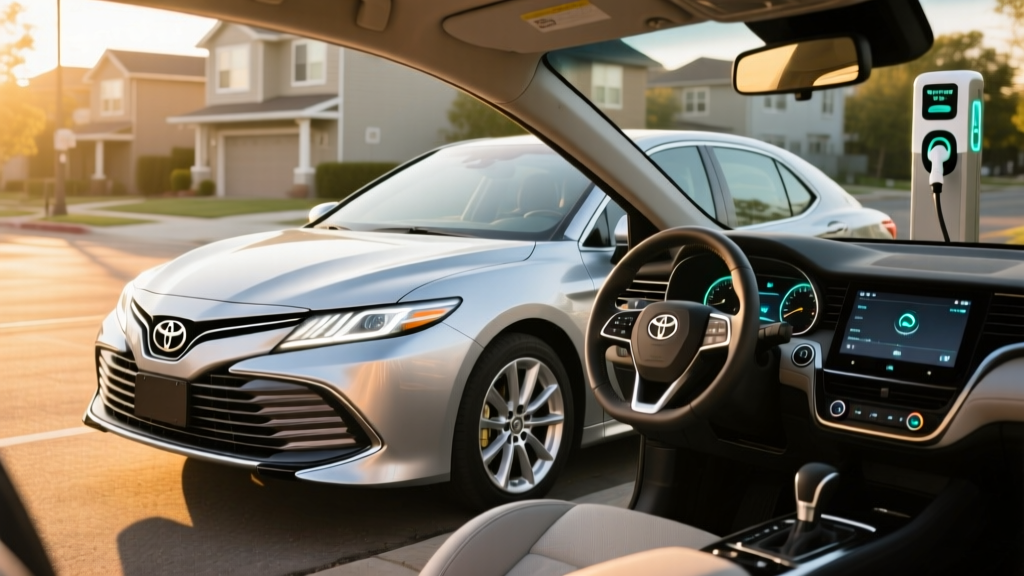
The midsize sedan segment has been gutted by crossovers, but the Toyota Camry refuses to go quietly. Now in its ninth generation and offered exclusively as a hybrid since the 2025 model year, the Camry targets buyers who want sedan comfort without the fuel bills of a gas-only midsize car. The XLE trim sits near the top of the lineup, adding premium touches to Toyota's fifth-generation hybrid system.
If you've landed here searching for the Toyota Camry XLE Hybrid, you likely want hard numbers: What does it actually get at the pump? How does the hybrid system work day-to-day? And is it worth it over a plug-in hybrid or a full battery-electric vehicle? This guide answers those questions with EPA data, real-world driving observations, and ownership cost analysis.
Toyota Camry XLE Hybrid at a Glance: Key Specs
| Specification | Value |
|---|---|
| Powertrain | 2.5L 4-cylinder + 2 electric motors (5th-gen hybrid) |
| Combined Horsepower | 225 hp |
| Drivetrain | FWD (AWD available on SE/XSE; XLE is FWD) |
| EPA Fuel Economy | 51 city / 49 highway / 51 combined MPG |
| Fuel Tank Capacity | 13.2 gallons |
| Total Driving Range | ~673 miles (EPA combined) |
| 0–60 mph (est.) | ~7.1 seconds |
| Cargo Volume | 15.1 cu ft |
| Hybrid Battery | Lithium-ion, ~1.6 kWh (sealed, self-charging) |
| Starting MSRP (XLE FWD) | $35,495 (incl. destination) |
| Hybrid Battery Warranty | 10 years / 150,000 miles |
| Powertrain Warranty | 5 years / 60,000 miles |
Fuel Economy: EPA Ratings vs. Real-World MPG
The headline number for the Camry XLE Hybrid is its EPA rating: 51 MPG city, 49 MPG highway, and 51 MPG combined, according to fueleconomy.gov. That city-biased efficiency is a hallmark of Toyota's hybrid synergy drive system, which leans heavily on electric-motor propulsion at low speeds and recaptures energy through regenerative braking.
In mixed suburban and highway driving, owners and independent testers consistently report 47–53 MPG combined. City-heavy commutes with frequent stops often push the number above the EPA city rating — sometimes into the mid-50s. Sustained highway cruising at 75+ mph tends to drop efficiency to 43–46 MPG, as the gasoline engine carries a greater share of the load. In cold weather (below 35°F), expect a 5–10% reduction as the engine runs more frequently to maintain cabin heat and battery temperature.
| Trim | City | Highway | Combined |
|---|---|---|---|
| LE (FWD) | 53 | 50 | 52 |
| SE (FWD) | 48 | 47 | 47 |
| XLE (FWD) | 51 | 49 | 51 |
| XSE (AWD) | 44 | 43 | 44 |
The XLE's slightly lower combined rating compared to the base LE comes from its larger 18-inch alloy wheels, additional sound-deadening weight, and more power-drawing comfort features (heated/ventilated seats, larger infotainment screen). The difference is marginal — roughly 1 MPG combined — and unlikely to be noticeable in daily driving.
How the Hybrid System Works: HEV vs. PHEV vs. EV
The Camry XLE Hybrid is a conventional hybrid electric vehicle (HEV), not a plug-in hybrid. This distinction matters, and it's a common source of confusion among shoppers cross-shopping electrified vehicles.
HEV vs. PHEV vs. BEV — What's the Difference?
| Type | Plugs In? | Electric-Only Range | Fuel Source | Example |
|---|---|---|---|---|
| HEV (Hybrid) | No — self-charging via regen & engine | ~1 mile at low speed | Gasoline only | Camry Hybrid |
| PHEV (Plug-in Hybrid) | Yes — Level 1 or Level 2 | 25–45 miles typical | Electricity + gasoline | Toyota RAV4 Prime |
| BEV (Battery Electric) | Yes — Level 1, 2, or DC fast | 200–400+ miles | Electricity only | Tesla Model 3, Hyundai Ioniq 6 |
The Camry Hybrid's small ~1.6 kWh lithium-ion battery pack charges exclusively through regenerative braking and the onboard gasoline engine. You never plug it in. The system automatically manages when to use electric-only propulsion (typically at low speeds, during coasting, and when starting from a stop), when to blend engine and motor power, and when to run the engine alone.
Toyota does not currently offer a Camry PHEV in the U.S. market. If plug-in capability with electric-only commuting is a priority, you'd need to look at the Toyota RAV4 Prime (42 miles electric-only) or a competitor like the Hyundai Tucson PHEV (33 miles). For a sedan with plug-in capability, options are thin — the segment has largely shifted to full BEVs or conventional hybrids.
Powertrain Deep Dive: 225 HP from Toyota's 5th-Gen Hybrid
The 2026 Camry XLE Hybrid uses Toyota's fifth-generation Hybrid Synergy Drive, pairing a 2.5-liter Dynamic Force four-cylinder engine (producing approximately 184 hp and 163 lb-ft of torque on its own) with two motor-generators integrated into the transaxle. Combined system output is rated at 225 horsepower.
The front motor (MG2) handles primary propulsion and regenerative braking, while the smaller rear motor (MG1) serves as a starter, generator, and power-split device controller. There is no traditional multi-speed transmission — Toyota uses an electronically controlled continuously variable transmission (eCVT), which provides seamless acceleration without shift shock.
The XLE trim is front-wheel drive only. If all-wheel drive is a must, you'll need to step to the SE or XSE trims, which add a rear-mounted electric motor for on-demand AWD (bumping combined output to 232 hp but reducing fuel economy to 44 MPG combined).
Acceleration is adequate rather than thrilling. The 0–60 mph time of approximately 7.1 seconds puts the Camry XLE Hybrid in line with rivals like the Honda Accord Hybrid but well behind sporty EVs. Where the hybrid system shines is in low-speed responsiveness — electric motor torque fills in before the gasoline engine reaches its power band, making city merging and stoplight launches feel punchier than the horsepower figure alone suggests.
Pricing, Trims, and Tax Credit Eligibility
The 2026 Toyota Camry XLE Hybrid starts at an MSRP of approximately $35,495, including destination charges. Adding packages (such as the available panoramic roof, premium JBL audio, or advanced technology package) can push the as-tested price into the $39,000–$41,000 range.
No. Under the current IRS §30D rules, the federal clean vehicle tax credit (up to $7,500) is available only for plug-in electric vehicles — battery-electric (BEV) and plug-in hybrid (PHEV) models that meet battery-sourcing, critical-mineral, MSRP cap, and buyer income requirements. The Camry Hybrid is a conventional HEV and does not qualify for the §30D federal tax credit. Some states offer their own hybrid incentives or HOV-lane access, but these vary widely by jurisdiction. Check your state's energy or DMV website for current local programs. For federal credit rules, see IRS.gov §30D guidance.
While the lack of a federal tax credit is a disadvantage versus PHEVs and BEVs that do qualify, the Camry Hybrid's lower base price and exceptional fuel economy often close the gap in total cost of ownership within 2–3 years of typical driving.
Hybrid Battery Warranty, Lifespan, and Replacement Cost
Toyota covers the Camry Hybrid's battery pack for 10 years or 150,000 miles, whichever comes first. This warranty guarantees the battery against defects and excessive capacity loss. Additionally, all hybrid-system components (inverter, motor-generators, control module) are covered under the 8-year/100,000-mile hybrid system warranty.
Battery longevity is consistently the top concern among first-time hybrid buyers. The data is reassuring: Toyota's hybrid battery packs, particularly the lithium-ion units used in the current generation, have demonstrated strong durability in fleet and consumer use. Independent surveys and long-term ownership reports suggest most Toyota hybrid batteries last well beyond 150,000 miles before showing meaningful degradation. The fifth-generation system also uses a more conservative state-of-charge window (never fully charging or fully depleting the pack), which reduces chemical stress and extends cycle life.
Replacement cost: If the battery does need replacement outside of warranty, expect to pay between $2,500 and $4,000 for a new OEM pack, including labor. Refurbished or reconditioned packs are available from third-party suppliers for $1,500–$2,500. For context, this is roughly equivalent to a major transmission repair on a conventional gas car — a meaningful expense, but not the catastrophic five-figure bill some fear.
Who Should Buy the Camry XLE Hybrid (and Who Shouldn't)
✓ Choose the Camry XLE Hybrid If:
- You want 50+ MPG without changing your fueling habits (no plugging in)
- You drive 12,000–20,000+ miles per year and want to minimize fuel spend
- You don't have reliable access to home or workplace charging
- You value Toyota's long-term reliability reputation and strong resale value
- You want a comfortable, well-equipped midsize sedan under $40,000
- You take frequent road trips and don't want to plan around charging stops
✗ Look Elsewhere If:
- You have home charging and a short commute — a PHEV or BEV eliminates most gasoline use
- You want federal tax credit eligibility (§30D requires a plug-in vehicle)
- You need AWD in the XLE trim (AWD requires SE/XSE)
- You prioritize sporty handling over efficiency (consider the Honda Accord Hybrid or a BEV)
- You want the lowest possible per-mile fuel cost — electricity at $0.13/kWh beats gasoline at any MPG
5-Year Cost of Ownership: Camry Hybrid vs. Gas Sedan vs. BEV
To put the Camry XLE Hybrid's value in perspective, here's a simplified 5-year/75,000-mile cost comparison against a typical gas-only midsize sedan and a comparably priced BEV, assuming 15,000 miles driven annually, $3.50/gallon regular unleaded, and $0.14/kWh home electricity.
| Vehicle Type | Efficiency | Fuel/Energy Cost (5 yr) | Tax Credit | Est. Net Fuel Advantage |
|---|---|---|---|---|
| Gas midsize sedan (30 MPG) | 30 MPG combined | ~$8,750 | $0 | Baseline |
| Camry XLE Hybrid (51 MPG) | 51 MPG combined | ~$5,147 | $0 | Save ~$3,603 |
| Comparable BEV (3.5 mi/kWh) | ~120 MPGe | ~$3,000 | Up to $7,500 | Save ~$5,750 + credit |
The Camry Hybrid saves roughly $3,600 in fuel over five years versus a 30 MPG gas sedan — enough to offset a meaningful portion of its price premium. A BEV saves even more, particularly when the §30D credit applies, but requires home charging infrastructure and acceptance of range and charging-time trade-offs on long trips.
Frequently Asked Questions
How many MPG does the Toyota Camry XLE Hybrid actually get?
The EPA rates the 2026 Camry XLE Hybrid at 51 city / 49 highway / 51 combined MPG. In real-world mixed driving, most owners report 47–53 MPG combined, with city-heavy routes often exceeding the EPA city estimate. Sustained high-speed highway driving and cold weather will reduce these figures by 5–10%.
Does the Camry Hybrid need to be plugged in?
No. The Camry Hybrid is a conventional HEV (hybrid electric vehicle). Its small battery charges through regenerative braking and the gasoline engine. You fuel it exclusively at gas stations, just like a traditional car.
Is there a plug-in hybrid (PHEV) version of the Camry?
Toyota does not currently sell a Camry PHEV in the United States. The closest Toyota PHEV is the RAV4 Prime, which offers 42 miles of electric-only range. For a sedan with plug-in capability, you'll need to look at non-Toyota PHEVs or full BEVs.
How long does the Camry Hybrid battery last?
Toyota warranties the hybrid battery for 10 years or 150,000 miles. Real-world data from Toyota's hybrid fleet suggests most packs last well beyond the warranty period. The fifth-generation system's conservative charge management (keeping the battery in a mid-state-of-charge window) helps maximize longevity.
What does it cost to replace the hybrid battery?
Out-of-warranty replacement with a new OEM battery pack runs approximately $2,500–$4,000 including labor. Refurbished packs are available for $1,500–$2,500. This is comparable to a major powertrain repair on a conventional vehicle.
Is the Camry XLE Hybrid better than a full EV?
It depends on your situation. If you lack home charging, drive long distances regularly, or live in an area with sparse public charging infrastructure, the Camry Hybrid offers exceptional efficiency without lifestyle changes. If you have reliable home Level 2 charging and a commute under 40 miles, a BEV will deliver lower per-mile energy costs, fewer moving parts, and potential tax credit savings. Neither is universally "better" — the right choice depends on your charging access, driving patterns, and budget.
Does the Camry XLE Hybrid qualify for any tax credits?
The Camry Hybrid does not qualify for the federal §30D clean vehicle tax credit, which is limited to plug-in vehicles (BEVs and PHEVs). Some states may offer hybrid-specific rebates or incentives — check your state energy office or DMV for current programs.