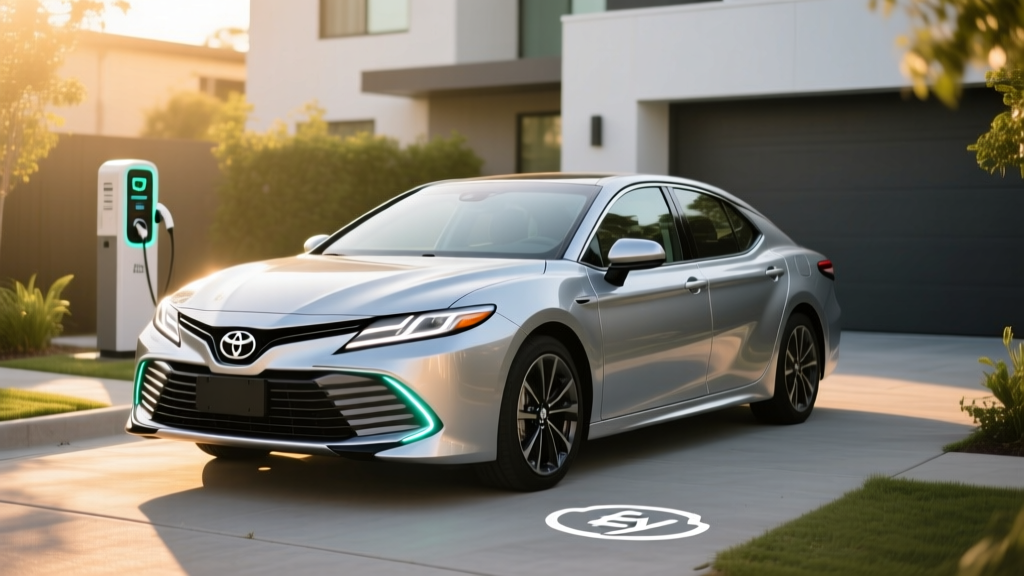
The midsize sedan segment has gone almost entirely electrified, but not every buyer is ready for a battery-electric vehicle. Enter the Toyota Camry plug-in hybrid — specifically, the 2026 Camry PHEV, a model that bridges the gap between Toyota's legendary conventional hybrid and the full-electric future. With an EPA-estimated 52 miles of electric-only range and a combined 48 MPG once the battery depletes, it's designed for commuters who want EV-like daily driving without range anxiety on road trips.
But does the math actually work? Below, we break down real-world efficiency, charging logistics, powertrain specs, tax credit eligibility, and whether this PHEV makes more sense than the standard Camry HEV or a dedicated EV like the Hyundai Ioniq 6.
HEV vs. PHEV: Which Camry Are You Actually Looking At?
Toyota sells two distinct electrified Camry variants, and confusing them is the most common mistake shoppers make. Here's the fundamental difference:
| Feature | Camry HEV (Conventional Hybrid) | Camry PHEV (Plug-In Hybrid) |
|---|---|---|
| Needs to be plugged in? | No — self-charging via regen and engine | Yes — plug in to access EV range |
| Battery size | 1.6 kWh (small buffer) | 18.1 kWh usable |
| Electric-only range | ~1 mile at low speed | 52 miles (EPA) |
| Combined MPG (gas mode) | 52 MPG | 48 MPG |
| Starting MSRP | ~$29,990 | ~$36,490 |
| Federal tax credit | Not eligible | Up to $3,750 (§30D, see below) |
The conventional HEV is the right call if you can't charge at home or work. The PHEV only unlocks its value proposition if you can plug in regularly — ideally every night. Without charging, you're carrying around 400+ pounds of extra battery mass and getting slightly worse fuel economy than the lighter HEV.
2026 Camry PHEV Powertrain and Performance Specs
| Specification | 2026 Toyota Camry PHEV |
|---|---|
| Powertrain | 2.5L 4-cyl + front electric motor |
| Combined system output | 225 hp / 163 lb-ft torque |
| 0–60 mph | 7.1 seconds (est.) |
| Battery (usable) | 18.1 kWh lithium-ion (NMC) |
| EV-only range (EPA) | 52 miles |
| Total range (EV + gas) | ~510 miles |
| Charge port | J1772 (Level 1/2 only, no DC fast charge) |
| Level 2 charge time (0–100%) | ~2.5 hours at 7.2 kW |
| Level 1 charge time (120V) | ~9 hours |
| Drivetrain | FWD (AWD not offered on PHEV) |
| Base MSRP (SE trim) | $36,490 |
The 225 hp combined output is adequate for merging and passing, though not sporty. The electric motor provides strong initial torque off the line, and the transition from EV to hybrid mode is seamless — most drivers won't notice the engine start unless they're watching the energy-flow display.
Critical note on DC fast charging: The Camry PHEV does not support DC fast charging. This is standard for most PHEVs — the battery is small enough that Level 2 (240V) charging fully replenishes it in about 2.5 hours. You won't be using Electrify America or Tesla Superchargers with this vehicle.
Fuel Economy and Electric Range: EPA vs. Real World
| Driving Mode | EPA Estimate | Real-World Expectation |
|---|---|---|
| EV-only (MPGe) | 102 MPGe combined | 90–105 MPGe (weather-dependent) |
| Hybrid mode — City | 50 MPG | 50–55 MPG (hybrids excel in city) |
| Hybrid mode — Highway | 46 MPG | 42–46 MPG |
| Hybrid mode — Combined | 48 MPG | 45–50 MPG |
| EV-only range | 52 miles | 40–52 miles (cold weather cuts ~20%) |
The Camry PHEV's 52-mile EPA electric range covers the average American's one-way commute with room to spare. According to fueleconomy.gov, the average daily driving distance in the US is roughly 37 miles — meaning many PHEV owners could go weeks without burning gasoline if they charge nightly.
In colder climates (below 40°F), expect that 52-mile range to drop to roughly 40–44 miles. The PHEV's battery thermal management is less aggressive than a full EV's, and cabin heating draws from the battery until the engine kicks on. This is normal PHEV behavior, not a defect.
Once the battery depletes, the 48 MPG combined hybrid mode takes over seamlessly. Toyota's hybrid synergy drive is among the most efficient in the industry, and real-world owners on fueleconomy.gov's "My MPG" tracker consistently report 46–52 MPG in mixed driving after the battery is spent.
Charging Setup: What You Need at Home
Because the Camry PHEV battery is only 18.1 kWh, home charging is straightforward and relatively inexpensive to set up.
| Charging Level | Power | Time (0–100%) | Equipment Needed |
|---|---|---|---|
| Level 1 (120V outlet) | ~1.4 kW | ~9 hours | Included portable cord |
| Level 2 (240V) | 7.2 kW | ~2.5 hours | Home wall charger or public L2 |
For most PHEV owners, Level 1 charging on a standard 120V household outlet is sufficient. Plug in when you get home at 6 PM, and the battery is full by 3 AM — well before your morning commute. A Level 2 home charger ($300–$600 for equipment, plus $500–$1,500 for electrician installation) is convenient but not mandatory the way it is for a full EV.
This is a key practical advantage of the PHEV: you don't need a 200-amp panel upgrade or a $2,000 electrical installation to make it work. Any standard garage outlet will do.
Pricing, Trims, and Federal Tax Credit Eligibility
The 2026 Toyota Camry PHEV starts at $36,490 (SE trim, including destination). A fully loaded XSE PHEV reaches approximately $42,000 with options.
Regarding the federal §30D plug-in hybrid tax credit: the Camry PHEV qualifies for up to $3,750 under current IRS rules. This is not the full $7,500 available to some EVs, because the credit is split into two halves — $3,750 for battery component sourcing and $3,750 for critical minerals sourcing. As of the 2026 model year, Toyota has confirmed the Camry PHEV meets the battery component requirement but not the full critical minerals threshold.
Per IRS §30D guidelines, additional eligibility requirements include:
- MSRP cap: Vehicle must be under $55,000 (sedan) — the Camry PHEV clears this easily
- Buyer income cap: AGI under $150,000 (single) / $300,000 (joint)
- Point-of-sale transfer: You can apply the credit at the dealership to reduce your purchase price directly
- Assembly: Must be assembled in North America (the Camry PHEV is built in Georgetown, KY)
Always verify current eligibility on the IRS website or with a tax professional before purchasing — sourcing rules change, and credit amounts can shift mid-year.
Battery Warranty, Reliability, and Replacement Cost
Toyota Hybrid/PHEV Battery Warranty: 10 years / 150,000 miles (whichever comes first) on the hybrid battery pack. This applies in all 50 states. The broader powertrain warranty covers 5 years / 60,000 miles.
Toyota's hybrid battery longevity record is arguably the best in the industry. The Prius, now in its 25th year, has demonstrated that NiMH and lithium-ion hybrid batteries routinely last 150,000–200,000+ miles before meaningful degradation. The Camry PHEV's larger lithium-ion pack benefits from conservative charge/discharge buffers — Toyota never lets the battery reach true 0% or 100%, which significantly extends cycle life.
If the battery does need replacement outside of warranty, expect a cost between $3,500 and $5,500 (parts and labor) at a Toyota dealership. Independent hybrid-battery refurbishers offer reconditioned packs for $2,000–$3,000. This is dramatically less than full EV battery replacements, which can exceed $12,000.
Toyota's overall brand reliability continues to lead the industry. The Camry has been an IIHS Top Safety Pick contender for over a decade, and the 2026 model carries forward the Toyota Safety Sense 3.0 suite (pre-collision braking, lane tracing, adaptive cruise, and road sign assist).
Camry PHEV vs. Full EV vs. Gas: Which Should You Choose?
Choose the Camry PHEV if:
- Your commute is under 50 miles round-trip and you can charge nightly
- You take 3+ road trips per year and don't want to plan around charging stations
- You live in an apartment or area with limited public charging infrastructure
- You want EV-like daily driving but need 500+ miles of total range
Choose a full EV (e.g., Hyundai Ioniq 6, Tesla Model 3) if:
- You have reliable Level 2 home charging
- Your daily driving is predictable and under 250 miles
- You want the lowest per-mile energy cost (~$0.04/mi on home solar vs. ~$0.08/mi on PHEV electric)
- You want to eliminate oil changes and engine maintenance entirely
Choose the standard Camry HEV (conventional hybrid) if:
- You cannot charge at home or work
- You want the lowest upfront cost (~$6,500 less than the PHEV)
- You drive primarily highway miles where the PHEV's electric range adds little value
Pros and Cons at a Glance
Pros
- 52 miles of real-world-usable EV range covers most commutes
- No range anxiety — 510+ miles total with a full tank and charge
- Level 1 (120V) charging is sufficient; no expensive home install required
- Toyota's industry-leading hybrid reliability and 10-year battery warranty
- Eligible for up to $3,750 federal tax credit (point-of-sale)
- Strong resale value — Camry consistently leads midsize sedan depreciation charts
Cons
- $6,500 premium over the conventional Camry HEV
- No DC fast charging — irrelevant for most, but limits public charging utility
- FWD only; no AWD option on the PHEV variant
- 225 hp is adequate but not exciting — this is an efficiency play, not a performance sedan
- Tax credit is $3,750, not the full $7,500 — reduces the payback period advantage
- EV range drops ~20% in cold weather (to ~40 miles)
Frequently Asked Questions
How many MPG does the Toyota Camry plug-in hybrid get?
The 2026 Camry PHEV gets an EPA-estimated 48 MPG combined (50 city / 46 highway) in hybrid mode after the battery is depleted. In EV-only mode, it achieves 102 MPGe. Real-world owners typically see 45–52 MPG combined depending on driving conditions.
How far can the Camry PHEV go on electric only?
The EPA rates the 2026 Camry PHEV at 52 miles of electric-only range. In real-world driving, expect 44–52 miles depending on temperature, terrain, and speed. Cold weather (below 40°F) reduces this to approximately 40–44 miles.
Does the Toyota Camry plug-in hybrid qualify for a tax credit?
Yes — the 2026 Camry PHEV qualifies for up to $3,750 under the IRS §30D federal clean vehicle credit. Eligibility depends on buyer income (under $150K single / $300K joint), and the credit can be transferred at the point of sale to reduce your purchase price. Verify current eligibility at irs.gov.
Is the Camry PHEV reliable? What does a battery replacement cost?
Toyota's hybrid battery warranty covers 10 years / 150,000 miles, and the brand's track record with hybrid batteries is the best in the industry. If replacement is ever needed out of warranty, expect $3,500–$5,500 at a dealership, or $2,000–$3,000 from an independent refurbisher.
Do I need to install a special charger for the Camry PHEV?
No. A standard 120V household outlet (Level 1) will fully charge the 18.1 kWh battery in about 9 hours — sufficient for overnight charging. A Level 2 (240V) charger reduces this to ~2.5 hours but is optional, not required.
How does the Camry PHEV compare to the RAV4 Prime?
The RAV4 Prime offers 42 miles of EV range, AWD, and 302 hp — but starts around $44,000. The Camry PHEV gives you more EV range (52 miles), better fuel economy (48 vs. 38 MPG combined), and a lower starting price ($36,490), but sacrifices AWD and cargo versatility.