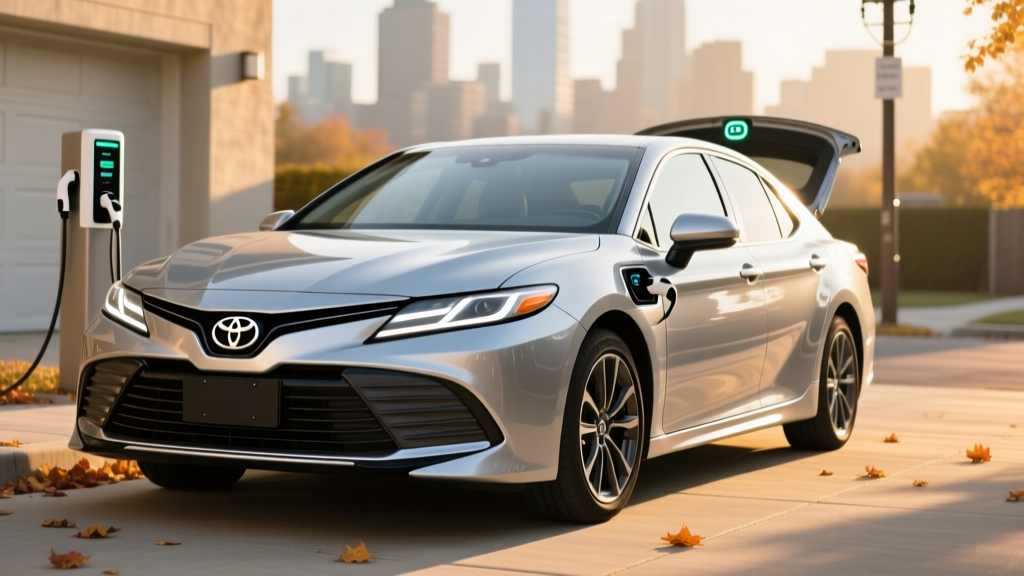
If you've been searching for a Camry PHEV—a plug-in hybrid version of Toyota's best-selling sedan—you're not alone. The idea of plugging in a Camry for 25–30 miles of electric-only commuting before the gas engine kicks in sounds ideal. But here's the reality check upfront: Toyota does not sell a plug-in hybrid (PHEV) version of the Camry in the United States as of the 2026 model year.
What Toyota does offer is the Camry Hybrid (HEV), a conventional self-charging hybrid that requires no plug and delivers exceptional fuel economy. Meanwhile, the RAV4 Prime stands as Toyota's only PHEV in the US lineup. This guide breaks down exactly what the 2026 Camry Hybrid delivers, why a Camry PHEV doesn't exist stateside, and which electrified sedan actually fits your needs.
HEV vs PHEV: What's the Difference, and Why It Matters
Before diving into specs, it's critical to understand the distinction between the two hybrid architectures—confusing them is one of the most common mistakes EV-curious shoppers make.
Conventional Hybrid (HEV) — 2026 Camry Hybrid
- No plug required. The battery charges through regenerative braking and the gas engine.
- Battery: ~1.1 kWh (small, assists acceleration and enables brief EV-mode at low speeds).
- Electric-only range: Under 1 mile, at very low speeds. Not meaningful for commute substitution.
- Refueling: Gas station only, like any conventional car.
- Benefit: Dramatically improved MPG with zero behavior change.
Plug-In Hybrid (PHEV) — Not Available for Camry
- Plug required to unlock the full benefit. Charges via Level 1 (120V) or Level 2 (240V).
- Battery: Typically 13–20 kWh (much larger, enables real EV-mode driving).
- Electric-only range: 25–45 miles on most PHEVs—enough for many commutes.
- Refueling: Electric grid + gas station.
- Benefit: Daily EV driving with gas backup for longer trips.
The Camry Hybrid is the first category. If you want a Toyota PHEV sedan, you'd need to look at the Prius Prime—or step up to the RAV4 Prime SUV.
2026 Toyota Camry Hybrid: EPA MPG, Powertrain, and Specs
For the 2026 model year, the Camry comes exclusively as a hybrid. Toyota dropped the gas-only four-cylinder after 2024, going all-in on the fifth-generation Toyota Hybrid System (THS). Here's the full breakdown:
| Specification | 2026 Camry Hybrid (FWD) | 2026 Camry Hybrid (AWD) |
|---|---|---|
| Combined System HP | 225 hp | 232 hp |
| Engine | 2.5L 4-cyl + 2 electric motors | 2.5L 4-cyl + 3 electric motors |
| EPA City MPG | 53 mpg | 51 mpg |
| EPA Highway MPG | 50 mpg | 49 mpg |
| EPA Combined MPG | 51 mpg | 50 mpg |
| Hybrid Battery | ~1.1 kWh lithium-ion | ~1.1 kWh lithium-ion |
| 0–60 mph | ~7.1 sec | ~6.8 sec |
| Fuel Tank | 13.2 gal | 13.2 gal |
| Total Range (est.) | ~670 miles | ~660 miles |
| Starting MSRP | ~$30,495 (LE) | ~$31,995 (LE AWD) |
Source: fueleconomy.gov and Toyota. Specs based on LE trim; higher trims may vary slightly.
Real-World MPG: Does the Camry Hybrid Actually Hit 51 Combined?
The EPA rates the FWD Camry Hybrid LE at 51 mpg combined (53 city / 50 highway). But how does that translate to real driving?
City driving is where this hybrid shines brightest. Toyota's THS relies heavily on the electric motor at low speeds, shuttling between EV mode and engine assist seamlessly. In stop-and-go traffic, many owners report exceeding the EPA city figure—55–58 mpg is common in warm weather on flat urban routes. Regenerative braking recaptures energy that a gas car wastes as heat at every stoplight.
Highway driving tells a different story. At sustained 75–80 mph speeds, the engine does most of the work. The hybrid system provides less benefit here, and real-world highway fuel economy tends to land in the 44–48 mpg range, especially with headwinds, hills, or cold temperatures. This is still exceptional for a midsize sedan—but it's a few mpg below the EPA sticker.
Cold weather penalty: Expect a 10–15% MPG drop in sub-freezing temperatures. The engine runs more often to generate cabin heat and warm the catalytic converter, reducing time spent in EV mode. A 51 mpg combined rating might dip to 43–46 mpg in January in Minnesota. This is normal hybrid behavior, not a defect.
- Warm-weather city: 53–58 mpg (meets or exceeds EPA)
- Mixed commuting: 48–53 mpg
- Highway (75+ mph): 44–48 mpg
- Cold-weather combined: 43–46 mpg
Why Toyota Doesn't Offer a Camry PHEV (And What to Get Instead)
A plug-in hybrid Camry would need a larger battery (13–18 kWh), onboard charger, charge port, and heavier electrical hardware—all adding cost, weight, and complexity. Toyota has made a strategic choice: the Camry Hybrid serves the high-volume, no-plug-needed buyer, while the Prius Prime fills the PHEV sedan slot.
Here's how the closest Toyota alternatives compare:
| Model | Type | EV Range | Combined MPG / MPGe | Starting MSRP |
|---|---|---|---|---|
| Camry Hybrid | HEV | N/A (<1 mi) | 51 mpg | ~$30,495 |
| Prius Prime | PHEV | 44 miles | 127 MPGe / 52 mpg (gas) | ~$33,445 |
| RAV4 Prime | PHEV | 42 miles | 94 MPGe / 38 mpg (gas) | ~$44,905 |
The Prius Prime is the closest thing to a "Camry PHEV" in spirit: a midsize Toyota PHEV sedan with 44 miles of electric-only range (per the EPA), enough to cover most commutes without burning a drop of gas. It also qualifies for the federal §30D tax credit (subject to income and sourcing requirements—see below).
Tax Credit Eligibility: Does the Camry Hybrid Qualify?
This is where the HEV vs PHEV distinction has real financial consequences:
- Camry Hybrid (HEV): Does NOT qualify for the §30D federal plug-in vehicle tax credit. Conventional hybrids are ineligible—they have no plug and no qualifying battery capacity under IRS rules.
- Prius Prime (PHEV): May qualify for up to $3,750 under §30D, depending on battery critical-mineral and component sourcing requirements. The full $7,500 requires meeting both sourcing thresholds, which shift annually. Check the latest on IRS.gov.
Income caps apply: Modified AGI cannot exceed $150,000 (single), $225,000 (head of household), or $300,000 (joint). MSRP cap for sedans: $55,000. Point-of-sale transfer is available at participating dealers.
Some states offer their own hybrid incentives, though most target PHEVs and BEVs. Check your state energy office or AFDC.energy.gov for local programs.
Battery Warranty, Reliability, and Replacement Costs
Hybrid battery longevity is the number-one concern for first-time hybrid buyers. Toyota has two decades of hybrid production history, and the data is reassuring.
2026 Camry Hybrid Battery Warranty
- Hybrid battery: 10 years / 150,000 miles (whichever comes first)
- Hybrid system components: 8 years / 100,000 miles (inverter, transaxle, control module)
- Capacity retention: Toyota warrants the battery against failure, not a specific degradation percentage (unlike EVs). In practice, Camry Hybrid batteries rarely lose more than 10–15% capacity over 150,000 miles because the system keeps the battery in a narrow 40–80% state of charge—ideal for longevity.
Replacement cost if out of warranty: A new OEM hybrid battery for the Camry runs approximately $3,000–$4,500 installed at a dealer. Independent hybrid specialists often offer refurbished or reconditioned batteries for $1,500–$2,500. Given the 10-year/150,000-mile warranty and the small size of the battery (~1.1 kWh), replacement is uncommon during typical ownership.
Reliability track record: Toyota's hybrid system is among the most proven powertrains in the industry. The eCVT transaxle has no traditional belts, clutches, or torque converter—fewer wear items than a conventional automatic. Brake pads last significantly longer thanks to regenerative braking handling most deceleration. The Camry Hybrid consistently earns top reliability marks from owner surveys.
Camry Hybrid vs PHEV vs Full EV: Which Fits Your Life?
Choosing between a conventional hybrid, a plug-in hybrid, and a battery-electric vehicle comes down to three factors: charging access, commute distance, and trip patterns.
Choose the Camry Hybrid (HEV) if:
- You have no access to home or workplace charging (apartment, street parking).
- You want maximum MPG with zero behavior change—just fill up at gas stations.
- Your trips are a mix of city and highway with no single dominant pattern.
- Budget matters: $30,495 starting price with no charging equipment to buy.
Choose the Prius Prime (PHEV) if:
- You can install a Level 2 charger at home or have reliable workplace charging.
- Your daily commute is under 40 miles round-trip (the 44-mile EV range covers it).
- You want EV-like daily driving but need gas flexibility for road trips.
- You qualify for the §30D tax credit, effectively lowering the price gap.
Choose a Full EV (e.g., Tesla Model 3, Hyundai Ioniq 6) if:
- You have reliable home Level 2 charging and your daily driving is under 250 miles.
- You want to eliminate gas entirely and minimize maintenance (no oil, no spark plugs, fewer brake jobs).
- You qualify for the full $7,500 federal credit, significantly offsetting the higher purchase price.
- You're comfortable planning longer road trips around DC fast-charging stops.
Pricing and Trims: 2026 Camry Hybrid Lineup
| Trim | Drivetrain | MSRP (approx.) | Key Features |
|---|---|---|---|
| LE | FWD | $30,495 | 8" touchscreen, TSS 3.0, wireless CarPlay |
| LE | AWD | $31,995 | Same + electronic AWD rear motor |
| SE | FWD / AWD | $32,095 / $33,595 | Sport-tuned suspension, 18" wheels |
| XSE | FWD / AWD | $35,295 / $36,795 | 12.3" display, leather, JBL audio |
| XLE | FWD / AWD | $35,795 / $37,295 | Premium comfort, ventilated seats |
All trims include Toyota Safety Sense 3.0 (adaptive cruise, lane-keeping, automatic emergency braking, blind-spot monitoring). This is a Level 2 driver-assist suite—the driver must remain engaged at all times.
✓ Pros
- 51 mpg combined EPA—among the best midsize sedans
- No plug needed; zero lifestyle adjustment
- 670+ mile total range per tank
- Strong reliability record; 10yr/150k hybrid battery warranty
- Competitive starting price ($30,495)
- Standard Toyota Safety Sense 3.0 across all trims
✗ Cons
- No PHEV option—can't commute on electric-only
- No federal tax credit eligibility (HEV)
- Highway MPG falls below EPA sticker at high speeds
- Modest acceleration (7.1 sec 0–60 FWD)
- ~1.1 kWh battery too small for meaningful EV-mode driving
- AWD adds ~$1,500 and drops MPG slightly
Frequently Asked Questions
How many MPG does the 2026 Camry Hybrid get?
The FWD Camry Hybrid LE is EPA-rated at 53 city / 50 highway / 51 combined mpg. The AWD version drops slightly to 51/49/50 mpg. In real-world city driving, many owners see 53–58 mpg thanks to regenerative braking. Highway driving at 75+ mph typically yields 44–48 mpg.
Does a Camry PHEV (plug-in hybrid) exist?
Not in the US market. Toyota sells the Camry exclusively as a conventional hybrid (HEV) in the United States. If you want a Toyota plug-in hybrid sedan, the Prius Prime offers 44 miles of electric-only range. The Camry is sold as a PHEV in some Asian markets, but Toyota has not announced US plans.
How far can the Camry Hybrid go on electric only?
Less than one mile, at very low speeds (under 25 mph). The ~1.1 kWh battery is designed to assist the gas engine, not replace it. For meaningful electric-only commuting (25+ miles), you need a PHEV like the Prius Prime or a full EV.
Is the Camry Hybrid reliable, and what does battery replacement cost?
Toyota's hybrid system has a 25+ year track record and is among the most reliable powertrains available. The hybrid battery is warranted for 10 years / 150,000 miles. Out-of-warranty replacement costs approximately $3,000–$4,500 at a dealer, or $1,500–$2,500 from independent hybrid specialists using refurbished units. Most Camry Hybrid batteries outlast the car.
Does the Camry Hybrid qualify for any tax credit?
No federal tax credit. The §30D Clean Vehicle Credit applies only to plug-in vehicles (PHEVs and BEVs) meeting battery-sourcing and income requirements. The Camry Hybrid is a conventional HEV and is ineligible. Some states may offer small hybrid incentives—check AFDC.energy.gov for your state.
Hybrid vs PHEV vs EV — which should I buy?
If you can't charge at home, the Camry Hybrid (HEV) is the best choice—excellent MPG, no plug needed. If you can charge at home and commute under 40 miles, the Prius Prime (PHEV) lets you drive electric daily with gas backup. If you want zero gas and have reliable charging, a full EV like the Tesla Model 3 or Hyundai Ioniq 6 eliminates fuel stops and most maintenance.
Does the Camry Hybrid need to be plugged in?
No. The Camry Hybrid is a conventional HEV. Its small battery charges through regenerative braking and the gas engine. There is no charge port and no need for any charging equipment. You fuel it at a gas station like any other car.
Specifications reflect 2026 model year data available at time of publication. Pricing, tax credit rules, and model availability are subject to change. Verify current IRS §30D eligibility at IRS.gov and confirm MPG at fueleconomy.gov.