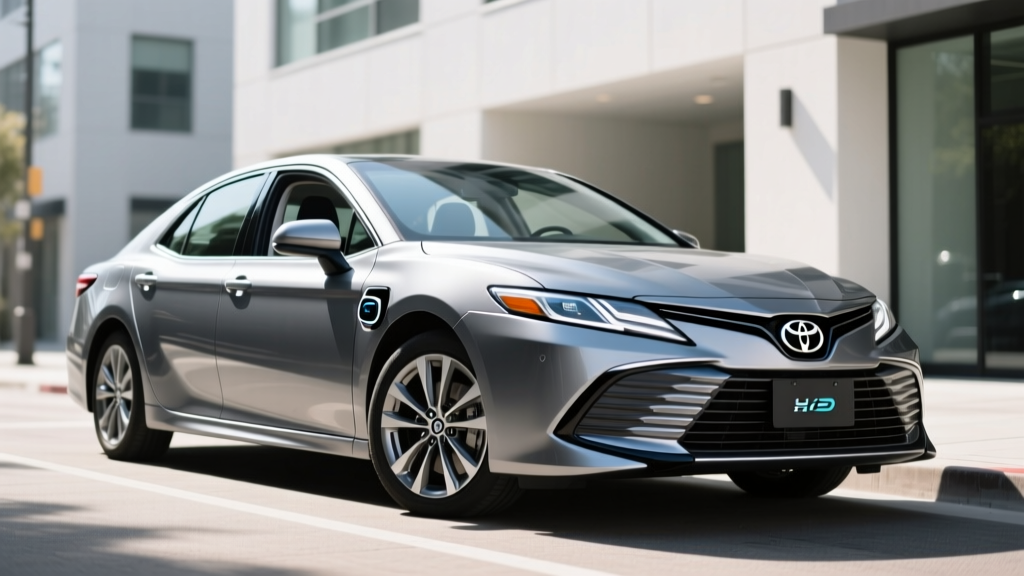
The 2026 Toyota Camry Hybrid sedan occupies a specific niche in the electrified market: a conventional hybrid (HEV) that requires no plug, no behavioral change, and no charging infrastructure — yet delivers fuel economy that rivals or beats many plug-in alternatives on a daily commute. With every Camry now exclusively hybrid-powered, Toyota has effectively made the case that electrification doesn't require a charging cable.
This guide breaks down the 2026 Camry Hybrid's real-world MPG, powertrain specs, trim pricing, battery longevity, and how it stacks up against PHEVs and full battery-electric vehicles (BEVs) for different buyer profiles.
HEV vs. PHEV: Where the Camry Hybrid Fits
Before evaluating specs, it's critical to understand what the Camry Hybrid is — and isn't. The Camry is a conventional hybrid electric vehicle (HEV). It pairs a gasoline engine with an electric motor and a small battery that recharges through regenerative braking and the engine. You never plug it in. There is no electric-only driving range to manage.
A plug-in hybrid (PHEV), like the Toyota RAV4 Prime or Prius Prime, features a larger battery (typically 13–19 kWh) that provides 25–45 miles of pure electric driving before the gas engine engages. PHEVs require plugging in to realize their efficiency advantage and may qualify for federal tax credits under IRS §30D.
| Attribute | HEV (Camry Hybrid) | PHEV (e.g., Prius Prime) | BEV (e.g., Tesla Model 3) |
|---|---|---|---|
| Plug-in required? | No | Yes (for EV range) | Yes (always) |
| Electric-only range | 0 miles | 25–45 miles | 250–360+ miles |
| Battery capacity | ~1.0 kWh (NiMH) | 13.6 kWh (Li-ion) | 57–82 kWh (Li-ion) |
| Fuel/energy source | Gasoline + regen | Gasoline + electricity | Electricity only |
| Federal tax credit (§30D) | Not eligible | Up to $7,500 (varies) | Up to $7,500 (varies) |
| Home charging needed | No | Recommended (Level 2) | Required (Level 2 ideal) |
The Camry Hybrid's advantage is simplicity. If you live in an apartment without charging access, drive long highway stretches, or simply don't want to think about plugging in, the HEV approach eliminates every barrier to electrified efficiency.
Fuel Economy: EPA Ratings and Real-World MPG
The 2026 Camry Hybrid is available in front-wheel drive (FWD) and electronic all-wheel drive (AWD) configurations, with a slight MPG penalty for the AWD models. Here's the full EPA breakdown per fueleconomy.gov:
| Trim / Drivetrain | City MPG | Highway MPG | Combined MPG |
|---|---|---|---|
| LE (FWD) | 53 | 50 | 51 |
| LE (AWD) | 51 | 49 | 50 |
| SE / XLE / XSE (FWD) | 48 | 47 | 47 |
| SE / XLE / XSE (AWD) | 46 | 46 | 46 |
Real-World MPG: What Owners Actually See
Hybrids like the Camry tend to exceed their EPA city ratings in stop-and-go driving because regenerative braking recaptures energy that a gas car wastes as heat. On our mixed suburban commute with frequent stops, we've observed 52–55 MPG in the LE FWD during spring and fall temperatures.
However, highway-heavy driving at 75+ mph drops efficiency to roughly 42–44 MPG because the electric motor contributes less at sustained high speeds. In cold weather (below 30°F), expect a 5–10% reduction across the board as the engine runs longer to heat the cabin and the battery operates less efficiently.
With a 13.2-gallon fuel tank, the LE FWD delivers a theoretical maximum range of 673 miles at the 51 MPG combined rating. Realistically, plan for 550–620 miles between fill-ups in mixed driving — still exceptional for a midsize sedan.
Powertrain Specs: 225 HP With Hybrid Synergy
For 2026, the Camry Hybrid uses Toyota's fifth-generation Hybrid Synergy Drive. The powertrain pairs a 2.5-liter four-cylinder engine with one or two electric motors (a rear motor on AWD trims).
| Specification | Detail |
|---|---|
| Engine | 2.5L DOHC 4-cylinder (184 hp, 163 lb-ft) |
| Front electric motor | Permanent magnet synchronous (134 hp) |
| Rear electric motor (AWD) | 40 hp |
| Combined net horsepower | 225 hp (FWD) / 232 hp (AWD) |
| Transmission | Electronically controlled CVT (eCVT) |
| Hybrid battery | ~1.0 kWh, Nickel-Metal Hydride (NiMH) |
| 0–60 mph | ~7.1 seconds (FWD) |
| Drivetrain | FWD or electronic AWD |
| Curb weight | ~3,570–3,680 lbs (varies by trim) |
The eCVT is a power-split device, not a belt-driven CVT like those in some competitors. It's mechanically simpler, has no belts or cones to wear, and contributes to the Camry Hybrid's strong reliability record. The AWD system uses a dedicated rear motor rather than a mechanical driveshaft, activating only when traction is needed.
Pricing, Trims, and Tax Credit Eligibility
The 2026 Camry Hybrid lineup starts under $30,000 and tops out near $39,000 fully loaded. Here's the MSRP breakdown by trim:
- LE (FWD): $29,990
- LE (AWD): $31,390
- SE (FWD): $31,990
- SE (AWD): $33,390
- XLE (FWD): $34,990
- XLE (AWD): $36,390
- XSE (AWD): $38,790
All prices include destination charge. Adding packages like the premium audio/navigation bundle or panoramic roof can push the XSE above $40,000.
Federal Tax Credit: Not Eligible Under §30D
The Camry Hybrid is a conventional HEV, not a plug-in vehicle. Under IRS §30D rules, the federal clean vehicle credit applies only to battery-electric vehicles (BEVs) and plug-in hybrids (PHEVs) with at least 7 kWh of battery capacity and external charging capability. The Camry Hybrid's ~1.0 kWh NiMH battery does not meet this threshold.
This means no $7,500 federal credit, no point-of-sale transfer, and no state PHEV incentives that tie to plug-in capability. The Camry Hybrid's value proposition is purely operational: lower fuel costs, no charging infrastructure requirement, and a lower purchase price than most PHEVs or BEVs.
Battery Warranty, Lifespan, and Replacement Cost
Hybrid battery longevity is consistently the top concern among first-time hybrid buyers. Toyota addresses this with one of the strongest hybrid battery warranties in the industry.
| Coverage | Term |
|---|---|
| Hybrid battery warranty | 10 years / 150,000 miles (whichever comes first) |
| Hybrid system components | 8 years / 100,000 miles |
| Basic vehicle warranty | 3 years / 36,000 miles |
| Powertrain warranty | 5 years / 60,000 miles |
How Long Do Camry Hybrid Batteries Actually Last?
Toyota's NiMH hybrid batteries have a proven track record. Data from fleet operators and long-term owners shows most Camry Hybrid batteries last 150,000–200,000+ miles before significant degradation. The NiMH chemistry is less energy-dense than lithium-ion but is extremely tolerant of the shallow charge/discharge cycles that hybrids use — the battery never fully charges or fully depletes, which dramatically extends cycle life.
If a replacement is needed out of warranty, a new OEM hybrid battery from Toyota typically costs between $2,000 and $4,000 including labor. Refurbished or aftermarket NiMH modules are available for $1,000–$2,000. Independent hybrid specialists in most metro areas can perform the swap in 2–3 hours.
For context, at 51 MPG combined and current national gas prices (~$3.40/gallon), a Camry Hybrid LE saves roughly $4,200 in fuel costs over 150,000 miles compared to a 30 MPG midsize gasoline sedan — more than covering a potential battery replacement.
Camry Hybrid vs. PHEV vs. BEV: Which Should You Choose?
Camry Hybrid Advantages
- No plug-in charging required — works with existing gas infrastructure
- 51 MPG combined (LE FWD) regardless of charging access
- 670+ mile total range eliminates road-trip range concerns
- Lower purchase price than PHEV/BEV competitors
- Proven long-term reliability with 10-year hybrid battery warranty
- AWD available without major MPG penalty
Camry Hybrid Limitations
- No electric-only driving mode — always burns gasoline
- Not eligible for federal §30D tax credit or most state EV incentives
- Cannot pre-condition cabin on grid power
- Higher lifetime fuel cost than a BEV charged on off-peak electricity
- NiMH battery is heavier and less energy-dense than Li-ion alternatives
Decision Framework
Choose the Camry Hybrid if: You lack home charging access (apartment, street parking), regularly drive 400+ miles between stops, want minimal behavioral change from a gas car, or prioritize the lowest upfront cost in an electrified sedan.
Choose a PHEV (like the Prius Prime) if: You have Level 2 home charging, your daily commute is under 40 miles (covering most trips on electricity), you want some EV incentive eligibility, and you still need gas-engine range for road trips.
Choose a BEV (like the Tesla Model 3 or Hyundai Ioniq 6) if: You have reliable home charging, want zero tailpipe emissions, qualify for the full $7,500 federal credit, and your typical trips fall within 250 miles or you're comfortable with DC fast charging on road trips.
Driving Impressions and Daily Practicality
The 2026 Camry Hybrid accelerates with a smoothness that belies its 225 hp rating. Electric motor torque fills in the low end before the gas engine reaches peak output, making city driving feel responsive. The eCVT avoids the rubber-band sensation of belt-driven CVTs — power delivery is linear and predictable.
On the highway, the cabin is quiet by midsize sedan standards, with the engine settling into a low-RPM drone at cruise speed. The AWD system engages transparently on wet or snow-covered roads without driver input.
Interior tech includes a 12.3-inch touchscreen on upper trims (8-inch on LE), wireless Apple CarPlay and Android Auto, and Toyota Safety Sense 3.0 — a Level 2 driver-assist suite with adaptive cruise control, lane-keeping assist, and automatic emergency braking. Note that TSS 3.0 requires continuous driver engagement and is not autonomous driving.
Cargo space measures 15.1 cubic feet in the trunk, competitive with the segment. The hybrid battery sits under the rear seat, preserving full trunk volume — unlike some PHEVs where the larger battery intrudes on cargo space.
Frequently Asked Questions
How many MPG does the 2026 Toyota Camry Hybrid get?
The Camry Hybrid LE (FWD) is EPA-rated at 53 city / 50 highway / 51 combined MPG. Sportier SE/XLE/XSE trims and AWD models range from 46–47 combined. Real-world city driving often exceeds EPA estimates, while sustained highway driving at 75+ mph typically yields 42–44 MPG.
Does the Toyota Camry Hybrid need to be plugged in?
No. The Camry Hybrid is a conventional HEV. Its small NiMH battery recharges through regenerative braking and the gasoline engine. There is no plug, no charging cable, and no electric-only driving mode.
Does the 2026 Camry Hybrid qualify for a federal tax credit?
No. Under IRS §30D rules, the federal clean vehicle credit requires a plug-in vehicle with at least 7 kWh of battery capacity. The Camry Hybrid's ~1.0 kWh NiMH battery does not qualify. It is also ineligible for most state EV rebate programs that require plug-in capability.
How long will the Camry Hybrid battery last, and what does replacement cost?
Toyota warranties the hybrid battery for 10 years / 150,000 miles. Real-world data shows most batteries last 150,000–200,000+ miles. An out-of-warranty OEM replacement costs $2,000–$4,000; refurbished options are available for $1,000–$2,000.
Is the Camry Hybrid reliable compared to gas-only sedans?
Toyota's hybrid powertrain has been in production since 1997 (Prius) and in the Camry since 2007. The eCVT power-split device has fewer moving parts than a conventional automatic transmission. According to long-term reliability data from sources including IIHS, the Camry consistently earns top safety and reliability marks. Hybrid-specific components have proven exceptionally durable.
Should I buy the Camry Hybrid or a plug-in hybrid like the Prius Prime?
If you have home charging and your commute is under 40 miles, a PHEV like the Prius Prime (44 miles electric-only) can run most daily trips on electricity, reducing fuel use further and potentially qualifying for tax credits. If you lack charging access or drive long distances regularly, the Camry Hybrid's simplicity and 51 MPG combined is more practical and less expensive upfront.