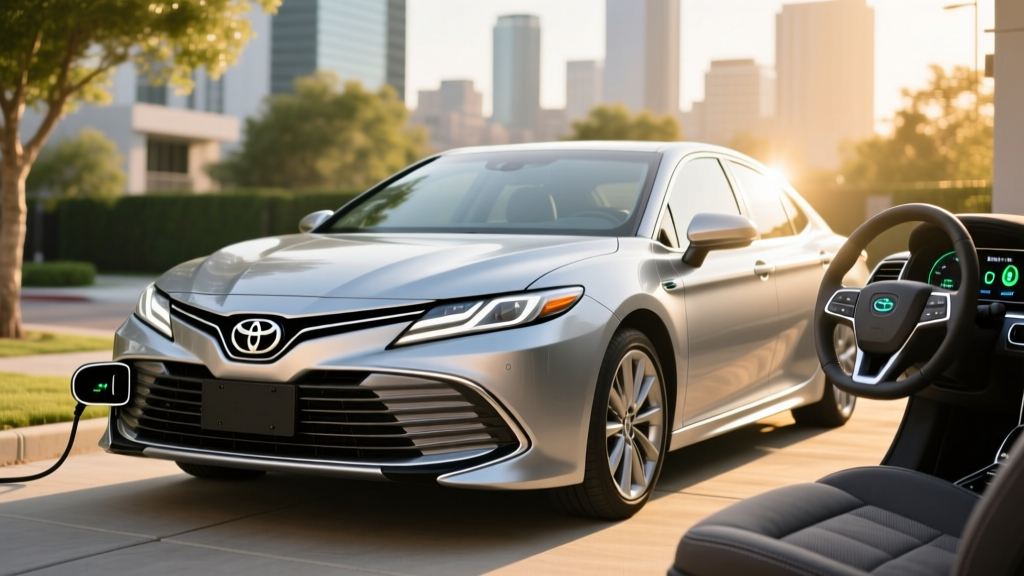
The Toyota Camry Hybrid has long been the default choice for buyers who want sedan comfort with exceptional fuel economy. The SE trim specifically targets drivers who refuse to accept that "efficient" must mean "boring." For 2026, the Camry Hybrid SE continues as a conventional hybrid (HEV) — no plug required — pairing a 2.5-liter four-cylinder engine with Toyota's fifth-generation hybrid system for a combined 225 horsepower and an EPA-estimated 47 MPG combined on all-wheel-drive models (51 combined on front-wheel drive).
This guide breaks down the exact numbers that matter: real-world MPG versus the EPA sticker, the SE's sport-tuned differentiators, total cost of ownership, and where the Camry Hybrid SE fits against plug-in hybrids and full battery-electric vehicles in 2026.
Toyota Camry Hybrid SE: Key Specifications at a Glance
| Specification | FWD | AWD (Electronic) |
|---|---|---|
| Powertrain | 2.5L 4-cyl + hybrid motor | 2.5L 4-cyl + dual hybrid motors |
| Combined Horsepower | 225 hp | 232 hp |
| EPA City MPG | 53 | 51 |
| EPA Highway MPG | 50 | 44 |
| EPA Combined MPG | 51 | 47 |
| Fuel Tank Capacity | 13.2 gal | 13.2 gal |
| Total Driving Range | ~673 mi | ~620 mi |
| 0–60 mph (est.) | ~7.2 sec | ~6.9 sec |
| Hybrid Battery | ~1.6 kWh (lithium-ion) | ~1.6 kWh (lithium-ion) |
| Plug-In Required? | No (self-charging HEV) | No (self-charging HEV) |
| Starting MSRP | ~$31,795 | ~$33,295 |
| Hybrid Battery Warranty | 10 yr / 150,000 mi | 10 yr / 150,000 mi |
Sources: fueleconomy.gov, Toyota USA. Pricing includes destination charge. Verify with your dealer as trims and packages adjust final cost.
HEV vs. PHEV vs. EV: Which Powertrain Fits Your Driving?
The Camry Hybrid SE is a conventional hybrid (HEV). This is a critical distinction in 2026, where the market now offers three electrified paths. Here is how they differ:
Conventional Hybrid (HEV) — Camry Hybrid SE
No plug. No behavior change. The small battery (~1.6 kWh) recharges via regenerative braking and the gasoline engine. You simply fill up at any gas station. Electric-only driving is limited to brief low-speed crawling (typically under 1 mile at low speeds). The payoff: dramatically better MPG than a gas-only car with zero lifestyle adjustment.
Plug-In Hybrid (PHEV) — e.g., Toyota RAV4 Prime, Prius Prime
Plug in to unlock electric range. A larger battery (typically 13–19 kWh) delivers 25–44 miles of electric-only driving before the gas engine engages. Total range remains 400–600+ miles. Requires access to Level 1 or Level 2 charging to capture the efficiency benefit. If you never plug in, a PHEV operates as a heavier, less efficient HEV.
Battery Electric Vehicle (BEV) — e.g., Tesla Model 3, Hyundai Ioniq 6
No gas engine. 100% electric. Ranges from 250–400+ miles per charge. Requires home or reliable public charging. Lowest per-mile "fuel" cost but highest upfront price and charging-infrastructure dependency.
Choose the Camry Hybrid SE (HEV) If:
- You lack access to home or workplace charging (apartment, street parking, no garage outlet).
- Your daily driving is variable — some days 15 miles, some days 400 — and you cannot plan charging stops.
- You want near-EV city efficiency without any range anxiety or charging logistics.
- Your budget is under $35,000 and you want proven long-term reliability.
Real-World MPG: What Camry Hybrid SE Owners Actually Report
EPA estimates are a useful baseline, but Toyota hybrids have a well-documented real-world quirk: they frequently exceed EPA city numbers while sometimes falling slightly short on sustained highway driving. This is the inverse of most gasoline cars and stems from how the hybrid system maximizes regenerative braking and electric-motor assist in stop-and-go traffic.
| Driving Scenario | FWD EPA | FWD Real-World (est.) | AWD EPA | AWD Real-World (est.) |
|---|---|---|---|---|
| City / Stop-and-Go | 53 | 50–56 | 51 | 48–54 |
| Highway (70–80 mph) | 50 | 44–48 | 44 | 40–44 |
| Combined (Mixed) | 51 | 47–52 | 47 | 43–48 |
| Cold Weather (Below 32°F) | — | 42–47 | — | 38–43 |
Why highway MPG drops: At sustained speeds above 70 mph, aerodynamic drag dominates and the hybrid system's regenerative advantage diminishes. The gasoline engine carries most of the load. Expect 44–48 MPG on the FWD SE during a 75-mph interstate cruise, not the 50 MPG highway sticker.
Why cold weather hurts: Below freezing, the engine runs more frequently to heat the cabin and maintain battery temperature. Expect a 10–15% MPG reduction in sustained winter conditions. This is less severe than the 20–30% range loss a full EV experiences in the same temperatures, but it is measurable.
Owner-reported data on fueleconomy.gov for recent-model-year Camry Hybrids consistently clusters around 45–52 MPG combined, validating the EPA estimates for mixed driving. Lead-foot drivers and those in hilly terrain should budget toward the lower end.
Camry Hybrid SE Powertrain: How 225 HP and 51 MPG Coexist
The 2026 Camry Hybrid SE uses Toyota's fifth-generation Hybrid Synergy Drive. Here is the hardware:
- Engine: 2.5-liter Dynamic Force inline-4, Atkinson cycle, producing 184 hp and 163 lb-ft of torque on its own.
- Front Electric Motor: Integrated into the transaxle, contributing to a net combined system output of 225 hp (FWD) or 232 hp (AWD).
- AWD Rear Motor (AWD models): A separate rear-mounted electric motor provides electronic all-wheel drive without a mechanical driveshaft, engaging automatically when traction is needed.
- Hybrid Battery: Lithium-ion pack, approximately 1.6 kWh usable capacity, mounted under the rear seat for optimal weight distribution. This is a compact, self-charging pack — not the 50–100 kWh packs found in full EVs.
- Transmission: Electronically controlled continuously variable transmission (eCVT), which is mechanically a planetary gearset, not a traditional belt-driven CVT.
The SE trim specifically adds a sport-tuned suspension with stiffer spring rates and dampers compared to the LE and XLE hybrid trims, plus paddle shifters for simulated 6-speed manual gear selection. The result is noticeably firmer ride quality and sharper turn-in — a genuine differentiator in a segment where most hybrids prioritize soft compliance.
2026 Pricing, Trims, and Tax Credit Eligibility
The Camry Hybrid SE sits in the middle of the Camry Hybrid lineup. Here is the 2026 pricing structure:
| Trim | FWD MSRP | AWD MSRP |
|---|---|---|
| LE | ~$29,995 | ~$31,495 |
| SE | ~$31,795 | ~$33,295 |
| XSE | ~$34,295 | ~$35,795 |
| XLE | ~$34,795 | ~$36,295 |
Does the Camry Hybrid SE Qualify for a Federal Tax Credit?
No. Under current IRS §30D Clean Vehicle Credit rules, conventional hybrids (HEVs) like the Camry Hybrid do not qualify for the federal tax credit. The credit applies only to plug-in electric vehicles (PHEVs and BEVs) that meet battery capacity, critical-mineral sourcing, MSRP caps, and buyer income thresholds.
Some states offer their own hybrid or clean-vehicle incentives — for example, certain utility rebates or state-level clean-fuel programs — but these vary widely by jurisdiction. Check your state's energy office or your local utility provider for current programs. A tax professional can confirm any applicable credits.
What About the Camry's Value Proposition Without a Credit?
The absence of a tax credit is offset by the Camry Hybrid SE's low entry price and minimal running costs. At ~$31,795, the SE is roughly $10,000–$15,000 less than a comparably equipped EV like the Tesla Model 3 or Hyundai Ioniq 6. Over five years and 75,000 miles, the fuel savings versus a gas-only midsize sedan (at ~28 MPG combined) can reach $3,500–$4,500 depending on local gas prices, largely closing the gap with any potential EV tax-credit advantage after accounting for higher EV insurance and depreciation.
Battery Longevity, Warranty, and Replacement Costs
Hybrid Battery Warranty
10 years or 150,000 miles (whichever comes first) — this is Toyota's standard hybrid battery warranty across all 50 states. The warranty covers defects and capacity loss below a specified threshold (typically 60–70% of original capacity, though Toyota's exact threshold should be confirmed with your dealer).
This warranty has applied since the 2020 model year. Earlier Camry Hybrids (2018–2019) carried an 8-year/100,000-mile warranty.
Real-World Battery Lifespan
Toyota's hybrid battery track record is among the best in the industry. The Prius, which shares similar hybrid architecture, has documented cases of original batteries lasting 200,000–300,000 miles with normal use. The Camry Hybrid's lithium-ion pack (replacing the older nickel-metal-hydride units in pre-2021 models) runs cooler and cycles less aggressively, further supporting longevity.
The critical factor is that the Camry Hybrid's ~1.6 kWh battery is never deeply discharged. The hybrid system operates within a narrow state-of-charge window (roughly 40–80% SoC), which dramatically reduces cell stress compared to a full EV that cycles between 10–90% daily.
Battery Replacement Cost
If the hybrid battery does require replacement outside of warranty:
- OEM Toyota replacement: $2,500–$4,500 (parts and labor at a dealership).
- Refurbished / aftermarket pack: $1,500–$2,500 installed at an independent hybrid specialist.
- Individual cell module replacement: Some hybrid specialists can replace failed modules within the pack for $500–$1,200, extending the pack's life at a fraction of full replacement cost.
For context, a full EV battery replacement (e.g., Tesla Model 3, Hyundai Ioniq 5) runs $10,000–$20,000+. The Camry Hybrid's small, simple battery is one of its lowest-risk ownership costs.
What the SE Trim Actually Gets You (vs. LE and XSE)
The SE sits between the value-oriented LE and the sport-premium XSE. Here is what differentiates the SE specifically:
- Sport-tuned suspension — firmer damping and spring rates for flatter cornering (not available on LE or XLE).
- 18-inch alloy wheels with a dark-gray finish (LE uses 16-inch; XSE uses 19-inch).
- SofTex sport seats with fabric inserts and embossed SE branding.
- Leather-trimmed steering wheel with paddle shifters.
- Dual exhaust tips (aesthetic, no performance difference).
- Smart Key System with push-button start and remote keyless entry on all doors.
- 8-inch Toyota Audio Multimedia touchscreen with wireless Apple CarPlay and Android Auto.
What the SE does not include that the XSE adds: 19-inch wheels, panoramic glass roof, ambient interior lighting, and the available 12.3-inch digital instrument cluster. If you want maximum sport aesthetics, the XSE is the upgrade; if you want the sport suspension and paddle shifters without paying for cosmetic extras, the SE is the rational pick.
Camry Hybrid SE Ownership Costs Over 5 Years
| Category | Estimated Cost | Notes |
|---|---|---|
| Purchase Price (MSRP) | $31,795 | Before dealer discounts, taxes, registration |
| Fuel (75,000 mi at 48 MPG avg, $3.40/gal) | ~$5,313 | Gas-only midsize sedan (~28 MPG): ~$9,107 |
| Maintenance (oil, filters, brakes, tires) | ~$2,200 | Hybrids use less brake wear due to regen |
| Insurance (national avg.) | ~$7,500 | Varies by driver, state, and coverage level |
| Depreciation (est. 5-yr) | ~$13,000 | Camry Hybrid retains value well; ~59% retained at 5 yr |
| Total Estimated 5-Yr Cost | ~$59,808 | Gas-only equivalent: ~$65,000+ |
The Camry Hybrid SE saves approximately $3,800 in fuel over five years compared to a 28-MPG gas-only midsize sedan. Brake pad replacement intervals are typically 80,000–120,000 miles thanks to regenerative braking handling most deceleration, saving $300–$500 versus a conventional sedan over the same period.
Pros, Cons, and the Final Verdict
✓ Pros
- 51 MPG combined (FWD) — among the best of any non-plug-in sedan
- No charging infrastructure needed — works with existing gas-station habits
- 10-year / 150,000-mile hybrid battery warranty
- Sport-tuned suspension on SE adds genuine driving engagement
- 620–673 miles of total range per tank
- Strong resale value and proven reliability record
- Standard Toyota Safety Sense 3.0 (adaptive cruise, lane-keeping, auto emergency braking)
✗ Cons
- No federal tax credit (HEVs excluded from §30D)
- Highway MPG drops to 44–48 real-world at 75+ mph
- eCVT can drone under hard acceleration (no traditional gear shifts)
- SE's sport suspension is firmer — ride quality trades comfort for handling
- No electric-only driving beyond very low-speed crawling
- Cargo space unchanged from gas Camry but smaller than some hybrid competitors due to battery placement under rear seat
- AWD model sacrifices ~4 MPG combined versus FWD
Frequently Asked Questions
How many MPG does the Toyota Camry Hybrid SE get?
The 2026 Camry Hybrid SE is EPA-rated at 53 city / 50 highway / 51 combined (FWD) and 51 city / 44 highway / 47 combined (AWD). In real-world mixed driving, expect 47–52 MPG for FWD and 43–48 MPG for AWD. Sustained highway driving above 70 mph will pull numbers toward the lower end of these ranges.
Does the Camry Hybrid need to be plugged in?
No. The Camry Hybrid is a conventional hybrid (HEV). Its small battery recharges automatically through regenerative braking and the gasoline engine. You never plug it in — you simply refuel at any gas station as you would with a conventional car.
How far can the Camry Hybrid SE drive on electric only?
Effectively less than one mile at very low speeds (under 25 mph in light-load conditions). The hybrid system uses the electric motor to assist the gasoline engine and enable brief engine-off coasting, but it is not designed for meaningful electric-only driving. If you want 25–44 miles of electric-only range, you need a plug-in hybrid (PHEV) like the Toyota Prius Prime or RAV4 Prime.
Is the Camry Hybrid reliable? What does battery replacement cost?
Toyota's hybrid system has over 25 years of proven reliability since the original 1997 Prius. The Camry Hybrid's lithium-ion battery is warranted for 10 years / 150,000 miles, and real-world data suggests many original batteries last 200,000+ miles. Out-of-warranty replacement costs $2,500–$4,500 for an OEM pack, or $1,500–$2,500 for a refurbished unit — far less than EV battery replacement.
Does the Camry Hybrid SE qualify for any tax credit?
The Camry Hybrid SE does not qualify for the federal §30D Clean Vehicle Credit, which is limited to plug-in vehicles (PHEVs and BEVs). Some states and utilities offer separate incentives for hybrids — check your state energy office or local utility for current programs. Always consult a tax professional for personal eligibility.
Should I get the Camry Hybrid SE or a full EV?
Choose the Camry Hybrid SE if you lack reliable home charging, drive unpredictable long distances, or want a lower purchase price (under $35K) with zero charging logistics. Choose a full EV (like the Tesla Model 3 or Chevrolet Equinox EV) if you have home Level 2 charging, drive under 300 miles daily, want the lowest per-mile energy cost (~$0.04–$0.06/mi vs. ~$0.07–$0.10/mi for the Camry Hybrid), and can accommodate a higher purchase price offset by the $7,500 federal tax credit (if eligible).
Is the SE's sport suspension noticeably different from the LE?
Yes. The SE's stiffer dampers and spring rates reduce body roll in corners and provide more communicative steering feedback, but the trade-off is a firmer ride over potholes and rough pavement. If comfort is your priority, the LE or XLE is a better match. If you enjoy a more engaged driving feel and accept the ride firmness, the SE justifies its ~$1,800 premium over the LE.