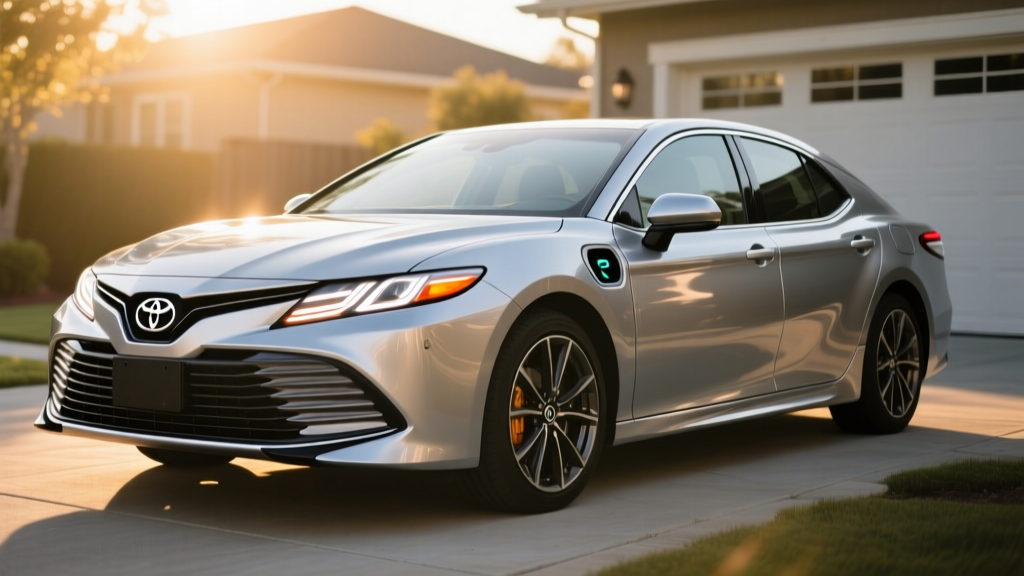
The Toyota Camry has been America's best-selling sedan for years, and since the 2025 redesign, it's been offered exclusively as a hybrid. For the 2026 model year, Toyota continues this all-hybrid strategy with a proven fifth-generation powertrain, available all-wheel drive, and a starting price that undercuts many gas-only competitors. This Toyota Camry Hybrid review breaks down the exact fuel economy figures, real-world efficiency data, battery longevity, and ownership costs you need before signing a purchase agreement.
One clarification up front: the 2026 Camry is a conventional hybrid (HEV), not a plug-in hybrid (PHEV). It does not have a charge port, does not run on electric-only power for meaningful distances, and does not qualify for the federal §30D EV tax credit. If you want plug-in capability from Toyota, you're looking at the RAV4 Prime or Prius Prime. We'll address that choice below.
2026 Toyota Camry Hybrid Fuel Economy: EPA and Real-World MPG
The 2026 Camry Hybrid carries over the EPA ratings established with the 2025 redesign. Front-wheel-drive (FWD) models achieve the highest numbers, while the available electronic all-wheel-drive (AWD) system adds a rear motor and trades a small amount of efficiency for traction.
| Drivetrain | City MPG | Highway MPG | Combined MPG |
|---|---|---|---|
| FWD (LE, SE, XLE, XSE) | 53 | 50 | 51 |
| AWD (SE, XLE, XSE) | 51 | 49 | 50 |
Source: fueleconomy.gov
Powertrain Specs: Fifth-Generation Toyota Hybrid System
The 2026 Camry uses Toyota's fifth-generation hybrid system, pairing a 2.5-liter four-cylinder engine with one or two electric motors depending on drivetrain configuration.
| Specification | FWD | AWD |
|---|---|---|
| Engine | 2.5L inline-4 (184 hp) | 2.5L inline-4 (184 hp) |
| Front Electric Motor | 134 hp | 134 hp |
| Rear Electric Motor | — | 40 hp |
| Net Combined Horsepower | 225 hp | 232 hp |
| Transmission | eCVT | eCVT |
| 0–60 mph (est.) | ~7.2 sec | ~7.0 sec |
| Hybrid Battery | ~1.1 kWh lithium-ion | ~1.1 kWh lithium-ion |
The small lithium-ion battery pack charges and discharges continuously during driving — it's never plugged in. The eCVT (electronically controlled continuously variable transmission) is a planetary gearset, not a belt-driven CVT, which gives it superior durability and a more linear power delivery than older CVT designs.
Pricing, Trims, and Tax Credit Eligibility
The 2026 Camry Hybrid lineup spans four trims, with AWD available on three of them. Here's the MSRP breakdown before any incentives:
| Trim | Drivetrain | MSRP |
|---|---|---|
| LE | FWD | $29,495 |
| SE | FWD or AWD | $30,795 / $31,595 |
| XLE | FWD or AWD | $33,995 / $34,795 |
| XSE | FWD or AWD | $34,595 / $35,395 |
Battery Warranty, Reliability, and Replacement Cost
Hybrid battery longevity remains the single most common concern among first-time hybrid buyers. Toyota's track record here is among the strongest in the industry, with Camry and Prius hybrid batteries regularly lasting 150,000–200,000+ miles with minimal degradation.
If the hybrid battery does eventually need replacement outside of warranty, expect to pay between $2,500 and $4,000 for a new OEM battery pack at a Toyota dealer, including labor. Refurbished or aftermarket packs can reduce that to $1,500–$2,500. Given that most Camry Hybrids see 15+ years of service before any battery concern, this is a long-tail cost that rarely affects first or even second owners.
Toyota's hybrid system reliability is well-documented. The brand consistently earns top marks from Consumer Reports and J.D. Power for long-term dependability. The eCVT design has fewer wear components than a traditional automatic transmission — no clutch packs, no torque converter, no friction bands to replace.
HEV vs. PHEV vs. Full EV: Which Is Right for You?
The 2026 Camry is an HEV. If you're cross-shopping electrified sedans, here's how the three categories compare in practical terms:
| Factor | HEV (Camry Hybrid) | PHEV (e.g., Prius Prime) | BEV (e.g., Tesla Model 3) |
|---|---|---|---|
| Plug-in Required? | No | Yes (Level 1/2) | Yes (Level 2/DC) |
| Electric-Only Range | ~1 mi (low-speed) | ~40–44 mi | 250–350+ mi |
| Combined MPG / MPGe | 51 MPG | 52 MPG + 127 MPGe | 132–142 MPGe |
| Home Charging Needed? | No | Recommended | Essential |
| Federal Tax Credit | $0 | Up to $7,500* | Up to $7,500* |
| Starting Price | $29,495 | ~$33,000 | ~$38,990 |
| Best For | No home charger, high mileage | Short commute + home charger | Full electric commitment |
*§30D credit eligibility depends on buyer income, vehicle MSRP caps, battery sourcing, and point-of-sale transfer rules. Verify at irs.gov.
Choose a PHEV if: You have a garage or driveway with a 120V or 240V outlet, your daily commute is under 40 miles round-trip, and you want to drive mostly on electricity while retaining a gas engine for road trips. The Prius Prime or RAV4 Prime fills this role.
Choose a full EV if: You have reliable Level 2 home charging, your daily driving is under 250 miles, and you want to eliminate gas entirely. The Tesla Model 3, Hyundai Ioniq 6, or Chevrolet Equinox EV are strong sedan/crossover options.
Driving Impressions and Daily Usability
The 2026 Camry Hybrid accelerates with quiet confidence. The 225 hp (FWD) output is competitive with turbocharged four-cylinder sedans, and the electric motor's instant torque fills in the low-end response that smaller engines lack. Merging onto highways and overtaking at 55–70 mph feels effortless — there's no downshift lag because the eCVT adjusts motor contribution seamlessly.
Ride quality on the XLE trim, with its softer suspension tuning and 17-inch wheels, absorbs potholes and expansion joints well. The SE and XSE trims use a sport-tuned suspension with 18- or 19-inch wheels that sharpens handling at the cost of some ride compliance — noticeable on rough concrete highways but not harsh.
The cabin is genuinely quiet at highway speed, a carryover benefit of the ninth-generation Camry platform. Toyota's 12.3-inch infotainment screen (standard on SE and above, 8-inch on LE) supports wireless Apple CarPlay and Android Auto. Physical climate controls remain, which is a practical win over touchscreen-only HVAC setups.
Cargo space measures 15.1 cubic feet in the trunk — competitive with the Honda Accord Hybrid and Hyundai Sonata Hybrid. The rear seat folds 60/40 for longer items, though the hybrid battery placement under the rear seat means there's no pass-through to the trunk from the cabin floor.
Safety Ratings and Driver-Assistance Features
Every 2026 Camry Hybrid comes standard with Toyota Safety Sense 3.0, which includes:
- Pre-Collision System with pedestrian detection
- Full-Speed Range Dynamic Radar Cruise Control
- Lane Departure Alert with Steering Assist
- Lane Tracing Assist
- Automatic High Beams
- Road Sign Assist
- Proactive Driving Assist (gentle braking when approaching slower vehicles)
The Camry earned a TOP SAFETY PICK+ rating from the IIHS (the highest designation) and a 5-Star overall rating from NHTSA. These are carryover ratings from the 2025 redesign, which shares the same platform and safety structure.
Pros and Cons at a Glance
- 51 MPG combined (FWD) — real-world often matches or exceeds EPA
- Sub-$30K starting price for a midsize hybrid sedan
- 10-year/150,000-mile hybrid battery warranty
- Available AWD without major MPG penalty
- TOP SAFETY PICK+ from IIHS
- No plug-in or behavior change required
- Strong resale value; Camry holds ~55% at 5 years
- No federal tax credit (HEV, not PHEV/BEV)
- No electric-only driving mode beyond low-speed creep
- AWD not available on base LE trim
- Trunk pass-through blocked by battery placement
- 8-inch base screen feels dated vs. competitors
- Rear-seat headroom slightly tight for 6'2"+ passengers
Frequently Asked Questions
How many MPG does the 2026 Toyota Camry Hybrid get?
The FWD Camry Hybrid achieves 53 city / 50 highway / 51 combined MPG per the EPA. AWD models rate at 51 city / 49 highway / 50 combined. In real-world mixed driving, most owners report 49–53 MPG combined, with city-heavy routes sometimes pushing above the EPA estimate thanks to regenerative braking.
Does the Camry Hybrid need to be plugged in?
No. The Camry Hybrid is a conventional HEV. Its small lithium-ion battery charges exclusively through regenerative braking and the gasoline engine. There is no charge port. You simply fill up with gas as you would with any conventional car.
Is the Camry Hybrid reliable, and what does battery replacement cost?
Toyota's hybrid system has two decades of proven reliability. The hybrid battery is warranted for 10 years or 150,000 miles. Out-of-warranty replacement runs $2,500–$4,000 at a dealer, though most batteries last well beyond 150,000 miles. The eCVT transmission has fewer failure points than a conventional automatic.
Does the 2026 Camry Hybrid qualify for any tax credit?
No. The federal §30D clean vehicle credit applies only to plug-in vehicles (PHEVs and BEVs) with battery packs of at least 7 kWh. The Camry Hybrid's ~1.1 kWh battery does not qualify. Some states offer hybrid-specific incentives — check your state energy office for current programs.
How does the Camry Hybrid compare to the Honda Accord Hybrid?
The 2026 Accord Hybrid rates at 48 MPG combined (FWD) — 3 MPG less than the Camry Hybrid. The Accord offers slightly more rear-seat legroom and a more engaging driving feel, while the Camry edges ahead on fuel economy, starting price, and available AWD. Both carry strong reliability records and 10-year hybrid battery warranties.
Should I buy the Camry Hybrid or wait for a plug-in version?
Toyota has not announced a Camry PHEV for the U.S. market. If plug-in capability is a priority, the Toyota Prius Prime (44 miles electric-only, ~$33K) or RAV4 Prime (42 miles, ~$44K) are the closest alternatives within the Toyota lineup. For buyers without home charging access, the Camry HEV remains the most practical electrified sedan Toyota offers.