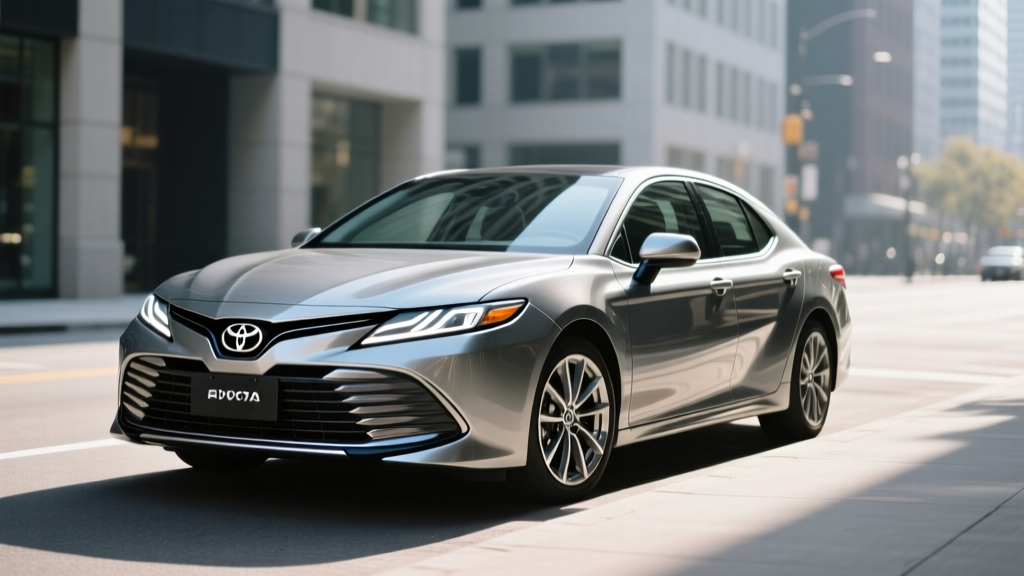
The Toyota Camry has been America's best-selling sedan for years, and since the 2025 redesign, it's offered exclusively as a hybrid. For buyers researching the Toyota Camry Hybrid MSRP, the picture is straightforward: four trims, a standard hybrid powertrain across the board, and pricing that undercuts most midsize competitors. But the real story isn't just the sticker price — it's what you get in fuel savings, reliability, and long-term ownership costs over five to ten years.
This guide breaks down every 2026 Camry Hybrid trim's MSRP, the EPA fuel economy numbers (and how they translate in real driving), the hybrid battery warranty, and how this HEV stacks up against plug-in hybrids and full EVs for different buyers.
2026 Toyota Camry Hybrid MSRP by Trim
Every 2026 Camry uses Toyota's fifth-generation hybrid system. There is no gas-only variant and no plug-in hybrid (PHEV) option — this is a conventional self-charging hybrid (HEV). Here's what each trim costs before destination fees or dealer adjustments.
| Trim | MSRP (FWD) | MSRP (AWD) | Key Additions |
|---|---|---|---|
| LE | $29,495 | $30,995 | 8-inch touchscreen, TSS 3.0, wireless CarPlay/Android Auto |
| SE | $31,090 | $32,590 | Sport-tuned suspension, 18-inch alloy wheels, paddle shifters |
| XLE | $34,295 | $35,795 | 12.3-inch display, heated front seats, leather-trimmed interior |
| XSE | $35,495 | $36,995 | Sport styling + XLE luxury, 19-inch wheels, ambient lighting |
Destination fee: $1,195 across all trims (add to above figures for out-the-door base pricing).
AWD note: The electronic on-demand AWD system adds a rear-mounted electric motor (no mechanical driveshaft) and costs $1,500 on every trim. It does not affect EPA MPG ratings.
EPA Fuel Economy: City, Highway, and Combined MPG
The Camry Hybrid's efficiency is where it earns its keep. The fifth-generation hybrid system pairs a 2.5-liter four-cylinder engine with electric motors for a combined output of 225 horsepower (FWD) or 232 hp (AWD). Here are the official EPA figures from fueleconomy.gov:
| Drivetrain | City MPG | Highway MPG | Combined MPG |
|---|---|---|---|
| FWD (all trims) | 53 | 50 | 52 |
| AWD (all trims) | 51 | 49 | 50 |
Those numbers are exceptional for a midsize sedan. To put them in context: a comparable gas-only Honda Accord 1.5T achieves 31 MPG combined, and the Hyundai Sonata Hybrid lands at 47 MPG combined.
Real-World MPG: What Owners Actually See
Toyota's hybrid system is one of the rare powertrains where real-world city driving often matches or exceeds the EPA estimate. The hybrid system recovers energy through regenerative braking at every stoplight, which is exactly where conventional cars waste the most fuel.
- Expect 50–55 MPG in stop-and-go traffic
- Hypermilers routinely report 55+ MPG on flat urban routes
- Short trips with a cold engine drop this to ~45 MPG
- Sustained 75+ mph highway driving: expect 44–48 MPG
- Cold weather (below 30°F): 10–15% reduction, landing around 44–47 MPG combined
- Mountain driving with steep grades: 38–42 MPG on climbs, strong regen recovery on descents
Annual fuel cost estimate: At 15,000 miles/year and $3.40/gallon regular unleaded, a FWD Camry Hybrid costs roughly $980/year in fuel — about $750 less than a 30-MPG gas sedan. Over a 10-year ownership cycle, that's $7,500 in fuel savings.
Powertrain Details: The Fifth-Generation Hybrid System
Understanding what's under the hood helps explain both the efficiency and the driving feel:
- Engine: 2.5L Dynamic Force inline-4 (184 hp, 163 lb-ft torque)
- Front electric motor: 134 hp integrated into the transaxle
- Combined system output: 225 hp (FWD) / 232 hp (AWD with rear motor)
- Transmission: eCVT (planetary gearset, not a belt-driven CVT — no rubber-band effect)
- 0–60 mph: 7.1 seconds (FWD), competitive with turbocharged rivals
- Hybrid battery: ~1.1 kWh lithium-ion pack (bipolar design, smaller and lighter than previous generation)
The small 1.1 kWh battery is a key distinction. This is a conventional hybrid (HEV), not a plug-in hybrid. You cannot plug it in, and it has no meaningful electric-only range. The battery exists to buffer energy from regenerative braking and assist the gas engine during acceleration — it recharges itself through braking and engine power.
HEV vs. PHEV: Where the Camry Fits
| Feature | Camry Hybrid (HEV) | Typical PHEV (e.g., Prius Prime) |
|---|---|---|
| Plug-in charging | No — self-charging | Yes — Level 1 or Level 2 |
| Battery capacity | ~1.1 kWh | 13.6 kWh |
| Electric-only range | None (motor assists at low speed) | ~44 miles |
| Total range | ~560 miles (12-gal tank) | ~440 miles combined |
| Federal tax credit | Not eligible | Up to $7,500 (§30D) |
| Best for | No home charging access, simplicity | Home charging, short daily commutes |
Does the Camry Hybrid Qualify for Any Tax Credit?
The short answer: no federal tax credit under IRS §30D rules. The federal clean vehicle credit applies only to plug-in electric vehicles (BEVs and PHEVs) with a minimum battery capacity of 7 kWh. The Camry Hybrid's ~1.1 kWh pack doesn't qualify.
However, there are a few financial considerations worth noting:
- State incentives: A handful of states offer rebates or HOV lane access for hybrids. Check your state's energy office for current programs — these change frequently.
- Lower total cost of ownership: The fuel savings alone ($750+/year) offset the lack of a tax credit within a few years versus a gas-only competitor.
- Insurance: Camry Hybrid insurance rates are typically in line with gas-powered midsize sedans — no significant EV premium.
- No home charging installation needed: Unlike a PHEV or BEV, there's no $500–$2,000 Level 2 charger installation cost to factor in.
Battery Warranty, Lifespan, and Replacement Cost
Hybrid battery longevity is consistently the top concern for first-time hybrid buyers. Here's what Toyota provides and what real-world data shows:
- Coverage: 10 years / 150,000 miles (whichever comes first)
- What's covered: Hybrid battery pack, hybrid control module, inverter, and related components
- Capacity threshold: Toyota warrants against defects and abnormal loss of capacity — there is no published minimum State of Health percentage, but in practice, claims are honored when the battery cannot hold sufficient charge for normal hybrid operation
- Transferable: Yes — warranty transfers to subsequent owners, supporting resale value
Real-world lifespan data: Toyota's hybrid batteries have an excellent longevity track record. Independent fleet data and owner surveys consistently show Camry and Prius hybrid batteries lasting 150,000–200,000+ miles before significant degradation. The fifth-generation bipolar lithium-ion design (introduced with the 2025 redesign) is more compact and thermally efficient than the older nickel-metal hydride packs, and early indications suggest equal or better longevity.
Replacement cost if out of warranty: A new OEM hybrid battery pack for the Camry Hybrid runs approximately $2,500–$4,000 (parts and labor). Refurbished/remanufactured packs are available for $1,500–$2,500. This is dramatically less than a full EV battery replacement ($10,000–$20,000+), and far less likely to be needed during typical ownership.
Camry Hybrid vs. PHEV vs. Full EV: Which Fits You?
The Camry Hybrid occupies a specific niche. Here's a practical decision framework:
- You don't have access to home or workplace charging
- You want zero behavior change — just drive and fill up at gas stations
- You frequently take long road trips and don't want to plan charging stops
- You live in an apartment or rent and can't install a charger
- You want proven long-term reliability with minimal maintenance
- You have home Level 2 charging and a commute under 40 miles
- You want to drive mostly on electricity daily but keep a gas engine for road trips
- You want to qualify for the federal tax credit (up to $7,500)
- You want to reduce gas consumption to near-zero on weekdays
- You have reliable home charging (Level 2)
- Your daily driving is under 250 miles
- You want the lowest per-mile energy cost (3–5¢/mile vs. 7–8¢/mile for the Camry Hybrid)
- You want zero tailpipe emissions and minimal maintenance (no oil changes, fewer moving parts)
- You qualify for the full federal tax credit and any state incentives
- You want to eliminate gas station visits entirely
- You want EV-style instant torque and one-pedal driving
- You have short, frequent trips in very cold climates (engine runs more to maintain cabin heat)
Reliability Ratings and Safety
Toyota's hybrid powertrain is one of the most battle-tested systems in the automotive industry, with over 25 years of continuous refinement since the original Prius.
- IIHS rating: The 2025/2026 Camry earned the Top Safety Pick+ designation with good ratings across all crashworthiness tests.
- NHTSA: 5-star overall safety rating for the current generation.
- Toyota Safety Sense 3.0: Standard on every trim — includes pre-collision system with pedestrian detection, full-speed dynamic radar cruise control, lane departure alert with steering assist, lane tracing assist, and road sign assist.
- Predicted reliability: Toyota consistently ranks at or near the top of J.D. Power and Consumer Reports reliability surveys, and the hybrid system has fewer wear components than a conventional automatic transmission (no torque converter, no traditional gear shifts).
5-Year Total Cost of Ownership Estimate
| Cost Category | Camry Hybrid LE (FWD) | Gas Sedan Baseline (30 MPG) |
|---|---|---|
| MSRP + destination | $30,690 | $28,500 |
| Fuel (15K mi/yr, 5 years) | $4,900 | $8,500 |
| Maintenance (5 years) | $2,200 | $3,000 |
| Insurance (avg, 5 years) | $7,500 | $7,200 |
| Estimated depreciation | $11,500 | $12,000 |
| Total 5-year cost | $56,790 | $59,200 |
The Camry Hybrid's higher MSRP is offset by lower fuel and maintenance costs. By year three, most owners are net-positive versus a comparable gas sedan, and the gap widens as fuel prices rise. Toyota's strong resale values also help — Camry Hybrids hold their value well in the used market.
Frequently Asked Questions
How many MPG does the 2026 Toyota Camry Hybrid get?
The FWD Camry Hybrid is EPA-rated at 53 city / 50 highway / 52 combined MPG. The AWD version drops slightly to 51/49/50. In real-world city driving, many owners report matching or exceeding these numbers thanks to aggressive regenerative braking. Highway cruising at 75+ mph typically yields 44–48 MPG.
Does the Camry Hybrid need to be plugged in?
No. The Camry Hybrid is a conventional hybrid (HEV). It charges its own small battery through regenerative braking and the gasoline engine. You never plug it in — just fill up at a gas station as you would with any conventional car.
Is the Camry Hybrid reliable, and what does battery replacement cost?
Toyota's hybrid system has a 25-year track record and is among the most reliable powertrains on the market. The hybrid battery is warrantied for 10 years/150,000 miles. Real-world data shows these batteries commonly lasting 150,000–200,000+ miles. If replacement is needed out of warranty, expect $2,500–$4,000 for a new OEM pack — far less than an EV battery replacement.
Does the 2026 Camry Hybrid qualify for the federal tax credit?
No. The IRS §30D clean vehicle tax credit requires a minimum battery capacity of 7 kWh and plug-in capability. The Camry Hybrid's ~1.1 kWh battery does not qualify. Only plug-in hybrids (like the Prius Prime) and full EVs are eligible. Check IRS.gov for current eligibility rules.
Should I buy the Camry Hybrid or a plug-in hybrid like the Prius Prime?
If you have home charging and a short commute (under 40 miles), the Prius Prime's 44 miles of electric-only range lets you drive mostly gas-free on weekdays while keeping a gas engine for road trips — and it qualifies for a federal tax credit. If you lack home charging, take frequent long trips, or want the lowest upfront cost and zero behavior change, the Camry Hybrid is the simpler, more practical choice.
What is the total driving range on a full tank?
With a 13.2-gallon fuel tank and 52 MPG combined (FWD), the Camry Hybrid delivers approximately 686 miles of total range — one of the longest ranges of any vehicle on the market, gas or electric. Real-world range with mixed driving is typically 600–650 miles before needing a fill-up.