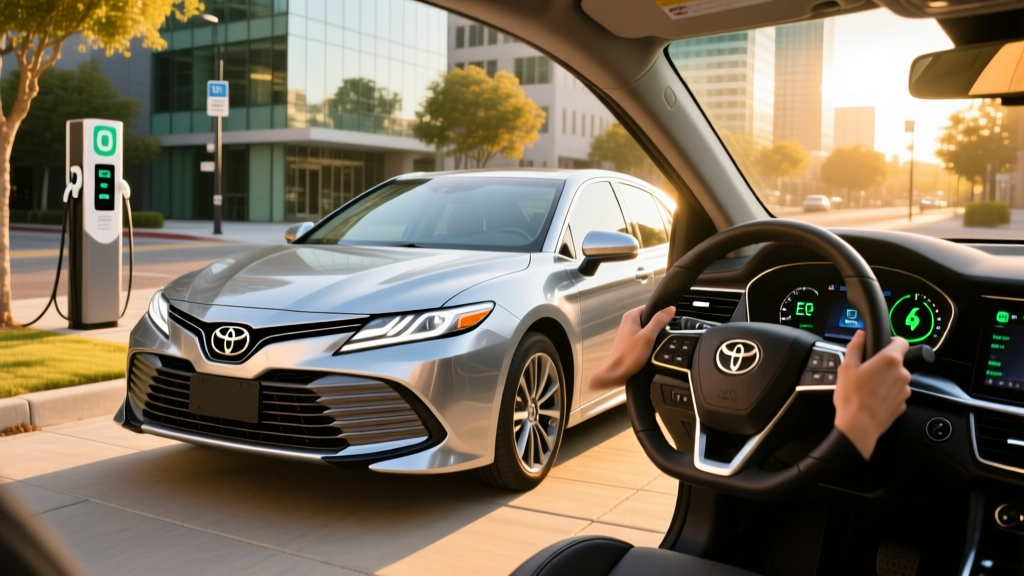
The midsize sedan segment has thinned out dramatically, but the new Toyota Camry Hybrid isn't just surviving — it's thriving as a hybrid-only lineup. For the current generation (introduced for the 2025 model year and carried into 2026), Toyota dropped all gasoline-only powertrains from the Camry, betting that buyers want electrified efficiency without plugging in. That decision has paid off: the Camry Hybrid now competes with the Honda Accord Hybrid and Hyundai Sonata Hybrid while offering something neither does as broadly — available electronic on-demand all-wheel drive across most trims.
Whether you're cross-shopping a full EV like the Tesla Model 3 or a plug-in hybrid like the Prius Prime, this guide breaks down exactly what the Camry Hybrid delivers in fuel economy, powertrain performance, battery longevity, and total ownership cost — with real-world numbers, not just EPA stickers.
HEV vs PHEV: Where the Camry Hybrid Fits
Before we get into the numbers, it's important to clarify what the Camry Hybrid is — and what it isn't. The Camry Hybrid is a conventional hybrid electric vehicle (HEV), not a plug-in hybrid (PHEV). That distinction shapes everything from how you fuel it to what tax credits it qualifies for.
| Feature | HEV (Camry Hybrid) | PHEV (e.g., Prius Prime) | BEV (e.g., Model 3) |
|---|---|---|---|
| Plug-in charging required? | No — gas only | Yes — Level 1/2 | Yes — Level 2/DC |
| Electric-only range | ~1 mile at low speed | 32–44 miles | 250–360+ miles |
| Total range | 550–600+ miles | 400–440+ miles | 250–360+ miles |
| Federal tax credit (§30D) | Not eligible | Up to $3,750 (varies) | Up to $7,500 (varies) |
| Home charging install needed? | No | Recommended | Required |
| Battery size | ~1.1 kWh (small buffer) | 13.6 kWh usable | 60–82 kWh |
The Camry Hybrid's small lithium-ion battery pack recharges through regenerative braking and the gasoline engine. You never plug it in. The electric motor assists during acceleration and enables brief low-speed electric-only crawling (typically under 1 mile at parking-lot speeds), but the engine is always the primary energy source. This is a fundamentally different ownership proposition than a PHEV, which can handle daily commutes on grid electricity before the engine kicks in.
Fuel Economy: EPA Ratings and Real-World MPG
The Camry Hybrid's headline number is its fuel efficiency, and it varies slightly by trim and drivetrain configuration. Here's the full EPA breakdown according to fueleconomy.gov:
| Trim / Drivetrain | City MPG | Highway MPG | Combined MPG | Est. Total Range |
|---|---|---|---|---|
| LE (FWD) | 53 | 50 | 51 | ~612 miles |
| LE (AWD) | 51 | 49 | 50 | ~600 miles |
| SE / XLE / XSE (FWD) | 48 | 47 | 47 | ~564 miles |
| SE / XLE / XSE (AWD) | 46 | 46 | 46 | ~552 miles |
The LE trim achieves its higher numbers partly due to lighter weight, smaller 16-inch wheels, and lower rolling-resistance tires. Moving to the sportier SE or premium XLE/XSE trims costs you 4–5 MPG combined — a meaningful trade-off if efficiency is your priority.
Real-World MPG: What Owners Actually See
Toyota hybrids historically exceed their EPA city ratings in stop-and-go driving because regenerative braking recaptures energy that a gas car wastes as heat. On the flip side, sustained highway driving at 75+ mph reduces the hybrid advantage since the electric motor contributes less at constant speed.
Based on aggregated owner reports and independent testing for the current-generation Camry Hybrid:
- City / suburban driving: 48–56 MPG (many drivers match or beat the 53 MPG EPA city rating on the LE)
- Highway (70 mph cruise): 43–48 MPG — expect a noticeable drop from the combined rating
- Cold weather (below 30°F): 38–44 MPG — the engine runs more frequently to provide cabin heat and warm up the catalytic converter
- Mixed real-world average: 45–50 MPG for most owners in moderate climates
The 12-gallon fuel tank on the Camry Hybrid is smaller than many midsize sedans, but the efficiency compensates. You'll still see 500+ miles between fill-ups in normal driving.
Powertrain Specs: Fifth-Gen Hybrid System with 225 HP
The current Camry Hybrid uses Toyota's fifth-generation hybrid synergy drive, pairing a 2.5-liter Dynamic Force four-cylinder engine with one or two electric motors depending on drivetrain.
| Specification | Detail |
|---|---|
| Engine | 2.5L inline-4 (Atkinson cycle) |
| Engine output | 184 hp / 163 lb-ft torque |
| Front electric motor | 100 kW (134 hp) |
| Rear electric motor (AWD only) | 30 kW (40 hp) |
| Net combined system horsepower | 225 hp (FWD) / 232 hp (AWD) |
| Transmission | eCVT (planetary gearset, not belt-driven) |
| 0–60 mph | ~7.1 seconds (FWD), ~6.9 seconds (AWD) |
| Hybrid battery | ~1.1 kWh lithium-ion (sealed, not user-serviceable) |
| Drivetrain | FWD standard; electronic on-demand AWD available |
The 225–232 combined horsepower figure represents a significant step up from the previous-generation Camry Hybrid's 208 hp. The eCVT is Toyota's proven planetary gearset design — there's no traditional belt or chain, and it has a reputation for durability well past 200,000 miles. The AWD system uses a dedicated rear electric motor that engages automatically during acceleration or low-traction conditions; there's no mechanical driveshaft connecting the axles.
One practical note: the Camry Hybrid does not offer a dedicated EV mode button in most trims. The system manages electric and gas operation automatically, prioritizing efficiency. You can't force extended electric-only driving as you could in a PHEV.
Pricing, Trims, and Tax Credit Eligibility
For the 2026 model year, the Camry Hybrid starts under $30,000 and tops out around $38,000 fully loaded — positioning it competitively against both hybrid and non-hybrid midsize sedans.
| Trim | MSRP (FWD) | MSRP (AWD) | Key Features |
|---|---|---|---|
| LE | ~$29,495 | ~$30,895 | 8" touchscreen, TSS 3.0, wireless CarPlay/Android Auto |
| SE | ~$31,095 | ~$32,495 | Sport-tuned suspension, 18" wheels, paddle shifters |
| XLE | ~$34,095 | ~$35,495 | Leather-trimmed seats, 12.3" display, ambient lighting |
| XSE | ~$35,595 | ~$36,995 | Sport appearance, JBL audio, panoramic roof option |
Does the Camry Hybrid Qualify for a Federal Tax Credit?
No. The Camry Hybrid is a conventional HEV, and the IRS §30D Clean Vehicle Credit applies only to plug-in electric vehicles (PHEVs and BEVs) with a minimum battery capacity of 7 kWh. Since the Camry Hybrid's battery is approximately 1.1 kWh and the vehicle cannot be plugged in, it does not qualify for the federal purchase credit.
Some states and utilities offer rebates for conventional hybrids, but these are increasingly rare as incentive programs shift toward plug-in vehicles. Check your state energy office or utility provider for any local hybrid incentives, but don't count on them.
Hybrid Battery Warranty and Replacement Cost
Toyota covers the Camry Hybrid's battery pack under its Hybrid Battery Warranty for 10 years or 150,000 miles (whichever comes first) in all 50 states. This was extended from the previous 8-year/100,000-mile coverage starting with the 2020 model year.
Replacement cost if out of warranty: A new OEM hybrid battery pack for the Camry Hybrid typically costs between $2,500 and $4,000 including labor at a Toyota dealer. Third-party refurbished packs are available for $1,500–$2,500. In practice, Toyota hybrid batteries from the past decade have demonstrated strong longevity, with many lasting well past 200,000 miles with minimal capacity loss. The small battery in an HEV undergoes shallow charge/discharge cycles (typically operating between 40–80% state of charge), which is far less stressful than the deep cycling in a full EV.
Reliability and Long-Term Ownership
The Camry nameplate has decades of reliability data behind it, and the hybrid variant has been part of the lineup since 2007. Toyota's hybrid system is one of the most proven in the industry, with millions of units on the road globally across the Prius, Camry, RAV4 Hybrid, and Highlander Hybrid families.
Key reliability considerations:
- Hybrid system: The eCVT planetary gearset has no friction clutches or bands to wear out. Failures are rare and typically related to inverter cooling rather than the gearset itself.
- Brake wear: Regenerative braking significantly reduces pad and rotor wear. Many owners report 80,000–100,000+ miles on original brake pads.
- Engine longevity: The Atkinson-cycle 2.5L runs lower peak cylinder pressures than a conventional Otto-cycle engine, contributing to long service life with standard maintenance.
- Safety: The current Camry earns top marks from IIHS, including a Top Safety Pick+ rating with Toyota Safety Sense 3.0 standard on all trims (pre-collision system, lane tracing assist, full-speed dynamic radar cruise control, and road sign assist).
Toyota's basic new-vehicle warranty covers 3 years/36,000 miles, with a 5-year/60,000-mile powertrain warranty. The 10-year/150,000-mile hybrid battery warranty is the standout coverage item.
Camry Hybrid vs. the Alternatives: Which Powertrain Is Right for You?
The Camry Hybrid occupies a specific niche. Here's a decision framework based on your driving profile:
Choose the Camry Hybrid (HEV) if:
- You don't have access to home or workplace charging and can't install a Level 2 charger
- You want 50+ MPG without changing your fueling habits
- You drive a mix of city and highway and want proven reliability
- You want AWD in a fuel-efficient sedan without a turbo or larger engine
- You plan to keep the car 8–10+ years and value the hybrid battery warranty
Choose a PHEV (e.g., Prius Prime) if:
- You can charge at home and your daily commute is under 40 miles round-trip
- You want to drive mostly on electricity but need gas flexibility for road trips
- You want to access federal tax credits (up to $3,750 for the Prius Prime, subject to IRS §30D eligibility)
Choose a full EV (e.g., Tesla Model 3, Hyundai Ioniq 6) if:
- You have reliable home charging (Level 2)
- You want the lowest per-mile fuel cost (~$0.04–$0.06/mile on electricity vs. ~$0.09–$0.11/mile on gas at 50 MPG)
- You want maximum federal tax credit eligibility ($7,500, subject to income and sourcing rules)
- You're comfortable with 250–360 miles of range and DC fast charging on road trips
Cost of Ownership: Camry Hybrid vs. Gas vs. EV
To put the Camry Hybrid's economics in context, here's a 5-year/75,000-mile fuel cost comparison assuming $3.50/gallon gas and $0.16/kWh electricity:
| Vehicle | Combined Efficiency | 5-Year Fuel Cost (75k mi) |
|---|---|---|
| Camry Hybrid (LE, 51 MPG) | 51 MPG | ~$5,147 |
| Gas midsize sedan (30 MPG avg) | 30 MPG | ~$8,750 |
| BEV (3.5 mi/kWh, home charging) | 120 MPGe | ~$3,429 |
The Camry Hybrid saves roughly $3,600 in fuel over a comparable gas sedan across five years. A full EV saves about $1,700 more than the hybrid — but comes with a higher purchase price, potential charging installation costs ($500–$2,000 for Level 2), and higher insurance premiums in many states. The hybrid's advantage is zero infrastructure investment: you drive it off the lot and start saving immediately.
Pros
- Up to 51 MPG combined (LE FWD) — among the best in the midsize segment
- 225–232 hp provides confident merging and passing
- Available AWD on all trims — rare for a hybrid sedan
- No charging infrastructure required
- 10-year/150,000-mile hybrid battery warranty
- Toyota Safety Sense 3.0 standard across all trims
- 600+ mile total range on a single tank
Cons
- No federal tax credit (HEV, not PHEV or BEV)
- 12-gallon tank means more frequent stops than you'd expect
- AWD and higher trims drop efficiency to 46 MPG combined
- No plug-in option — can't drive on grid electricity
- Rear seat doesn't fold completely flat (hybrid battery placement)
- eCVT drone under hard acceleration (common to planetary hybrid systems)
Frequently Asked Questions
How many MPG does the new Toyota Camry Hybrid get?
The Camry Hybrid LE achieves an EPA-estimated 53 city / 50 highway / 51 combined MPG. Sportier SE, XLE, and XSE trims with AWD are rated at 46 MPG combined. In real-world driving, many owners report 45–50 MPG in mixed conditions, with city driving often exceeding the EPA rating and highway driving falling 3–5 MPG below it.
Is the Toyota Camry Hybrid a plug-in?
No. The Camry Hybrid is a conventional hybrid (HEV). You never plug it in. The battery charges through regenerative braking and the gasoline engine. If you want a Toyota plug-in hybrid, look at the Prius Prime (up to 44 miles of electric-only range) or the RAV4 Prime (42 miles electric-only).
Does the Camry Hybrid qualify for any tax credit?
The Camry Hybrid does not qualify for the federal §30D Clean Vehicle Credit, which requires a minimum 7 kWh battery and plug-in capability. Some state or utility programs may offer small hybrid rebates, but these are increasingly uncommon. Check your local incentives, but plan your purchase without expecting a credit.
How long will the Camry Hybrid battery last, and what does replacement cost?
Toyota warranties the hybrid battery for 10 years or 150,000 miles. Based on historical data from Toyota's hybrid fleet, many batteries last 200,000+ miles with minimal degradation. If replacement is needed out of warranty, expect $2,500–$4,000 for an OEM pack at a dealer, or $1,500–$2,500 for a refurbished unit.
Is the Camry Hybrid better than a full EV for my situation?
If you can't charge at home, frequently drive in extreme cold, regularly take 400+ mile road trips without stopping, or want the lowest possible upfront cost with no charging infrastructure investment, the Camry Hybrid is likely the better fit. If you have home charging, a commute under 40 miles, and want the lowest per-mile operating cost, a BEV or PHEV will save you more over time.
Does the Camry Hybrid have AWD?
Yes. Electronic on-demand AWD is available on every trim level (LE, SE, XLE, XSE) for approximately $1,400 additional. The system uses a dedicated 30 kW rear electric motor — there's no mechanical driveshaft. It engages automatically during acceleration from a stop, in slippery conditions, or when the system detects front-wheel slip.
What's the difference between the Camry Hybrid LE and SE/XLE?
The LE prioritizes maximum fuel efficiency with 16-inch wheels and lighter equipment, achieving 51 MPG combined. The SE adds sport-tuned suspension, 18-inch wheels, and paddle shifters. The XLE adds premium interior features like leather-trimmed seats and a larger 12.3-inch display. The XSE combines sport styling with premium features. All non-LE trims are rated at 47 MPG combined (FWD) or 46 MPG (AWD).