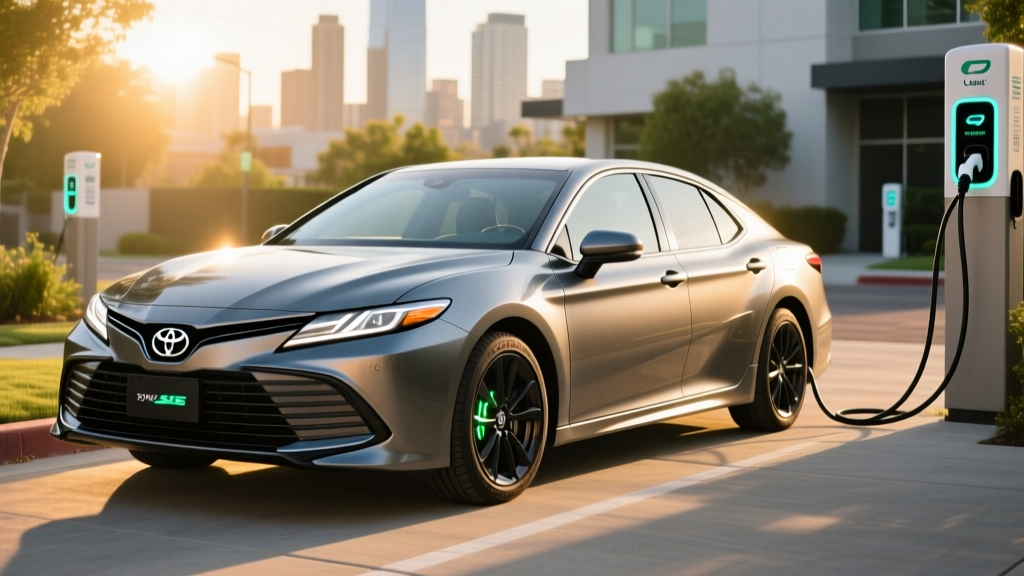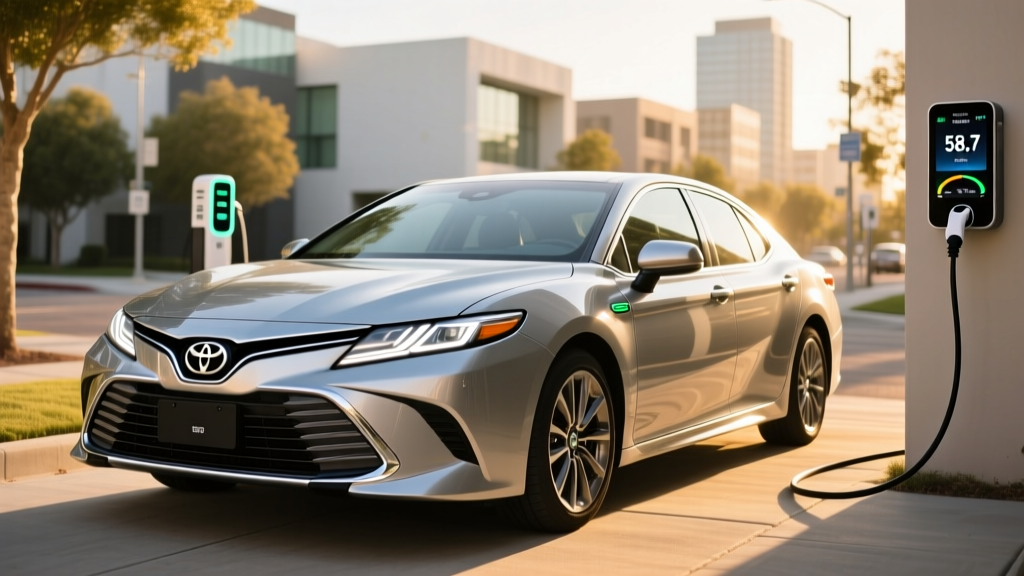
The 2026 Toyota Camry is offered exclusively as a hybrid. Toyota dropped the gasoline-only four-cylinder after the previous generation, betting that its fifth-generation hybrid system would satisfy both efficiency-minded commuters and performance-oriented drivers. For shoppers researching Toyota Camry hybrid cars, that bet has largely paid off: the current Camry Hybrid delivers up to 51 MPG combined, offers available electronic all-wheel drive, and undercuts most midsize competitors on price while maintaining Toyota's reputation for long-term reliability.
This guide breaks down every trim's fuel economy, the hybrid powertrain specs, real-world MPG observations, battery warranty coverage, and whether the Camry Hybrid is the right choice compared to a plug-in hybrid or full battery-electric vehicle.
HEV vs PHEV: Where the Camry Hybrid Fits
Before examining specs, it's essential to understand what the Camry Hybrid is—and what it isn't. The Camry Hybrid is a conventional hybrid electric vehicle (HEV). It pairs a gasoline engine with an electric motor and a small battery pack that recharges through regenerative braking and the engine itself. You never plug it in. There is no electric-only driving mode of meaningful distance.
This is fundamentally different from a plug-in hybrid (PHEV) like the Toyota RAV4 Prime or the now-discontinued Prius Prime, which carries a larger battery (typically 13-18 kWh), offers 25-44 miles of electric-only range, and can be plugged into a wall outlet or public charger. Toyota does not currently offer a Camry PHEV variant in the US market.
Camry Hybrid (HEV) vs a Typical PHEV
| Feature | Camry Hybrid (HEV) | Typical Midsize PHEV |
|---|---|---|
| Plugs in? | No | Yes (Level 1/2) |
| Electric-only range | ~1 mile (low-speed creep) | 25-44 miles |
| Battery size | ~1.0 kWh (NiMH/Li-ion) | 13-18 kWh |
| Federal tax credit (§30D) | Not eligible | Up to $7,500 (if eligible) |
| Fuel economy (gas engine running) | 44-51 MPG combined | 35-42 MPG combined (hybrid mode) |
| Requires home charging access? | No | Yes, for full benefit |
The practical takeaway: if you have no access to home or workplace charging, the Camry HEV is the correct choice. You get outstanding fuel economy with zero lifestyle change. If you do have charging access and want electric-only commuting, you'll need to look at a PHEV like the Hyundai Tucson PHEV, Toyota Prius Prime, or a full BEV.
Fuel Economy: EPA Ratings and Real-World MPG
The 2026 Camry Hybrid continues with the same powertrain architecture introduced for the ninth generation. Toyota offers front-wheel drive (FWD) across all trims and electronic all-wheel drive (AWD-e) on select trims. The AWD system adds a rear-mounted electric motor, which slightly reduces fuel economy but provides traction confidence.
| Trim / Drivetrain | City MPG | Highway MPG | Combined MPG |
|---|---|---|---|
| LE FWD | 53 | 50 | 51 |
| SE FWD | 48 | 47 | 47 |
| XLE FWD | 48 | 47 | 47 |
| SE AWD | 46 | 46 | 46 |
| XLE AWD | 44 | 43 | 44 |
Source: fueleconomy.gov — EPA estimates. Your mileage will vary.
Real-World MPG Observations
Toyota's hybrid system excels in stop-and-go city driving, where the electric motor handles low-speed propulsion and the engine shuts off at stops. In real-world mixed driving, owners consistently report that the LE FWD trim meets or slightly exceeds its 51 MPG combined rating in urban-heavy commutes. Highway-dominant driving at 70-80 mph typically yields 42-46 MPG for FWD trims, below the EPA highway rating, because hybrids lose their city-driving advantage at sustained high speeds.
Cold weather reduces fuel economy by roughly 5-10% due to increased engine warm-up time, cabin heating demands, and reduced battery efficiency. Expect 44-47 MPG combined from an LE FWD in winter conditions versus 50-53 MPG in summer.
The SE and XLE trims sacrifice 4-5 MPG combined versus the LE due to larger 18- or 19-inch wheels, wider tires, and additional weight from premium features. The AWD-e system's rear motor adds roughly 150 lbs, accounting for the further 1-2 MPG drop.
Powertrain and Performance Specs
The 2026 Camry Hybrid uses Toyota's fifth-generation hybrid synergy drive. The core components:
| Specification | Detail |
|---|---|
| Engine | 2.5L 4-cylinder Dynamic Force (A25A-FXS) |
| Engine output | 184 hp / 163 lb-ft torque |
| Front electric motor | 134 hp / 155 lb-ft |
| Rear electric motor (AWD-e only) | 40 hp / 89 lb-ft |
| Net combined system horsepower | 225 hp (FWD) / 232 hp (AWD) |
| Transmission | eCVT (planetary gearset, not a belt CVT) |
| 0-60 mph | ~7.1 seconds (FWD), ~6.9 seconds (AWD) |
| Hybrid battery | ~1.0 kWh lithium-ion pack |
| Fuel tank | 13.2 gallons |
| Total driving range | ~560-670 miles (depending on trim) |
The 225-232 hp output puts the Camry Hybrid in a strong position versus its midsize competitors. The eCVT is a planetary gearset—not the rubber-band-feeling belt CVTs found in some competitors—and it delivers smooth, linear acceleration. The AWD-e variant is actually the quicker car to 60 mph because the rear motor provides additional launch traction.
Because this is a conventional HEV, there is no plug, no charging port, and no DC fast charging capability. The small ~1.0 kWh battery recharges entirely through regenerative braking and the gasoline engine.
Pricing, Trims, and Tax Credit Eligibility
The 2026 Camry Hybrid lineup starts at an accessible price point and scales up through four main trims:
- LE FWD: ~$29,990 MSRP (destination included)
- SE FWD: ~$32,490 MSRP
- XLE FWD: ~$34,990 MSRP
- XSE (new sport trim): ~$36,490 MSRP
AWD-e adds approximately $1,500 to SE and XLE trims. Fully loaded XLE AWD models with premium packages reach approximately $40,000.
Federal Tax Credit: Not Eligible
Some states offer rebates for conventional hybrids, but these are increasingly rare as incentives shift toward plug-in vehicles. Check your state energy office or AFDC's state incentive database for local programs.
Even without a federal credit, the Camry Hybrid's low starting price and exceptional fuel economy produce strong total cost of ownership. At 51 MPG combined and $3.25/gallon gasoline, annual fuel cost for 12,000 miles is approximately $765—compared to roughly $1,300 for a comparable gas-only midsize sedan averaging 30 MPG combined.
Battery Warranty, Reliability, and Replacement Cost
Hybrid Battery Warranty Coverage
Duration: 10 years / 150,000 miles (whichever comes first)
Coverage: Defects in materials and workmanship; capacity below a defined threshold
Transferable: Yes, to subsequent owners (boosts resale value)
Additional coverage: Hybrid system components (inverter, control module, electric motors) also covered for 8 years / 100,000 miles
Toyota's hybrid battery reliability record is among the best in the industry. The Prius, which shares hybrid architecture lineage with the Camry, has demonstrated battery packs lasting 200,000+ miles with minimal degradation. The Camry's ~1.0 kWh lithium-ion pack operates within a narrow state-of-charge window (roughly 40-80% SoC), managed by Toyota's battery management system to minimize stress and extend cycle life. This shallow-cycling strategy is why hybrid batteries often outlast the vehicles themselves.
What If the Battery Fails Out of Warranty?
If the hybrid battery does require replacement beyond the 10-year/150,000-mile warranty window, expect the following costs:
- OEM replacement battery: $2,500-$4,000 (part) + $500-$1,000 (labor)
- Refurbished/reconditioned battery: $1,200-$2,200 installed
- Individual cell module replacement: $500-$1,200 (specialist shops only)
For context, the Camry Hybrid's small battery is far less expensive to replace than a BEV's 60-80 kWh traction battery ($8,000-$20,000+). And given Toyota's track record, most Camry Hybrids will never need a battery replacement within typical ownership periods.
Camry Hybrid vs the Alternatives: Which Is Right for You?
Choosing between the Camry Hybrid, a PHEV, and a full EV depends on your driving patterns, charging access, and budget. Here's a decision framework:
Choose the Camry Hybrid (HEV) if:
- You have no reliable access to home or workplace charging
- Your budget is under $35,000 and you want maximum fuel savings
- You take frequent long road trips and don't want to plan around charging stops
- You want the lowest-complexity path to 45-51 MPG
- You plan to own the car 10+ years (Toyota reliability + no battery-plug infrastructure)
Choose a PHEV (e.g., Prius Prime, Tucson PHEV) if:
- You have Level 2 home charging and a commute under 40 miles
- You want electric-only daily driving but gas flexibility for road trips
- You qualify for the §30D federal tax credit (income + sourcing requirements met)
- You want to reduce gasoline consumption to near-zero on weekdays
Choose a Full EV (e.g., Tesla Model 3, Hyundai Ioniq 6) if:
- You have reliable home Level 2 charging
- Your daily driving is under 250 miles and you're comfortable with public DC fast charging for road trips
- You want the lowest per-mile energy cost (~$0.04-$0.06/mile on home electricity vs ~$0.07/mile for the Camry Hybrid)
- You want to eliminate oil changes, spark plugs, and transmission fluid entirely
Pros and Cons of the 2026 Camry Hybrid
✓ Pros
- Class-leading 51 MPG combined (LE FWD)
- No plugging in—zero lifestyle change from a gas car
- 225-232 hp is genuinely quick for a midsize hybrid sedan
- 10-year/150,000-mile hybrid battery warranty
- AWD-e available for snow-belt buyers
- Starting MSRP under $30,000
- 560+ mile total range per tank
- Strong resale value (Toyota brand + hybrid demand)
✗ Cons
- No federal tax credit eligibility (HEV, not PHEV/BEV)
- No electric-only driving mode (not even 1 mile at speed)
- Highway MPG drops to low 40s at 75+ mph
- SE/XLE trims lose 4-5 MPG vs the LE
- AWD-e costs ~$1,500 extra and drops MPG further
- Rear seat doesn't fold flat on some trims (battery placement)
- No plug means no access to HOV lane perks in most states
Safety and Driver Assistance
Every 2026 Camry Hybrid comes standard with Toyota Safety Sense 3.0, which includes:
- Pre-Collision System with Pedestrian Detection
- Full-Speed Range Dynamic Radar Cruise Control
- Lane Departure Alert with Steering Assist
- Lane Tracing Assist
- Automatic High Beams
- Road Sign Assist
- Proactive Driving Assist (gentle braking/deceleration support)
This is an SAE Level 2 driver-assistance system. The driver must remain fully engaged, with hands on the wheel and eyes on the road, at all times. It is not autonomous or self-driving. The Camry Hybrid earned a TOP SAFETY PICK rating from the IIHS in prior model years, and the 2026 model carries forward the same structural platform.
Frequently Asked Questions
How many MPG does the Toyota Camry Hybrid get?
The 2026 Camry Hybrid LE FWD achieves an EPA-estimated 53 city / 50 highway / 51 combined MPG. SE and XLE FWD trims are rated at 47 combined. AWD trims range from 44-46 combined. In real-world city-heavy driving, many owners report meeting or slightly exceeding the EPA combined rating, while highway-dominant driving at speeds above 70 mph typically yields 42-46 MPG for FWD trims.
Does the Camry Hybrid need to be plugged in?
No. The Camry Hybrid is a conventional HEV. Its small battery recharges through regenerative braking and the gasoline engine. There is no charging port and no plug-in capability. If you want a Toyota sedan you can plug in, look at the Prius Prime (PHEV).
Is the Camry Hybrid reliable, and what does a battery replacement cost?
Toyota's hybrid system has over two decades of proven reliability. The hybrid battery is warrantied for 10 years/150,000 miles, and real-world data from the Prius and Camry Hybrid platforms shows batteries routinely lasting 200,000+ miles. If replacement is needed out of warranty, expect $2,500-$4,000 for an OEM battery or $1,200-$2,200 for a refurbished unit installed.
Does the Toyota Camry Hybrid qualify for a federal tax credit?
No. The IRS §30D clean vehicle credit applies only to plug-in electric vehicles (BEVs and PHEVs) that meet battery sourcing, MSRP cap, and buyer income requirements. The Camry Hybrid is a conventional HEV with no plug-in capability, so it is ineligible. Some states may offer small hybrid rebates—check your state's energy office.
Hybrid vs PHEV vs EV—which should I choose over the Camry Hybrid?
Choose the Camry Hybrid if you lack home charging access, want a low purchase price under $30K, and take long road trips. Choose a PHEV (like the Prius Prime) if you have home charging and want electric-only commuting with gas backup. Choose a full EV (like the Tesla Model 3 or Hyundai Ioniq 6) if you have reliable charging, want the lowest per-mile energy cost, and are comfortable with DC fast charging on road trips.
How far can the Camry Hybrid drive on a full tank?
With a 13.2-gallon fuel tank and 51 MPG combined (LE FWD), the Camry Hybrid can travel approximately 670 miles between fill-ups. AWD trims rated at 44 combined yield roughly 580 miles per tank. This is one of the longest total ranges of any midsize sedan sold in the US.
Is AWD worth the MPG penalty?
If you live in a region with frequent snow, ice, or heavy rain, the AWD-e system's traction advantage is worth the 5-7 MPG combined penalty. The rear electric motor engages automatically when slip is detected and doesn't add the weight or drivetrain losses of a mechanical AWD system. For dry-climate buyers, FWD provides better fuel economy and a lower purchase price.