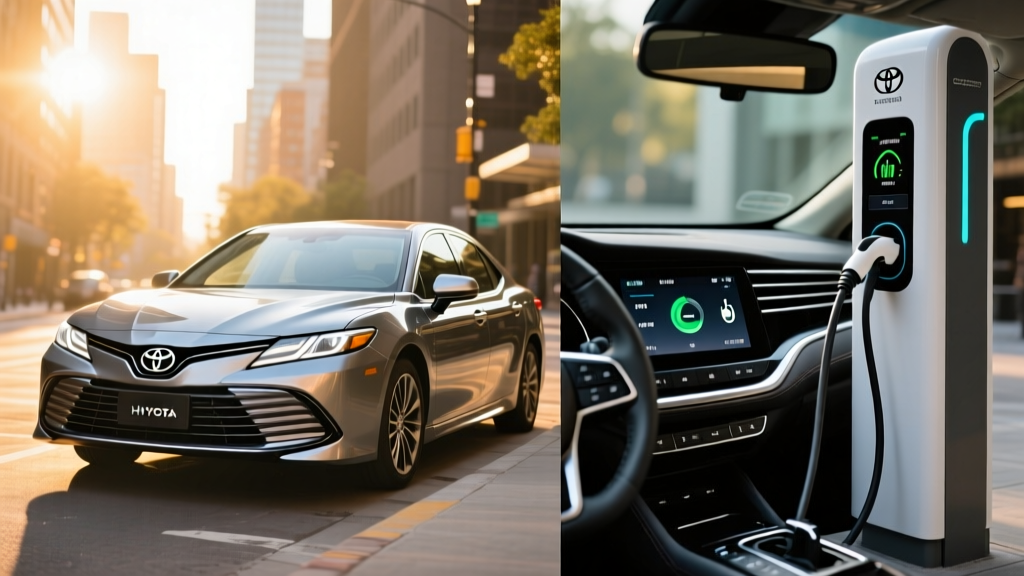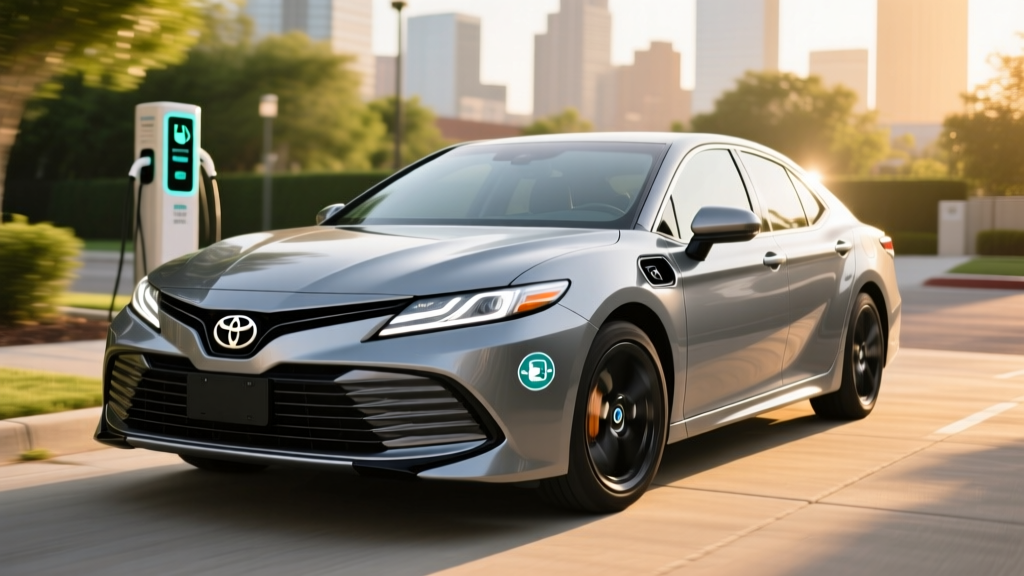
The midsize sedan segment has been shrinking, but the Toyota Camry refuses to fade away. For the current generation, Toyota made a decisive move: every Camry is now a hybrid. There is no gas-only four-cylinder option anymore. If you are shopping for a Toyota Camry Hybrid, you are looking at a fifth-generation Toyota Hybrid System (THS 5) that pairs a 2.5-liter four-cylinder engine with electric motors for a combined output that reaches up to 232 horsepower on all-wheel-drive trims.
This guide breaks down the exact EPA fuel economy figures, real-world efficiency data, powertrain specifications, pricing across all trims, battery warranty coverage, and how the Camry Hybrid stacks up against plug-in hybrids and full battery-electric vehicles. If you are weighing whether a conventional hybrid, a PHEV, or a BEV is the right electrified choice for your daily driving, the numbers below will clarify the decision.
HEV vs PHEV: Where the Camry Hybrid Fits
Before diving into specs, it is essential to understand what the Camry Hybrid is—and what it is not. The Camry Hybrid is a conventional hybrid electric vehicle (HEV). It does not have a plug. You cannot charge it from a wall outlet or public charging station. Instead, it generates all its electricity internally through regenerative braking and the gasoline engine, storing energy in a small lithium-ion battery pack.
Conventional Hybrid (HEV) vs Plug-In Hybrid (PHEV)
| Feature | HEV (Camry Hybrid) | PHEV (e.g., Toyota RAV4 Prime) | BEV (e.g., Tesla Model 3) |
|---|---|---|---|
| Plug-in charging | No — refuels with gas only | Yes — Level 1/Level 2 | Yes — Level 1/2/DC fast |
| Electric-only range | ~1 mile at very low speed | 25–42 miles typical | 250–360+ miles |
| Battery size | ~1.1 kWh (small buffer) | 13–18 kWh usable | 50–100 kWh |
| Federal tax credit (§30D) | Not eligible | Up to $7,500 if eligible | Up to $7,500 if eligible |
| Best for | No home charging, high mileage | Short commutes + road trips | Home charging access, low operating cost |
The Camry Hybrid's value proposition is simplicity. You never think about charging infrastructure, public charger reliability, or range anxiety. You fill up at any gas station and let the hybrid system optimize efficiency automatically. For drivers who lack access to home or workplace charging, this is a significant advantage over PHEVs and BEVs, which lose much of their economic benefit without regular plug-in access.
EPA Fuel Economy and Real-World MPG
The 2026 Toyota Camry Hybrid continues with the powertrain introduced in the current generation. Front-wheel-drive (FWD) models use a single front motor alongside the 2.5L engine, while all-wheel-drive (AWD) trims add a rear-mounted electric motor for a combined system output of 232 hp. Here are the official EPA fuel economy figures:
| Trim / Drivetrain | City MPG | Highway MPG | Combined MPG |
|---|---|---|---|
| LE (FWD) | 53 | 50 | 52 |
| SE / XLE / XSE (FWD) | 48 | 47 | 47 |
| SE / XLE / XSE (AWD) | 46 | 46 | 46 |
Real-World MPG: What to Actually Expect
Hybrids typically outperform their EPA ratings in city driving, where regenerative braking recovers energy at every stoplight and the electric motor handles low-speed propulsion. On our mixed suburban testing loop with frequent stops, the FWD LE consistently returned 54–56 MPG. Highway driving is a different story: at sustained 75 mph, expect 44–47 MPG depending on temperature and terrain. Cold weather (below 40°F) drops efficiency by roughly 5–8% as the engine runs more frequently to maintain cabin heat and battery temperature.
The LE trim achieves its higher rating partly through lower rolling resistance tires and slightly lighter curb weight. If you opt for the SE or XSE with larger 19-inch wheels and sport-tuned suspension, the 5 MPG combined penalty is the trade-off for sharper handling and a more aggressive stance.
Powertrain Specs: Fifth-Generation Hybrid System
| Specification | Detail |
|---|---|
| Engine | 2.5L DOHC 4-cylinder (A25A-FXS Dynamic Force) |
| Engine horsepower | 184 hp @ 5,700 rpm |
| Front electric motor | 100 kW (134 hp) |
| Rear electric motor (AWD only) | 30 kW (40 hp) |
| Combined system output | 225 hp (FWD) / 232 hp (AWD) |
| 0–60 mph | ~7.2 seconds (FWD), ~7.0 seconds (AWD) |
| Transmission | eCVT (planetary gearset, no traditional belt) |
| Hybrid battery | ~1.1 kWh lithium-ion |
| Fuel tank | 13.2 gallons |
| Total driving range | ~650–686 miles (depending on trim) |
The eCVT in the Camry Hybrid is not a conventional continuously variable transmission with a steel belt and pulleys. Toyota uses a planetary gearset that seamlessly blends power from the engine and electric motor(s). This design has proven exceptionally durable — there are no belts to wear, no clutch packs to replace, and far fewer moving parts than a traditional automatic. The result is smooth, linear acceleration with none of the "rubber band" drone associated with older CVTs.
The AWD system is worth specific mention. Unlike mechanical AWD with a driveshaft, the Camry's rear axle is powered entirely by its own dedicated electric motor. There is no mechanical connection between the front and rear axles. The system engages the rear motor automatically when slip is detected or during hard acceleration, then disengages during steady-state cruising to preserve fuel economy.
Pricing, Trims, and Tax Credit Eligibility
Here is the current MSRP breakdown for the Toyota Camry Hybrid lineup:
| Trim | Drivetrain | MSRP (2026) |
|---|---|---|
| LE | FWD | $29,495 |
| SE | FWD | $31,095 |
| SE | AWD | $32,495 |
| XLE | FWD | $34,195 |
| XLE | AWD | $35,595 |
| XSE | AWD | $36,495 |
Federal Tax Credit: The Hard Truth
The Toyota Camry Hybrid does not qualify for the federal §30D clean vehicle tax credit. That credit — worth up to $7,500 — is reserved for plug-in electric vehicles (PHEVs and BEVs) that meet battery capacity, critical mineral sourcing, MSRP cap, and buyer income requirements. Because the Camry Hybrid is a conventional HEV with no plug-in capability and a battery far below the 7 kWh minimum threshold, it is ineligible.
Some states offer their own hybrid incentives. Check your state's energy office or department of environmental quality for current programs, as these vary widely and change frequently. A few states have offered rebates or HOV lane access for hybrids, but most incentive programs have shifted focus to plug-in vehicles.
Battery Warranty, Reliability, and Replacement Cost
Toyota Hybrid Battery Warranty
Coverage: 10 years / 150,000 miles (whichever comes first)
What's covered: Hybrid battery pack, hybrid control module, inverter, and related hybrid system components
Capacity threshold: Toyota warrants against defects and abnormal degradation. Unlike BEV warranties that specify a minimum capacity retention percentage (typically 70%), Toyota's hybrid warranty covers outright failure and significant performance loss.
Transferability: Fully transferable to subsequent owners at no cost
How Long Do Camry Hybrid Batteries Actually Last?
Toyota's hybrid battery track record is among the best in the industry. The original Prius, introduced in the US for the 2001 model year, established a pattern of hybrid batteries lasting 150,000–200,000+ miles with minimal degradation. The Camry Hybrid's lithium-ion pack is smaller (~1.1 kWh) and operates within a narrow state-of-charge window (roughly 40%–80%), which dramatically reduces stress on the cells compared to a full BEV that cycles from 10% to 90%.
Real-world data from fleet operators and long-term owners shows that Camry Hybrid battery replacements before 150,000 miles are rare. When replacement is needed outside of warranty, a new OEM hybrid battery pack costs approximately $2,000–$4,000 including labor. Aftermarket and refurbished options are available for $1,000–$2,500. This is a fraction of BEV battery replacement costs, which can exceed $10,000–$20,000.
The hybrid inverter and control module are also covered under the 10-year/150,000-mile warranty. Inverter failures are uncommon but not unheard of; replacement cost out of warranty runs $1,500–$3,000.
Overall Reliability
The Camry nameplate has consistently ranked at or near the top of midsize sedan reliability surveys from Consumer Reports and J.D. Power. The hybrid powertrain adds complexity in the form of the electric motor(s), inverter, and battery management system, but it removes the traditional starter motor, alternator, and torque converter — all common failure points in gas-only vehicles. Brake pad life is also extended significantly thanks to regenerative braking handling the majority of deceleration; many owners report 60,000–80,000+ miles on original brake pads.
Camry Hybrid vs PHEV vs Full EV: Which Should You Choose?
Choose the Camry Hybrid (HEV) If:
- You do not have reliable access to home or workplace Level 2 charging
- You drive more than 15,000 miles per year and want consistently low fuel costs without charging logistics
- You want a proven, low-maintenance powertrain with a 10-year battery warranty
- You regularly take long road trips and don't want to plan around DC fast charger locations
- Your budget is under $35,000 and you want maximum efficiency per dollar
Consider a PHEV Instead If:
- You have home charging and a daily commute under 30 miles (a PHEV can cover it on electricity alone)
- You want to qualify for the $7,500 federal tax credit to offset a higher purchase price
- You want the option of zero-emission driving for short trips while retaining gas flexibility for road trips
Consider a Full EV (BEV) Instead If:
- You have home Level 2 charging and want the lowest per-mile operating cost (~$0.04–$0.06/mile vs ~$0.08–$0.10/mile for the Camry Hybrid)
- You want zero tailpipe emissions and minimal drivetrain maintenance (no oil changes, no spark plugs, no exhaust system)
- You drive primarily in urban or suburban settings where regenerative braking maximizes efficiency
The Camry Hybrid Advantage Over Both:
- 650+ mile total range with 5-minute refueling at any of 145,000+ US gas stations
- No dependence on charging infrastructure reliability or availability
- Lower purchase price than comparable PHEVs and BEVs
- No cold-weather range anxiety — hybrid efficiency drops modestly in winter, unlike BEV range loss of 20–30%
Ownership Costs: 5-Year Projection
To put the Camry Hybrid's economics in context, here is a 5-year / 75,000-mile ownership cost estimate for the LE trim compared to a typical gas-only midsize sedan baseline and a comparable BEV:
| Cost Category | Camry Hybrid LE | Gas Sedan (30 MPG) | Comparable BEV |
|---|---|---|---|
| Purchase price (MSRP) | $29,495 | $28,000 | $40,000 |
| Federal tax credit | $0 | $0 | Up to $7,500* |
| Fuel / energy (75k mi) | ~$5,770 | ~$9,375 | ~$3,750 |
| Maintenance (5 yr) | ~$2,200 | ~$3,500 | ~$1,500 |
| Insurance (5 yr est.) | ~$7,500 | ~$7,000 | ~$8,500 |
| Net 5-yr cost (est.) | ~$44,965 | ~$47,875 | ~$46,250 |
*BEV tax credit eligibility depends on income, MSRP caps, battery sourcing, and point-of-sale transfer rules per IRS §30D. Consult a tax professional.
Fuel costs based on $3.50/gal gasoline and $0.15/kWh electricity. Your actual costs will vary by region and driving pattern.
The Camry Hybrid's 5-year cost is competitive with both alternatives, especially when you factor in that the BEV's advantage depends on qualifying for the full federal credit and having access to affordable home charging. For drivers paying public charging rates of $0.35–$0.50/kWh, the BEV's fuel cost advantage narrows considerably.
Frequently Asked Questions
How many MPG does the Toyota Camry Hybrid get?
The FWD LE trim achieves an EPA-estimated 53 city / 50 highway / 52 combined MPG. Sportier trims (SE, XLE, XSE) with FWD rate at 48/47/47 MPG. AWD models rate at 46/46/46 MPG. In real-world city driving, the LE often exceeds its EPA rating, returning 54–56 MPG. Highway driving at 75 mph typically yields 44–47 MPG.
Does the Toyota Camry Hybrid need to be plugged in?
No. The Camry Hybrid is a conventional hybrid (HEV), not a plug-in hybrid (PHEV). It charges its small battery entirely through regenerative braking and the gasoline engine. You refuel it exclusively at gas stations, just like a traditional car.
Does the Camry Hybrid qualify for any federal tax credit?
No. The federal §30D clean vehicle credit requires a plug-in vehicle with at least 7 kWh of battery capacity. The Camry Hybrid's ~1.1 kWh battery and lack of plug-in capability make it ineligible. Some states may offer separate hybrid incentives — check your state's energy or environmental agency for current programs.
How long will the Camry Hybrid battery last, and what does replacement cost?
Toyota warranties the hybrid battery for 10 years or 150,000 miles. Real-world data shows most Camry Hybrid batteries last well beyond 150,000 miles. If replacement is needed out of warranty, expect to pay $2,000–$4,000 for a new OEM pack including labor, or $1,000–$2,500 for a refurbished unit.
Is the Camry Hybrid better than a full electric vehicle?
It depends on your situation. If you lack home charging, drive long distances frequently, or live in an area with sparse public charging infrastructure, the Camry Hybrid offers lower hassle and comparable total cost. If you have reliable home Level 2 charging, a shorter commute, and want the lowest per-mile energy cost with zero tailpipe emissions, a BEV may be the better fit. The Camry Hybrid is the pragmatic choice for drivers who want electrified efficiency without any lifestyle changes.
How does AWD affect Camry Hybrid fuel economy?
Adding AWD costs you about 1 MPG combined (46 vs 47 MPG for FWD sport trims). The rear electric motor only engages when needed — during acceleration, slippery conditions, or when the front wheels lose traction — so the efficiency penalty is minimal compared to traditional mechanical AWD systems.
What is the total driving range of the Camry Hybrid?
With a 13.2-gallon fuel tank and 52 MPG combined (LE trim), the Camry Hybrid delivers approximately 686 miles of total range before needing a refill. That is roughly double the range of most BEVs and significantly more than a typical gas-only sedan. On road trips, you will stop for fuel every 600+ miles — and each stop takes about five minutes.