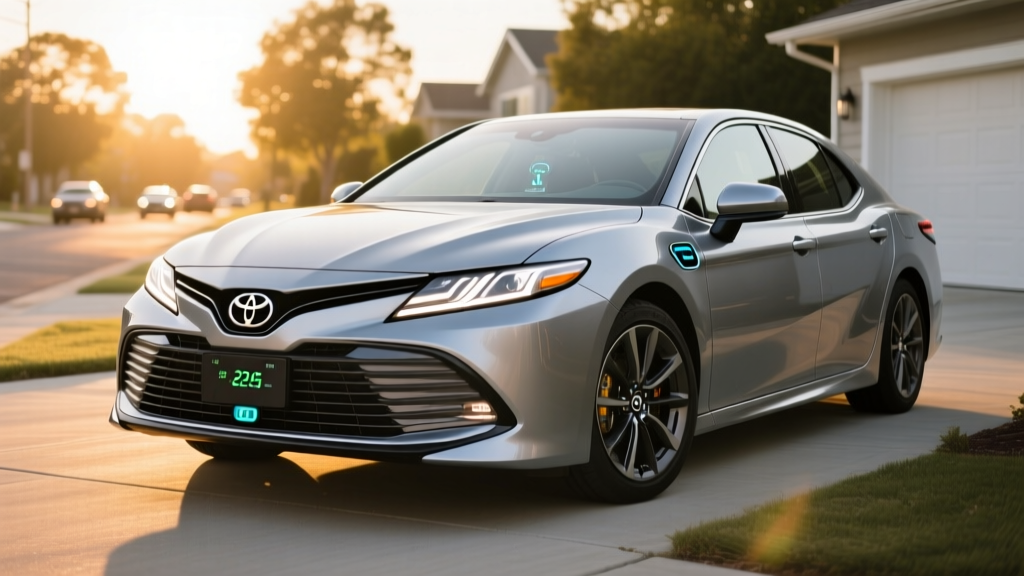
The Toyota Camry has been America's best-selling sedan for years, and its transition to an all-hybrid lineup has only sharpened its appeal. For 2026, every Camry rolls off the line as a hybrid, pairing Toyota's fifth-generation hybrid system with a 2.5-liter four-cylinder engine. The result? A midsize sedan that delivers exceptional fuel economy without sacrificing the practicality buyers expect.
But what are the real-world Toyota Camry Hybrid miles per gallon numbers? The EPA estimates are impressive, but as any hybrid owner knows, real-world results — especially in city driving — often tell a more interesting story. We'll break down every trim's efficiency, explain why hybrids thrive in stop-and-go traffic, and help you decide whether the Camry Hybrid, a PHEV, or a full EV is the right move for your commute.
EPA Ratings: Toyota Camry Hybrid MPG by Drivetrain
The 2026 Camry Hybrid comes in two drivetrain configurations: front-wheel drive (FWD) and all-wheel drive (AWD). The AWD system adds a rear electric motor, which costs a small amount of efficiency but provides meaningful traction in rain and snow. Here's the official EPA breakdown from fueleconomy.gov:
| Configuration | City MPG | Highway MPG | Combined MPG | Fuel Tank | Total Range |
|---|---|---|---|---|---|
| FWD (LE, SE, XLE, XSE) | 53 | 50 | 51 | 13.2 gal | ~673 mi |
| AWD (SE, XLE, XSE) | 51 | 49 | 50 | 13.2 gal | ~660 mi |
These numbers place the Camry Hybrid at the top of the midsize sedan segment, rivaling the Honda Accord Hybrid (48 combined) and significantly outperforming the Hyundai Sonata Hybrid (47 combined). The 53-mpg city figure is particularly notable — it's where Toyota's hybrid system earns its keep.
Real-World MPG: Why Hybrids Often Beat the EPA Sticker in the City
If you've ever seen a Camry Hybrid owner report 55 or even 58 mpg on a forum, they aren't exaggerating. Here's why: the EPA city test cycle includes extended idling and moderate acceleration, but Toyota's hybrid system can shut off the gas engine entirely at low speeds, running on battery power alone for short distances.
- City / suburban driving: 52–58 MPG (often exceeds EPA's 53 city rating)
- Highway (70–75 mph): 44–48 MPG (aerodynamic drag reduces hybrid advantage)
- Mixed daily commute: 48–53 MPG
- Cold weather (below 35°F): Expect 5–10% reduction as the engine runs more frequently for cabin heat
The key insight: hybrids are at their best in the city. Regenerative braking recaptures energy at every stoplight, and the electric motor handles low-speed acceleration where gas engines are least efficient. On the highway, the advantage narrows because the engine must run continuously at higher loads, and aerodynamic drag dominates.
In practical terms, a Camry Hybrid FWD owner with a 15-mile suburban commute featuring frequent stops could easily average 55 mpg in mild weather. That same driver on a 200-mile highway road trip should expect closer to 46 mpg. Both are excellent — just manage your expectations for long interstate drives.
Powertrain Specs: What Powers the Camry Hybrid
The 2026 Camry Hybrid uses Toyota's fifth-generation Hybrid Synergy Drive, which is lighter, more compact, and more efficient than the fourth-gen system used in the previous generation.
| Specification | Detail |
|---|---|
| Engine | 2.5L inline-4, Atkinson cycle |
| Engine Output | 184 hp / 163 lb-ft torque |
| Front Electric Motor | 134 hp / 155 lb-ft |
| Rear Electric Motor (AWD only) | 40 hp / 89 lb-ft |
| Net System Horsepower | 225 hp (FWD) / 232 hp (AWD) |
| Hybrid Battery | 1.1 kWh lithium-ion (sealed NiMH on prior gen) |
| Transmission | eCVT (planetary gearset, not a belt CVT) |
| 0–60 mph | 7.1 sec (FWD) / 6.9 sec (AWD) |
| Plug-in Required? | No — regenerative braking and engine recharge the battery |
The 1.1 kWh battery is small by EV standards, but that's by design. A conventional hybrid (HEV) battery doesn't store energy for long electric-only drives — it acts as a buffer, capturing braking energy and deploying it for acceleration assist. The engine and motor work in concert through the planetary gearset, which provides seamless power blending without the rubber-band feel of traditional belt-driven CVTs.
HEV vs. PHEV vs. EV: Which Powertrain Fits You?
The Camry is only available as a conventional hybrid (HEV) — it does not plug in. If you're cross-shopping, here's how the three electrified powertrain types compare:
| Factor | HEV (Camry Hybrid) | PHEV (e.g., Prius Prime) | BEV (e.g., Tesla Model 3) |
|---|---|---|---|
| Plugs in? | No | Yes | Yes |
| Electric-only range | ~1 mi at low speed | 35–44 mi | 250–360 mi |
| Home charging needed? | No | Recommended (Level 2) | Essential |
| Gas required? | Yes | Yes (when battery depletes) | No |
| Federal tax credit | None | Up to $7,500 (if eligible) | Up to $7,500 (if eligible) |
| Starting price (2026) | ~$29,500 | ~$33,000 | ~$39,000+ |
| Best for | No home charger, long trips | Short commute + home charger | Home charger + mostly electric |
Choose the Camry Hybrid (HEV) if: You don't have access to home or workplace charging, you take frequent road trips, or you want maximum simplicity. You'll never think about charging — just fill up at any gas station and go.
Choose a PHEV (like the Prius Prime) if: You have a garage or driveway where you can install a Level 2 charger, your daily commute is under 40 miles, and you still want gas-engine flexibility for weekend trips.
Choose a full EV (like the Model 3 or Ioniq 6) if: You have reliable home charging, want to eliminate gas entirely, and your typical trips fall within the vehicle's range (or you're comfortable planning DC fast-charging stops on road trips).
Pricing, Trims, and Tax Credit Eligibility
The 2026 Camry Hybrid starts at $29,495 for the LE FWD trim, making it one of the most affordable hybrid sedans available. Here's the trim-level breakdown:
| Trim | Drivetrain | MSRP | Combined MPG |
|---|---|---|---|
| LE | FWD | $29,495 | 51 |
| SE | FWD | $30,795 | 51 |
| SE | AWD | $32,195 | 50 |
| XLE | FWD | $33,295 | 51 |
| XLE | AWD | $34,695 | 50 |
| XSE | AWD | $35,495 | 50 |
Federal tax credit: The Camry Hybrid does not qualify for the IRS §30D Clean Vehicle Credit. That credit applies only to plug-in electric vehicles (PHEVs and BEVs) with sufficient battery capacity. Conventional hybrids like the Camry are excluded.
Some states and local utilities offer rebates for hybrid purchases, but these vary widely by jurisdiction. Check your state's energy office or utility provider for current programs — do not assume a credit applies without verifying eligibility.
Battery Warranty, Reliability, and Replacement Costs
Hybrid battery longevity is the single most common concern among first-time hybrid buyers. Here's what Toyota provides and what real-world data shows:
- Hybrid battery: 10 years / 150,000 miles (whichever comes first)
- Hybrid system components (inverter, motor, eCVT): 8 years / 100,000 miles
- Limited vehicle warranty: 3 years / 36,000 miles basic, 5 years / 60,000 miles powertrain
Toyota's hybrid battery track record is among the best in the industry. The Camry Hybrid's lithium-ion pack is small (1.1 kWh) and operates within a conservative state-of-charge window — typically between 40% and 80% — which dramatically reduces degradation. Toyota has been building hybrids since the 1997 Prius, and data from fleet operators and high-mileage owners consistently shows hybrid batteries lasting well beyond 150,000 miles.
Battery replacement cost: If the hybrid battery does eventually need replacement out of warranty, expect $2,500–$4,000 for a new OEM pack at a Toyota dealer. Refurbished/remanufactured packs from third-party suppliers run $1,500–$2,500. Given the 10-year/150,000-mile warranty and typical Camry ownership patterns, most original owners will never face this expense.
Toyota's hybrid reliability ratings remain excellent. The IIHS typically awards the Camry Top Safety Pick status, and Consumer Reports consistently rates Toyota's hybrid powertrains among the most reliable in their lineup.
Pros and Cons: The Camry Hybrid Ownership Experience
- 51–53 MPG combined — among the best of any midsize sedan
- No plug-in charging required; zero behavior change from a gas car
- 673-mile total range means fewer fuel stops on road trips
- Strong resale value and proven long-term reliability
- 10-year / 150,000-mile hybrid battery warranty
- AWD available for snow-belt buyers
- 225–232 hp provides confident highway merging
- No electric-only driving beyond very low-speed creeping
- Does not qualify for the $7,500 federal EV tax credit
- Highway MPG drops to mid-40s at sustained 75+ mph speeds
- eCVT drone under hard acceleration (though improved over prior gen)
- Smaller trunk than some competitors (15.1 cu ft vs. Accord's 16.7)
- No DC fast charging capability (not applicable — this is an HEV)
Who Should Buy the 2026 Camry Hybrid?
The Camry Hybrid is the right choice if you want maximum fuel efficiency with zero lifestyle compromise. You don't need a garage, a home charger, or a changed routine — you just drive it like any other sedan and let the hybrid system handle the rest.
Ideal Camry Hybrid buyers:
- Apartment dwellers or street parkers with no access to plug-in charging
- High-mileage commuters (20,000+ miles/year) who benefit most from 50+ MPG
- Road-trip enthusiasts who don't want to plan around charging stations
- Buyers in cold climates where EV range loss is a concern (hybrids are far less affected)
- First-time electrified vehicle buyers who want a proven, low-risk entry point
Look elsewhere if: You have home charging and a short commute (a PHEV like the Prius Prime lets you drive mostly electric daily), or you're ready to go fully electric and want the lowest per-mile energy cost and zero tailpipe emissions.
Frequently Asked Questions
How many MPG does the Toyota Camry Hybrid get?
The 2026 Camry Hybrid FWD achieves 53 city / 50 highway / 51 combined MPG per the EPA. The AWD version rates at 51 city / 49 highway / 50 combined. In real-world city driving, many owners report 52–58 MPG thanks to regenerative braking and electric-only low-speed operation.
Does the Camry Hybrid need to be plugged in?
No. The Camry Hybrid is a conventional hybrid (HEV), not a plug-in hybrid (PHEV). The 1.1 kWh battery recharges through regenerative braking and the gas engine. You never plug it in — just fill it with gas at any station.
How far can the Camry Hybrid go on a full tank?
With a 13.2-gallon fuel tank and 51 MPG combined, the FWD Camry Hybrid can travel approximately 673 miles between fill-ups. Highway-heavy driving will reduce this to around 600–630 miles, while city-heavy driving may push it past 700 miles.
Is the Camry Hybrid reliable, and what does battery replacement cost?
Toyota's hybrid system is one of the most proven in the industry, with decades of real-world data supporting its durability. The hybrid battery carries a 10-year / 150,000-mile warranty. Out-of-warranty replacement costs $2,500–$4,000 for a new OEM pack, though most batteries last well beyond 150,000 miles.
Does the Toyota Camry Hybrid qualify for a tax credit?
No. The federal §30D Clean Vehicle Credit applies only to plug-in vehicles (PHEVs and BEVs). The Camry Hybrid, as a conventional HEV, is not eligible. Some state or utility programs may offer hybrid incentives — check your local jurisdiction for details.
Camry Hybrid vs. Prius: which gets better MPG?
The standard Prius achieves up to 57 MPG combined (FWD), edging out the Camry's 51. However, the Camry offers significantly more interior space, a larger trunk, available AWD, and a more premium driving experience. The Prius is the efficiency champion; the Camry Hybrid is the efficiency-plus-comfort pick.
Is AWD worth the MPG penalty on the Camry Hybrid?
The AWD system costs only 1 MPG combined (50 vs. 51). If you drive in snow, rain, or on gravel roads regularly, the added traction is well worth the negligible efficiency trade-off. For dry-climate buyers who rarely see adverse weather, FWD saves money at purchase and at the pump.