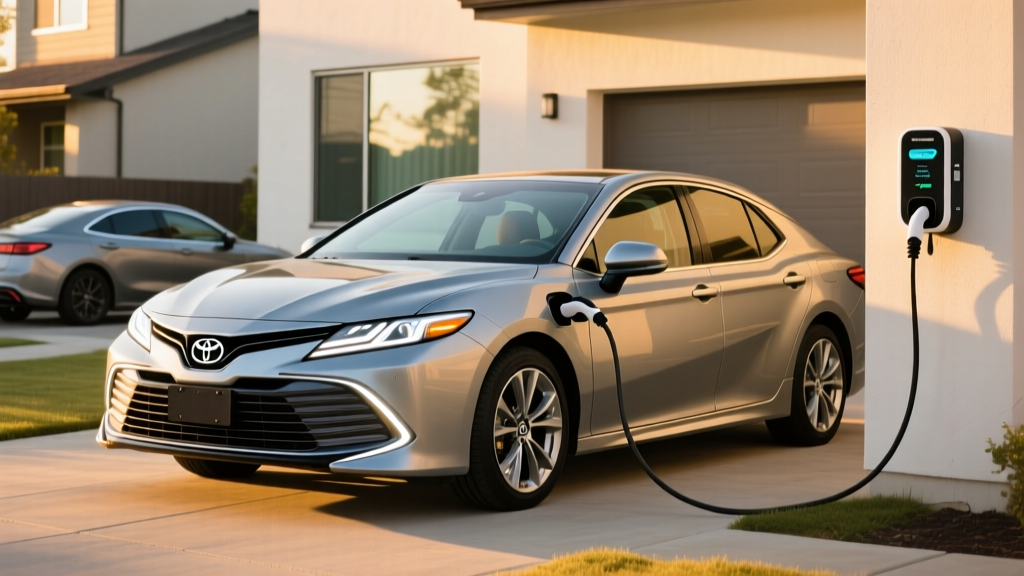
The Toyota Camry has been America's best-selling midsize sedan for years, and since the 2025 model year, every Camry sold in the U.S. is a hybrid. That makes the question of Toyota Camry hybrid mileage more important than ever — there's no gas-only fallback in the lineup anymore. For 2026, Toyota continues with its fifth-generation hybrid system, pairing a 2.5-liter four-cylinder engine with electric motors to deliver class-leading efficiency without sacrificing practicality.
If you're researching the Camry Hybrid against plug-in hybrids, full EVs, or rival midsize hybrids like the Honda Accord Hybrid or Hyundai Sonata Hybrid, this guide gives you the exact numbers — EPA ratings, real-world MPG data, powertrain specs, battery longevity, and total cost of ownership — so you can decide whether the Camry Hybrid is the right move for your commute.
2026 Toyota Camry Hybrid MPG: EPA Ratings by Trim
Toyota offers the 2026 Camry Hybrid in front-wheel drive (FWD) and electronic all-wheel drive (eAWD) configurations, and the drivetrain choice directly affects fuel economy. Here are the official EPA numbers from fueleconomy.gov:
| Trim / Drivetrain | City MPG | Highway MPG | Combined MPG |
|---|---|---|---|
| LE (FWD) | 51 | 44 | 48 |
| SE / XLE / XSE (FWD) | 48 | 43 | 46 |
| LE (eAWD) | 49 | 42 | 46 |
| SE / XLE / XSE (eAWD) | 46 | 40 | 44 |
The LE trim achieves the highest rating because it rides on smaller, lower-rolling-resistance wheels (16-inch vs. 18- or 19-inch on higher trims) and weighs slightly less. The eAWD system adds a rear electric motor for traction but costs you 2-4 MPG combined compared to the equivalent FWD trim.
How the Fifth-Generation Hybrid Powertrain Works
The 2026 Camry uses Toyota's latest fifth-generation Toyota Hybrid System (THS), which debuted with the 2025 Camry redesign. Here's what's under the hood:
| Specification | 2026 Camry Hybrid |
|---|---|
| Engine | 2.5L DOHC 4-cylinder (Dynamic Force) |
| Front Electric Motor | Permanent magnet synchronous |
| Rear Motor (eAWD only) | 40 kW rear electric motor |
| Combined Net Horsepower (FWD) | 225 hp |
| Combined Net Horsepower (eAWD) | 232 hp |
| Hybrid Battery | 1.0 kWh lithium-ion (nominal) |
| Transmission | eCVT (planetary gearset) |
| 0-60 MPH | ~7.1 sec (FWD) / ~6.9 sec (eAWD) |
| Fuel Tank | 13.2 gallons |
| Total Range (LE FWD, est.) | ~630 miles |
This is a conventional hybrid (HEV) — not a plug-in hybrid. The 1.0 kWh battery is small and recharges entirely through regenerative braking and the gasoline engine. You never plug it in. The eCVT is not a traditional belt-driven CVT; it uses a planetary gearset that seamlessly blends power from the engine and electric motors, which is why Toyota's hybrids feel smooth without the rubber-band sensation of older CVT designs.
The 225 hp combined output puts the Camry Hybrid ahead of most midsize hybrid competitors and provides confident highway merging. The eAWD variant's extra rear motor adds 7 hp and provides meaningful traction in rain and light snow without a significant efficiency penalty.
HEV vs. PHEV vs. EV: Which Powertrain Fits You?
A common question from Camry shoppers is whether they should consider a plug-in hybrid or a full battery-electric vehicle instead. Here's a clear breakdown:
| Factor | Camry Hybrid (HEV) | Plug-In Hybrid (e.g., Prius Prime) | Full EV (e.g., Tesla Model 3) |
|---|---|---|---|
| Plug-in required? | No | Yes (for max benefit) | Yes |
| Electric-only range | None (EV assist only) | ~30-44 mi | 250-360+ mi |
| City MPG / MPGe | 48-51 MPG | 50-52 MPG / 127 MPGe (EV mode) | 130-140 MPGe |
| Home charging needed? | No | Recommended (Level 2) | Essential (Level 2) |
| Base MSRP (2026) | ~$29,990 | ~$33,500-$39,000 | ~$39,000-$48,000 |
| Federal tax credit (§30D) | Not eligible | Up to $7,500 (if eligible) | Up to $7,500 (if eligible) |
| Best for | No home charging access; simplicity | Short commute + road trips | Home charging + low running cost |
- You rent or live somewhere you cannot install a Level 2 charger
- You want maximum simplicity — no charging cables, no apps, no range planning
- Your budget is under $35,000 and you want a midsize sedan
- You drive a mix of city and highway and want 600+ miles of total range
- You have a garage or driveway with a 120V or 240V outlet
- Your daily commute is under 40 miles round-trip (you'll rarely use gas)
- You want electric driving for daily errands but gas flexibility for road trips
- You have reliable home Level 2 charging
- You want the lowest per-mile fuel cost (~$0.04/mi vs ~$0.08/mi for the Camry Hybrid)
- You're eligible for the $7,500 federal tax credit, which can offset the higher MSRP
Real-World Toyota Camry Hybrid Mileage: What Owners Report
EPA numbers tell part of the story, but the Camry Hybrid has a reputation for matching or exceeding its ratings in real-world driving — especially in city conditions where regenerative braking does the heavy lifting.
Based on aggregated owner data from Fuelly and Edmunds long-term testing:
- City-heavy commutes (under 45 MPH): 48-54 MPG. Some drivers in warm climates with light traffic report touching 55 MPG on the LE trim.
- Mixed suburban driving: 43-48 MPG, closely matching the EPA combined rating.
- Highway road trips (70-80 MPH): 37-42 MPG. Hybrids lose their city advantage at sustained high speeds where aerodynamic drag dominates and regenerative braking contributes little.
- Cold weather (below 35°F): 40-45 MPG combined. The gasoline engine runs more frequently to generate cabin heat and keep the hybrid battery at optimal temperature, reducing electric-only assist time.
The Camry Hybrid's fuel tank holds 13.2 gallons. At the LE's 48 MPG combined rating, that yields roughly 630 miles of total range — enough for most drivers to visit a gas station once every two to three weeks. Even the eAWD trims at 44 MPG combined deliver approximately 580 miles per tank.
Pricing, Trims, and Tax Credit Eligibility
The 2026 Camry Hybrid starts at approximately $29,990 for the LE trim (including destination), making it one of the most affordable midsize hybrid sedans available. Here's the trim breakdown:
| Trim | FWD MSRP | eAWD MSRP | Key Features |
|---|---|---|---|
| LE | $29,990 | $31,390 | 16" wheels, 8" touchscreen, TSS 3.0, wireless CarPlay/Android Auto |
| SE | $31,490 | $32,890 | Sport-tuned suspension, 18" wheels, paddle shifters |
| XLE | $34,290 | $35,690 | Leather-trimmed seats, 12.3" display, ambient lighting |
| XSE | $35,490 | $36,890 | Sport styling + premium features, 19" wheels |
Federal tax credit: The conventional Camry Hybrid (HEV) does not qualify for the IRS §30D Clean Vehicle Credit. That credit applies only to plug-in electric vehicles (PHEVs and BEVs) with sufficient battery capacity and meeting critical-mineral and battery-component sourcing requirements. If the $7,500 credit is a priority for you, you'd need to look at a PHEV like the Toyota Prius Prime or a full EV — but factor in their higher base prices and the need for home charging infrastructure.
Some states and local utilities offer rebates for conventional hybrids, though these are far less common than EV incentives. Check your state energy office or utility provider for current programs.
Hybrid Battery Warranty, Reliability, and Replacement Cost
Battery longevity is the single most common concern from first-time hybrid buyers. Here are the facts for the 2026 Camry:
- Duration: 10 years / 150,000 miles (whichever comes first)
- Coverage: Defects and capacity loss below a specified threshold
- Hybrid system components: 8 years / 100,000 miles (inverter, motor, control module)
- Transferable: Yes, to subsequent owners
Toyota's hybrid battery track record is among the best in the industry. The Camry Hybrid uses a relatively small 1.0 kWh lithium-ion pack that operates in a shallow state-of-charge window — typically between 40% and 80% — which dramatically reduces stress on the cells. Toyota's hybrid battery management system never allows full charge or full depletion, which is why these packs routinely last 150,000-200,000+ miles before significant degradation.
According to data aggregated from Toyota dealerships and independent hybrid repair shops:
- Typical hybrid battery lifespan: 15-20 years or 180,000-250,000 miles under normal use
- Full battery replacement cost (out of warranty): $2,500-$4,500 including labor at a Toyota dealer; $1,500-$3,000 at an independent hybrid specialist using refurbished or aftermarket cells
- Individual module replacement: Some independent shops can replace degraded modules within the pack for $500-$1,200, extending the pack's life at a fraction of the full replacement cost
The Camry consistently earns top reliability marks from Consumer Reports and J.D. Power, and the fifth-generation THS has proven robust since its introduction. For comparison, a conventional automatic transmission replacement in a gas-only midsize sedan can cost $3,500-$5,500 — a hybrid battery replacement is in a similar range and typically needed far less frequently.
Toyota Safety Sense 3.0 (TSS 3.0) comes standard on every 2026 Camry Hybrid, including pre-collision braking with pedestrian detection, lane departure alert with steering assist, full-speed adaptive cruise control, and automatic high beams. The Camry earns a TOP SAFETY PICK rating from the IIHS.
Camry Hybrid vs. Competitors: MPG and Value Comparison
How does the Camry Hybrid stack up against other midsize hybrid sedans on mileage and price?
| Vehicle | Combined MPG | HP | Base MSRP | Battery Warranty |
|---|---|---|---|---|
| 2026 Toyota Camry Hybrid LE | 48 | 225 | $29,990 | 10 yr / 150k mi |
| 2026 Honda Accord Hybrid | 44 | 204 | $33,990 | 8 yr / 100k mi |
| 2026 Hyundai Sonata Hybrid | 47 | 192 | $31,250 | 10 yr / 100k mi |
| 2026 Kia K5 Hybrid | 44 | 192 | $30,490 | 10 yr / 100k mi |
The Camry Hybrid LE leads the segment in combined MPG while offering the most horsepower. Its starting price undercuts the Accord Hybrid by roughly $4,000 and the Sonata Hybrid by about $1,200. Toyota's 10-year/150,000-mile hybrid battery warranty also matches or exceeds competitors, with Hyundai and Kia offering 10 years but capped at 100,000 miles.
5-Year Cost of Ownership Estimate
Here's a practical look at what owning a 2026 Camry Hybrid LE actually costs compared to a typical gas-only midsize sedan (25 MPG combined) over five years and 75,000 miles:
| Cost Category | Camry Hybrid LE (48 MPG) | Gas Sedan (25 MPG) |
|---|---|---|
| Fuel (at $3.40/gal avg.) | $5,313 | $10,200 |
| Maintenance (est.) | $2,800 | $3,400 |
| Insurance (avg.) | $7,500 | $7,200 |
| Depreciation (est.) | $11,000 | $12,500 |
| 5-Year Total | ~$26,613 | ~$33,300 |
The Camry Hybrid saves approximately $6,700 over five years, driven primarily by fuel savings of nearly $4,900. Hybrids also tend to have lower brake wear costs because regenerative braking reduces friction brake usage — brake pads on Toyota hybrids often last 80,000+ miles. Toyota hybrids also hold their resale value well; the Camry Hybrid's depreciation is lower than most gas-only competitors, according to Kelley Blue Book projections.
Pros
- Class-leading 48-51 MPG combined
- No plug-in charging required — works with existing habits
- 225-232 hp provides confident acceleration
- 630+ mile total range per tank
- 10-year/150,000-mile hybrid battery warranty
- Standard TSS 3.0 safety suite
- Available eAWD for snow/rain traction
- Strong resale value
Cons
- No electric-only driving mode (unlike PHEVs)
- Does not qualify for the $7,500 federal EV tax credit
- Highway MPG drops at sustained 75+ MPH speeds
- eAWD trims sacrifice 2-4 MPG for traction
- Larger wheels on SE/XSE trims reduce efficiency
- Not as engaging to drive as some turbocharged rivals
Frequently Asked Questions
How many MPG does the 2026 Toyota Camry Hybrid get?
The EPA rates the 2026 Camry Hybrid LE at 51 city / 44 highway / 48 combined MPG. Higher trims (SE, XLE, XSE) with larger wheels are rated at 48 city / 43 highway / 46 combined. Adding eAWD reduces combined MPG by 2 points. In real-world city driving, many owners report meeting or slightly exceeding their EPA city rating thanks to aggressive regenerative braking.
Does the Camry Hybrid need to be plugged in?
No. The Camry Hybrid is a conventional hybrid (HEV). Its small 1.0 kWh battery charges entirely through regenerative braking and the gasoline engine. You fuel it like any other car at a gas station. If you want plug-in capability with electric-only range, consider the Toyota Prius Prime (PHEV), which offers up to 44 miles of electric-only driving.
Is the Camry Hybrid reliable, and how long will the battery last?
Toyota's hybrid systems have a decades-long track record of reliability. The Camry Hybrid battery is warrantied for 10 years/150,000 miles and typically lasts 180,000-250,000 miles in normal use. If replacement is needed out of warranty, expect $2,500-$4,500 at a dealer or $1,500-$3,000 at a hybrid specialist. The Camry consistently earns top reliability scores from Consumer Reports and J.D. Power.
Does the 2026 Camry Hybrid qualify for any tax credit?
No. The IRS §30D Clean Vehicle Credit applies only to plug-in electric vehicles (PHEVs and BEVs) with qualifying battery capacity, MSRP limits, buyer income caps, and battery sourcing requirements. The conventional Camry Hybrid does not qualify. Some state or utility rebates may apply — check your local programs.
How does the Camry Hybrid compare to a full EV in running costs?
At $3.40/gallon gas and 48 MPG, the Camry Hybrid costs roughly $0.07 per mile in fuel. A comparable EV like the Tesla Model 3 charged at home at $0.13/kWh and 4 mi/kWh costs about $0.03-$0.04 per mile. Over 15,000 miles per year, the EV saves approximately $450-$600 in fuel. However, the Camry Hybrid's lower purchase price (~$10,000-$15,000 less than most EVs) and lack of home charging requirements offset much of that gap for the first several years of ownership.
Is eAWD worth the MPG trade-off?
If you live in an area with frequent rain, snow, or icy roads, the eAWD system's 2-4 MPG penalty (about $150-$200/year in additional fuel at current gas prices) is a small price for significantly improved traction. The rear motor engages automatically when slippage is detected and does not add weight or complexity comparable to a mechanical AWD system. For mild-climate drivers who rarely see snow, FWD is the more efficient choice.