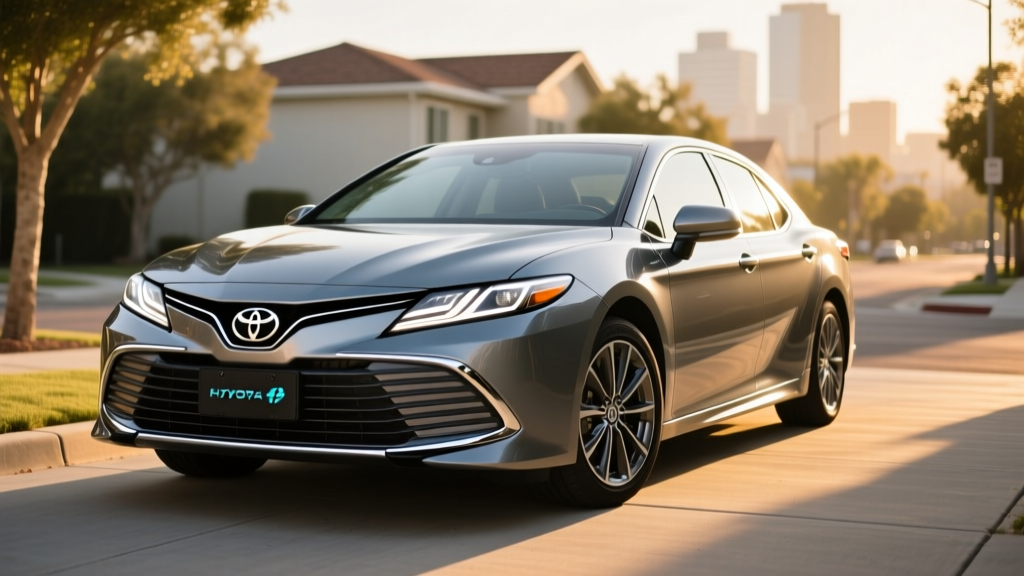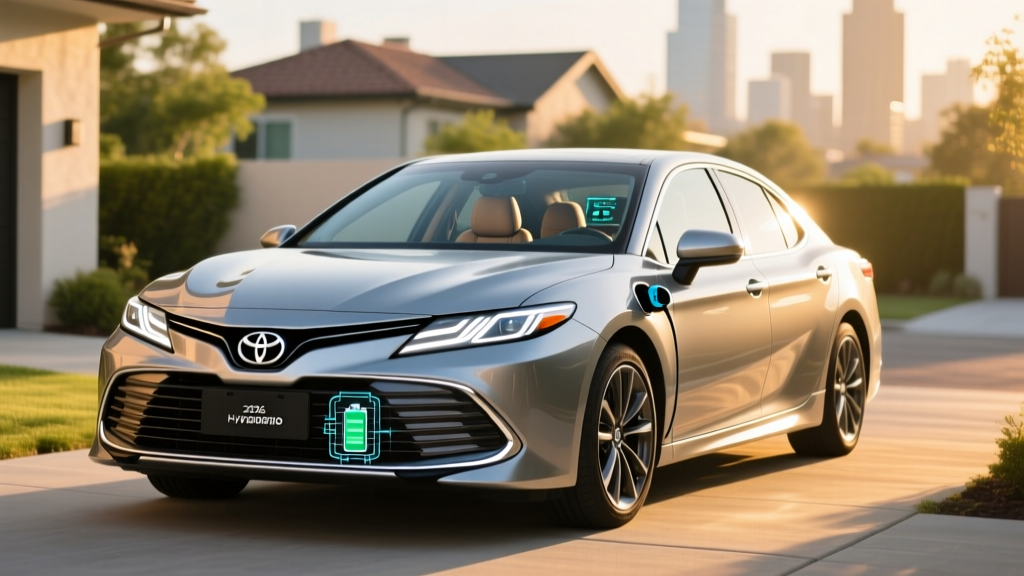
The ninth-generation Toyota Camry Hybrid continues to dominate the midsize sedan segment in 2026, offering a compelling mix of efficiency, reliability, and value. With lease deals frequently appearing in the $289–$399/month range depending on trim and region, the Camry Hybrid remains one of the most accessible ways to cut fuel costs without committing to a full electric vehicle. This guide breaks down exactly what you're getting — from EPA MPG figures and powertrain specs to battery warranty coverage and how the Camry Hybrid stacks up against plug-in hybrids and full EVs.
2026 Toyota Camry Hybrid: Quick Spec Overview
| Specification | 2026 Camry Hybrid (FWD) | 2026 Camry Hybrid (AWD) |
|---|---|---|
| Powertrain | 2.5L 4-cyl + 2 electric motors | 2.5L 4-cyl + 3 electric motors |
| Combined Horsepower | 225 hp | 232 hp |
| EPA City MPG | 53 mpg | 51 mpg |
| EPA Highway MPG | 50 mpg | 49 mpg |
| EPA Combined MPG | 51 mpg | 50 mpg |
| Fuel Tank Capacity | 13.2 gal | 13.2 gal |
| Total Driving Range | ~673 miles | ~660 miles |
| 0–60 mph | ~7.2 sec | ~7.0 sec |
| Hybrid Battery | ~1.6 kWh (NiMH/Li-ion) | ~1.6 kWh (NiMH/Li-ion) |
| Plug-In Required? | No (regenerative + engine charging) | No |
| Base MSRP (LE) | $29,995 | $31,395 |
| Battery Warranty | 10 years / 150,000 miles | 10 years / 150,000 miles |
Source: fueleconomy.gov and Toyota specifications. Real-world results vary by driving style, terrain, and climate.
Understanding the Camry Hybrid: HEV, Not PHEV
The 2026 Toyota Camry Hybrid is a conventional hybrid electric vehicle (HEV). It does not plug in. The small hybrid battery charges through regenerative braking and the gasoline engine. You never need a charging cable or outlet.
A plug-in hybrid (PHEV), like the Toyota RAV4 Prime or Prius Prime, has a larger battery (typically 13–19 kWh) that you charge via a wall outlet or charging station, enabling 25–44 miles of electric-only driving before the gas engine kicks in. The Camry lineup does not currently offer a PHEV variant.
This distinction matters enormously for lease shoppers. If your daily commute is under 30 miles round-trip and you have home charging access, a PHEV lets you drive almost entirely on electricity most days. If you lack charging access or regularly drive longer distances, the Camry HEV's no-plug-required simplicity is a major advantage — you just fill up at any gas station and let the hybrid system optimize efficiency automatically.
Fuel Economy: EPA vs Real-World MPG
| Driving Scenario | FWD EPA | FWD Real-World Expectation | AWD Real-World Expectation |
|---|---|---|---|
| City / Stop-and-Go | 53 mpg | 52–58 mpg (hybrids excel here) | 50–55 mpg |
| Highway (70 mph cruise) | 50 mpg | 44–48 mpg | 43–47 mpg |
| Combined Mixed Driving | 51 mpg | 47–53 mpg | 46–52 mpg |
| Cold Weather (below 32°F) | — | 40–46 mpg (engine runs more for cabin heat) | 39–45 mpg |
The Camry Hybrid's 51 mpg combined EPA rating is genuinely achievable in mixed suburban and city driving. In fact, many owners report exceeding the EPA city figure in stop-and-go traffic, because regenerative braking recaptures energy at every stop and the electric motor handles low-speed propulsion. This is the opposite of gas-only cars, which get their worst mileage in the city.
Where the Camry Hybrid loses ground is sustained highway driving above 70 mph. At those speeds, aerodynamic drag dominates and the engine does most of the work with less assistance from the hybrid system. Expect 44–48 mpg on a long interstate trip — still excellent for a midsize sedan, but noticeably below the sticker number.
Cold weather hits all hybrids harder. Below freezing, the gasoline engine runs more frequently to generate cabin heat and maintain battery temperature, dropping efficiency by roughly 10–15%. If you live in a northern climate, budget for 40–46 mpg in winter months.
Lease Pricing and Tax Credit Reality
As of early 2026, Toyota Camry Hybrid lease deals typically fall in these ranges, though they vary significantly by region, dealer, credit tier, and current incentives:
- LE (base): $289–$339/month, 36 months, $2,500–$3,500 due at signing
- SE (sport trim): $319–$369/month, 36 months, $2,500–$3,500 due at signing
- XLE (premium): $349–$399/month, 36 months, $3,000–$4,000 due at signing
- XSE (sport premium): $359–$409/month, 36 months, $3,000–$4,000 due at signing
AWD typically adds $1,500–$2,000 to the capitalized cost, translating to roughly $15–$25/month more.
The IRS §30D federal tax credit (up to $7,500) applies only to plug-in electric vehicles (BEVs and PHEVs) that meet battery sourcing, critical mineral, MSRP cap, and buyer income requirements. The Camry Hybrid is a conventional HEV with no plug — it does not qualify for the federal EV tax credit.
However, some states and utilities offer rebates for conventional hybrids. Check your state energy office and local utility for programs. Toyota Financial Services also periodically offers lease cash incentives ($500–$1,500) that reduce your monthly payment — ask your dealer about current TFS offers.
Camry Hybrid vs PHEV vs Full EV: Which Fits You?
| Factor | Camry Hybrid (HEV) | PHEV (e.g., Prius Prime) | Full EV (e.g., Tesla Model 3) |
|---|---|---|---|
| Plug-In Required? | No | Yes (for electric miles) | Yes (always) |
| Electric-Only Range | ~1 mile (low-speed creep) | 35–44 miles | 250–360+ miles |
| Total Range | ~670 miles | ~500–600 miles (gas+electric) | 250–360 miles |
| Home Charging Needed? | No | Recommended (Level 1 or 2) | Essential (Level 2) |
| Combined Efficiency | 51 mpg | 50 mpg + 127 MPGe (electric) | 132 MPGe |
| Fuel Cost (annual, 15k mi) | ~$1,030 (gas only) | ~$550–$800 (mixed) | ~$500–$750 (electricity) |
| Base Price Range | $29,995–$37,000 | $33,000–$40,000 | $38,990–$55,000 |
| Federal Tax Credit | None | Up to $7,500 (if eligible) | Up to $7,500 (if eligible) |
| Maintenance Complexity | Low (mature hybrid system) | Moderate (larger battery, charging hardware) | Low (fewer moving parts) |
- Choose the Camry Hybrid (HEV) if: You don't have reliable home or workplace charging, you drive 40+ miles daily, you want maximum simplicity with no plug-in routine, or you want the lowest entry price with proven long-term reliability.
- Choose a PHEV if: You have Level 1 or Level 2 charging at home, your daily commute is under 40 miles round-trip (so you can drive mostly on electricity), and you still want gas-engine flexibility for road trips.
- Choose a full EV if: You have Level 2 home charging, your daily driving is under 250 miles, you want zero tailpipe emissions and the lowest per-mile fuel cost, and you're comfortable planning around public DC fast chargers for road trips.
Powertrain and Driving Impressions
The 2026 Camry Hybrid uses Toyota's fifth-generation hybrid system. The 2.5-liter Dynamic Force four-cylinder engine produces 184 hp on its own, paired with front-mounted electric motor-generators that bring the net system output to 225 hp (FWD) or 232 hp (AWD). The AWD variant adds a rear-mounted electric motor — there's no mechanical driveshaft to the rear wheels.
Acceleration is adequate rather than thrilling: 0–60 mph in roughly 7.0–7.2 seconds. The electric motor provides immediate low-end torque, making the Camry Hybrid feel responsive from a stoplight and during city merging. At highway speeds, the CVT keeps the engine in its most efficient range, which means passing acceleration requires a downshift that raises engine RPM noticeably.
The transition between electric-only and gasoline operation is nearly imperceptible — a hallmark of Toyota's hybrid maturity. Under light loads and at low speeds, the car runs on electric power alone for short bursts (typically under 1 mile). The regenerative braking system has multiple levels adjustable through the shift selector, though true one-pedal driving isn't available as it is in full EVs.
Hybrid Battery Warranty and Longevity
Toyota covers the Camry Hybrid battery with a 10-year / 150,000-mile warranty (whichever comes first) in all 50 states. This warranty covers defects and capacity loss below a defined threshold. The hybrid system components (inverter, motor-generators, control electronics) are also covered under this term.
Additionally, California-emissions states (which include CA, CO, CT, DE, ME, MD, MA, NJ, NM, NY, OR, RI, VT, WA, and others adopting CARB standards) extend certain hybrid component coverage further.
Toyota's hybrid batteries have an exceptional longevity track record. The Camry Hybrid's battery pack is relatively small (~1.6 kWh) and operates within a conservative state-of-charge window — typically between 40% and 80% — which dramatically reduces degradation stress compared to full EVs that cycle from near-empty to near-full. Many first-generation Prius and Camry Hybrid taxis have logged 200,000–300,000+ miles on original batteries.
If replacement is ever needed out of warranty, a new OEM Camry Hybrid battery costs approximately $2,500–$4,000 installed. Refurbished/remanufactured units are available for $1,500–$2,500. Given the 10-year/150,000-mile warranty and the system's proven durability, battery replacement is a low-probability event for most owners — and a non-issue for lessees who return the car after 36 months.
Is the Camry Hybrid Reliable?
Toyota's hybrid system is among the most proven powertrains in automotive history, with over 25 years of continuous refinement since the 1997 Prius. The Camry Hybrid consistently earns top reliability ratings from Consumer Reports and J.D. Power. The e-CVT transmission has no traditional belts, clutches, or torque converter — it's a planetary gearset with far fewer wear components than a conventional automatic.
Brake wear is also significantly reduced thanks to regenerative braking handling most deceleration. Many Camry Hybrid owners report original brake pads lasting 80,000–100,000+ miles — a maintenance savings that partially offsets the hybrid system's added complexity.
The NHTSA and IIHS safety ratings for the current-generation Camry remain strong, with Toyota Safety Sense 3.0 standard across all trims (pre-collision with pedestrian detection, lane departure alert, dynamic radar cruise control, and automatic high beams).
Pros and Cons at a Glance
- 51 mpg combined — among the best in the midsize class
- No plug-in charging required — works everywhere
- 10-year/150,000-mile hybrid battery warranty
- Standard AWD option (rare in this segment)
- Strong resale value and proven reliability
- Competitive lease pricing from ~$289/month
- Toyota Safety Sense 3.0 standard
- No federal tax credit (HEV, not PHEV/BEV)
- Highway MPG drops to 44–48 real-world
- CVT drone under hard acceleration
- No electric-only driving beyond low-speed creep
- Rear seat headroom slightly reduced vs prior generation
- No DC fast charging capability (not applicable — no plug)
Frequently Asked Questions
How many MPG does the 2026 Toyota Camry Hybrid get?
The FWD Camry Hybrid achieves 53 city / 50 highway / 51 combined MPG per the EPA. The AWD variant rates 51/49/50. In real-world driving, expect to match or exceed the city figure in stop-and-go traffic (52–58 mpg) but fall below the highway number on sustained interstate drives (44–48 mpg). Cold weather reduces all figures by 10–15%.
Does the Camry Hybrid plug in or need charging?
No. The Camry Hybrid is a conventional HEV. Its small hybrid battery charges exclusively through regenerative braking and the gasoline engine. You never plug it in. If you want plug-in electric driving, look at PHEV options like the Toyota Prius Prime (44 miles electric-only) or a full BEV.
How far can the Camry Hybrid go on electric only?
Effectively less than 1 mile, and only at very low speeds (parking lots, stop-and-go creep). The hybrid battery is too small (~1.6 kWh) for meaningful electric-only driving. For 25–44 miles of electric-only range, you'd need a PHEV.
Does the Camry Hybrid qualify for any tax credit?
Not the federal §30D credit, which requires a plug-in vehicle (BEV or PHEV) meeting battery sourcing, MSRP cap ($55,000 for sedans), and buyer income limits. Some states and utilities offer smaller hybrid incentives — check locally. The Camry Hybrid's lower base price ($29,995) and strong fuel savings often offset the lack of a federal credit over a 3-year lease.
Is the hybrid battery reliable and what does replacement cost?
Toyota's hybrid batteries have an outstanding track record spanning 25+ years. The Camry Hybrid battery is covered for 10 years / 150,000 miles. Out-of-warranty replacement runs $2,500–$4,000 for a new OEM unit, but most batteries last well beyond the warranty period. For lessees, battery longevity is a non-concern since you'll return the vehicle long before any degradation risk.
Camry Hybrid vs full EV — which saves more money?
A full EV (like a Tesla Model 3 or Hyundai Ioniq 6) costs less per mile to fuel (~$0.04–$0.06/mi vs ~$0.07–$0.09/mi for the Camry Hybrid) and may qualify for the $7,500 federal credit. However, EVs cost more upfront, require home Level 2 charging installation ($500–$2,000), and carry higher insurance premiums. Over a 3-year lease at 15,000 miles/year, the Camry Hybrid's lower purchase price and no-charging-infrastructure cost often make total cost of ownership competitive — especially if your electricity rates are above $0.15/kWh.
Always verify current lease terms directly with your local Toyota dealer and check IRS.gov for the latest tax credit rules, as incentives and eligibility change periodically.