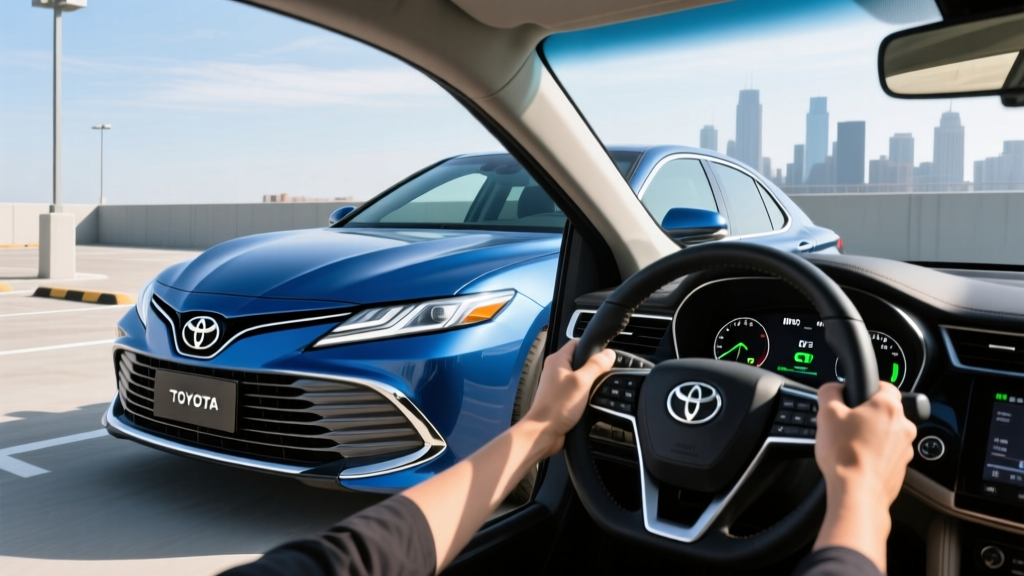
The Toyota Camry has gone fully hybrid for the 2025 model year, eliminating the gas-only four-cylinder option that defined the sedan for decades. For buyers researching the Toyota Camry Hybrid cost, the numbers tell a compelling story: starting at $28,400, delivering up to 51 MPG combined, and backed by a 10-year/150,000-mile hybrid battery warranty. But pricing, fuel economy, and long-term ownership expenses vary significantly by trim and driving pattern.
This guide breaks down every cost factor — from MSRP by trim to real-world MPG to projected fuel savings — so you can determine whether the Camry Hybrid's value proposition holds up in your driveway.
2025 Toyota Camry Hybrid Pricing by Trim
The Camry Hybrid lineup spans four trims, with all-wheel drive available on every one for a $1,600 premium. Here is the current MSRP structure including destination charges:
| Trim | FWD MSRP | AWD MSRP | Key Additions |
|---|---|---|---|
| LE | $28,400 | $30,000 | 8-inch touchscreen, wireless CarPlay/Android Auto, TSS 3.0 |
| SE | $29,900 | $31,500 | Sport-tuned suspension, 18-inch alloy wheels, paddle shifters |
| XLE | $33,400 | $35,000 | 12.3-inch display, leather-trimmed seats, heated front seats |
| XSE | $34,900 | $36,500 | Sport styling + premium features, 12.3-inch display, ambient lighting |
The LE trim represents the strongest value entry point — you get the full hybrid powertrain, Toyota Safety Sense 3.0, and the highest EPA fuel economy rating. Moving up to XLE or XSE adds roughly $5,000–$6,500, primarily for interior luxury and technology upgrades rather than performance gains.
Fuel Economy: EPA Ratings and Real-World MPG
The Camry Hybrid's fuel economy splits into two tiers based on wheel size and drivetrain. The LE trim with its 16-inch wheels and FWD achieves the headline numbers, while SE/XLE/XSE trims with larger wheels and available AWD see a modest drop.
| Configuration | City MPG | Highway MPG | Combined MPG |
|---|---|---|---|
| LE FWD | 53 | 50 | 51 |
| LE AWD | 51 | 49 | 49 |
| SE/XLE/XSE FWD | 48 | 47 | 47 |
| SE/XLE/XSE AWD | 46 | 46 | 46 |
Real-world MPG expectations: Toyota's hybrid system excels in stop-and-go city driving where regenerative braking recaptures energy and the electric motor handles low-speed propulsion. Owners consistently report matching or slightly exceeding EPA city estimates — 52–54 MPG in warm-weather urban driving is common for the LE trim. Highway efficiency at 75+ MPH tends to run 2–4 MPG below the sticker due to aerodynamic drag and the engine operating more frequently. In cold weather below 40°F, expect a 5–8% reduction across the board as the engine runs more often for cabin heat and battery warmup.
Source: EPA Fuel Economy — 2025 Toyota Camry Hybrid
Powertrain Specifications and Performance
The 2025 Camry Hybrid pairs a 2.5-liter four-cylinder engine with Toyota's fifth-generation hybrid transaxle. The system produces 225 horsepower in FWD configuration and 232 horsepower with AWD, which adds a rear-mounted electric motor for on-demand traction.
| Specification | FWD | AWD |
|---|---|---|
| Combined System Output | 225 hp | 232 hp |
| Engine | 2.5L 4-cyl Dynamic Force | 2.5L 4-cyl Dynamic Force |
| Front Motor | 100 kW (134 hp) | 100 kW (134 hp) |
| Rear Motor (AWD only) | — | 30 kW (40 hp) |
| Hybrid Battery | ~1.6 kWh (Li-ion) | ~1.6 kWh (Li-ion) |
| 0–60 MPH (est.) | ~7.2 sec | ~7.0 sec |
The Camry Hybrid is a conventional hybrid (HEV), not a plug-in hybrid. You never plug it in — the battery charges through regenerative braking and engine-driven generation. This keeps the system simple and eliminates range anxiety, but it also means electric-only driving is limited to brief low-speed bursts under 1 mile, not the 25–40 miles a plug-in hybrid can deliver.
Hybrid vs. Plug-In Hybrid vs. Full EV: Which Fits You?
Toyota discontinued the Camry Hybrid PHEV variant years ago, so the current model is exclusively a conventional HEV. Understanding the distinction is critical for buyers cross-shopping electrified sedans:
Conventional Hybrid (HEV) — Camry Hybrid
- No plug-in charging required; fuel at any gas station
- 51 MPG combined (LE); no electric-only range to manage
- Lower upfront cost ($28,400–$36,500)
- Best for: drivers without reliable home or workplace charging access
Plug-In Hybrid (PHEV) — e.g., Toyota Prius Prime
- Plug in to charge; ~40 miles electric-only range before engine engages
- Combined 48 MPG after battery depletes
- Higher upfront cost; may qualify for $3,750–$7,500 federal tax credit
- Best for: short-commute drivers with home Level 2 charging who want gas-free weekday driving with road-trip flexibility
Battery Electric Vehicle (BEV) — e.g., Tesla Model 3, Hyundai Ioniq 6
- 100% electric; 270–360+ miles EPA range; DC fast charging
- Zero tailpipe emissions; lowest per-mile "fuel" cost (electricity vs. gas)
- Highest upfront cost; $7,500 federal credit eligibility varies by model and sourcing
- Best for: drivers with reliable home charging who want maximum operating savings and minimal maintenance
The Camry Hybrid occupies a practical middle ground: it delivers hybrid efficiency without requiring any change to your refueling habits. If you drive 40+ miles daily, have access to a 240V outlet at home, and want to eliminate most fuel costs, a PHEV or BEV may serve you better. If you live in an apartment without charging access or regularly drive 500+ miles without stopping, the Camry HEV is the lower-friction choice.
Tax Credits and Incentives
Here is where the math requires precision: the conventional Camry Hybrid does not qualify for the federal §30D clean vehicle tax credit. Under current IRS rules, the credit applies only to plug-in electric vehicles (PHEVs and BEVs) that meet battery capacity thresholds, MSRP caps, buyer income limits, and critical-mineral sourcing requirements.
The Camry Hybrid's lithium-ion battery is too small (~1.6 kWh) to meet the plug-in threshold. This means you pay full MSRP with no federal offset.
State and local incentives vary. Some states offer hybrid-specific rebates or reduced registration fees, but these are jurisdiction-dependent and change frequently. Check your state energy office or department of revenue for current programs. Toyota also periodically offers manufacturer incentives (cash-back or low-APR financing) on the Camry Hybrid — check Toyota's official offers page for current deals in your ZIP code.
Hybrid Battery Warranty and Replacement Cost
Long-term battery reliability is the top concern among first-time hybrid buyers. Toyota addresses this with one of the strongest warranties in the segment:
Toyota Hybrid Battery Warranty
Coverage: 10 years or 150,000 miles (whichever comes first) from date of first use. Covers defects and capacity loss below a defined threshold. Transferable to subsequent owners.
Hybrid System Components: 8 years / 100,000 miles for the inverter, transaxle, and associated control modules.
Real-world longevity data: Toyota's hybrid system has been in continuous production since the 2001 Prius, and real-world fleet data shows hybrid batteries frequently lasting 150,000–200,000+ miles before significant degradation. The lithium-ion pack in the current Camry is smaller and less stressed than a full EV battery, which contributes to its longevity. Most owners will sell the vehicle before the hybrid battery requires replacement.
Replacement cost if out of warranty: A new OEM hybrid battery for the Camry Hybrid typically costs $2,000–$3,500 installed at a dealership. Aftermarket refurbished or reconditioned units are available for $1,200–$2,000. Given the 10-year warranty and the battery's track record, this is a low-probability expense for most buyers.
Total Cost of Ownership: 5-Year Projection
To evaluate the Camry Hybrid's true cost, compare it against a similarly priced gas-only midsize sedan baseline (approximately 28 MPG combined) over five years and 75,000 miles, assuming $3.50/gallon regular fuel:
| Cost Factor | Camry Hybrid LE (51 MPG) | Gas Sedan Baseline (28 MPG) |
|---|---|---|
| Purchase Price (MSRP) | $28,400 | $27,500 |
| Fuel Cost (75,000 mi) | $5,147 | $9,375 |
| Estimated Maintenance | $2,800 | $3,200 |
| Insurance (est. average) | $7,500 | $7,200 |
| 5-Year Total (est.) | $43,847 | $47,275 |
| Net Savings vs. Gas | ~$3,428 over 5 years | |
The Camry Hybrid's ~$900 MSRP premium over a comparable gas sedan is typically recovered within 18–24 months through fuel savings alone for drivers covering 15,000 miles per year. Maintenance costs are marginally lower because regenerative braking extends brake pad life and the hybrid system eliminates the traditional starter motor and alternator.
Insurance premiums run slightly higher on average — roughly $25–$50/month more than a gas-only equivalent — due to higher repair costs for hybrid-specific components. Get a personalized quote before purchasing to confirm your rate.
Reliability and Safety Ratings
Toyota's hybrid powertrain has a well-established reliability record. The Camry nameplate consistently ranks at or near the top of midsize sedan reliability surveys from Consumer Reports and J.D. Power.
The 2025 Camry comes standard with Toyota Safety Sense 3.0, which includes:
- Pre-Collision System with Pedestrian Detection
- Full-Speed Range Dynamic Radar Cruise Control
- Lane Departure Alert with Steering Assist
- Lane Tracing Assist
- Automatic High Beams
- Road Sign Assist
The previous-generation Camry earned the IIHS Top Safety Pick+ designation and a 5-Star overall rating from NHTSA. The 2025 redesign is expected to meet or exceed those benchmarks given Toyota's consistent safety engineering.
Who Should Buy the Camry Hybrid?
Choose the Camry Hybrid If:
- You want 50+ MPG without changing your refueling routine
- You lack access to home or workplace plug-in charging
- You drive 12,000–20,000+ miles per year and want to minimize fuel cost
- You prioritize proven reliability and a 10-year hybrid battery warranty
- You want a comfortable midsize sedan with strong resale value
Look Elsewhere If:
- You want electric-only commuting — consider a PHEV like the Prius Prime or a BEV like the Tesla Model 3
- You need SUV cargo space and ground clearance — look at the RAV4 Hybrid or Highlander Hybrid
- You want maximum federal tax credits — only PHEVs and BEVs qualify under §30D
- You prioritize sporty driving dynamics — the Camry Hybrid prioritizes efficiency over performance
Frequently Asked Questions
How many MPG does the Toyota Camry Hybrid get in real driving?
The LE FWD trim is EPA-rated at 53 city / 50 highway / 51 combined. In real-world testing, city driving often yields 52–54 MPG in warm weather thanks to regenerative braking. Highway driving at 75+ MPH typically returns 46–48 MPG. Cold weather reduces efficiency by 5–8% across the board.
Does the Camry Hybrid need to be plugged in?
No. The Camry Hybrid is a conventional hybrid (HEV), not a plug-in hybrid. The battery charges through regenerative braking and the gasoline engine. You refuel exclusively at gas stations.
Does the Toyota Camry Hybrid qualify for a federal tax credit?
No. Under current IRS §30D rules, the federal clean vehicle credit applies only to plug-in electric vehicles (PHEVs and BEVs). The Camry Hybrid's battery is too small to qualify. Check your state for any local hybrid incentives.
How long will the Camry Hybrid battery last, and what does replacement cost?
Toyota warrants the hybrid battery for 10 years / 150,000 miles. Real-world data shows these batteries frequently lasting 150,000–200,000+ miles. Out-of-warranty replacement costs $2,000–$3,500 for a new OEM unit, or $1,200–$2,000 for an aftermarket refurbished pack.
Is AWD worth the extra cost on the Camry Hybrid?
AWD adds $1,600 to any trim and reduces fuel economy by 2–3 MPG combined (49 vs. 51 for the LE). It provides meaningful traction benefits in snow and rain but is not necessary for most buyers in mild climates. If you live in a region with harsh winters, the fuel economy penalty is a worthwhile tradeoff for the added confidence.
How does the Camry Hybrid compare to the Prius?
The Prius offers slightly better fuel economy (up to 57 MPG combined) in a smaller, more affordable package starting around $27,950. The Camry Hybrid provides more rear-seat legroom, a larger trunk, a quieter ride, and a more premium interior. If maximum MPG is your priority, choose the Prius. If comfort and space matter more, the Camry Hybrid is the stronger pick.