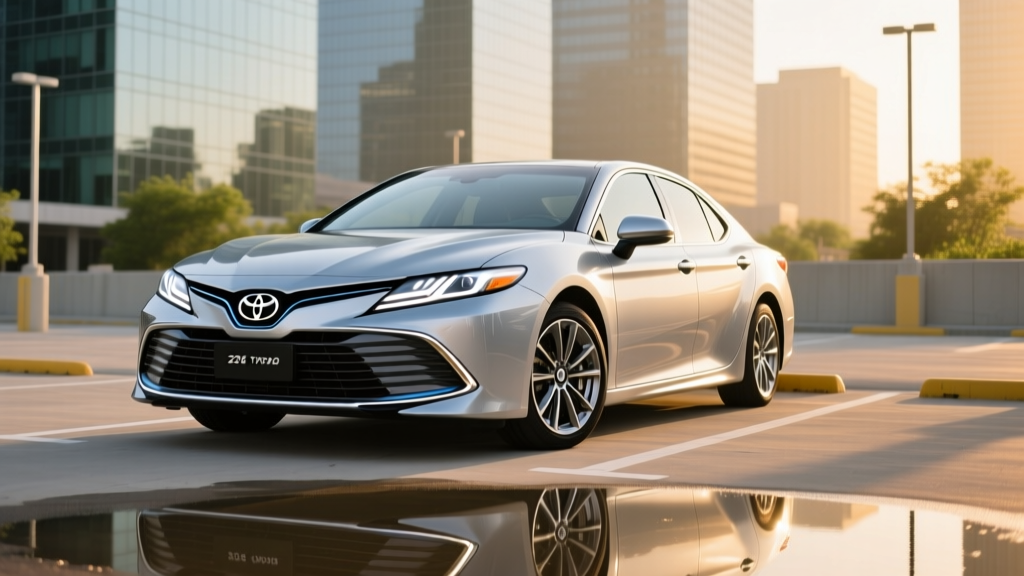
The Toyota Camry has been America's best-selling sedan for years, and for the 2025 model year, Toyota made a decisive move: every Camry is now a hybrid. There is no gas-only version. That shift makes understanding the Camry Hybrid cost — from sticker price to fuel savings to long-term battery reliability — essential for any midsize sedan shopper in 2026.
This guide breaks down every number that matters: trim-level pricing, EPA and real-world MPG, the hybrid powertrain specs, battery warranty coverage, and a five-year total cost of ownership comparison against both a conventional gas sedan and a full battery-electric vehicle. No marketing fluff, just the data you need to decide.
2026 Toyota Camry Hybrid Pricing by Trim
The 2026 Camry Hybrid carries over the powertrain and platform introduced with the all-hybrid ninth generation. Pricing starts under $29,000 and climbs to the mid-$30,000s for a fully loaded XSE with all-wheel drive. Here is the manufacturer's suggested retail pricing before any dealer adjustments or incentives:
| Trim | Drivetrain | MSRP | Key Additions |
|---|---|---|---|
| LE | FWD | $28,700 | 8-inch touchscreen, TSS 3.0, 16-inch alloys |
| LE | AWD | $30,200 | Electronic on-demand AWD rear motor |
| SE | FWD | $30,900 | Sport-tuned suspension, 18-inch wheels, paddle shifters |
| SE | AWD | $32,400 | AWD + sport trim features |
| XLE | FWD | $33,400 | 12.3-inch display, leather-trimmed seats, wireless CarPlay |
| XLE | AWD | $34,900 | AWD + premium features |
| XSE | AWD | $36,100 | Top sport trim, JBL audio, panoramic roof available |
Destination charges add approximately $1,095 across all trims. Dealer markups vary regionally, though the Camry's high production volume generally keeps prices close to MSRP in most markets.
EPA Fuel Economy and Real-World MPG
Fuel economy is the headline reason buyers cross-shop the Camry Hybrid cost against gas-only competitors. The EPA rates the front-wheel-drive LE at an impressive 51 mpg city / 49 mpg highway / 50 mpg combined. AWD trims drop slightly to 49/47/48 combined due to the additional drivetrain mass and the rear motor's parasitic losses when not engaged.
| Configuration | City | Highway | Combined | Fuel Tank | Est. Total Range |
|---|---|---|---|---|---|
| LE / XLE (FWD) | 51 mpg | 49 mpg | 50 mpg | 13.2 gal | ~660 miles |
| SE / XSE (AWD) | 49 mpg | 47 mpg | 48 mpg | 13.2 gal | ~634 miles |
Hybrid Powertrain: What's Under the Hood
The 2026 Camry uses Toyota's fifth-generation hybrid system, pairing a 2.5-liter Dynamic Force four-cylinder engine running the Atkinson cycle with one or two electric motors depending on drivetrain configuration.
- Engine: 2.5L inline-4, 184 hp / 163 lb-ft torque (standalone)
- Front electric motor: 134 hp / 155 lb-ft
- Combined net system output: 225 hp (FWD), 232 hp (AWD)
- AWD rear motor: 40 hp, electronically engaged on demand
- Transmission: eCVT (planetary gearset, no belt or traditional gears)
- 0–60 mph: ~7.1 seconds (FWD), ~6.9 seconds (AWD)
The eCVT is not a conventional continuously variable transmission with a steel belt and cones. It uses a planetary gearset to blend engine and motor power seamlessly. There are no fixed gears to shift and no rubber band effect. Acceleration is linear, and the engine only revs audibly under hard acceleration or sustained hill climbs.
Hybrid Battery: Chemistry, Warranty, and Replacement Cost
This is where the Camry Hybrid cost equation extends beyond the purchase price. The ninth-generation Camry uses a lithium-ion (Li-ion) hybrid battery pack — an upgrade from the nickel-metal hydride (NiMH) packs in older Camry Hybrids. The Li-ion pack is smaller, lighter, and more energy-dense, which contributes to the improved fuel economy and trunk space.
Battery replacement cost: If the hybrid battery fails outside warranty coverage, a new OEM replacement pack costs between $2,000 and $4,000 installed at a Toyota dealership. Independent hybrid specialists often offer refurbished packs for $1,500–$2,500. Individual module replacement (only the failed cells) can bring the cost down to $500–$1,200 at a specialist shop.
Longevity data: Toyota's hybrid batteries have a strong track record. Fleet data from Prius and Camry Hybrid taxis routinely show 200,000+ miles on the original pack. The Li-ion chemistry in the current generation is expected to last the life of the vehicle for most owners. Degradation is minimal because the battery operates in a narrow state-of-charge window (roughly 40–80%) — Toyota's battery management system never allows a full 0% or 100% charge, which dramatically extends cycle life.
Camry Hybrid vs. Gas Sedan vs. Full EV: Which Fits You?
The Camry Hybrid occupies a specific niche. It is not a plug-in hybrid (PHEV) — there is no charging port, no electric-only driving mode, and no larger battery to charge at home. It is a conventional hybrid (HEV) that recovers energy through regenerative braking and engine optimization. Here is how the three powertrain paths compare for a typical sedan buyer:
| Factor | Camry Hybrid (HEV) | Gas Sedan (e.g., Honda Accord 1.5T) | Full EV (e.g., Tesla Model 3 / Hyundai Ioniq 6) |
|---|---|---|---|
| Starting MSRP | $28,700 | $27,895 | $38,990+ |
| EPA Combined MPG / MPGe | 48–50 mpg | 30–33 mpg | 130+ MPGe |
| Annual Fuel Cost (12k mi) | ~$870 | ~$1,450 | ~$540 (home charging) |
| Plug-in Required? | No | No | Yes |
| Home Charging Setup | None needed | None needed | Level 2 install ($500–$2,000) |
| Federal Tax Credit (§30D) | Not eligible | Not eligible | Up to $7,500 (if eligible) |
| Best For | No plug access, long commutes, budget-conscious | Lowest upfront cost, short commutes | Home charging access, lowest running cost |
Key distinction — HEV vs. PHEV: The Camry Hybrid is a conventional hybrid (HEV). You never plug it in. It charges its small battery through regenerative braking and the gasoline engine. A plug-in hybrid (PHEV) like the Toyota RAV4 Prime or Chrysler Pacifica Hybrid has a larger battery (typically 15–20 kWh) that provides 25–45 miles of electric-only range and must be plugged in to realize those benefits. Toyota does not currently offer a Camry PHEV in the US market. If you want plug-in electric range in a Toyota sedan, you would need to look at the Prius Prime (44 miles electric-only, ~$33,445 starting MSRP).
Five-Year Total Cost of Ownership
Sticker price is only the entry fee. The Camry Hybrid cost story is best told through a five-year ownership lens. Below is an estimated breakdown assuming 12,000 miles per year, $3.40/gallon regular unleaded, and $0.14/kWh home electricity. Insurance estimates reflect national averages for a midsize sedan.
| Cost Category (5 Years) | Camry Hybrid LE ($28,700) | Honda Accord 1.5T ($27,895) | Tesla Model 3 RWD ($38,990) |
|---|---|---|---|
| Purchase Price | $28,700 | $27,895 | $38,990 |
| Federal Tax Credit | $0 | $0 | –$7,500 (if eligible) |
| Fuel / Electricity | $4,350 | $7,250 | $2,700 |
| Insurance (avg.) | $7,800 | $7,500 | $9,600 |
| Maintenance | $2,200 | $3,100 | $1,500 |
| Estimated Depreciation | $11,500 | $12,000 | $15,600 |
| 5-Year Net Cost | $54,050 | $57,745 | $59,690 |
The Camry Hybrid comes out ahead on five-year net cost in this scenario, primarily because of its low purchase price, strong fuel economy, and Toyota's class-leading resale value. The EV wins on per-mile energy cost but starts from a higher base price and carries higher insurance premiums. Your actual numbers will shift based on local fuel and electricity prices, annual mileage, and whether you qualify for the IRS §30D clean vehicle credit.
Does the Camry Hybrid Qualify for Any Tax Credit?
No. The Camry Hybrid is a conventional hybrid (HEV), not a plug-in vehicle. The federal §30D Clean Vehicle Credit applies only to battery-electric vehicles (BEVs) and plug-in hybrids (PHEVs) that meet specific battery capacity, critical mineral sourcing, MSRP cap ($55,000 for sedans), and buyer income limits. Since the Camry Hybrid has no plug and a battery under 1 kWh, it does not qualify.
Some states offer small incentives for conventional hybrids, but these are increasingly rare as state programs shift focus to zero-emission vehicles. Check your state's energy office or department of environmental quality for current programs. A few states historically offered $250–$1,000 rebates for HEVs, but most have sunset these.
Who Should Buy the Camry Hybrid?
- You cannot install a home charger (apartment, street parking, no garage)
- You drive 15,000+ miles per year and want to minimize fuel costs without lifestyle changes
- You want a proven, low-maintenance powertrain with a 10-year battery warranty
- You prefer a traditional sedan with 660+ miles of total range and 5-minute refueling
- You value strong resale value — Camry Hybrids hold ~60% of their value at 5 years
- You have reliable Level 2 home charging and a daily commute under 50 miles
- You qualify for the full $7,500 federal tax credit and want the lowest per-mile cost
- You want zero tailpipe emissions and access to HOV lanes (state-dependent)
- You can charge at home but also take frequent road trips exceeding 300 miles
- You want 40+ miles of electric-only daily commuting with a gas backup
Pros
- 50 mpg combined EPA — among the best of any non-plug-in sedan
- No charging infrastructure required — fill up at any gas station
- 660-mile total range eliminates all range anxiety
- 10-year / 150,000-mile hybrid battery warranty
- Strong reliability record and high resale value
- Toyota Safety Sense 3.0 standard on every trim
- AWD available across all trims for ~$1,500 premium
Cons
- No federal or state EV tax credit eligibility
- Not a plug-in — no electric-only driving mode
- eCVT drone under hard acceleration (common hybrid complaint)
- AWD reduces fuel economy by ~2 mpg combined
- Base LE trim uses cloth seats and a smaller 8-inch screen
- No spare tire — tire repair kit only
Frequently Asked Questions
How many MPG does the 2026 Camry Hybrid actually get?
The EPA rates the FWD Camry Hybrid at 51 city / 49 highway / 50 combined. AWD trims are rated at 49/47/48. In real-world city driving under 45 mph, many owners report 53–55 mpg thanks to frequent regenerative braking. Highway driving at 75+ mph typically drops to 42–46 mpg. Cold weather (below 30°F) reduces economy by 5–10%.
Is the Camry Hybrid a plug-in hybrid?
No. The Camry Hybrid is a conventional hybrid (HEV). It has no charging port and no electric-only driving mode. The battery recharges through regenerative braking and the gasoline engine. You never plug it in. If you want a Toyota with plug-in capability, consider the Prius Prime (44 miles electric-only range).
How far can the Camry Hybrid go on a full tank?
With a 13.2-gallon fuel tank and 50 mpg combined (FWD), the Camry Hybrid can travel approximately 660 miles between fill-ups. AWD trims achieve roughly 634 miles. This is significantly more range than any current EV and eliminates the need to plan trips around charging stations.
Is the Camry Hybrid reliable, and what does battery replacement cost?
Toyota's hybrid system is one of the most proven in the industry, with over 25 years of production history. The hybrid battery is warrantied for 10 years / 150,000 miles. Out-of-warranty replacement costs $2,000–$4,000 for a new OEM pack, or $1,500–$2,500 for a refurbished unit. Fleet data shows most packs last well beyond 200,000 miles. The eCVT transmission has no wear items like clutches or bands and is extremely durable.
Does the Camry Hybrid qualify for the $7,500 federal tax credit?
No. The IRS §30D Clean Vehicle Credit requires a plug-in vehicle (BEV or PHEV) with a battery capacity of at least 7 kWh. The Camry Hybrid's battery is under 1 kWh and the vehicle has no charging port. It does not qualify for any federal EV tax credit. Check irs.gov for current credit rules and eligible vehicle lists.
Is AWD worth the $1,500 premium on the Camry Hybrid?
If you live in a region with frequent snow, ice, or heavy rain, the electronic on-demand AWD system provides meaningful traction improvement. The rear motor engages automatically when front-wheel slip is detected. The trade-off is a 2 mpg combined reduction (48 vs. 50) and a slight weight increase. For dry-climate drivers, FWD is the more economical choice.
How does the Camry Hybrid compare to the Honda Accord Hybrid?
The Accord Hybrid is rated at 48 mpg combined (vs. the Camry's 50 mpg) and starts at a similar price point. The Accord offers slightly more rear legroom and a more refined interior, while the Camry edges ahead on fuel economy and has the AWD option the Accord lacks. Both carry 10-year hybrid battery warranties. The choice often comes down to styling preference and dealer pricing in your area.