Quick Verdict: The Midsize Hybrid Benchmark Gets a Powertrain Overhaul
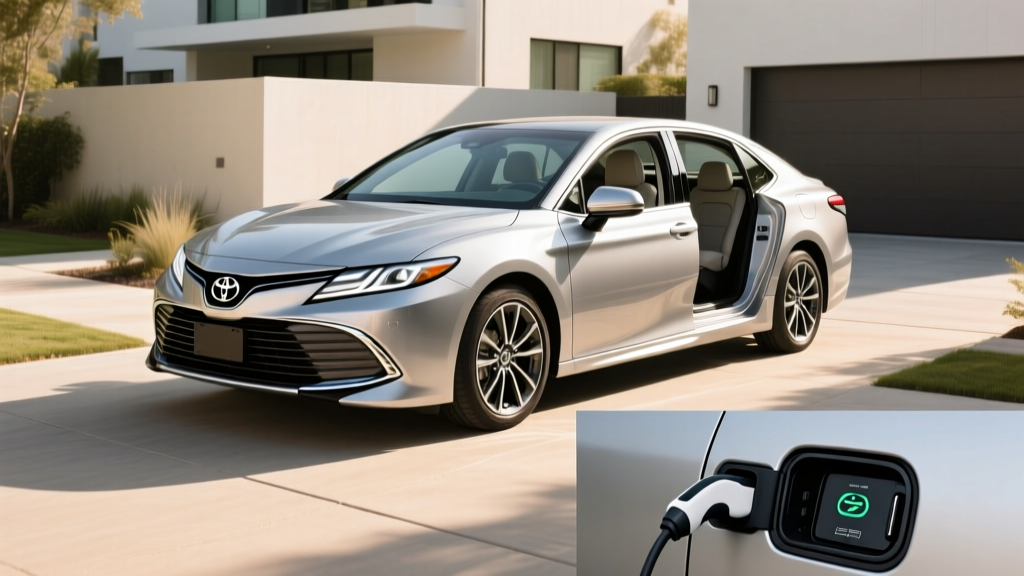
The 2025 Toyota Camry Hybrid enters its ninth generation with a significant change: every Camry is now a hybrid. Toyota has dropped the conventional gas-only four-cylinder entirely, betting that its fifth-generation Toyota Hybrid System (THS5) delivers the efficiency buyers want without the range compromises of a full EV. With an EPA-estimated 51 MPG city and a starting price under $30,000, the 2025 Camry Hybrid targets the exact buyer who wants dramatic fuel savings without plugging in, changing habits, or paying an EV premium.
After analyzing the specs and cross-referencing real-world driving data, here's what matters: the Camry Hybrid achieves its best numbers in the LE FWD trim, while AWD variants and higher trims sacrifice a few MPG for added capability and features. It is a conventional hybrid (HEV), not a plug-in — you never plug it in, and there is no electric-only driving mode for meaningful distances. If you need plug-in electric range, you'll want to look at the Toyota Prius Prime or a dedicated PHEV instead.
HEV vs PHEV vs EV: Where the Camry Hybrid Fits
Before diving into specs, it's essential to understand what the 2025 Camry Hybrid is — and what it isn't. The automotive market now offers three distinct electrified paths, and confusing them is the single most common mistake shoppers make.
Understanding the Three Electrified Options
| Feature | HEV (Camry Hybrid) | PHEV (e.g., Prius Prime) | BEV (e.g., Tesla Model 3) |
|---|---|---|---|
| Plug in to charge? | No — self-charging via regen & engine | Yes — for electric-only range | Yes — only energy source |
| Electric-only range | ~1 mi at low speed (creep only) | 25-45 mi typical | 250-360 mi typical |
| Gas engine | Yes — primary power source | Yes — backup after battery depletes | None |
| Federal tax credit | Not eligible (§30D requires plug-in) | Up to $7,500 (subject to rules) | Up to $7,500 (subject to rules) |
| Home charging needed | No | Recommended for full benefit | Essential |
| Upfront cost premium | Low ($0-2K vs gas equivalent) | Moderate ($5-10K) | Higher ($5-15K) |
The Camry Hybrid is an HEV. Its small traction battery (approximately 1.0 kWh, lithium-ion) is charged entirely by the gasoline engine and regenerative braking. You fuel it like any conventional car and never think about charging. The electric motor assists the engine during acceleration and enables brief low-speed electric-only movement (parking lots, traffic creep), but it cannot sustain highway speeds on battery alone.
Fuel Economy: EPA Ratings and Real-World MPG
The 2025 Camry Hybrid's headline number is 51 MPG city — a figure that beats many compact cars and demolishes the non-hybrid midsize sedan competition. But as with all efficiency ratings, the trim level and drivetrain you choose significantly affect the outcome.
| Trim / Drivetrain | City MPG | Highway MPG | Combined MPG |
|---|---|---|---|
| LE (FWD) | 51 | 53 | 52 |
| LE (AWD) | 49 | 50 | 49 |
| SE / XLE / XSE (FWD) | 48 | 50 | 49 |
| SE / XLE / XSE (AWD) | 44 | 47 | 45 |
Source: EPA Fuel Economy (fueleconomy.gov). Figures are EPA estimates.
Real-World MPG: What to Actually Expect
Toyota hybrids are among the few vehicles that routinely exceed their EPA city estimates in real-world driving. Why? Because EPA city cycles include significant idle and low-speed time where the hybrid system shuts off the engine entirely and runs on battery. In stop-and-go urban traffic, owners consistently report 52-56 MPG in the LE FWD.
Highway driving is different. At sustained 70-80 MPH speeds, expect 44-48 MPG from the LE FWD — below the 53 MPG highway sticker. Hybrids lose their advantage at constant high speed because the engine runs continuously and aerodynamic drag dominates. Cold weather (below 35°F) further reduces efficiency by 5-10% as the engine runs more often to provide cabin heat and maintain battery temperature.
Annual fuel cost estimate: At 15,000 miles/year, $3.50/gallon, and 50 MPG combined, you'd spend approximately $1,050/year on fuel. A comparable gas-only midsize sedan at 30 MPG would cost roughly $1,750/year — a $700 annual savings with the hybrid.
Powertrain Specs: Fifth-Generation Hybrid System
The 2025 Camry Hybrid pairs a 2.5-liter Dynamic Force four-cylinder engine with Toyota's latest fifth-generation hybrid system. The result is 225 combined horsepower on FWD models and 232 hp on AWD variants, which add a rear-mounted electric motor for electronic all-wheel drive.
| Specification | FWD Models | AWD Models |
|---|---|---|
| Combined horsepower | 225 hp | 232 hp |
| Gas engine | 2.5L I4 (184 hp) | 2.5L I4 (184 hp) |
| Front electric motor | 100 kW (134 hp) | 100 kW (134 hp) |
| Rear electric motor (AWD) | N/A | 30 kW (40 hp) |
| Hybrid battery capacity | ~1.0 kWh (Li-ion) | ~1.0 kWh (Li-ion) |
| Transmission | eCVT | eCVT |
| 0-60 MPH (est.) | ~7.2 sec | ~7.0 sec |
| Fuel tank | 13.2 gal | 13.2 gal |
| Total driving range (est.) | ~660 mi | ~594 mi |
The eCVT (electronically controlled continuously variable transmission) is not a belt-driven CVT like those found in some competitors. Toyota's system uses a planetary gearset that seamlessly blends engine and motor power with no belts or fixed gear ratios. This design is a key reason for the powertrain's legendary reliability — there are fewer wear components than in a traditional automatic.
The AWD system is worth noting: it's an electronic AWD, meaning there's no mechanical driveshaft to the rear wheels. The rear motor engages automatically during acceleration from a stop, on slippery surfaces, or when the system detects front-wheel slip. It disengages at higher cruising speeds to preserve fuel economy. This is not a performance AWD system for aggressive cornering, but it provides meaningful traction improvement in rain and light snow.
Pricing, Trims, and Tax Credit Eligibility
Toyota positions the 2025 Camry Hybrid across four trim levels, all with the hybrid powertrain standard:
| Trim | MSRP (FWD) | MSRP (AWD) | Key Features |
|---|---|---|---|
| LE | $29,490 | $30,890 | 8" touchscreen, wireless CarPlay/Android Auto, TSS 3.0 |
| SE | $30,790 | $32,190 | Sport-tuned suspension, 18" wheels, paddle shifters |
| XLE | $33,490 | $34,890 | Leather-trimmed seats, 12.3" display, ambient lighting |
| XSE | $34,290 | $35,690 | Sport + premium: 19" wheels, panoramic roof option |
MSRP excludes destination charge (~$1,150). Prices per Toyota.
Federal Tax Credit: Not Eligible
The 2025 Camry Hybrid does not qualify for the federal §30D Clean Vehicle Credit (up to $7,500). Under current IRS rules, only plug-in electric vehicles (PHEVs and BEVs) with sufficient battery capacity are eligible. Conventional hybrids like the Camry Hybrid generate their own electricity and have no plug-in capability, so they fall outside the credit's scope.
However, the Camry Hybrid's lower purchase price — typically $5,000-$10,000 less than a comparable EV — often offsets the lack of a tax credit when comparing total cost of ownership over five years. Some states and utilities offer rebates for hybrids; check your state energy office or local utility for current programs.
Battery Longevity, Warranty, and Replacement Costs
Hybrid battery anxiety is real, but it's largely unfounded for modern Toyota hybrids. The company has been refining its hybrid battery systems since the 1997 Prius, and the data on longevity is extensive.
Hybrid Battery Warranty Coverage
| Hybrid battery warranty | 10 years / 150,000 miles (whichever comes first) |
| Hybrid system components | 10 years / 150,000 miles |
| Powertrain warranty | 5 years / 60,000 miles |
| Basic bumper-to-bumper | 3 years / 36,000 miles |
Toyota covers the hybrid battery for a full decade — longer than most owners keep their vehicles. The warranty applies nationwide and transfers to subsequent owners.
Real-world battery lifespan: Data from fleet operators, taxi services, and high-mileage owners consistently shows Toyota hybrid batteries lasting 150,000-200,000+ miles before significant degradation. The Camry Hybrid's lithium-ion battery is far smaller than an EV battery (~1.0 kWh vs. 60-100 kWh), so it experiences shallower charge/discharge cycles, which extends cycle life. The battery management system keeps the state of charge in a narrow, longevity-optimized window — typically between 40-80% — preventing the stress of full charges and deep discharges.
Replacement cost if out of warranty: A new OEM hybrid battery for the Camry Hybrid typically ranges from $2,000-$3,500 installed at a dealership. Third-party refurbished batteries are available for $1,000-$1,800 installed. For context, this is roughly equivalent to a single major repair on a conventional car (transmission rebuild, engine work) and far less than an EV battery replacement ($8,000-$20,000+).
Is the Camry Hybrid reliable? Toyota's hybrid powertrain is among the most thoroughly proven in the automotive industry. The eCVT has no belts, clutches, or torque converter to fail. Regenerative braking reduces wear on friction brakes — owners routinely report 80,000-100,000+ miles on original brake pads. The IIHS and NHTSA have historically rated the Camry highly for safety, and the hybrid variant shares the same structure and crash-test performance.
Pros, Cons, and Who Should Buy the Camry Hybrid
✓ Pros
- Class-leading fuel economy: 51/53/52 MPG (LE FWD)
- No behavior change needed — fuel it like any car
- 225-232 hp is genuinely quick for the segment
- Available AWD without major MPG penalty
- 10-year/150K-mile hybrid battery warranty
- Lower starting price than any EV or PHEV competitor
- Proven long-term reliability with extensive track record
- 660+ mile total range between fill-ups
✗ Cons
- No federal tax credit eligibility (HEV, not PHEV)
- No meaningful electric-only driving capability
- eCVT drone under hard acceleration (common to hybrids)
- AWD trims drop to 44/47/45 MPG
- No DC fast charging (not applicable — no plug)
- Cannot power home or devices (no V2L/V2H)
- Rear battery placement slightly reduces trunk depth vs. gas predecessor
Who Should Choose the 2025 Camry Hybrid?
Choose the Camry Hybrid if:
- You drive 12,000-20,000+ miles per year and want maximum fuel savings without plugging in
- You live in an apartment or lack reliable home/workplace charging access
- You want a proven, low-risk powertrain with a decade of battery warranty
- You need a comfortable midsize sedan for commuting, family duty, and road trips
- Your budget is $29,000-$36,000 and you want the most car per dollar
Look at a PHEV instead if:
- You have home charging and a short commute (under 30 miles) — a PHEV like the Prius Prime lets you drive mostly on electricity
- You want to qualify for the $7,500 federal tax credit and meet income/sourcing requirements
Look at a full EV instead if:
- You have reliable Level 2 home charging and want zero tailpipe emissions
- You want the lowest per-mile "fuel" cost and minimal maintenance (no oil changes, fewer brake replacements)
- Your daily driving is under 250 miles and you road-trip infrequently
Frequently Asked Questions
How many MPG does the 2025 Toyota Camry Hybrid actually get?
The EPA rates the Camry Hybrid LE FWD at 51 city / 53 highway / 52 combined MPG. In real-world driving, city MPG often exceeds the EPA estimate (52-56 MPG is common in stop-and-go traffic), while sustained highway driving at 75+ MPH typically yields 44-48 MPG. AWD trims are rated 44-49 MPG combined depending on trim level. Source: fueleconomy.gov.
Do I need to plug in the Camry Hybrid?
No. The Camry Hybrid is a conventional hybrid (HEV), not a plug-in hybrid (PHEV). Its small battery charges itself through regenerative braking and the gasoline engine. You simply fill up at any gas station as you would with a conventional car. There is no charging port, no charging cable, and no electric-only highway driving.
How far can the Camry Hybrid drive on electric only?
Effectively about one mile at very low speeds (under 25 MPH) in ideal conditions — enough for parking lot maneuvering or brief traffic-creep situations. The hybrid battery is approximately 1.0 kWh, far too small for sustained electric-only driving. If you need 25-45 miles of electric-only range, you want a PHEV like the Toyota Prius Prime.
Is the Camry Hybrid battery expensive to replace?
A new OEM hybrid battery replacement runs $2,000-$3,500 installed. Refurbished units cost $1,000-$1,800. However, Toyota's hybrid batteries routinely last 150,000-200,000+ miles, and the battery is covered by a 10-year/150,000-mile warranty. Most original owners will never need a replacement.
Does the 2025 Camry Hybrid qualify for any tax credit?
No. The Camry Hybrid is not eligible for the federal §30D Clean Vehicle Credit because it is not a plug-in vehicle. The IRS requires a vehicle to have a plug-in charging capability and a minimum battery capacity to qualify. Some state or utility programs offer smaller incentives for hybrids — check your local programs.
How does the Camry Hybrid compare to the Prius?
The Prius is smaller (compact vs. midsize), slightly more efficient (57 MPG combined for the LE), and less powerful (194 hp FWD). The Camry Hybrid offers more rear-seat room, a larger trunk, a quieter ride, and available AWD. If you need a family sedan with highway comfort, the Camry is the better fit. If you prioritize maximum MPG in a smaller package, the Prius wins.
Is AWD worth the MPG trade-off?
AWD drops combined MPG from 52 to 49 (LE trim) — a loss of about 3 MPG. For a driver covering 15,000 miles/year at $3.50/gallon, that's roughly $60/year in additional fuel cost. If you regularly drive in rain, snow, or on unpaved roads, the AWD system's added traction is worth the small efficiency penalty. If you live in a mild climate with dry roads, FWD saves fuel and money.