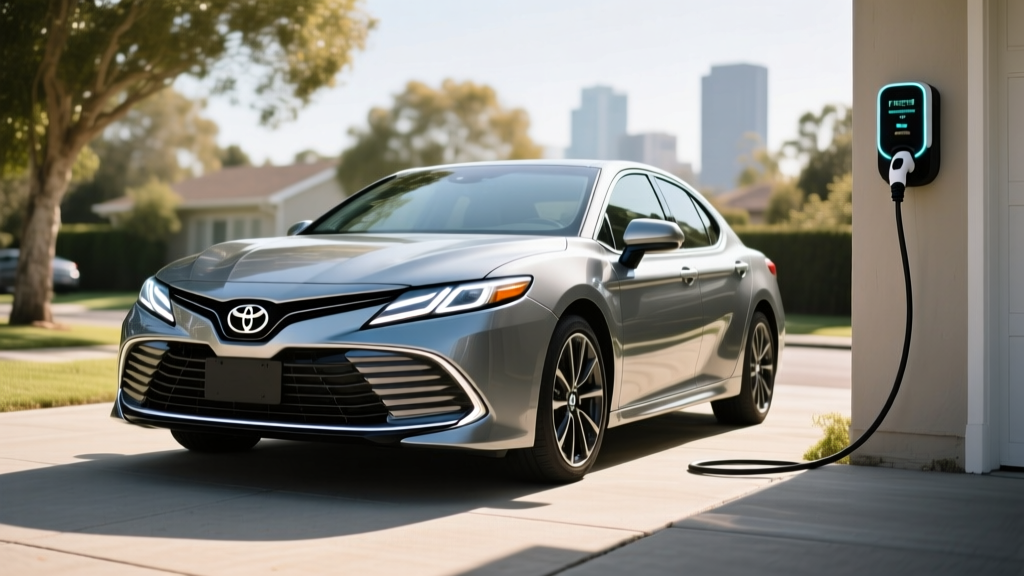
The 2024 Camry Hybrid: America's Best-Selling Sedan Goes All-Hybrid
For 2025, Toyota made a decisive move: every Camry now ships with a hybrid powertrain. That makes the 2024 Toyota Camry Hybrid the final model year where buyers could still choose between a conventional gas engine and the hybrid system — and it's the year that proved the hybrid was the one worth buying. With EPA ratings up to 52 MPG combined, standard all-wheel drive on most trims, and Toyota's proven hybrid reliability, the 2024 Camry Hybrid remains one of the most practical sedans on the used and certified-pre-owned market heading into 2026.
This guide covers everything a buyer or current owner needs to know: exact EPA fuel economy by trim, real-world MPG expectations, powertrain specs, battery longevity and warranty, pricing context, and how this conventional hybrid (HEV) stacks up against plug-in hybrids and full EVs.
Fuel Economy: EPA Ratings and Real-World MPG
Fuel economy varies by trim and drivetrain. Front-wheel-drive models achieve the highest ratings, while the available electronic all-wheel drive (AWD) — which uses a separate rear-mounted electric motor — costs you a few MPG but adds traction confidence.
| Trim | City MPG | Highway MPG | Combined MPG | Drivetrain |
|---|---|---|---|---|
| LE | 51 | 53 | 52 | FWD |
| LE AWD | 51 | 52 | 51 | AWD |
| SE | 44 | 47 | 46 | FWD |
| SE AWD | 44 | 46 | 45 | AWD |
| XLE | 44 | 47 | 46 | FWD |
| XLE AWD | 44 | 46 | 44 | AWD |
Source: fueleconomy.gov
Real-World MPG: What Owners Actually See
Toyota hybrids have a well-documented tendency to exceed their EPA ratings in city driving and occasionally fall slightly short on sustained highway runs. The hybrid system's regenerative braking recaptures energy during stop-and-go traffic, which is where the electric motor does its heaviest work. Based on owner-reported data aggregated by Fuelly and Edmunds long-term testing:
- LE FWD real-world average: 48–54 MPG combined, with city-heavy commutes regularly hitting 55+ MPG
- SE/XLE real-world average: 42–48 MPG combined; the sport-tuned suspension and larger 19-inch wheels on the SE create measurable drag and rolling-resistance penalties
- Highway-heavy driving (70+ mph sustained): Expect 44–48 MPG on the LE, 40–44 MPG on SE/XLE — hybrids lose their city advantage at high constant speeds
- Cold weather (below 30°F): MPG drops 8–15% as the engine runs more frequently to generate cabin heat and maintain battery temperature
Powertrain Specs: Engine, Motors, and Total Output
The 2024 Camry Hybrid uses Toyota's fifth-generation hybrid system, which pairs a 2.5-liter four-cylinder Atkinson-cycle engine with electric motors. The system was refined for smoother power delivery and slightly improved efficiency over the previous generation.
| Specification | FWD Models | AWD Models |
|---|---|---|
| Gas Engine | 2.5L I4 Atkinson-cycle | 2.5L I4 Atkinson-cycle |
| Engine Horsepower | 176 hp | 176 hp |
| Front Electric Motor | 134 hp (100 kW) | 134 hp (100 kW) |
| Rear Electric Motor (AWD only) | N/A | 54 hp (40 kW) |
| Net Combined Horsepower | 208 hp | 219 hp |
| Transmission | eCVT | eCVT |
| 0–60 mph (est.) | ~7.2 sec | ~7.0 sec |
| Hybrid Battery | 1.6 kWh lithium-ion | 1.6 kWh lithium-ion |
| Fuel Tank | 13.2 gal | 13.2 gal |
The net combined output is 208 hp for FWD and 219 hp for AWD — Toyota rates these conservatively, as the engine and motor don't peak simultaneously. Acceleration is adequate for merging and passing, though this is a comfort-oriented sedan, not a performance vehicle. The eCVT (electronically controlled continuously variable transmission) uses a planetary gearset rather than a belt, which eliminates the rubber-band feel that plagues some competitors' CVTs.
Key detail for AWD buyers: The rear motor on AWD trims engages automatically under acceleration and in low-traction conditions. Unlike mechanical AWD systems, there's no driveshaft — the rear wheels are powered purely by electricity. This means the AWD system adds minimal weight and complexity while improving 0–30 mph launch traction.
Battery Longevity, Warranty, and Replacement Costs
Battery reliability is the single biggest concern for hybrid buyers, and it's where Toyota's track record is strongest. The Camry Hybrid's 1.6 kWh lithium-ion traction battery is small by EV standards, but it's also worked far less hard — it never fully charges or fully depletes, operating in a narrow state-of-charge window that dramatically extends cycle life.
What Does Real-World Degradation Look Like?
Toyota's hybrid batteries in the Camry, Prius, and RAV4 Hybrid have demonstrated exceptional longevity in fleet and owner data:
- 100,000 miles: Typical capacity loss of 5–10%, virtually imperceptible to the driver
- 150,000 miles: Most batteries retain 85–92% of original capacity
- 200,000+ miles: Many original batteries still in service; Taxi and rideshare fleets routinely report 250,000+ miles on the original pack
The battery management system's conservative charge window (roughly 40–80% state of charge during normal operation) is the primary reason for this durability. Unlike EV batteries that regularly cycle from 10–90% SoC, the Camry's hybrid battery operates in a narrow band that minimizes stress.
Battery Replacement Cost
If a replacement is needed out of warranty:
- New OEM battery from Toyota: $2,500–$4,000 (parts) + $500–$800 (labor)
- Refurbished/remanufactured battery: $1,500–$2,500 installed
- Individual cell/module replacement: Some independent hybrid specialists can replace individual failed modules for $500–$1,200, though this is less common on newer lithium-ion packs than on older NiMH Prius batteries
For context, the 2024 Camry Hybrid's lithium-ion battery is more compact and less expensive to replace than the older nickel-metal-hydride packs used in earlier Camry Hybrid generations. The vast majority of 2024 models will still be well within their warranty window for years to come.
Pricing, Trims, and Tax Credit Eligibility
The 2024 Toyota Camry Hybrid was offered in three core trims with the following original MSRP (before destination charges):
| Trim | FWD MSRP | AWD MSRP | Key Features |
|---|---|---|---|
| LE | $28,855 | $29,955 | 8" touchscreen, TSS 2.5+, wireless CarPlay/AA |
| SE | $30,390 | $31,490 | Sport suspension, 19" wheels, paddle shifters |
| XLE | $33,295 | $34,395 | Leather, 9" screen, JBL audio, ambient lighting |
Does the 2024 Camry Hybrid Qualify for a Federal Tax Credit?
No. The 2024 Toyota Camry Hybrid is a conventional hybrid (HEV), not a plug-in electric vehicle. Under current IRS §30D rules, the federal clean vehicle credit of up to $7,500 applies only to battery electric vehicles (BEVs) and plug-in hybrids (PHEVs) that meet battery capacity, critical-mineral sourcing, MSRP cap, and buyer income requirements. Conventional hybrids like the Camry Hybrid do not qualify for any federal purchase credit.
Some states and local utilities offer rebates for hybrid purchases, but these vary by jurisdiction and change frequently. Check your state energy office or utility provider for current programs. The Camry Hybrid's value proposition rests on fuel savings and reliability, not incentive-driven pricing.
Camry Hybrid vs. PHEV vs. Full EV: Which Is Right for You?
The 2024 Camry Hybrid occupies a specific niche. Here's how it compares to the alternatives a cross-shopping buyer typically considers:
| Factor | Camry Hybrid (HEV) | Typical PHEV (e.g., RAV4 Prime) | Typical BEV (e.g., Tesla Model 3) |
|---|---|---|---|
| Plug-in Required? | No | Yes (for EV range) | Yes (always) |
| Electric-Only Range | None (EV assist only) | 25–42 mi | 250–350 mi |
| Fuel/Charge Cost per Mile | ~$0.07 (gas at $3.50/gal) | ~$0.04 (electric) / $0.09 (gas) | ~$0.04 (home) / $0.12 (DCFC) |
| Home Charging Install | Not needed | Level 2 recommended ($500–$2,000) | Level 2 required ($500–$2,500) |
| Federal Tax Credit | None | Up to $7,500 (if eligible) | Up to $7,500 (if eligible) |
| Road Trip Convenience | Gas stations everywhere | Gas + optional charging | Route planning required |
| Maintenance | Oil changes, standard | Oil changes + EV systems | Minimal (no oil, fewer fluids) |
- Choose the Camry Hybrid (HEV) if: You don't have reliable home charging access, want maximum simplicity with no plug-in routine, drive long highway miles regularly, or want the lowest upfront cost with no charging infrastructure investment.
- Choose a PHEV if: You have home Level 2 charging, your daily commute is under 35 miles (so you can run mostly on electricity), but you still want gas-engine freedom for road trips without route planning.
- Choose a full BEV if: You have home charging, want the lowest per-mile operating cost, qualify for the federal tax credit, and are comfortable with DC fast-charging on road trips.
Pros and Cons: The Honest Assessment
✓ Pros
- Up to 52 MPG combined (LE FWD) — among the best of any midsize sedan
- Standard Toyota Safety Sense 2.5+ on every trim
- AWD available across all trims with minimal MPG penalty
- 10-year/150,000-mile hybrid battery warranty
- No charging infrastructure needed — just gas up and go
- Strong resale value and certified-pre-owned availability
- Proven 5th-gen hybrid system with deep reliability data
✗ Cons
- No federal tax credit (HEV, not a plug-in)
- SE and XLE trims drop to 44–46 MPG combined — a significant penalty vs. the LE
- eCVT drones under hard acceleration (though less than belt-type CVTs)
- 208–219 hp is adequate, not quick — rivals like the Hyundai Sonata Hybrid offer similar power with a conventional automatic
- Rear seat is tighter than some competitors (38.0" legroom)
- No plug-in variant available in the US market
- Infotainment is functional but not class-leading in responsiveness
Ownership Costs: 5-Year Fuel Savings vs. Gas Camry
The 2024 model year was the last where Toyota sold a gas-only Camry alongside the hybrid. Here's how the fuel economics compare over five years at 15,000 miles per year (75,000 miles total), using $3.50/gallon gasoline:
| Model | Combined MPG | Gallons Used (75k mi) | 5-Year Fuel Cost |
|---|---|---|---|
| 2024 Camry LE (gas, 2.5L) | 32 | 2,344 | $8,203 |
| 2024 Camry Hybrid LE | 52 | 1,442 | $5,048 |
| Savings with Hybrid | +20 MPG | −902 gallons | −$3,155 |
The hybrid LE carried roughly a $1,000–$1,500 MSRP premium over the equivalent gas-only LE in 2024. That premium is typically recouped within 2–3 years of average driving through fuel savings alone, after which the hybrid is strictly cheaper to operate. At higher gas prices, the payback period shortens further.
Frequently Asked Questions
How many MPG does the 2024 Toyota Camry Hybrid get?
The 2024 Camry Hybrid LE achieves an EPA-rated 51 city / 53 highway / 52 combined MPG. The SE and XLE trims are rated at 44 city / 47 highway / 46 combined (FWD). AWD models lose 1–2 MPG across the board. In real-world driving, city-heavy commuters often exceed EPA estimates, while sustained highway driving at 75+ mph tends to fall 3–5 MPG below the sticker.
Does the Camry Hybrid need to be plugged in?
No. The 2024 Camry Hybrid is a conventional hybrid (HEV). Its small 1.6 kWh battery recharges entirely through regenerative braking and the gasoline engine. There is no plug, no charging cable, and no electric-only driving mode. You fuel it exactly like a regular gas car.
Is the 2024 Camry Hybrid reliable?
Toyota's hybrid powertrain is among the most proven in the industry, with over 25 years of continuous production since the original Prius. The 2024 Camry Hybrid's 5th-generation system has fewer moving parts than a conventional automatic transmission (the eCVT uses a planetary gearset with no belts or clutches). Toyota covers the hybrid battery and related components for 10 years or 150,000 miles. Independent reliability data from Consumer Reports and J.D. Power consistently ranks Toyota hybrids at or near the top of their segments.
What does it cost to replace the Camry Hybrid battery?
Out of warranty, a new OEM hybrid battery replacement costs approximately $2,500–$4,000 for the part plus $500–$800 in labor. Refurbished options run $1,500–$2,500 installed. However, Toyota's hybrid batteries rarely require replacement within the first 150,000 miles due to the conservative charge-management strategy that keeps the battery in a narrow state-of-charge window.
Does the 2024 Camry Hybrid qualify for any tax credit?
No federal tax credit applies. The IRS §30D clean vehicle credit is available only for plug-in electric vehicles (BEVs and PHEVs) that meet battery sourcing, MSRP, and buyer income requirements. The Camry Hybrid is a conventional HEV and does not qualify. Some state or utility-level incentives for hybrids may exist — check your local programs — but these vary widely and are not guaranteed.
Should I buy the Camry Hybrid or wait for the 2025+ all-hybrid Camry?
Starting with the 2025 model year, Toyota eliminated the gas-only Camry entirely — every new Camry is now a hybrid. The 2025+ models use a slightly updated version of the same hybrid system with minor efficiency and technology improvements. If you're buying used or CPO, the 2024 Camry Hybrid represents the same proven powertrain at a lower price point. If buying new, you'll get the hybrid regardless. The 2024 model year is significant primarily because it's the last year you could have chosen gas-only — and the data overwhelmingly shows the hybrid was the better buy.