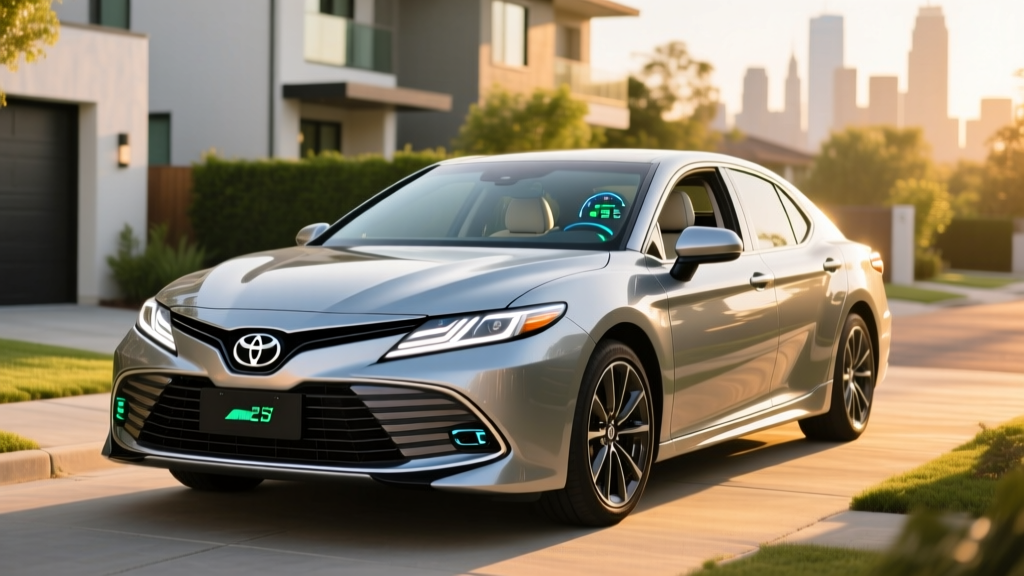
The 2025 Toyota Camry is now exclusively a hybrid. Toyota dropped the four-cylinder gas-only and V6 powertrains entirely, replacing them with a fifth-generation Toyota Hybrid System (THS) across every trim. For midsize sedan buyers, this simplifies the choice but raises a key question: does the hybrid-only Camry deliver enough efficiency and value to justify the transition, or should you look to a plug-in hybrid or full EV instead?
We've analyzed EPA data, real-world driving impressions, and ownership costs to give you the exact numbers you need before signing a purchase agreement.
Quick Verdict: The 2025 Camry Hybrid at a Glance
The 2025 Camry Hybrid is a conventional hybrid electric vehicle (HEV). It does not plug in. The gasoline engine and regenerative braking recharge a small battery pack, and the car manages the blend of electric and gas power automatically. If you're looking for a plug-in hybrid (PHEV) with electric-only driving range, the Camry does not currently offer one — you'd need to look at the Toyota Prius Prime or RAV4 Prime instead.
| Spec | FWD Models | AWD Models |
|---|---|---|
| Powertrain | 2.5L 4-cyl + 2 electric motors | 2.5L 4-cyl + 3 electric motors |
| Combined Horsepower | 225 hp | 232 hp |
| EPA City MPG | 53 mpg (LE) | 51 mpg (LE) |
| EPA Highway MPG | 50 mpg (LE) | 49 mpg (LE) |
| EPA Combined MPG | 51 mpg (LE) | 50 mpg (LE) |
| 0–60 mph | ~7.2 sec (est.) | ~6.9 sec (est.) |
| Drivetrain | Front-wheel drive | Electronic AWD (rear motor) |
| Starting MSRP | $29,490 (LE trim, incl. destination) | |
Fuel Economy: EPA Ratings vs. Real-World MPG
The headline number is 53 mpg city for the front-wheel-drive LE trim, according to fueleconomy.gov. Here's the full breakdown by trim:
| Trim | Drivetrain | City | Highway | Combined |
|---|---|---|---|---|
| LE | FWD | 53 mpg | 50 mpg | 51 mpg |
| LE | AWD | 51 mpg | 49 mpg | 50 mpg |
| SE / XLE / XSE | FWD | 48 mpg | 47 mpg | 47 mpg |
| SE / XLE / XSE | AWD | 46 mpg | 46 mpg | 46 mpg |
Real-world expectations: Toyota hybrids historically match or exceed EPA city figures in stop-and-go driving because regenerative braking recaptures energy that gas cars waste as heat. In mixed suburban driving, owners commonly report 48–54 mpg in the LE FWD. Highway-heavy commutes at 75+ mph tend to yield 42–46 mpg — aerodynamic drag hits all sedans hard at speed, and the hybrid system's advantage narrows on the open road.
Cold weather reduces MPG by roughly 5–10% due to increased engine idling for cabin heat and reduced battery efficiency. This is a smaller penalty than EVs experience in winter, but it's worth factoring in if you live in northern climates.
Powertrain: How the Fifth-Gen Hybrid System Works
The 2025 Camry pairs a 2.5-liter Dynamic Force four-cylinder engine with Toyota's latest hybrid transaxle. On FWD models, two motor-generators sit within the transaxle — one primarily starts the engine and acts as a generator, the other drives the front wheels. AWD models add a third, independent electric motor on the rear axle, providing electronic all-wheel drive without a mechanical driveshaft.
Combined output is 225 horsepower (FWD) or 232 hp (AWD). That's a meaningful bump over the outgoing 208 hp fourth-gen system, and it shows in passing confidence and highway merging. The engine itself runs on the Atkinson cycle for efficiency, producing 184 hp and 163 lb-ft of torque, supplemented by the electric motors' instant torque delivery.
The lithium-ion hybrid battery pack is modest — approximately 1.0 kWh of usable capacity. This is normal for a conventional HEV. The battery isn't designed for electric-only range; it serves as an energy buffer that captures regenerative braking energy and assists the gas engine during acceleration.
HEV vs. PHEV vs. EV: Which Powertrain Fits You?
The Camry is an HEV. Understanding the distinction matters because buyers sometimes assume "hybrid" means you can plug it in.
| Factor | HEV (Camry Hybrid) | PHEV (e.g., Prius Prime) | BEV (e.g., Tesla Model 3) |
|---|---|---|---|
| Plugs in? | No | Yes | Yes |
| Electric-only range | ~1 mile at low speed | 35–44 miles | 250–350+ miles |
| Home charging needed? | No | Recommended (120V or 240V) | Essential (240V Level 2) |
| Fueling | Gas station only | Gas station + electric outlet | Electric only |
| Best for | No home charging access; long highway commutes | Short daily commute + home charging; road trips on gas | Home charging access; mostly under 250 mi/day |
| Federal tax credit | Not eligible (§30D) | Up to $7,500 (model-dependent) | Up to $7,500 (model-dependent) |
Choose the Camry Hybrid if: You want maximum fuel efficiency without changing your fueling habits. No charger installation, no range planning, no apps. You fill up at a gas station and the car handles the rest.
Look at a PHEV instead if: You have home charging and a commute under 40 miles. A PHEV like the Prius Prime lets you drive most weekdays on electricity, with the gas engine available for longer trips.
Go full EV if: You have reliable home Level 2 charging, your daily driving is under 200 miles, and you want to eliminate gas costs entirely. The long-term savings on fuel and maintenance are substantial, though the upfront price is higher.
Pricing, Trims, and Tax Credit Eligibility
The 2025 Camry Hybrid starts at $29,490 for the LE FWD trim, including destination charge. Here's the approximate trim walk:
- LE: $29,490 (FWD) / $31,090 (AWD)
- SE: $31,990 (FWD) / $33,590 (AWD)
- XLE: $34,490 (FWD) / $36,090 (AWD)
- XSE: $36,040 (FWD) / $37,640 (AWD)
AWD is available across all trims and adds roughly $1,600.
Reliability, Battery Warranty, and Replacement Cost
Toyota's hybrid systems have a two-decade track record dating back to the 2001 Prius. The fifth-generation THS in the 2025 Camry uses fewer moving parts than a conventional automatic transmission (no torque converter, no traditional gear shifts), which contributes to long-term durability.
Hybrid battery replacement cost: If the battery fails outside warranty, expect to pay between $2,000 and $4,000 for a replacement, depending on whether you use a new OEM unit, a refurbished pack, or a third-party supplier. In practice, Camry and Prius hybrid batteries routinely last 150,000–200,000+ miles before significant degradation. Individual cell replacement (rather than the full pack) is sometimes possible for $500–$1,500 at specialized hybrid repair shops.
The 12V auxiliary battery is a separate item — it's a standard lead-acid or AGM battery that will need replacement every 4–6 years, just like in any other car.
Driving Impressions and Practical Considerations
The 2025 Camry Hybrid is not a sports sedan, but the 225–232 hp output makes it genuinely quick for the class. The electric motor's instant torque fills in the low-end gap that older hybrids suffered from, and highway merging no longer requires planning. The CVT-style transaxle keeps the engine in its efficient band, which means some drone under hard acceleration — a trade-off for the efficiency gains.
Ride quality is composed, and the cabin is noticeably quieter than the previous generation thanks to improved sound insulation. The LE and SE trims ride on 16- and 18-inch wheels respectively; the smaller wheels deliver a slightly smoother ride and better MPG.
Cargo and interior: The trunk offers approximately 15.1 cubic feet of space, competitive with the Honda Accord Hybrid and Hyundai Sonata Hybrid. The rear seat is roomy for two adults on longer trips. All trims include Toyota Safety Sense 3.0 (pre-collision, lane tracing, adaptive cruise) as standard equipment.
Pros and Cons
- Class-leading 53 mpg city (LE FWD)
- 225–232 hp — noticeably quicker than prior gen
- AWD available on every trim
- No plug-in charging required
- 10-year/150,000-mile hybrid battery warranty
- Toyota Safety Sense 3.0 standard on all trims
- Strong resale value and proven reliability
- No PHEV variant — can't drive on electric only
- No federal tax credit (HEV, not plug-in)
- CVT drone under hard acceleration
- Higher trims approach $40K, encroaching on EV territory
- AWD reduces MPG by 1–2 mpg across the board
- Infotainment still not class-best vs. Hyundai/Kia
Frequently Asked Questions
How many MPG does the 2025 Toyota Camry Hybrid get?
The FWD LE trim achieves 53 city / 50 highway / 51 combined mpg per the EPA. AWD drops that to 51/49/50 mpg. Higher trims (SE, XLE, XSE) with larger wheels and sport-tuned suspensions rate slightly lower, at 46–48 combined mpg.
Can the Camry Hybrid drive on electric power only?
Only at very low speeds for very short distances (under ~1 mile). This is a conventional hybrid, not a plug-in. The electric motor assists the gas engine and captures braking energy, but the gas engine is always available and does most of the work at highway speeds. If you want meaningful electric-only range, look at the Toyota Prius Prime (up to 44 miles EV range).
Does the 2025 Camry Hybrid qualify for a tax credit?
No. The IRS §30D Clean Vehicle Credit requires a plug-in vehicle with a minimum battery capacity of 7 kWh. The Camry Hybrid's battery is approximately 1.0 kWh and the car doesn't plug in. No federal credit applies. Check your state and utility for possible efficiency rebates.
Is the Camry Hybrid battery reliable, and what does replacement cost?
Toyota hybrid batteries have an excellent longevity record, commonly lasting 150,000–200,000+ miles. Toyota covers the hybrid battery for 10 years or 150,000 miles. Out-of-warranty replacement runs $2,000–$4,000 for a full pack, with individual cell repair available for less at hybrid specialists.
How does the Camry Hybrid compare to the Honda Accord Hybrid?
Both are excellent. The 2025 Accord Hybrid rates at 48 combined mpg (per fueleconomy.gov) vs. the Camry's 51 combined. The Honda offers a slightly more engaging driving feel and a more refined infotainment system. The Camry wins on pure efficiency, AWD availability (not offered on the Accord Hybrid), and a lower starting price by roughly $1,500.
Should I buy the Camry Hybrid or go full electric?
If you lack home charging access, frequently drive over 300 miles in a day, or live in an area with sparse public charging infrastructure, the Camry Hybrid is the pragmatic choice — you get 50+ mpg with zero behavior change. If you have a garage with a 240V outlet and your daily driving is under 200 miles, an EV like the Tesla Model 3 or Hyundai Ioniq 6 will cost less per mile to operate and requires less routine maintenance, despite the higher purchase price.