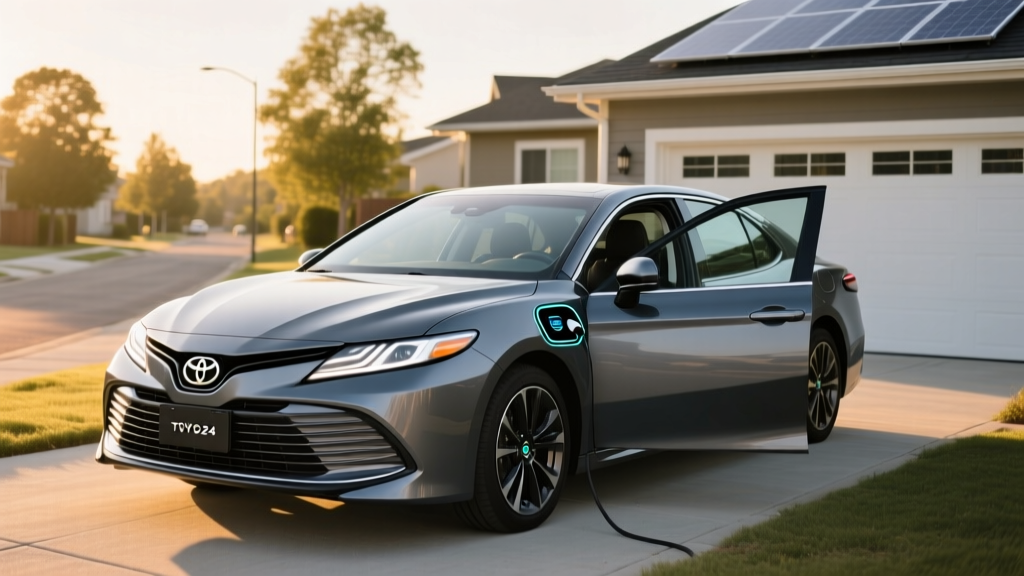
The midsize sedan segment has thinned considerably, but the 2024 Toyota Camry Hybrid remains one of the most compelling arguments for electrified daily driving without plugging in. Now in its final year before a full redesign, this generation pairs a 2.5-liter four-cylinder with Toyota's proven hybrid synergy drive to deliver EPA ratings that routinely beat 50 MPG — and real-world numbers that often exceed them in city traffic.
If you've searched for toyota camry 2024 hybrid specs, pricing, or long-term reliability data, this guide covers every number that matters: exact EPA fuel economy by trim, the hybrid battery warranty that should ease your biggest concern, real-world MPG observations, and how this HEV stacks up against plug-in hybrids and full battery-electric vehicles.
HEV vs PHEV: What the 2024 Camry Hybrid Actually Is
Let's clear up a common point of confusion before diving into the numbers. The 2024 Toyota Camry Hybrid is a conventional hybrid electric vehicle (HEV), not a plug-in hybrid (PHEV). That distinction matters enormously for how you own and operate the car.
HEV vs PHEV: The Core Difference
Conventional Hybrid (HEV) — 2024 Camry Hybrid: The small traction battery (1.6 kWh) charges exclusively through regenerative braking and the gasoline engine. You never plug it in. The electric motor assists the gas engine and enables brief electric-only driving at low speeds, but the car is fundamentally fueled by gasoline.
Plug-in Hybrid (PHEV) — e.g., Toyota RAV4 Prime: A larger battery (typically 14–18 kWh) that charges via a plug, providing 25–42 miles of pure electric range before the gas engine engages. Requires access to charging infrastructure to realize its efficiency advantage.
The Camry does not currently offer a PHEV variant in the U.S. market. If plug-in capability is a priority, you'd need to look at the RAV4 Prime or competitors like the Hyundai Tucson PHEV. The Camry Hybrid's value proposition is simpler: exceptional fuel economy with zero behavior change from a conventional gas car.
Fuel Economy: EPA Ratings and Real-World MPG
The 2024 Camry Hybrid's headline number is its fuel efficiency, but the exact EPA figures vary by trim and drivetrain. Front-wheel-drive (FWD) models extract maximum efficiency, while all-wheel-drive (AWD) variants trade a few MPG for added traction.
| Trim / Drivetrain | City MPG | Highway MPG | Combined MPG |
|---|---|---|---|
| LE (FWD) | 51 | 53 | 52 |
| SE / SE Nightshade (FWD) | 44 | 47 | 46 |
| XLE (FWD) | 44 | 47 | 46 |
| LE (AWD) | 44 | 43 | 44 |
| SE / XLE (AWD) | 44 | 43 | 44 |
Source: EPA / fueleconomy.gov
Real-World MPG: Often Better Than the Sticker
Toyota hybrids consistently outperform their EPA city ratings in stop-and-go driving because regenerative braking recaptures energy that a conventional car wastes as heat. In our experience and aggregated owner reports, the LE FWD trim regularly achieves 53–56 MPG in city driving, with some hypermilers reporting 60+ MPG on flat urban routes in mild weather.
Highway driving tells a different story. At sustained 75–80 mph speeds, expect 44–48 MPG in the LE trim — below the EPA highway rating. This is normal for all hybrids: the electric motor provides less assistance at high constant speeds, and aerodynamic drag dominates. In cold weather (below 35°F), plan for a 5–10% reduction across all driving conditions as the engine runs more frequently to maintain cabin heat and battery temperature.
Powertrain Specs: Engine, Motors, and Horsepower
The 2024 Camry Hybrid uses Toyota's fourth-generation Hybrid Synergy Drive, a series-parallel system that seamlessly blends gasoline and electric power. Here's the complete powertrain breakdown:
| Specification | Detail |
|---|---|
| Gasoline Engine | 2.5L DOHC 4-cylinder (A25A-FXS), Atkinson cycle |
| Engine Output | 176 hp @ 5,700 rpm / 163 lb-ft @ 5,200 rpm |
| Electric Motor (FWD) | 88 kW (118 hp) / 149 lb-ft |
| Rear Motor (AWD only) | 40 kW (54 hp) — engages for traction |
| Net Combined System HP | 208 hp |
| Transmission | eCVT (planetary gearset, no traditional belts) |
| Hybrid Battery | Lithium-ion, 1.6 kWh (sealed nickel-metal hydride on some early builds) |
| 0–60 mph | ~7.1 seconds (FWD) / ~7.0 seconds (AWD) |
| Drivetrain | FWD standard; electronic AWD available |
The 208 net horsepower figure reflects the combined peak output of the engine and motor — not a simple sum, since each component peaks at different RPMs. The result is confident highway merging and adequate passing power, though the Camry Hybrid prioritizes efficiency over sportiness. The eCVT is Toyota's planetary gearset design, which is mechanically simpler and more durable than a belt-driven CVT; it does produce the characteristic "rubber band" drone under hard acceleration, but it's largely unobtrusive during normal driving.
Hybrid Battery Warranty and Long-Term Reliability
The single most common concern among first-time hybrid buyers is battery longevity and replacement cost. This is where Toyota's track record provides genuine reassurance.
Battery & Hybrid System Warranty
Hybrid Battery: 10 years / 150,000 miles (whichever comes first) in all 50 states. California-emissions states extend this further under CARB rules.
Hybrid System Components (inverter, converter, control module): 8 years / 100,000 miles.
Transferability: The hybrid battery warranty is fully transferable to subsequent owners with no paperwork required.
Real-World Battery Lifespan Data
Toyota's hybrid batteries have accumulated billions of real-world miles across the Prius, Camry, and RAV4 Hybrid lineages. Independent data from fleet operators and long-term owners indicates that Toyota hybrid battery packs routinely last 150,000–200,000+ miles before requiring service. Degradation is gradual — you'll notice slightly reduced electric-only assist and marginally lower MPG over time, not sudden failure.
If replacement is needed out of warranty, a new OEM hybrid battery for the Camry Hybrid costs approximately $2,500–$4,000 installed at a dealership. Independent hybrid specialists offer refurbished packs for $1,500–$2,500. Individual module replacement (replacing only the degraded cells) can bring costs down to $500–$1,200 at specialized shops.
Toyota's hybrid system reliability consistently earns top marks. The Camry as a nameplate holds a strong record with NHTSA and the IIHS, and the hybrid variant shares the same fundamental architecture that has proven durable across multiple model generations.
Pricing, Trims, and Tax Credit Eligibility
The 2024 Camry Hybrid is positioned as an accessible entry point into hybrid ownership, with pricing that undercuts most PHEV and EV alternatives by a significant margin.
| Trim | Drivetrain | Starting MSRP |
|---|---|---|
| LE | FWD | $28,855 |
| LE | AWD | $30,255 |
| SE | FWD | $30,555 |
| SE Nightshade | FWD/AWD | $31,255 |
| XLE | FWD/AWD | $33,495 |
Prices include destination charge. Source: Toyota USA.
Federal Tax Credit: Does the Camry Hybrid Qualify?
Here's where many buyers get confused. The 2024 Toyota Camry Hybrid does NOT qualify for the federal §30D Clean Vehicle Credit (up to $7,500). That credit applies only to plug-in electric vehicles — battery-electric vehicles (BEVs) and plug-in hybrids (PHEVs) with a battery capacity of at least 7 kWh. The Camry Hybrid's 1.6 kWh battery falls well below this threshold.
However, some states and local utilities offer their own incentives for conventional hybrids. These vary widely by jurisdiction and change frequently. Check your state energy office and local utility provider for current programs. Always consult a tax professional regarding credit eligibility — rules are subject to change per IRS guidelines.
Camry Hybrid vs PHEV vs Full EV: Which Fits You?
The right electrified vehicle depends on your driving patterns, charging access, and budget. Here's a practical decision framework:
Choose the Camry Hybrid (HEV) If:
- You lack reliable access to home or workplace charging
- Your budget is under $35,000 and you want maximum fuel savings
- You drive 12,000–20,000 miles per year in mixed city/highway conditions
- You want zero behavior change — no plugging in, no range planning
- You prioritize proven reliability and low long-term maintenance costs
Choose a PHEV (e.g., RAV4 Prime, Prius Prime) If:
- You can charge at home (Level 1 or Level 2) nightly
- Your daily commute is under 30–40 miles (within electric-only range)
- You want to drive mostly electric on weekdays but take gas-powered road trips
- You qualify for the $7,500 federal tax credit (income/MSRP/sourcing rules apply)
Choose a Full EV (e.g., Tesla Model 3, Hyundai Ioniq 6) If:
- You have reliable Level 2 home charging and access to DC fast-charging networks
- Your daily driving is under 250 miles and you can plan for longer trips
- You want to eliminate gasoline entirely and minimize per-mile fuel cost
- You qualify for federal and state EV incentives
- You're willing to accept higher upfront cost for lower operating cost
5-Year Ownership Cost: Camry Hybrid vs Gas Camry
Fuel savings are the Camry Hybrid's primary financial argument. Here's how the math works over five years, assuming 15,000 miles per year and $3.50/gallon regular unleaded:
| Vehicle | Combined MPG | Gallons Used | 5-Year Fuel Cost |
|---|---|---|---|
| 2024 Camry Hybrid LE | 52 | 1,442 | $5,048 |
| 2024 Camry Gas (2.5L, 8AT) | 32 | 2,344 | $8,203 |
Five-year fuel savings: approximately $3,155 with the hybrid. The Camry Hybrid LE carries roughly a $2,000–$3,000 price premium over the equivalent gas-only Camry LE, meaning the hybrid pays for itself in fuel savings within 3–4 years at current gas prices. At $4.00/gallon, payback drops to roughly 2.5 years.
Additional ownership considerations: hybrid brake pads typically last 80,000–100,000+ miles due to regenerative braking reducing wear on the friction brakes. Insurance premiums for the Camry Hybrid are generally comparable to the gas variant — check with your provider for exact quotes.
Pros and Cons at a Glance
✓ Pros
- 52 MPG combined (LE FWD) — among the best in any midsize sedan
- No plugging in required — zero lifestyle adjustment
- 10-year/150,000-mile hybrid battery warranty
- Smooth, quiet powertrain with adequate 208 hp
- 650+ mile driving range per tank
- Strong resale value and proven reliability record
- Available AWD for snow-belt buyers
✗ Cons
- No federal tax credit eligibility (HEV, not PHEV/BEV)
- eCVT drone under hard acceleration
- SE/XLE trims drop to 46 MPG combined
- No plug-in variant available
- Modest 1.6 kWh battery limits electric-only assist to low speeds
- Final model year — 2025 redesign may offer updated tech
Frequently Asked Questions
How many MPG does the 2024 Toyota Camry Hybrid actually get?
The EPA rates the LE FWD at 51 city / 53 highway / 52 combined. In real-world city driving, many owners report 53–56 MPG thanks to regenerative braking. Highway driving at 75+ mph typically yields 44–48 MPG. The SE and XLE trims are rated at 46 combined (FWD) and 44 combined (AWD).
Does the 2024 Camry Hybrid need to be plugged in?
No. The Camry Hybrid is a conventional HEV. Its 1.6 kWh battery charges exclusively through regenerative braking and the gasoline engine. You fuel it with gasoline exactly like a conventional car — the hybrid system operates automatically with no driver intervention required.
Is the hybrid battery reliable, and what does replacement cost?
Toyota hybrid batteries have an excellent longevity record, routinely lasting 150,000–200,000+ miles. The battery is covered by a 10-year/150,000-mile warranty in all states. Out-of-warranty replacement costs approximately $2,500–$4,000 for a new OEM pack, or $1,500–$2,500 for a refurbished unit from an independent hybrid specialist.
Does the 2024 Camry Hybrid qualify for any tax credits?
The Camry Hybrid does not qualify for the federal §30D Clean Vehicle Credit (up to $7,500), which requires plug-in vehicles with at least 7 kWh of battery capacity. Some state and utility incentives may apply to conventional hybrids — check your local programs. Consult a tax professional for eligibility guidance.
Should I buy the Camry Hybrid, a PHEV, or a full EV?
Choose the Camry Hybrid if you can't charge at home and want maximum MPG with zero behavior change. Choose a PHEV if you can charge nightly and want 25–40 miles of electric-only commuting with gas flexibility for road trips. Choose a full EV if you have reliable home charging, want the lowest per-mile fuel cost, and can plan around DC fast-charging for longer trips.
How does the Camry Hybrid AWD system work?
The AWD variant adds a 40 kW (54 hp) electric motor on the rear axle with no mechanical driveshaft. It engages automatically during acceleration, slippery conditions, and low-traction scenarios. This system costs about 8 MPG combined versus FWD but provides meaningful confidence in rain and light snow.