Quick Verdict: The Toyota C-HR Hybrid at a Glance
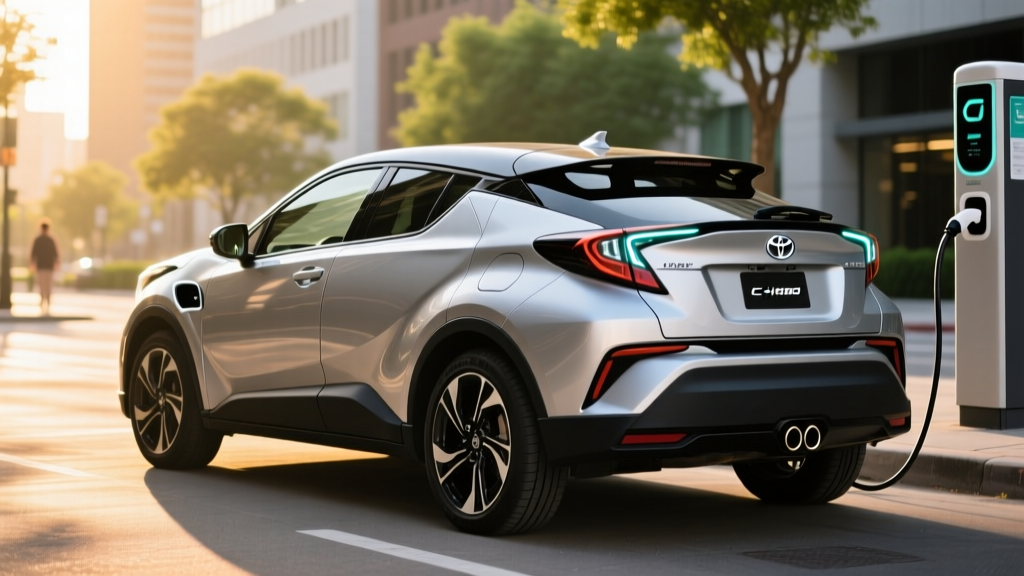
The Toyota C-HR Hybrid is a subcompact crossover that leans heavily on Toyota's fifth-generation hybrid synergy drive to deliver exceptional city fuel economy without ever needing to plug in. For 2026, the C-HR Hybrid continues as a conventional hybrid electric vehicle (HEV) — meaning it charges its own battery through regenerative braking and the gasoline engine. There is no plug-in hybrid (PHEV) variant of the C-HR, so if you're looking for electric-only driving range, you'll need to look at the RAV4 Prime or Prius Prime instead.
The C-HR Hybrid targets urban commuters who want crossover styling with Prius-rivaling efficiency. Its real advantage shows up in stop-and-go traffic, where the electric motor handles low-speed propulsion and the regenerative braking system recaptures energy that a conventional gas car would waste as heat.
| Specification | 2026 Toyota C-HR Hybrid |
|---|---|
| Powertrain Type | Conventional Hybrid (HEV) |
| Engine | 2.0L 4-cylinder + electric motor |
| Combined Horsepower | 196 hp (net system) |
| EPA MPG (City / Hwy / Combined) | 50 / 44 / 48 MPG |
| Fuel Tank Capacity | 11.4 gallons |
| Total Driving Range | ~547 miles |
| Hybrid Battery | ~1.0 kWh lithium-ion (sealed, non-plug-in) |
| Drivetrain | FWD standard / AWD-i available |
| 0–60 mph | ~7.8 seconds |
| Base MSRP | $30,850 (LE trim) |
| Battery Warranty | 10 years / 150,000 miles |
HEV vs PHEV: Why the C-HR Hybrid Is Strictly a Conventional Hybrid
Understanding the distinction between a conventional hybrid (HEV) and a plug-in hybrid (PHEV) is essential before evaluating the C-HR:
| Feature | HEV (C-HR Hybrid) | PHEV (e.g., RAV4 Prime) |
|---|---|---|
| Plug-in Charging | No — self-charging via regen and engine | Yes — plug into Level 1 or Level 2 |
| Electric-Only Range | Less than 1 mile at very low speeds | 30–42 miles on battery alone |
| Battery Size | ~1.0 kWh | 18.1 kWh usable |
| Federal Tax Credit (§30D) | Not eligible | Eligible up to $7,500 (if sourcing/income rules met) |
| Best For | No home charging access; want simplicity | Home charging available; short daily commute |
The C-HR Hybrid's small ~1.0 kWh battery pack is not designed for plug-in charging. It serves as a buffer: the electric motor draws from it during acceleration, and regenerative braking plus the gasoline engine replenish it continuously. You never plug in, never manage charge states, and never worry about finding a charger. This is the defining simplicity of the HEV architecture.
Fuel Economy: EPA Ratings and Real-World MPG
The EPA rates the 2026 Toyota C-HR Hybrid at 50 MPG city, 44 MPG highway, and 48 MPG combined for the front-wheel-drive configuration, per fueleconomy.gov. The AWD-i variant drops slightly to approximately 47 / 41 / 45 MPG due to the additional rear-axle motor and weight.
| Configuration | City MPG | Highway MPG | Combined MPG |
|---|---|---|---|
| FWD | 50 | 44 | 48 |
| AWD-i | 47 | 41 | 45 |
Real-World MPG: Where the C-HR Hybrid Shines
Toyota's hybrid system excels in urban driving, where the electric motor handles frequent low-speed acceleration and regenerative braking recovers energy at every stop. In real-world city testing, the C-HR Hybrid consistently meets or slightly exceeds its 50 MPG city rating — a characteristic unique to hybrids, since conventional gas cars get worse mileage in stop-and-go traffic.
Highway driving tells a different story. At sustained 70–80 mph speeds, the gasoline engine does most of the work, and aerodynamic drag dominates. Expect real-world highway fuel economy in the 40–43 MPG range on the FWD model. Cold weather (below 40°F) can reduce combined efficiency by 5–10%, as the engine runs more frequently to maintain cabin heat and the battery's charge/discharge efficiency drops slightly in low temperatures.
For a commuter doing 15,000 miles per year at the combined 48 MPG rating, annual fuel consumption is approximately 312 gallons. At a national average of $3.40/gallon, that's roughly $1,060 per year in fuel costs — compared to about $1,870 for a comparable gas-only subcompact crossover rated at 27 MPG combined.
Powertrain: How the Hybrid System Delivers 196 HP
The 2026 C-HR Hybrid uses Toyota's fifth-generation hybrid synergy drive, pairing a 2.0-liter Dynamic Force four-cylinder engine with one or two electric motor-generators depending on drivetrain configuration.
The gasoline engine produces approximately 150 hp and 139 lb-ft of torque on its own. Combined with the front electric motor-generator (which contributes additional torque at low RPMs where the engine is less efficient), the net system output reaches 196 horsepower. The AWD-i variant adds a rear-axle electric motor (approximately 40 hp) that engages automatically during acceleration and low-traction conditions, though it does not increase the net system horsepower rating.
An electronically controlled continuously variable transmission (eCVT) manages power delivery. Unlike a belt-driven CVT found in some competitors, Toyota's eCVT uses a planetary gearset that mechanically blends engine and motor power — resulting in smoother, more durable operation with no belt or pulley to wear out.
The 0–60 mph time of approximately 7.8 seconds places the C-HR Hybrid ahead of most non-hybrid subcompact crossovers in its class, and the instant electric motor torque gives it responsive off-the-line acceleration in city driving.
Hybrid Battery: Size, Warranty, and Replacement Cost
Toyota Hybrid Battery Warranty
Coverage: 10 years or 150,000 miles (whichever comes first), transferrable to subsequent owners.
What's covered: Defects in materials/workmanship, and capacity loss below a specified threshold (typically ~60–70% of original capacity).
Source: Toyota's official warranty guide
The C-HR Hybrid's lithium-ion traction battery is approximately 1.0 kWh — far smaller than a PHEV or BEV battery, because it only needs to buffer energy for short bursts of electric assist and regenerative capture. This small size is an advantage for longevity: the battery operates within a narrow state-of-charge window (roughly 40–80%), which dramatically reduces degradation stress compared to a full EV battery that cycles from 10% to 90%.
How Long Will the Hybrid Battery Last?
Toyota's hybrid battery track record is among the best in the industry. Data from Prius fleets and long-term owner surveys show that Toyota hybrid batteries routinely last 150,000–200,000+ miles before significant capacity loss. Many first-generation Prius vehicles (2001–2003) are still running on original hybrid batteries past 250,000 miles.
The key engineering reason: Toyota's battery management system (BMS) never allows the battery to fully charge or fully discharge. This shallow-cycling approach minimizes the lithium-ion degradation mechanisms (solid electrolyte interphase growth, lithium plating) that wear out larger EV batteries.
Battery Replacement Cost
If the hybrid battery does fail outside of warranty, replacement costs for a Toyota hybrid system battery typically range from $2,000 to $3,500 including parts and labor at a dealership. Independent hybrid specialists often offer refurbished or reconditioned battery packs for $1,200–$2,000. Given the 10-year/150,000-mile warranty and the proven longevity of Toyota's hybrid batteries, most owners will never face this cost.
Pricing, Trims, and Tax Credit Eligibility
The 2026 Toyota C-HR Hybrid starts at an MSRP of approximately $30,850 for the LE trim with FWD. Key trim levels and approximate pricing:
| Trim | Drivetrain | MSRP |
|---|---|---|
| LE | FWD | $30,850 |
| XLE | FWD | $33,200 |
| Limited | FWD | $36,100 |
| XLE AWD-i | AWD | $34,600 |
Federal Tax Credit: Not Eligible
Because the C-HR Hybrid is a conventional HEV (not a plug-in vehicle), it does not qualify for the IRS §30D Clean Vehicle Credit. That credit — which offers up to $7,500 — is reserved for battery electric vehicles (BEVs) and plug-in hybrids (PHEVs) with batteries of at least 7 kWh that meet critical-mineral sourcing, MSRP caps, and buyer income limits as defined by the IRS.
Conventional hybrids like the C-HR Hybrid are also ineligible for most state-level EV rebates and utility charging incentives, since they have no plug. However, some states and municipalities offer reduced registration fees or HOV lane access for hybrid vehicles — check your local DMV for specifics.
Reliability, Safety, and Ownership Costs
Toyota's hybrid powertrain is one of the most proven and reliable systems in the automotive industry. The eCVT planetary gearset has no belts, no clutch packs, and no traditional friction brakes to wear out (regenerative braking handles most deceleration, extending brake pad life to 80,000–100,000+ miles in normal driving). The hybrid system adds very few failure-prone components compared to a conventional gas powertrain.
Toyota Safety Sense 3.0 comes standard on all 2026 C-HR Hybrid trims, including pre-collision braking with pedestrian detection, full-speed adaptive cruise control, lane departure alert with steering assist, and automatic high beams. Note that this is an SAE Level 1–2 driver-assistance system — the driver must remain fully engaged at all times.
For total cost of ownership, the C-HR Hybrid's fuel savings of approximately $800/year versus a comparable gas crossover (at 15,000 miles/year) effectively pays back any price premium over a non-hybrid alternative within 2–4 years, depending on trim selection.
Pros
- 50 MPG city — excels in stop-and-go commuting
- No plug-in required; zero charging infrastructure needed
- 10-year / 150,000-mile hybrid battery warranty
- Proven Toyota hybrid reliability with low maintenance costs
- 196 hp provides adequate acceleration for the segment
- Regenerative braking extends brake pad life significantly
Cons
- No federal tax credit eligibility (HEV, not PHEV/BEV)
- Highway MPG drops to ~40–43 in real-world driving
- Cargo space tighter than RAV4 Hybrid or larger crossovers
- No electric-only driving mode for emissions-free short trips
- AWD-i reduces fuel economy by ~3 MPG combined
- eCVT drone under hard acceleration (common to Toyota hybrids)
Who Should Choose the C-HR Hybrid vs a PHEV or Full EV?
Choose the Toyota C-HR Hybrid (HEV) if:
- You lack access to home or workplace charging (apartment, street parking)
- Your commute is primarily city/urban driving where hybrid efficiency peaks
- You want maximum simplicity — no plugs, no charging apps, no range planning
- You want a proven, low-risk powertrain with a long warranty
- Your budget is under $37,000 and you want a crossover body style
Consider a PHEV (RAV4 Prime, Prius Prime) if:
- You have reliable Level 2 home charging and a commute under 40 miles
- You want electric-only daily driving with gas backup for road trips
- You want to qualify for the §30D federal tax credit (up to $7,500)
Consider a full EV (BEV) if:
- You have home Level 2 charging and your daily driving is under 250 miles
- You want zero tailpipe emissions and the lowest per-mile fuel cost
- You're eligible for the full §30D credit and state EV rebates
Frequently Asked Questions
How many MPG does the Toyota C-HR Hybrid get?
The EPA rates the 2026 C-HR Hybrid FWD at 50 MPG city, 44 MPG highway, and 48 MPG combined. The AWD-i variant achieves 47 / 41 / 45 MPG. Real-world city driving often meets or exceeds the EPA city rating, while sustained highway driving at 70+ mph typically yields 40–43 MPG.
Can the C-HR Hybrid drive on electric power only?
Not in any practical sense. The C-HR Hybrid can move under electric power alone for very short distances (under 1 mile) at low speeds (under 25 mph), such as creeping through a parking lot. It is not a plug-in hybrid and has no meaningful electric-only range. For electric-only commuting, look at the Prius Prime (44 miles electric) or RAV4 Prime (42 miles electric).
Does the Toyota C-HR Hybrid qualify for any tax credit?
No. The federal §30D Clean Vehicle Credit applies only to plug-in vehicles (BEVs and PHEVs) with battery packs of at least 7 kWh. The C-HR Hybrid's ~1.0 kWh battery and non-plug-in architecture make it ineligible. Some states may offer minor hybrid incentives, but these vary by jurisdiction and are typically far smaller than the federal credit.
Is the C-HR Hybrid reliable, and what does battery replacement cost?
Toyota's hybrid system is among the most reliable powertrains available, with extensive real-world data from millions of Prius, Camry Hybrid, and RAV4 Hybrid vehicles demonstrating 200,000+ mile lifespans. The hybrid battery is warranted for 10 years / 150,000 miles. Out-of-warranty replacement typically costs $2,000–$3,500 at a dealer, or $1,200–$2,000 through independent hybrid specialists.
How does the C-HR Hybrid compare to the RAV4 Hybrid?
The RAV4 Hybrid is larger, offers more cargo space (37.6 cu ft vs approximately 19 cu ft in the C-HR), and comes standard with AWD. It achieves 41 / 38 / 40 MPG — slightly less efficient than the C-HR Hybrid due to its greater weight and frontal area. The RAV4 Hybrid starts around $33,500. If cargo space and AWD are priorities, the RAV4 Hybrid is the better choice. If maximum city MPG and a lower price matter more, the C-HR Hybrid wins.
Do I need to plug in the C-HR Hybrid?
No. The C-HR Hybrid is a conventional (self-charging) hybrid. Its small battery is recharged entirely through regenerative braking and the gasoline engine. There is no charging port and no plug-in capability.