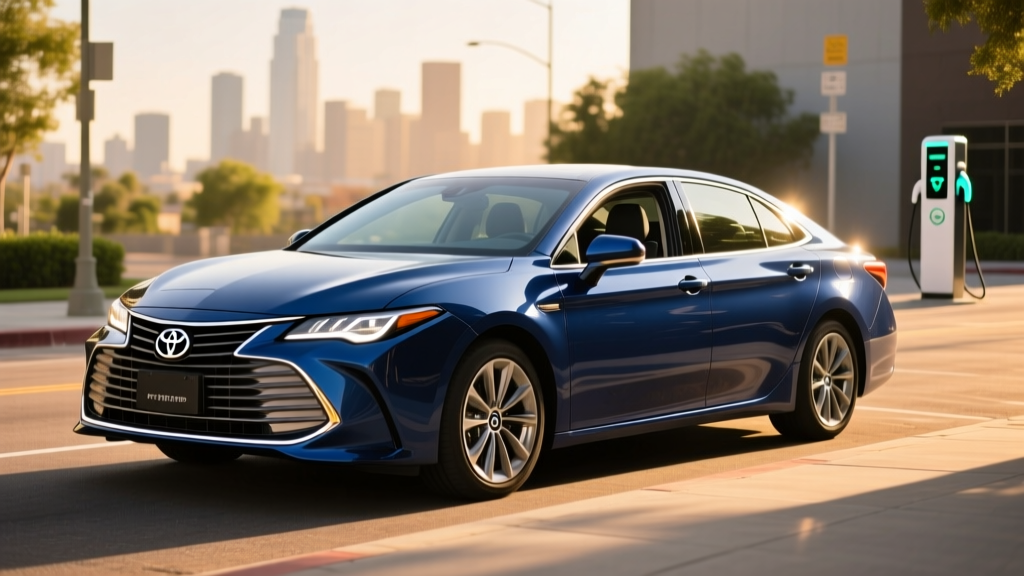
The Toyota Avalon Hybrid sedan occupies a distinct space in the midsize sedan segment: a full-size four-door with luxury-leaning refinement and hybrid efficiency that routinely exceeds its EPA estimates in daily driving. While Toyota discontinued the Avalon in the U.S. market after the 2022 model year, its hybrid powertrain architecture — shared with the Camry Hybrid — remains one of the most proven and cost-effective electrified setups on the road. For buyers evaluating a certified pre-owned Avalon Hybrid or comparing it against current hybrid and PHEV sedans, this guide covers every number that matters.
Toyota Avalon Hybrid Powertrain and Performance
The Avalon Hybrid pairs a 2.5-liter inline-four Atkinson-cycle gasoline engine with two electric motor-generators through Toyota's eCVT (electronically controlled continuously variable transmission). This is a conventional hybrid electric vehicle (HEV), meaning it charges its battery through regenerative braking and the engine — there is no plug and no electric-only driving mode.
| Specification | Toyota Avalon Hybrid (2022 Final MY) |
|---|---|
| Powertrain | 2.5L I4 Atkinson + 2 motor-generators |
| Combined System Output | 215 hp |
| Gas Engine | 176 hp @ 5,700 rpm / 163 lb-ft @ 5,200 rpm |
| Electric Motor (MG2) | 118 hp / 149 lb-ft |
| Transmission | eCVT (planetary gearset) |
| Hybrid Battery | 1.6 kWh (NiMH), sealed, air-cooled |
| 0–60 mph | ~7.3 seconds |
| Drivetrain | Front-wheel drive |
| Curb Weight | ~3,670 lbs |
The 215 combined horsepower is adequate for highway merging and passing, though it won't match the punch of a turbocharged V6. The eCVT eliminates shift shock entirely, and the transition between electric-only low-speed crawling and engine engagement is among the smoothest in the hybrid segment. Toyota's Hybrid Synergy Drive system has been refined over two decades, and the Avalon benefits from the latest generation of that architecture.
Fuel Economy: EPA Ratings vs. Real-World MPG
The Avalon Hybrid's efficiency is its defining attribute. The EPA rates the XLE trim at 43 mpg city, 44 mpg highway, and 44 mpg combined. The sportier XSE and Touring trims, with larger 19-inch wheels and stickier tires, drop slightly to 43/43/43 mpg.
| Trim | City (EPA) | Highway (EPA) | Combined (EPA) | Real-World Expectation |
|---|---|---|---|---|
| XLE (17-in wheels) | 43 mpg | 44 mpg | 44 mpg | 42–48 mpg |
| XSE / Touring (19-in) | 43 mpg | 43 mpg | 43 mpg | 40–46 mpg |
Real-world context: Conventional hybrids like the Avalon routinely exceed their EPA city estimates because stop-and-go driving maximizes regenerative braking and electric motor usage. In mixed suburban driving with moderate temperatures, owners on fueleconomy.gov's My MPG tracker frequently report 45–50 mpg. Highway driving at sustained 75+ mph speeds will pull figures closer to 39–41 mpg, as the gasoline engine carries more of the load without regen assistance. Cold weather (below freezing) typically reduces efficiency by 5–10% due to increased engine idling for cabin heat and reduced battery efficiency.
With a 13.2-gallon fuel tank, the Avalon Hybrid delivers a practical driving range of approximately 540–600 miles per tank in mixed driving — one of the longest ranges of any sedan sold in the U.S. in its era.
HEV vs. PHEV vs. Full EV: Where the Avalon Hybrid Fits
Understanding where the Avalon Hybrid sits on the electrification spectrum helps clarify whether it's the right fit versus a plug-in hybrid or battery-electric vehicle.
| Factor | Avalon Hybrid (HEV) | Typical PHEV Sedan | Full EV (BEV) |
|---|---|---|---|
| Plug-in required? | No — self-charging | Yes (Level 2 for best results) | Yes (Level 2 home + DC fast) |
| Electric-only range | ~0.5 mi at low speed | 20–45 mi | 250–400+ mi |
| Fuel/electricity cost | ~$0.08/mile (gas) | ~$0.04/mi (electric) + $0.08/mi (gas) | ~$0.03–0.05/mi |
| Home charging install | None needed | $500–2,000 (Level 2) | $800–3,000 (Level 2, 240V) |
| Federal tax credit (§30D) | Not eligible | Up to $7,500 (if qualified) | Up to $7,500 (if qualified) |
| Maintenance | Standard (oil, filters) | Standard + battery system | Minimal (no oil, fewer fluids) |
| Best for | No home charging access, high-mileage commuters | Short commutes + home charging + road trips | Home charging access + daily driving under 300 mi |
The Avalon Hybrid is the correct choice if you cannot install a home charger (apartment living, street parking, no garage), drive high annual mileage (15,000+ miles/year), or want zero behavioral change from a traditional gas car while still cutting fuel consumption by roughly 40% compared to a non-hybrid V6 sedan.
If you have reliable Level 2 home charging and a daily commute under 30 miles, a PHEV like the Toyota Prius Prime or Hyundai Sonata Plug-In Hybrid will let you complete most trips on electricity alone, reducing per-mile cost further. A full BEV (Tesla Model 3, Hyundai Ioniq 6) delivers the lowest operating costs but requires charging infrastructure commitment.
Pricing, Trims, and Tax Credit Eligibility
Because Toyota discontinued the Avalon after the 2022 model year, new inventory is no longer available. Pricing analysis here covers the final model-year MSRP for context and current certified pre-owned (CPO) market values.
| 2022 Trim | Original MSRP | Est. CPO Price (2026) |
|---|---|---|
| XLE Hybrid | $37,850 | $26,000–$30,000 |
| XSE Hybrid | $39,350 | $27,500–$32,000 |
| Touring Hybrid | $41,150 | $29,000–$34,000 |
| Limited Hybrid | $43,550 | $31,000–$36,000 |
Federal tax credit: The Avalon Hybrid is a conventional HEV and does not qualify for the IRS §30D Clean Vehicle Credit, which applies only to plug-in electric vehicles (PHEVs and BEVs) meeting battery sourcing, MSRP, and buyer income requirements. However, some states and utilities offer modest rebates for hybrid purchases — check your state energy office or local utility for current programs. For a full breakdown of federal credit eligibility, consult IRS §30D guidelines.
Hybrid Battery Warranty, Lifespan, and Replacement Cost
Hybrid battery longevity is consistently the top concern for buyers considering a used hybrid. Toyota's track record here is among the strongest in the industry.
Toyota Avalon Hybrid Battery Coverage
- Hybrid Battery Warranty: 10 years / 150,000 miles (for 2020+ model years; earlier years covered under 8 years / 100,000 miles)
- Hybrid System Components Warranty: 8 years / 100,000 miles (inverter, motor-generators, control module)
- Battery Chemistry: Nickel-metal hydride (NiMH), 1.6 kWh
- Expected Lifespan: 150,000–200,000+ miles with normal use
Replacement cost: If the hybrid battery fails outside warranty, a new OEM replacement from Toyota costs approximately $3,000–$4,500 including labor at a dealership. Independent hybrid specialists offer refurbished or reconditioned NiMH battery packs for $1,500–$2,500 installed. Some shops also perform individual module replacement (the battery pack contains 34 NiMH modules), which can bring costs down to $800–$1,500 if only a few modules have degraded.
Real-world reliability data: Toyota's hybrid system is fundamentally simpler than many buyers assume. The eCVT uses a planetary gearset with no clutch packs, bands, or torque converter — there are no friction elements to wear. The engine shuts off at stops and during low-load driving, reducing accumulated engine wear. Taxis and fleet vehicles using this same powertrain architecture have documented 300,000+ mile lifespans with original hybrid batteries. The IIHS rated the 2022 Avalon a Top Safety Pick+, adding confidence in overall vehicle durability.
Ownership Costs: 5-Year Comparison
To contextualize the Avalon Hybrid's value, here's a five-year total cost of ownership estimate compared against a conventional V6 sedan and a comparable plug-in hybrid.
| Cost Factor (5 yr / 75,000 mi) | Avalon Hybrid (HEV) | Non-Hybrid V6 Sedan | PHEV Sedan (e.g., Prius Prime) |
|---|---|---|---|
| Fuel / electricity | $8,500 | $13,600 | $5,200 |
| Maintenance | $3,200 | $3,800 | $2,900 |
| Insurance (avg) | $7,500 | $7,200 | $7,800 |
| Depreciation (est.) | $12,000 | $14,000 | $11,500 |
| Home charging install | $0 | $0 | $1,200 |
| Total (approx.) | $31,200 | $38,600 | $28,600 |
Based on $3.40/gallon regular unleaded and $0.14/kWh national average electricity. The Avalon Hybrid saves roughly $7,400 over five years versus a non-hybrid V6 sedan, primarily through fuel reduction. A PHEV saves more, but only if you can charge at home regularly to capture the electric-only miles.
Pros, Cons, and Final Verdict
Pros
- 44 mpg combined EPA — routinely exceeded in city driving
- 540+ mile real-world range per tank
- No plug-in infrastructure required
- Spacious rear seat (38.0" legroom) and 16.1 cu-ft trunk
- Toyota Safety Sense 2.5+ standard (AEB, adaptive cruise, lane keep)
- Proven hybrid system with 10-year / 150,000-mile battery warranty
- Low long-term maintenance costs (eCVT has no wearable friction components)
Cons
- Discontinued after 2022 — no new inventory available
- No plug-in or electric-only driving capability
- Not eligible for federal §30D tax credit
- eCVT drone under hard acceleration
- Infotainment system dated by 2026 standards (8-inch screen, no wireless CarPlay on base trims)
- All-wheel drive not available (FWD only)
Verdict: The Toyota Avalon Hybrid sedan remains one of the most rational used-hybrid purchases available. For buyers who need a large, comfortable sedan with exceptional fuel economy but lack the ability to charge at home, it's nearly unmatched. The proven reliability of Toyota's Hybrid Synergy Drive, combined with a generous battery warranty and strong CPO availability, makes it a low-risk entry into hybrid ownership.
Frequently Asked Questions
How many MPG does the Toyota Avalon Hybrid get?
The EPA rates the Avalon Hybrid XLE at 43 city / 44 highway / 44 combined mpg. The XSE and Touring trims with 19-inch wheels are rated at 43/43/43 mpg. In real-world suburban and city driving, many owners report 45–50 mpg thanks to regenerative braking maximizing electric motor usage at lower speeds.
Does the Toyota Avalon Hybrid need to be plugged in?
No. The Avalon Hybrid is a conventional hybrid (HEV). It charges its 1.6 kWh NiMH battery through regenerative braking and the gasoline engine. There is no plug, no charging cable, and no electric-only driving mode. You fuel it exactly like a standard gasoline car.
Is the Avalon Hybrid reliable, and what does battery replacement cost?
Toyota's hybrid system is one of the most reliable powertrains in the automotive industry. The hybrid battery is warrantied for 10 years / 150,000 miles on 2020–2022 models. Out-of-warranty replacement costs $3,000–$4,500 at a dealer or $1,500–$2,500 through an independent hybrid specialist. Many Toyota hybrid batteries last 200,000+ miles without significant degradation.
Does the Toyota Avalon Hybrid qualify for a tax credit?
No. The federal §30D Clean Vehicle Credit applies only to plug-in electric vehicles (PHEVs and BEVs) with sufficient battery capacity and compliant sourcing. The Avalon Hybrid is a conventional HEV and is not eligible. Some state or utility programs may offer minor incentives for hybrid purchases — check local resources.
Should I buy the Avalon Hybrid or a plug-in hybrid instead?
Choose the Avalon Hybrid if you cannot charge at home, drive high annual mileage, or want zero change to your refueling routine. Choose a PHEV (like the Prius Prime or RAV4 Prime) if you have Level 2 home charging and a commute under 40 miles — you'll run primarily on electricity for daily driving while retaining a gasoline engine for longer trips. A full EV offers the lowest operating cost but requires dedicated charging access.
Can the Avalon Hybrid run on electric power alone?
Only at very low speeds (under ~25 mph) for short distances (roughly half a mile) when the battery has sufficient charge. This is not a usable electric-only mode for commuting — it's designed for creeping in parking lots or stop-and-go traffic. The gasoline engine engages automatically whenever more power or sustained speed is needed.