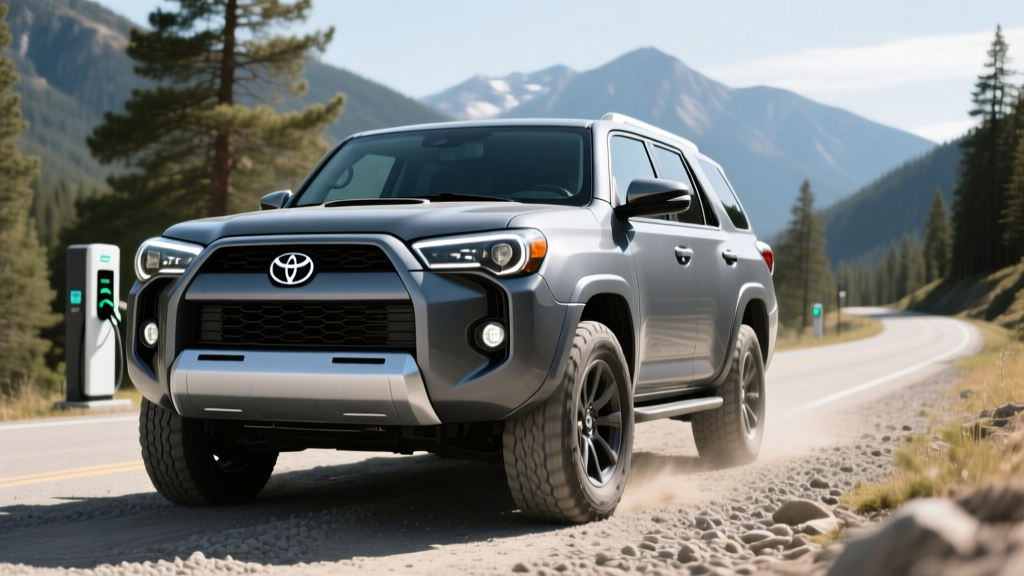
The Toyota 4Runner has been a body-on-frame stalwart for decades, and the sixth-generation model now offers something its predecessors never did: an electrified powertrain. The 2026 Toyota 4Runner Hybrid — officially badged with Toyota's i-FORCE MAX hybrid system — pairs a turbocharged four-cylinder with an electric motor to deliver more torque than the standard engine while shaving fuel costs at the pump. This guide covers every number you need: EPA MPG, real-world efficiency, powertrain output, battery warranty, pricing, and whether this hybrid SUV fits your driveway better than a full EV or a gas-only competitor.
HEV vs PHEV: What the 4Runner Hybrid Actually Is
Before examining specs, it is essential to understand what Toyota is — and is not — selling here. The 2026 4Runner with the i-FORCE MAX powertrain is a conventional hybrid electric vehicle (HEV). It does not have a plug. You cannot charge it from a wall outlet or public charger. The small battery pack recharges exclusively through regenerative braking and the gasoline engine.
This matters because buyers searching for a "4Runner hybrid" sometimes expect a plug-in hybrid (PHEV) with electric-only driving range. As of the 2026 model year, Toyota does not offer a 4Runner PHEV. If you want plug-in capability from Toyota's SUV lineup, you would need to look at the RAV4 Prime or the Prius Prime.
HEV vs PHEV — Quick Distinction
| Feature | HEV (4Runner i-FORCE MAX) | PHEV (e.g., RAV4 Prime) |
|---|---|---|
| Plugs in? | No | Yes |
| Electric-only range | None (motor assists engine) | 25–42 mi typical |
| Battery size | ~1.87 kWh (sealed NiMH) | 14–18 kWh (lithium-ion) |
| Refueling | Gas station only | Gas + Level 1/2 charging |
| Federal tax credit | Not eligible (§30D is for PHEVs/BEVs only) | Up to $7,500 if eligible |
2026 Toyota 4Runner Hybrid MPG: EPA Ratings and Real-World Numbers
The headline reason buyers cross-shop the i-FORCE MAX over the standard i-FORCE turbo four-cylinder is fuel economy. Here is how the EPA rates the 2026 4Runner Hybrid across configurations, based on fueleconomy.gov data:
| Configuration | City | Highway | Combined |
|---|---|---|---|
| 4Runner i-FORCE MAX 4x2 | 23 MPG | 27 MPG | 24 MPG |
| 4Runner i-FORCE MAX 4x4 | 22 MPG | 26 MPG | 23 MPG |
| 4Runner i-FORCE (gas-only) 4x4 | 19 MPG | 25 MPG | 21 MPG |
Real-World MPG vs EPA Sticker
Toyota's hybrid systems tend to exceed EPA city estimates in stop-and-go traffic, where regenerative braking and electric-motor assist do the heavy lifting. Owners of the i-FORCE MAX Tacoma and Tundra have reported 1–3 MPG above the EPA city figure in urban driving. Highway mileage, however, often runs 1–2 MPG below the sticker at sustained 75+ mph speeds — the aerodynamic profile of a body-on-frame SUV works against it. In cold weather (below 30°F), expect a 5–10% reduction in combined MPG as the engine runs longer to reach operating temperature and cabin heating draws additional load.
The hybrid's advantage is most pronounced in city and mixed driving. Compared with the gas-only i-FORCE 4x4, the i-FORCE MAX 4x4 gains roughly 2 MPG combined — a modest but meaningful improvement for a 4,800-pound SUV, especially when multiplied across 15,000 annual miles.
i-FORCE MAX Powertrain: Horsepower, Torque, and Specs
The i-FORCE MAX is Toyota's hybrid system for its body-on-frame trucks and SUVs (shared with the Tacoma, Tundra, and Sequoia). Here is the complete powertrain breakdown:
| Specification | Detail |
|---|---|
| Engine | 2.4L turbocharged inline-4 |
| Electric Motor | 48-hp motor-generator integrated in 8-speed automatic |
| Combined Output | 326 hp / 465 lb-ft torque |
| Transmission | 8-speed automatic (i-FORCE MAX) |
| Battery | ~1.87 kWh, sealed nickel-metal hydride (NiMH) |
| 0–60 mph (est.) | ~6.5 seconds (4x2) |
| Towing Capacity | Up to 6,000 lbs (properly equipped) |
| Drivetrain | Rear-wheel drive (4x2) or part-time/full-time 4WD (4x4) |
The 465 lb-ft of torque is the standout figure. That peak arrives low in the rev range thanks to the electric motor's instant response, giving the 4Runner Hybrid noticeably stronger off-the-line acceleration and low-speed trail crawling grunt compared with the 310 lb-ft from the standard i-FORCE engine. The motor-generator sits between the engine and transmission inside the bell housing — a packaging solution that preserves the 4Runner's ground clearance and approach/departure angles.
Pricing, Trims, and Tax Credit Eligibility
The i-FORCE MAX hybrid powertrain is available across multiple 4Runner trims for 2026. Pricing below reflects base MSRP before destination charges, based on Toyota's official specifications:
| Trim (i-FORCE MAX) | MSRP (4x2) | MSRP (4x4) |
|---|---|---|
| TRD Off-Road | $48,850 | $50,850 |
| Limited | $54,600 | $56,600 |
| TRD Pro | — | $61,400 |
| Platinum | $57,200 | $59,200 |
The i-FORCE MAX hybrid typically commands a $2,000–$2,500 premium over the equivalent gas-only i-FORCE trim. At 2–3 MPG improvement and current national fuel averages (~$3.30/gallon), the payback period for a driver covering 15,000 miles annually is roughly 5–7 years. Buyers who plan to keep the 4Runner beyond that window — and most Toyota truck buyers do — will see net savings.
Does the 4Runner Hybrid Qualify for a Federal Tax Credit?
No. The IRS §30D Clean Vehicle Credit applies only to plug-in electric vehicles (BEVs and PHEVs) with a battery capacity of at least 7 kWh. Because the 4Runner i-FORCE MAX is a conventional HEV with a ~1.87 kWh battery and no plug, it does not qualify for the federal $7,500 credit. Some states offer modest rebates for conventional hybrids — check your state energy office — but these are typically $500–$1,000 and vary widely. Always verify current eligibility with a tax professional.
Battery Warranty, Lifespan, and Replacement Cost
Hybrid battery longevity is consistently the top concern for first-time hybrid buyers. Toyota addresses this with one of the strongest warranties in the segment:
Toyota Hybrid Battery Warranty
- Coverage: 10 years / 150,000 miles (whichever comes first)
- Applies to: Hybrid battery pack and all hybrid-system components (inverter, motor-generator, control module)
- Transferable: Yes, to subsequent owners at no cost
- Capacity threshold: Toyota replaces or reconditions if the battery falls below functional performance standards during the warranty period
Toyota's NiMH hybrid batteries have a proven track record. Data from the Prius and Camry Hybrid fleets shows that these packs routinely last 150,000–200,000+ miles before significant degradation. The 4Runner's relatively small 1.87 kWh pack undergoes shallow charge/discharge cycles — it rarely drops below 40% or above 80% state of charge — which is the ideal condition for NiMH longevity.
If replacement is eventually needed out of warranty, a new OEM hybrid battery for the i-FORCE MAX system runs approximately $3,000–$4,500 including labor, based on current Toyota dealer pricing. Reconditioned packs from third-party suppliers are available for $1,500–$2,500. Given the shallow-cycling design and 10-year warranty, most original owners will never face this expense.
4Runner Hybrid vs Full EV vs Gas: Which Is Right for You?
Decision Framework
Choose the 4Runner Hybrid (HEV) if:
- You need a body-on-frame SUV with genuine off-road capability and 6,000-lb towing
- You lack access to home Level 2 charging (apartment, street parking, no garage)
- You regularly drive in remote areas where charging infrastructure is sparse
- You want better fuel economy than gas-only without changing your refueling habits
Choose a full EV (e.g., Rivian R1S, Tesla Model X) if:
- You have reliable home Level 2 charging
- Your daily driving is under 250 miles and you rarely tow heavy loads
- You want the lowest per-mile energy cost (~$0.04–$0.06/mile on home electricity vs ~$0.15–$0.18/mile for the 4Runner Hybrid)
- You qualify for the $7,500 federal tax credit, which can offset a higher purchase price
Choose the gas-only 4Runner if:
- You drive fewer than 8,000 miles per year (the hybrid premium won't pay back)
- You prioritize the lowest possible purchase price and are indifferent to MPG
Pros and Cons at a Glance
Pros
- 465 lb-ft of torque for strong acceleration and trail crawling
- 2–3 MPG improvement over gas-only, biggest gains in city driving
- 10-year/150,000-mile hybrid battery warranty
- No plug-in required — zero change to refueling habits
- Retains full off-road hardware (locking diff, crawl control, 9.0" ground clearance)
- Proven Toyota hybrid reliability across millions of vehicles
Cons
- No electric-only driving range — this is not a PHEV
- Not eligible for the $7,500 federal §30D tax credit
- $2,000–$2,500 price premium over gas-only trims
- Highway MPG still modest for a vehicle in this price range
- Hybrid battery adds ~150 lbs, slightly reducing payload capacity
- Fuel savings payback takes 5–7 years at average mileage
Frequently Asked Questions
How many MPG does the 2026 Toyota 4Runner Hybrid get?
The EPA rates the 4Runner i-FORCE MAX at 23 MPG city / 27 MPG highway / 24 MPG combined in 4x2 configuration, and 22/26/23 MPG in 4x4 configuration. Real-world city driving often yields 1–3 MPG above the EPA figure, while sustained highway driving at 75+ mph may return 1–2 MPG below.
Can the 4Runner Hybrid drive on electric power only?
Not in any meaningful sense. The i-FORCE MAX system can move the vehicle at very low speeds (parking lots, stop-and-go creep) on electric power alone for brief distances, but it is designed as an engine-assist hybrid, not an electric-drive vehicle. There is no EV mode button and no usable electric-only range.
Is the 4Runner Hybrid reliable, and what does battery replacement cost?
Toyota's i-FORCE MAX system shares architecture with the Tundra and Tacoma hybrids, which in turn derive from Toyota's decades of hybrid engineering (25+ million hybrids sold globally). The hybrid battery is covered for 10 years/150,000 miles. Out-of-warranty replacement costs approximately $3,000–$4,500 for a new OEM pack, though most owners will never need one.
Does the 4Runner Hybrid qualify for any tax credit?
The 4Runner i-FORCE MAX does not qualify for the federal §30D Clean Vehicle Credit because it is a conventional hybrid (HEV), not a plug-in vehicle. Some states offer small hybrid rebates ($500–$1,000), but availability varies. Check your state's energy office or consult a tax professional for current incentive details.
How does the 4Runner Hybrid compare to the Sequoia hybrid?
The Toyota Sequoia uses the larger i-FORCE MAX system (3.4L twin-turbo V6 + electric motor, 437 hp / 583 lb-ft) and achieves an EPA-estimated 19–21 MPG combined depending on configuration. The Sequoia is significantly larger, more expensive (starting ~$62,000), and offers three rows. If you need maximum interior space and towing (up to 9,520 lbs), the Sequoia is the pick. If you want a more compact, trail-focused SUV, the 4Runner Hybrid is the better fit.
Will Toyota offer a 4Runner PHEV or full electric 4Runner?
As of the 2026 model year, Toyota has not announced a 4Runner plug-in hybrid or battery-electric variant. Given Toyota's gradual approach to full electrification for body-on-frame vehicles and the recent launch of the sixth-generation platform, a PHEV or BEV 4Runner is unlikely before the 2028–2029 timeframe at the earliest. Any future announcement will be labeled as preliminary until production specs are confirmed.