Quick Verdict: What the Escape Hybrid Can (and Can't) Tow
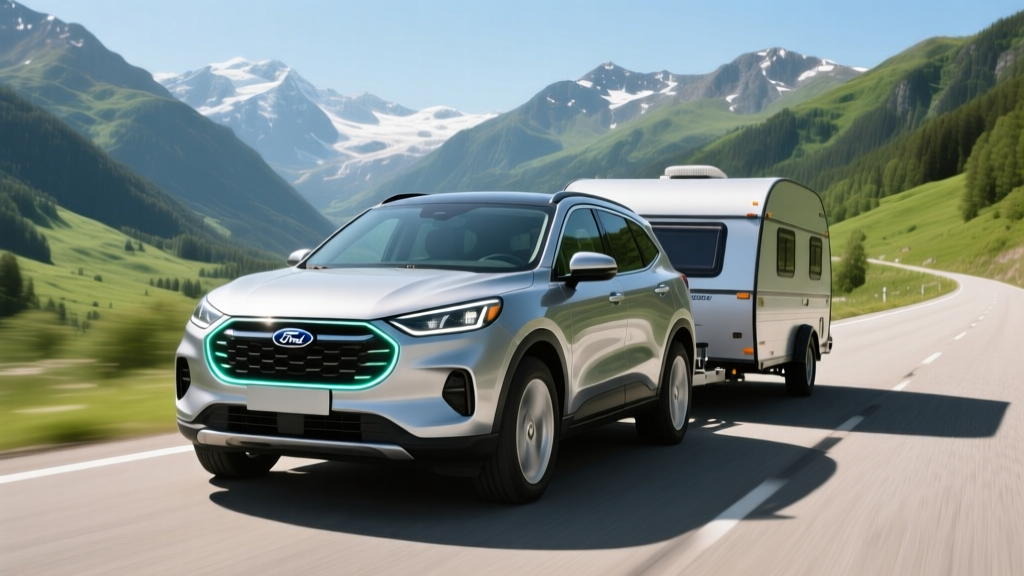
If you're researching the towing capacity Ford Escape Hybrid before buying, here's the number you need: 1,500 pounds maximum when properly equipped. That applies to both the conventional hybrid (HEV) and the plug-in hybrid (PHEV) versions of the current-generation Escape. It's enough for a small utility trailer, a pair of dirt bikes, or a light pop-up camper — but not a boat on a full-size trailer or any mid-weight travel trailer.
Ford publishes this figure in its official trailer-towing guide, and it holds across all trims that offer the hybrid powertrain. The limit is set by the powertrain's thermal capacity, the cooling system, and the unibody chassis — not by the electric motor alone. If your towing needs exceed 1,500 lbs, you'll need to look at a body-on-frame SUV like the Ford Explorer Hybrid (rated up to 5,000 lbs) or a truck.
HEV vs PHEV: Which Escape Hybrid Is Which?
Ford sells two distinct electrified Escape variants, and confusing them is the most common mistake shoppers make. They are fundamentally different vehicles under the skin.
| Attribute | Escape Hybrid (HEV) | Escape Plug-In Hybrid (PHEV) |
|---|---|---|
| Plug-in required? | No — self-charging via regen & engine | Yes — plug in to access electric-only range |
| Battery size | ~1.1 kWh (small buffer) | 14.4 kWh usable |
| Electric-only range | N/A (motor assists only) | 37 miles (EPA) |
| Total combined range | ~520 miles | ~520 miles (electric + gas) |
| EPA combined MPG | 39 MPG | 40 MPG (gas) / 105 MPGe (electric) |
| DC fast charging | N/A | No — AC only (Level 1 & Level 2) |
| Level 2 charge time (0–100%) | N/A | ~3.5 hours at 240V / 32A |
| Combined horsepower | 198 hp | 210 hp |
| Towing capacity | 1,500 lbs | 1,500 lbs |
| Drivetrain | AWD standard | FWD only |
The HEV is the simpler ownership story: you fuel it like any gas car and the hybrid system recovers energy during braking and deceleration. The PHEV adds a larger battery and a charge port, letting you drive 37 miles on electricity alone before the gas engine kicks in. If your daily commute is under 35 miles and you can charge at home, the PHEV effectively becomes an EV for weekdays and a hybrid for road trips.
Fuel Economy: EPA Numbers vs Real-World MPG
The EPA rates the Escape Hybrid (AWD) at 42 city / 36 highway / 39 combined MPG. The PHEV, when operating as a hybrid after the battery depletes, returns 40 MPG combined, plus an equivalent 105 MPGe when running on its electric charge. You can verify these figures on fueleconomy.gov.
| Driving Scenario | HEV Expected MPG | PHEV Expected MPG (hybrid mode) |
|---|---|---|
| City stop-and-go | 40–44 | 38–42 |
| Highway 65–70 mph | 33–36 | 34–37 |
| Combined mixed driving | 37–40 | 38–41 |
| Cold weather (below 30°F) | 33–37 | 32–36 |
Hybrids typically exceed their EPA city rating in real-world stop-and-go traffic because regenerative braking recovers energy that a conventional car wastes as heat. Highway MPG tends to run slightly below the EPA sticker because the electric motor contributes less at sustained high speeds. In cold weather, expect a 5–10% drop as the engine runs more frequently to provide cabin heat and the battery's internal resistance increases.
Powertrain Specs and How Towing Affects Efficiency
Both Escape Hybrid variants use a 2.5-liter Atkinson-cycle four-cylinder engine paired with an electric motor through Ford's eCVT (electronically controlled continuously variable transmission). The HEV produces a combined 198 horsepower with standard all-wheel drive. The PHEV bumps output to 210 horsepower but is front-wheel drive only — a trade-off for packaging the larger battery.
| Spec | HEV | PHEV |
|---|---|---|
| Engine | 2.5L I-4 Atkinson | 2.5L I-4 Atkinson |
| Electric motor | 88 kW (118 hp) | 96 kW (129 hp) |
| Combined system output | 198 hp | 210 hp |
| Transmission | eCVT | eCVT |
| 0–60 mph (est.) | ~7.8 sec | ~7.5 sec |
| Drivetrain | AWD | FWD |
When you hook up a trailer near the 1,500-lb limit, expect fuel economy to drop to roughly 25–30 MPG depending on terrain, speed, and wind. The hybrid system still helps — the electric motor provides instant torque off the line, which makes merged and hill starts feel more confident than a non-hybrid with similar displacement. But sustained highway towing forces the engine to work continuously, reducing the hybrid advantage.
Pricing, Trims, and Tax Credit Eligibility
As of the 2026 model year, the Escape Hybrid starts at approximately $34,990 MSRP (base Active trim with AWD). The PHEV variant starts around $40,490 MSRP (PHEV Premium trim, FWD). Loaded PHEV trims can approach $47,000 with options.
Federal Tax Credit: Does the Escape Hybrid Qualify?
- Conventional HEV: Does NOT qualify for the §30D federal tax credit. The credit applies only to plug-in electric vehicles (BEVs and PHEVs) meeting battery-sourcing and critical-mineral requirements.
- Escape PHEV: May qualify for up to $3,750 under the §30D credit, depending on battery-component and critical-mineral sourcing compliance. The full $7,500 requires meeting both thresholds. Income caps apply: $150,000 single / $300,000 joint MAGI. The MSRP cap for SUVs is $80,000, which the Escape clears easily.
- Point-of-sale transfer: Eligible buyers can transfer the credit to the dealer at purchase, reducing the out-of-pocket price immediately rather than waiting for tax filing.
Always confirm current-year eligibility with your tax professional and the IRS §30D guidance, as sourcing rules tighten annually.
Battery Warranty, Lifespan, and Replacement Cost
| Coverage | HEV | PHEV |
|---|---|---|
| Hybrid battery warranty | 8 years / 100,000 miles | 8 years / 100,000 miles |
| Hybrid components warranty | 8 years / 100,000 miles | 8 years / 100,000 miles |
| Powertrain warranty | 5 years / 60,000 miles | 5 years / 60,000 miles |
| Capacity retention threshold | N/A (small buffer) | ~70% of original capacity |
Ford's hybrid battery warranty covers defects and abnormal degradation for 8 years or 100,000 miles (whichever comes first), and in California Air Resources Board (CARB) states, that extends to 10 years / 150,000 miles. This is consistent across the industry — Toyota, Hyundai, and Honda offer similar terms.
In practice, the Escape Hybrid's battery pack is proven technology. Ford has been building Escape Hybrids since 2005, and first-generation packs routinely lasted 150,000+ miles with minimal degradation. The HEV's small ~1.1 kWh pack is cycled shallowly (never fully depleted or fully charged), which dramatically extends cycle life. The PHEV's 14.4 kWh pack sees deeper cycles but still benefits from active thermal management and a built-in buffer that prevents true 0% or 100% states.
If you do need a replacement outside warranty, expect to pay $2,500–$4,000 for the HEV pack and $5,000–$8,000 for the PHEV pack, including labor. Third-party refurbished packs are increasingly available for the HEV at the lower end of that range. Given the warranty length and historical reliability, most owners will never face this cost.
Who Should Buy the Escape Hybrid (and Who Shouldn't)
Choose the Escape Hybrid If…
- You need a compact crossover with AWD and light towing (1,500 lbs max)
- You want strong city MPG without plugging in or changing habits
- Your annual mileage is high (15,000+ mi/yr) and fuel savings compound
- You lack access to home or workplace charging (HEV requires no plug)
Look Elsewhere If…
- You need to tow more than 1,500 lbs — consider the Explorer Hybrid or a truck
- You want pure electric daily driving — the PHEV's 37-mile range may not cover longer commutes; a full BEV like the Mustang Mach-E (320+ mi range) is a better fit
- You prioritize performance — 198 hp and a 7.8-second 0–60 is adequate, not quick
- You need AWD on the PHEV — it's FWD only; the HEV has standard AWD
Escape Hybrid vs Full EV vs Gas: Decision Framework
- Choose the HEV if you can't charge at home, drive 12,000–20,000 miles/year, and want fuel savings without lifestyle changes.
- Choose the PHEV if you can install a Level 2 charger, your commute is under 35 miles, and you want EV-like daily driving with gas backup for road trips.
- Choose a full EV (e.g., Mustang Mach-E, Hyundai Ioniq 5) if you have reliable home charging, your daily driving is under 250 miles, and you want to eliminate gas entirely with lower per-mile energy costs.
- Choose a gas-only Escape only if the hybrid premium (~$2,500–$3,500) doesn't pencil out for your low annual mileage (under 8,000 mi/yr).
Frequently Asked Questions
What is the towing capacity of the Ford Escape Hybrid?
The Ford Escape Hybrid (both HEV and PHEV) has a maximum towing capacity of 1,500 pounds when properly equipped with the factory tow package. This covers small utility trailers, bike racks on hitch carriers, and lightweight pop-up campers. Always confirm your specific trim's rating in the owner's manual or Ford's trailer-towing guide.
How many MPG does the Escape Hybrid get in real-world driving?
The HEV is EPA-rated at 42 city / 36 highway / 39 combined. Real-world owners typically see 37–44 MPG combined depending on driving mix. City-heavy routes favor the hybrid system and often exceed the EPA sticker. Sustained highway driving at 75+ mph or cold-weather operation can drop MPG to the low-to-mid 30s.
How far can the Escape PHEV go on electric only?
The EPA rates the Escape PHEV at 37 miles of electric-only range. In mild weather at city speeds, some owners report 38–40 miles. In cold weather or at highway speeds, expect 30–33 miles before the gas engine activates. Once the battery depletes, it operates as a standard hybrid at ~40 MPG combined.
Does the Escape Hybrid qualify for a federal tax credit?
The conventional HEV does not qualify for the §30D federal tax credit — it applies only to plug-in vehicles. The PHEV may qualify for up to $3,750 (partial credit depending on battery sourcing compliance), subject to buyer income limits ($150K single / $300K joint) and the $80,000 MSRP cap for SUVs. Verify current-year rules at irs.gov and consult a tax professional.
Is the Ford Escape Hybrid reliable? What about battery replacement?
Ford's hybrid system is mature — the Escape Hybrid has been in production since 2005 with iterative improvements. The hybrid battery is warranted for 8 years/100,000 miles (10 years/150,000 miles in CARB states). Real-world data shows these packs routinely lasting 150,000+ miles. Out-of-warranty replacement runs $2,500–$4,000 (HEV) or $5,000–$8,000 (PHEV), but most owners never need one.
Can I charge the Escape Hybrid at home?
The conventional HEV has no plug — it charges its small battery through regenerative braking and the engine. The PHEV can charge at home using a standard 120V outlet (Level 1, ~10 hours for a full charge) or a 240V Level 2 charger (~3.5 hours). Neither version supports DC fast charging.
Does the Escape Hybrid need premium fuel?
No. Both the HEV and PHEV run on regular 87-octane unleaded gasoline. The Atkinson-cycle engine is tuned for efficiency, not high-compression performance, so premium fuel provides no benefit.
Final Word: The Escape Hybrid as a Light-Tow Daily Driver
The Ford Escape Hybrid occupies a specific niche: an efficient, AWD compact crossover that can handle light towing duties without the fuel penalty of a traditional gas SUV. Its 1,500-lb tow rating is the hard ceiling — if you need more, you'll have to move up in vehicle class. But for the majority of buyers who want a practical daily driver that sips fuel in the city, offers proven hybrid reliability, and can occasionally pull a small trailer, the Escape Hybrid delivers exactly what it promises. Just know the limit before you buy.