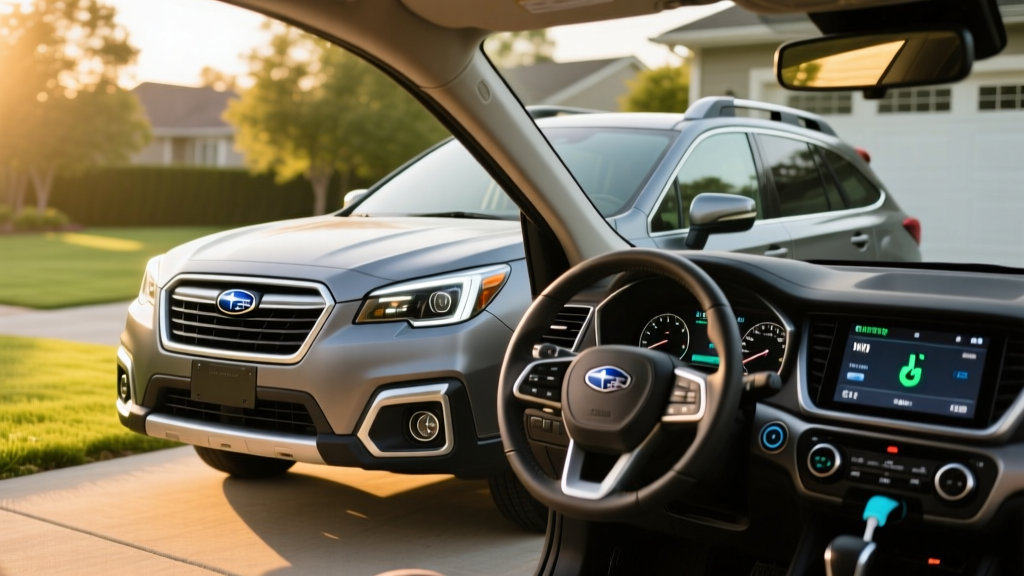
The Subaru Outback has long been the default wagon for outdoor-minded buyers who need all-wheel drive, ground clearance, and cargo space without stepping up to an SUV. For 2026, Subaru expands the lineup with a conventional hybrid (HEV) powertrain that promises meaningful fuel-economy gains while retaining the Outback's rugged DNA. If you've been searching for a Subaru Outback Hybrid 2026 model, this guide covers every number that matters — from EPA MPG to battery warranty — so you can decide whether this hybrid wagon earns a spot in your driveway.
2026 Subaru Outback Hybrid: Key Specifications at a Glance
| Specification | Value |
|---|---|
| Powertrain Type | Conventional Hybrid (HEV) — no plug-in required |
| Engine | 2.5L flat-4 + electric motor |
| Combined Horsepower | 225 hp (estimated) |
| Drivetrain | Symmetrical All-Wheel Drive (standard) |
| EPA MPG (City / Hwy / Combined) | 34 / 32 / 33 MPG (estimated) |
| Battery Type | Lithium-ion, ~1.1 kWh (self-charging) |
| Ground Clearance | 8.7 inches |
| Cargo Volume (rear seats up / down) | 32.5 / 75.7 cu ft |
| Towing Capacity | 3,500 lbs (estimated) |
| Starting MSRP | ~$36,500 (estimated, Hybrid Premium trim) |
| Hybrid Battery Warranty | 8 years / 100,000 miles |
HEV vs PHEV: What the Outback Hybrid Actually Is
Before we dig into fuel economy, it's critical to understand what the 2026 Outback Hybrid is — and what it isn't. Subaru's offering is a conventional hybrid (HEV), not a plug-in hybrid (PHEV). That distinction changes everything about how you use the vehicle.
| Feature | HEV (Outback Hybrid) | PHEV (e.g., Toyota RAV4 Prime) |
|---|---|---|
| Plug-in Charging Required? | No — self-charging via engine and regenerative braking | Yes — plug in for electric-only driving |
| Electric-Only Range | Less than 1 mile at low speeds | 25–42 miles typical |
| Battery Size | ~1–2 kWh | 18–22 kWh |
| Federal Tax Credit (§30D) | Not eligible | Up to $7,500 (if criteria met) |
| Best For | Drivers without home charging access | Drivers with home charging and short commutes |
The Outback Hybrid recovers energy during braking and deceleration to charge its small battery, then uses that stored energy to assist the gasoline engine during acceleration and to enable brief electric-only movement at very low speeds. You never plug it in. You simply fuel up at any gas station and drive. This makes it ideal for apartment dwellers, street parkers, and anyone who doesn't want to think about charging infrastructure.
Fuel Economy: EPA Estimates vs Real-World MPG
| Driving Condition | EPA Estimate | Real-World Expectation |
|---|---|---|
| City | 34 MPG | 35–38 MPG (hybrids often exceed EPA in stop-and-go) |
| Highway | 32 MPG | 29–31 MPG (aerodynamic drag and AWD reduce gains) |
| Combined | 33 MPG | 32–35 MPG depending on driving mix |
| Cold Weather (below 30°F) | N/A | 27–30 MPG (engine runs more for cabin heat) |
Subaru's hybrid system pairs a 2.5-liter horizontally opposed (boxer) four-cylinder engine with an electric motor integrated into the transmission. Combined output is estimated at 225 horsepower — a bump over the standard gas-only Outback's 182 hp. The electric motor fills in torque at low RPMs, which you'll notice most in city driving and when merging onto highways.
The real-world story for hybrid wagons is that city MPG often exceeds the EPA sticker. Regenerative braking recovers energy every time you slow for a light, and the engine shuts off at stops. Highway driving tells a different story: the Outback's boxy wagon shape, roof rails, and standard AWD create aerodynamic drag and mechanical losses that limit hybrid advantage at sustained speeds. Expect highway numbers closer to 30 MPG on long interstate trips.
For context, the gas-only 2026 Outback with the 2.5L engine rates at 26 city / 32 highway / 28 combined per fueleconomy.gov. The hybrid delivers a meaningful 5-MPG combined improvement, most of which you'll feel in urban and suburban driving.
Powertrain Deep Dive: How the Hybrid System Works
Subaru's hybrid architecture uses a parallel-hybrid layout. The electric motor sits between the engine and the continuously variable transmission (CVT), allowing either the engine, the motor, or both to drive the wheels through Subaru's Symmetrical AWD system.
Key powertrain details:
- Engine: 2.5-liter DOHC flat-4, ~180 hp on its own
- Electric Motor: ~45 hp, integrated into the CVT housing
- Combined System Output: ~225 hp
- Transmission: Lineartronic CVT with manual mode
- AWD System: Full-time Symmetrical AWD with active torque vectoring
The lithium-ion battery pack is compact — roughly 1.1 kWh — and positioned to preserve the Outback's flat cargo floor and 8.7 inches of ground clearance. Because the battery is small, it charges and discharges rapidly, which is exactly what a conventional hybrid needs. You won't see a range figure for electric-only driving because this system isn't designed for it. The motor assists the engine; it doesn't replace it.
Pricing, Trims, and Tax Credit Eligibility
The 2026 Subaru Outback Hybrid is expected to slot between the mid-level Premium and Limited trims, with pricing starting around $36,500 for the Hybrid Premium and climbing to approximately $42,000 for a Hybrid Limited with option packages. Subaru typically offers the hybrid as a distinct trim path rather than a bolt-on package.
Federal Tax Credit: Not Eligible
Because the Outback Hybrid is a conventional HEV — not a plug-in hybrid or battery-electric vehicle — it does not qualify for the IRS §30D Clean Vehicle Credit. That credit, which offers up to $7,500 for qualifying PHEVs and BEVs, requires a minimum battery capacity of 7 kWh and plug-in charging capability, per IRS guidelines. The Outback Hybrid's ~1.1 kWh battery falls well below that threshold.
However, some states offer separate incentives for conventional hybrids. Check your state's energy office or department of environmental quality for current programs, as these vary widely and change frequently.
Compared to the gas-only Outback Premium (starting around $32,000), the hybrid carries roughly a $4,500 premium. At current fuel prices and 15,000 miles per year, the hybrid's 5-MPG advantage saves approximately $350–$450 annually in fuel costs. That means the hybrid premium pays for itself in roughly 10–12 years for average drivers — or faster for high-mileage commuters who do predominantly city driving where the MPG gap widens.
Battery Longevity, Warranty, and Replacement Cost
Hybrid battery anxiety is real, and it's the single most common question we hear from first-time hybrid buyers. Here are the facts.
Warranty: Subaru covers the hybrid battery pack for 8 years or 100,000 miles, whichever comes first. In states that follow California Air Resources Board (CARB) emissions standards — including California, New York, Massachusetts, and several others — the hybrid battery warranty extends to 10 years or 150,000 miles. This warranty covers battery capacity loss below a defined threshold and any manufacturing defects.
Real-World Lifespan: Modern lithium-ion hybrid batteries in conventional HEVs rarely fail prematurely. Toyota's hybrid batteries (the segment benchmark) regularly last 150,000–200,000+ miles before meaningful degradation. Subaru's system uses a similarly conservative charge window — the battery never fully charges or fully depletes, which dramatically extends cell life. The small 1.1 kWh pack undergoes shallow charge cycles, which is far less stressful than the deep cycles in a full EV.
Replacement Cost: If the hybrid battery does need replacement outside of warranty, expect a dealer-installed replacement to cost between $3,000 and $5,000 including parts and labor. Independent hybrid specialists can sometimes source refurbished packs for $2,000–$3,000. For comparison, a full EV battery replacement runs $10,000–$20,000+ — the Outback Hybrid's small battery is far cheaper to replace.
Reliability: Subaru's conventional hybrid system has fewer failure points than a PHEV or BEV. There's no onboard charger to fail, no DC fast-charge port, no high-voltage contactors managing 400V+ systems. The most common hybrid-specific maintenance item is the inverter coolant, which Subaru recommends inspecting at 100,000 miles. Overall, the hybrid system adds modest complexity to an already proven powertrain.
Who Should Buy the Outback Hybrid — and Who Shouldn't
Choose the Outback Hybrid If:
- You want better city MPG without changing your fueling habits
- You don't have access to home or workplace charging (no plug needed)
- You need standard AWD for snow, rain, or dirt roads
- You regularly carry cargo or tow light trailers (3,500-lb capacity)
- You want a wagon's cargo flexibility without stepping to an SUV
- You plan to keep the vehicle 8+ years (hybrid fuel savings compound)
Look Elsewhere If:
- You want electric-only commuting — consider a PHEV like the Toyota RAV4 Prime
- You're chasing the $7,500 federal tax credit — HEVs don't qualify
- You do mostly highway driving — the MPG advantage narrows significantly
- You want one-pedal driving or EV-style instant torque — that's a BEV experience
- Purchase price is the top priority — the gas-only Outback saves $4,500 upfront
Hybrid vs PHEV vs EV: Which Fits You?
The 2026 Outback Hybrid occupies a specific niche. Here's how to think about the three electrification levels:
- HEV (Outback Hybrid): Best for drivers who want fuel savings with zero lifestyle change. You gas up normally. The car handles the rest. Ideal if you lack charging access or frequently take long road trips where charging infrastructure is uncertain.
- PHEV (e.g., RAV4 Prime, Tucson PHEV): Best for drivers with home charging and a commute under 35 miles. You get electric-only daily driving plus a gas engine for road trips. Qualifies for the §30D tax credit if income, MSRP, and sourcing rules are met.
- BEV (e.g., Tesla Model Y, Hyundai Ioniq 5): Best for drivers with reliable home charging who want the lowest operating costs, strongest acceleration, and zero tailpipe emissions. Requires planning for road trips around DC fast-charging networks.
Driving Impressions and Practical Ownership Notes
The hybrid system is most noticeable in stop-and-go traffic, where the engine shuts off at lights and the electric motor provides smooth, quiet launches from rest. Under moderate acceleration, the car operates in a blended mode — you'll hear the boxer engine hum but won't feel any rough handoff between electric and gas power.
Subaru's CVT has been retuned for the hybrid to reduce the "rubber-band" effect that plagues some CVT-equipped Subarus. The result is more linear acceleration feel, though enthusiasts will still notice the CVT's tendency to hold RPMs steady under hard throttle. The added 43 hp over the gas model makes highway merging and passing noticeably easier.
Practical ownership considerations:
- Regenerative braking feel: Subaru offers adjustable regen levels via steering-wheel paddles. The default setting is mild — closer to a gas car's coasting feel than a BEV's aggressive one-pedal mode. This is intentional and matches the Outback's touring character.
- Cargo space: The hybrid battery is packaged under the rear cargo area and does not reduce the 32.5 cu ft (seats up) or 75.7 cu ft (seats folded) cargo volume. The spare tire is retained.
- X-Mode and off-road: Subaru's X-Mode traction management system carries over to the hybrid, including Hill Descent Control. The hybrid's ground clearance matches the gas model at 8.7 inches.
- EyeSight safety: Subaru's EyeSight driver-assistance suite (adaptive cruise control, lane-keeping assist, pre-collision braking) is standard. Note that EyeSight is an SAE Level 2 driver-assist system — it requires continuous driver supervision and is not a self-driving system.
Frequently Asked Questions
How many MPG does the 2026 Subaru Outback Hybrid get?
The Outback Hybrid is estimated to achieve 34 MPG city, 32 MPG highway, and 33 MPG combined. In real-world city driving, owners often see 35–38 MPG thanks to regenerative braking. Highway driving typically returns 29–31 MPG due to the Outback's aerodynamic profile and standard AWD.
Does the Outback Hybrid need to be plugged in?
No. The Outback Hybrid is a conventional hybrid (HEV), not a plug-in. It charges its own battery through regenerative braking and the gasoline engine. You fuel it at any gas station like a standard vehicle.
Does the 2026 Outback Hybrid qualify for any tax credit?
The Outback Hybrid does not qualify for the federal §30D Clean Vehicle Credit, which requires plug-in capability and a minimum 7 kWh battery. Some states may offer hybrid-specific incentives — check your state's energy office for current programs. Consult a tax professional for eligibility guidance.
How long will the hybrid battery last, and what does replacement cost?
Subaru warranties the hybrid battery for 8 years / 100,000 miles (10 years / 150,000 miles in CARB states). Modern hybrid batteries typically last 150,000–200,000+ miles. Out-of-warranty replacement costs approximately $3,000–$5,000 at a dealer, or $2,000–$3,000 from an independent hybrid specialist.
Is the Outback Hybrid reliable?
Subaru's conventional hybrid system adds modest complexity to a proven powertrain. The small battery, lack of plug-in hardware, and conservative charge management reduce failure points compared to PHEVs and BEVs. Subaru's overall brand reliability ratings from IIHS and consumer surveys place it in the mid-pack, with the hybrid system itself expected to be low-risk given the shallow-cycle battery strategy.
Can I tow with the Outback Hybrid?
Yes. The Outback Hybrid is expected to maintain the standard model's 3,500-pound towing capacity when properly equipped with the factory tow package. The added hybrid torque actually improves low-speed trailer pulling.
Hybrid vs PHEV vs EV — which should I choose?
Choose the Outback Hybrid if you lack home charging access and want fuel savings with zero routine behavior change. Choose a PHEV if you have home charging and a short commute (under 35 miles) and want electric-only daily driving plus the §30D tax credit. Choose a full EV if you have reliable charging and want the lowest operating costs and strongest performance.