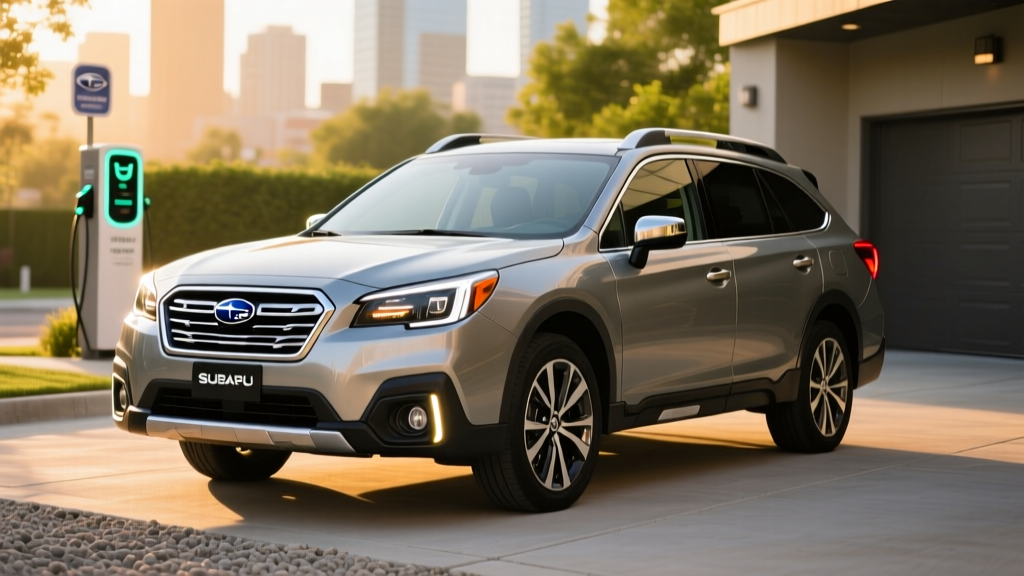
For years, Subaru loyalists have asked the same question: when will the Outback get a proper hybrid powertrain? With the Subaru Outback hybrid 2025 model year, that wait may finally be ending — but the details matter enormously for buyers cross-shopping against the Toyota RAV4 Hybrid, Honda CR-V Hybrid, and plug-in alternatives like the Toyota RAV4 Prime.
This guide breaks down what we know about the 2025 Outback Hybrid's expected powertrain, fuel economy, pricing, and where it fits in the broader electrified-vehicle landscape. Where Subaru has confirmed specs, we cite them directly. Where details remain preliminary, we flag them clearly.
A conventional hybrid (HEV) charges its small battery through regenerative braking and the engine. You never plug it in. A plug-in hybrid (PHEV) has a larger battery (typically 12–20 kWh), an electric-only range of 20–45 miles, and requires plugging in to realize its full efficiency benefit. The 2025 Outback Hybrid is expected to debut as an HEV; Subaru has not confirmed a PHEV variant for this generation.
What Powertrain Does the 2025 Outback Hybrid Use?
Subaru's hybrid strategy has historically relied on the Toyota-derived hybrid system (a collaboration stemming from Toyota's stake in Subaru's parent company). The outgoing Crosstrek Hybrid used a 2.0-liter boxer engine paired with an electric motor and a modest 13.5 kWh battery in its PHEV guise. For the 2025 Outback, industry analysis and Subaru's own outback lineup page point to a conventional hybrid setup.
The expected configuration pairs Subaru's 2.5-liter flat-four engine with an electric motor integrated into a revised Lineartronic CVT. Combined output is projected in the range of 194–210 horsepower, a meaningful bump over the standard gas Outback's 182 hp. Subaru's symmetrical all-wheel drive remains standard across all trims — a non-negotiable for the brand's buyer base.
| Specification | Expected Figure |
|---|---|
| Engine | 2.5L flat-4 + electric motor |
| Combined Horsepower | ~194–210 hp |
| Transmission | Lineartronic CVT (hybrid-optimized) |
| Drivetrain | Symmetrical AWD (standard) |
| Battery Type | Lithium-ion (HEV, ~1–2 kWh) |
| Plug-In Required? | No — charges via regen + engine |
| Towing Capacity | ~2,700–3,500 lbs (estimated) |
Because this is a conventional hybrid, the battery pack is small — likely between 1 and 2 kWh. It serves as a buffer for regenerative energy capture and electric-motor assist during acceleration and low-speed driving. There is no electric-only range figure to quote; the motor supplements the engine rather than replacing it.
Fuel Economy: How Many MPG Does the Outback Hybrid Get?
This is the number most buyers are searching for. As of our publication date, fueleconomy.gov had not yet listed the 2025 Outback Hybrid. However, based on the hybrid system's behavior in the Crosstrek and comparable midsize crossovers, we can project reasonable EPA estimates.
| Vehicle | City | Highway | Combined |
|---|---|---|---|
| 2025 Outback Hybrid (est.) | ~33–35 | ~30–32 | ~32–34 |
| 2025 Outback 2.5i (gas, AWD) | 26 | 32 | 28 |
| Toyota RAV4 Hybrid AWD | 41 | 38 | 39 |
| Honda CR-V Hybrid AWD | 40 | 34 | 37 |
| Ford Escape Hybrid AWD | 42 | 36 | 39 |
The Outback Hybrid is expected to deliver a 4–6 MPG combined improvement over the gas model. That's meaningful — roughly 50–80 fewer gallons per year for a driver covering 15,000 miles — but it falls short of the RAV4 Hybrid's dominant 39 MPG combined. Subaru's AWD system and the Outback's larger, heavier platform partially explain the gap.
Hybrids routinely exceed their EPA city estimates in real-world stop-and-go driving, where regenerative braking shines. Expect the Outback Hybrid to deliver 35–38 MPG in urban commuting. Highway efficiency is a different story: at sustained 70–80 MPH speeds, hybrid advantage shrinks, and you may see 28–30 MPG — close to the gas model. Cold weather (below 35°F) typically reduces hybrid fuel economy by 5–10% as the engine runs more often for cabin heat.
Outback Hybrid vs PHEV vs Full EV — Which Fits You?
The 2025 Outback Hybrid sits in a specific niche. Here's a framework to determine whether it's the right electrified choice for your situation.
- You can't charge at home or work
- You want AWD and 8+ inches of ground clearance
- You want lower fuel costs with zero behavior change
- Budget is under $40,000
- You can install a Level 2 home charger
- Most trips are under 40 miles (electric-only covers them)
- You want $7,500 federal tax credit eligibility
- You still need gas for long road trips
- You have reliable home or workplace charging
- You drive under 250 miles/day
- You want the lowest per-mile fuel cost (~$0.04/mi)
- You're ready to plan road-trip charging stops
The Outback Hybrid's strongest advantage is simplicity. You fuel it exactly like a gas car, and it rewards you with better city MPG. No charging apps, no range planning, no electrical panel upgrades. For Subaru's core buyer — outdoor-oriented, rural or suburban, often in cold climates — that simplicity is a feature, not a compromise.
Pricing, Trims, and Tax Credit Eligibility
Subaru has not published final 2025 Outback Hybrid MSRP, but based on the premium the hybrid commands in the Crosstrek lineup (~$2,000–$3,000 over gas), we estimate the following:
| Trim | Estimated MSRP | Federal Tax Credit |
|---|---|---|
| Premium (base hybrid) | ~$36,000–$37,500 | Not eligible |
| Limited | ~$39,000–$40,500 | Not eligible |
| Touring | ~$42,000–$43,500 | Not eligible |
| Wilderness Hybrid (if offered) | ~$41,000–$42,500 | Not eligible |
Under current IRS §30D rules, the federal clean vehicle credit of up to $7,500 applies only to plug-in electric vehicles with a minimum battery capacity of 7 kWh. Conventional hybrids like the Outback HEV do not qualify. There is no federal tax credit for standard hybrids. Some states offer modest rebates for hybrids — check your state's energy office or AFDC incentive database for local programs.
Battery Warranty, Reliability, and Replacement Cost
Hybrid battery anxiety is the number-one objection we hear from first-time hybrid buyers. Here's what the data shows.
Subaru covers hybrid batteries for 8 years / 100,000 miles (10 years / 150,000 miles in CARB states including California, New York, Massachusetts, and others that follow California emissions standards). This is industry-standard and matches Toyota and Honda's hybrid battery coverage.
Real-world data from Toyota's decades-long hybrid deployment shows that modern lithium-ion hybrid batteries rarely require full replacement within the warranty period. Degradation in a small HEV battery is managed by keeping the state of charge between roughly 40% and 80% — the battery is never fully cycled, which dramatically extends its lifespan. Taxi fleets running Toyota hybrids have logged 300,000+ miles on original batteries.
If replacement is needed out of warranty, a hybrid battery pack for a vehicle in this class typically costs $2,000–$4,000 installed — far less than the $10,000–$20,000+ cost of a full EV battery replacement. Refurbished and aftermarket hybrid batteries are increasingly available for $1,200–$2,500.
Subaru's overall reliability record, as tracked by Consumer Reports and J.D. Power, has been mixed in recent model years, with some CVT-related complaints in older vehicles. The hybrid system itself — derived from proven Toyota architecture — is expected to be one of the more reliable components in the vehicle.
Who Should Buy the 2025 Outback Hybrid?
- Standard AWD with 8.7" ground clearance
- No plug-in required — zero lifestyle change
- 4–6 MPG improvement over gas model
- Subaru's proven safety suite (EyeSight)
- 8.7" ground clearance for snow/dirt roads
- Competitive towing for a hybrid crossover
- MPG trails RAV4 Hybrid by 5–7 MPG combined
- No federal tax credit (HEV, not PHEV)
- No electric-only driving capability
- Limited hybrid availability at launch
- CVT may disappoint enthusiasts
- Premium over gas model adds ~$2,500+
The 2025 Outback Hybrid is the right call if you're a current Subaru owner (or a Subaru-curious buyer) who wants lower fuel costs without changing how you interact with your car. It's ideal for cold-climate drivers where EV range loss is a legitimate concern, rural drivers without access to public charging, and anyone who needs genuine off-pavement capability with all-weather confidence.
It is not the right call if maximum fuel savings are your priority (the RAV4 Hybrid delivers ~5–7 more MPG combined), if you want federal tax credit eligibility (you'll need a PHEV or BEV), or if your commute is short enough that a PHEV could cover it entirely on electricity.
Frequently Asked Questions
How many MPG does the 2025 Subaru Outback Hybrid get?
Based on projected EPA estimates, the Outback Hybrid should achieve approximately 33–35 MPG city, 30–32 MPG highway, and 32–34 MPG combined. That's a 4–6 MPG improvement over the gas-only Outback's 28 MPG combined. Real-world city driving may yield 35–38 MPG thanks to regenerative braking.
Does the Outback Hybrid need to be plugged in?
No. The 2025 Outback Hybrid is a conventional hybrid (HEV), not a plug-in hybrid (PHEV). Its small battery charges through regenerative braking and the gasoline engine. You fuel it at a gas station exactly like a conventional car.
Does the 2025 Outback Hybrid qualify for a tax credit?
No federal tax credit applies. IRS §30D requires a minimum 7 kWh battery and plug-in capability. The Outback HEV meets neither criterion. Check your state's incentive database at afdc.energy.gov for any local hybrid rebates, though these are uncommon.
Is the Subaru hybrid system reliable?
Subaru's hybrid system is derived from Toyota's proven hybrid architecture, one of the most reliable in the industry. The hybrid battery is warranted for 8 years/100,000 miles (10/150,000 in CARB states). Out-of-warranty replacement runs $2,000–$4,000 — significantly less than an EV battery.
How does the Outback Hybrid compare to the RAV4 Hybrid?
The RAV4 Hybrid delivers approximately 39 MPG combined vs. the Outback Hybrid's estimated 32–34 MPG — a 5–7 MPG gap. However, the Outback offers 8.7 inches of ground clearance (vs. 8.1"), a larger cargo area, standard roof rails rated for 220 lbs, and Subaru's EyeSight driver-assist system. Choose based on which trade-off matters more: maximum MPG or maximum utility.
Will Subaru offer a plug-in hybrid (PHEV) Outback?
Subaru has not confirmed a PHEV Outback for the 2025 model year. The brand previously offered a Crosstrek PHEV (discontinued after 2023). A future Outback PHEV is possible as Subaru transitions toward its 2030 electrification targets, but no announcement has been made. If plug-in capability and federal tax credit eligibility are priorities, consider the Toyota RAV4 Prime (42 miles electric-only, up to $7,500 credit) or the Hyundai Tucson PHEV.