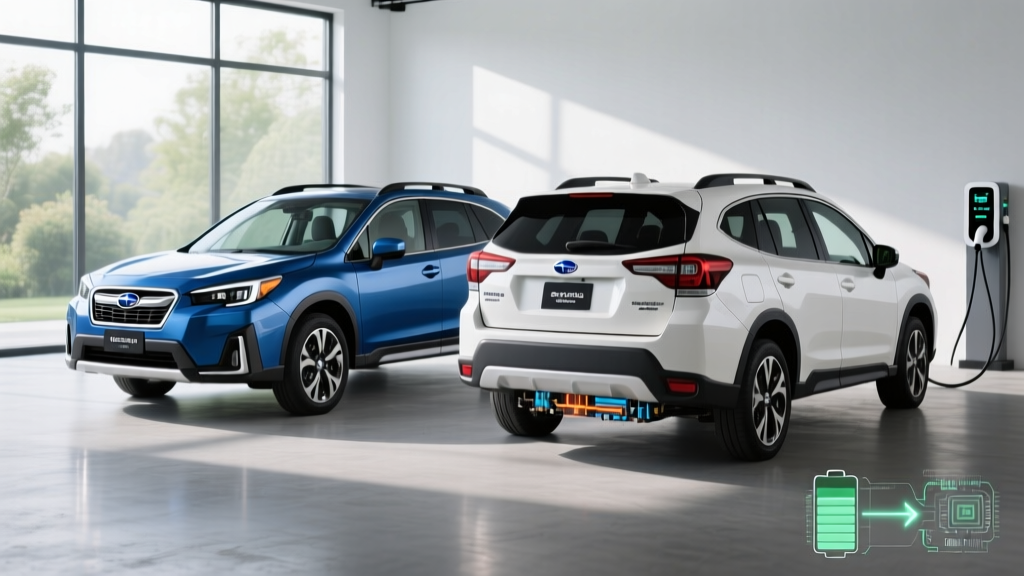
Subaru's approach to electrification has always been pragmatic rather than revolutionary, and the 2026 lineup of Subaru hybrid SUV models reflects that philosophy. If you want a vehicle that sips fuel, tackles dirt roads, and never forces you to hunt for a charger, Subaru's hybrid offerings deserve a serious look. But the lineup is compact — and understanding exactly what you're getting (and what you're not) is critical before you walk into a dealership.
For 2026, Subaru sells two hybrid SUVs in the US market: the Crosstrek Hybrid (a subcompact crossover) and the Forester Hybrid (a compact SUV). Both use conventional hybrid (HEV) powertrains — meaning no plug, no electric-only range, and no range anxiety. They simply recapture energy through regenerative braking and use a small electric motor to assist the gasoline engine. This guide covers every spec that matters: real-world MPG, powertrain details, pricing, warranty coverage, and whether a Subaru hybrid is the right fit compared to a plug-in hybrid or a full battery-electric vehicle.
HEV vs PHEV: What Subaru Actually Offers in 2026
Before diving into specs, let's clear up a common point of confusion. Subaru currently sells conventional hybrids (HEVs), not plug-in hybrids (PHEVs), in its US SUV lineup. The distinction matters enormously for your daily routine and your wallet.
| Feature | Conventional Hybrid (HEV) | Plug-In Hybrid (PHEV) |
|---|---|---|
| Plug-in charging required? | No — charges via regenerative braking and engine | Yes — plug in to access electric-only range |
| Electric-only driving | Minimal (under 1 mile at very low speeds) | Typically 20–45 miles on battery alone |
| Battery size | ~1–2 kWh (small buffer) | ~13–20+ kWh (usable) |
| Federal tax credit (§30D) | Not eligible | Up to $7,500 (subject to sourcing, income, MSRP caps) |
| Example in Subaru lineup | 2026 Crosstrek Hybrid, Forester Hybrid | None currently offered in the US |
Subaru previously sold a Crosstrek PHEV (model years 2019–2023), which offered about 17 miles of electric-only range on a ~8.8 kWh battery. That model has been discontinued and is not part of the 2026 lineup. If you see "Crosstrek Plug-In Hybrid" referenced online, it refers to the older generation. For 2026, every Subaru hybrid SUV is a self-charging HEV.
2026 Subaru Crosstrek Hybrid: MPG, Powertrain & Pricing
The Crosstrek Hybrid pairs Subaru's familiar 2.0-liter BOXER four-cylinder engine with a small electric motor integrated into the Lineartronic CVT transmission. The result is a modest power bump and noticeably better fuel economy, especially in stop-and-go city driving where regenerative braking does its best work.
| Specification | 2026 Crosstrek Hybrid |
|---|---|
| Engine | 2.0L BOXER 4-cylinder + electric motor |
| Combined Horsepower | ~154 hp (est.) |
| Drivetrain | Symmetrical AWD (standard) |
| Transmission | Lineartronic CVT |
| Hybrid Battery | ~1.1 kWh lithium-ion (not plug-in) |
| EPA MPG (City / Hwy / Combined) | 36 / 34 / 35 MPG |
| Fuel Tank Capacity | 13.2 gallons |
| Total Range (est.) | ~462 miles |
| 0–60 mph | ~9.0 seconds (est.) |
| Cargo Volume (rear seats up / down) | 20.8 / 55.3 cu ft |
| Starting MSRP | ~$30,995 |
Real-world MPG note: Conventional hybrids frequently exceed their EPA city rating in actual stop-and-go driving because regenerative braking recovers more energy at lower speeds. On the highway, where the engine runs more continuously, expect figures closer to or slightly below the EPA highway number. In mixed suburban and city driving, owners commonly report 36–38 MPG combined — a meaningful improvement over the gas-only Crosstrek's 29 MPG combined.
2026 Subaru Forester Hybrid: MPG, Powertrain & Pricing
The Forester Hybrid steps up to a larger, more family-friendly package while retaining the HEV formula. It uses a 2.5-liter BOXER engine paired with an electric motor, delivering more torque for highway merging and light towing while still achieving strong fuel economy for a compact SUV.
| Specification | 2026 Forester Hybrid |
|---|---|
| Engine | 2.5L BOXER 4-cylinder + electric motor |
| Combined Horsepower | ~194 hp (est.) |
| Drivetrain | Symmetrical AWD (standard) |
| Transmission | Lineartronic CVT |
| Hybrid Battery | ~1.1 kWh lithium-ion (not plug-in) |
| EPA MPG (City / Hwy / Combined) | 35 / 33 / 34 MPG |
| Fuel Tank Capacity | 13.2 gallons |
| Total Range (est.) | ~449 miles |
| 0–60 mph | ~8.2 seconds (est.) |
| Cargo Volume (rear seats up / down) | 28.9 / 74.4 cu ft |
| Starting MSRP | ~$35,495 |
Real-world MPG note: The Forester Hybrid's larger frontal area and weight work against it on the highway. In city and suburban driving, expect to meet or slightly beat the EPA city figure — 35–37 MPG is achievable in mixed traffic. On sustained 70+ mph highway runs, you may see 30–32 MPG. Cold-weather driving (below freezing) typically drops hybrid efficiency by 5–10% due to increased engine idling for cabin heat and reduced battery efficiency.
Side-by-Side: Crosstrek Hybrid vs Forester Hybrid
| Attribute | 2026 Crosstrek Hybrid | 2026 Forester Hybrid |
|---|---|---|
| Vehicle Class | Subcompact SUV | Compact SUV |
| Combined MPG | 35 | 34 |
| Combined HP | ~154 | ~194 |
| Ground Clearance | 8.7 inches | 8.7 inches |
| Cargo (seats up) | 20.8 cu ft | 28.9 cu ft |
| Towing Capacity | 1,000 lbs | 1,500 lbs |
| Base MSRP | ~$30,995 | ~$35,495 |
| Best For | Urban commuters, solo/couple drivers | Families, cargo haulers |
Both models come standard with Subaru's Symmetrical All-Wheel Drive and 8.7 inches of ground clearance — a combination that makes them genuine choices for unpaved roads, snow, and trailheads. Neither model sacrifices off-road capability for hybrid efficiency, which is a key differentiator against competitors like the Toyota RAV4 Hybrid (which also offers AWD but with a different system architecture).
Hybrid Battery Warranty & Long-Term Reliability
Hybrid battery longevity is consistently the top concern among first-time hybrid buyers. Here's what Subaru provides:
Subaru Hybrid Battery Warranty: 8 years / 100,000 miles (whichever comes first). In states that follow California Air Resources Board (CARB) emissions standards — including CA, CO, CT, ME, MD, MA, NJ, NY, OR, RI, VT, and WA — the hybrid battery warranty extends to 10 years / 150,000 miles.
Estimated out-of-warranty replacement cost: $2,000–$4,000 for the hybrid battery pack, depending on model and labor rates. Because Subaru's HEV batteries are small (~1.1 kWh), replacement costs are significantly lower than PHEV or full EV battery packs.
Subaru's hybrid system is relatively simple compared to PHEV or EV powertrains. The small battery buffer undergoes shallow charge/discharge cycles — it never fully depletes or fully charges, which dramatically extends cell life. According to IIHS reliability data and owner surveys, Subaru's hybrid components have shown low failure rates. The conventional hybrid architecture also means fewer high-voltage components that could require expensive service.
For context, Toyota's hybrid systems (the segment benchmark) routinely reach 200,000+ miles with minimal battery degradation. Subaru's hybrid system, while less proven at ultra-high mileage, uses similar principles and is expected to deliver comparable longevity under normal use.
Tax Credits, Incentives & Total Cost of Ownership
Here's where the HEV vs PHEV distinction hits your wallet directly:
- Federal §30D tax credit: Conventional hybrids like the Crosstrek Hybrid and Forester Hybrid do not qualify for the federal EV tax credit. The IRS §30D credit applies only to plug-in electric vehicles (PHEVs and BEVs) with qualifying battery capacity and critical-mineral sourcing.
- Used hybrid credit: The §25E used clean vehicle credit also does not apply to conventional HEVs.
- State incentives: A handful of states offer modest rebates or HOV lane access for hybrids, but these are increasingly targeted at PHEVs and BEVs. Check your state's energy or environmental agency for current programs.
- Fuel savings vs gas-only: The Crosstrek Hybrid's 35 MPG combined versus the gas-only Crosstrek's 29 MPG combined saves roughly $200–$350 per year in fuel (assuming 12,000 miles/year and $3.50/gallon). Over 5 years, that's $1,000–$1,750 — partially offsetting the hybrid's higher MSRP.
| 5-Year Cost Factor | Crosstrek Hybrid (35 MPG) | Crosstrek Gas (29 MPG) |
|---|---|---|
| Fuel Cost (12k mi/yr, $3.50/gal) | ~$6,000 | ~$7,241 |
| Federal Tax Credit | $0 | $0 |
| Estimated Insurance (5 yr) | ~$7,500 | ~$7,200 |
| Maintenance (5 yr) | ~$2,800 | ~$3,000 |
| Base MSRP | ~$30,995 | ~$26,995 |
| Est. 5-Year Total | ~$47,295 | ~$44,436 |
The hybrid commands a price premium that fuel savings alone won't fully recoup in five years. However, hybrids typically show stronger resale values than gas-only counterparts — a factor that narrows the gap when you account for trade-in or sale at year five. EPA fueleconomy.gov data confirms that hybrid SUVs retain a growing share of buyer demand, supporting used-market pricing.
Hybrid vs PHEV vs EV: Which Subaru Buyer Are You?
Choose a Subaru Hybrid (HEV) if:
- You don't have access to home or workplace charging (apartment, street parking, no garage outlet)
- You want better fuel economy without changing any habits — no plugging in, no route planning
- You drive in extreme cold regularly, where EV range loss is a concern
- You want AWD capability for trails, snow, or rural roads
- Your budget is under $40,000 and you want a new vehicle with full warranty coverage
Consider a PHEV (from another brand) if:
- You can charge at home and want 25–40 miles of electric-only commuting
- You want to qualify for the up-to-$7,500 federal tax credit
- Your daily commute is under 40 miles round-trip
- You want to drive mostly on electricity but keep a gas engine for road trips
Consider a full EV (BEV) if:
- You have reliable Level 2 home charging
- You want zero tailpipe emissions and the lowest per-mile energy cost
- Your daily driving is under 250 miles and you're comfortable with DC fast charging on road trips
- You want to maximize federal and state incentives
Subaru has announced plans to introduce additional electrified models, including battery-electric SUVs developed in partnership with Toyota. However, as of the 2026 model year, no Subaru PHEV or BEV SUV is currently on sale in the US. If a plug-in Subaru is a must-have, you'll need to watch for future announcements or consider competitors like the Toyota RAV4 Prime (PHEV) or the Hyundai Tucson PHEV.
Pros and Cons: Subaru Hybrid SUVs at a Glance
Pros
- Standard Symmetrical AWD on every trim — genuine all-weather capability
- 35 MPG combined without any plug-in charging or behavior change
- 8.7 inches of ground clearance for unpaved roads and deep snow
- Strong reliability reputation; simple hybrid system with low failure risk
- 8-year/100,000-mile hybrid battery warranty (10/150k in CARB states)
- EyeSight driver-assistance suite standard (adaptive cruise, lane-keep, pre-collision braking)
Cons
- No PHEV or EV option in the current Subaru SUV lineup
- No federal tax credit eligibility for conventional HEVs
- Modest hybrid powertrain — performance is adequate, not quick
- Hybrid premium over gas-only trims takes 5+ years to recoup via fuel savings alone
- CVT transmission can feel sluggish under hard acceleration
- Small ~1.1 kWh battery means virtually no electric-only driving capability
Frequently Asked Questions
How many MPG does the 2026 Subaru Crosstrek Hybrid get?
The EPA rates the 2026 Crosstrek Hybrid at 36 city / 34 highway / 35 combined MPG. In real-world mixed driving, owners commonly report 36–38 MPG combined, with city driving sometimes exceeding the EPA figure thanks to regenerative braking. Highway-only driving at 75+ mph may return 31–33 MPG.
How many MPG does the 2026 Subaru Forester Hybrid get?
The EPA rates the Forester Hybrid at 35 city / 33 highway / 34 combined MPG. Real-world results vary: expect 35–37 MPG in city and suburban conditions, and 30–32 MPG on sustained highway trips.
Can I plug in the 2026 Subaru Crosstrek Hybrid or Forester Hybrid?
No. Both the 2026 Crosstrek Hybrid and Forester Hybrid are conventional hybrids (HEVs). They charge their small battery packs through regenerative braking and the gasoline engine. There is no plug, no charging port, and no electric-only driving range. The previous-generation Crosstrek PHEV (discontinued after 2023) did offer plug-in capability, but that model is no longer in production.
How far can the Subaru Hybrid SUVs go on electric power alone?
Effectively zero miles at meaningful speeds. The hybrid system can propel the vehicle at very low speeds (parking lots, crawling in traffic) for brief distances under a mile, but the gasoline engine engages almost immediately during normal driving. If electric-only commuting is a priority, you need a PHEV or BEV — neither of which Subaru currently offers.
Do Subaru hybrid SUVs qualify for any tax credit?
No. The federal §30D clean vehicle credit applies only to plug-in vehicles (PHEVs and BEVs) with qualifying battery sourcing. Conventional hybrids are not eligible. Some states may offer minor incentives for hybrids, but these are increasingly rare. Check your state energy office for current programs.
How long will the Subaru hybrid battery last, and what does replacement cost?
Subaru warranties the hybrid battery for 8 years / 100,000 miles nationwide, and 10 years / 150,000 miles in CARB states. Because the battery is small (~1.1 kWh) and operates in a shallow charge/discharge window, it experiences far less stress than an EV or PHEV battery. Out-of-warranty replacement is estimated at $2,000–$4,000 — significantly less than the $8,000–$20,000 replacement cost for larger PHEV or BEV packs.
Is the Subaru hybrid system reliable compared to Toyota's?
Toyota's hybrid systems are the industry benchmark with decades of proven longevity. Subaru's hybrid system is newer and less battle-tested at extreme mileages, but it uses a simpler, smaller-scale architecture that has shown low failure rates in early data. Both brands offer 8-year/100,000-mile hybrid battery warranties. For buyers prioritizing maximum hybrid track record, Toyota has the edge; for those who value Subaru's AWD system and ground clearance, the Subaru hybrid is a credible choice.
How does the Subaru hybrid compare to the Toyota RAV4 Hybrid?
The Toyota RAV4 Hybrid delivers 41 city / 38 highway / 40 combined MPG with AWD — notably higher than the Forester Hybrid's 34 combined. The RAV4 Hybrid also offers more combined horsepower (~219 hp) and starts around $33,000. However, the Forester Hybrid offers superior outward visibility, a more spacious cargo area for its class, and Subaru's X-MODE for more serious off-road use. The choice depends on whether fuel economy (Toyota) or off-road capability and visibility (Subaru) rank higher on your list.
The 2026 Subaru hybrid SUV models won't win any efficiency awards against Toyota's hybrid dominance, and the lack of a PHEV option is a real gap for buyers who want plug-in capability and federal tax credits. But if your priority is a no-compromise AWD vehicle that gets mid-30s MPG without ever plugging in — and you regularly encounter snow, gravel, or trailheads — the Crosstrek Hybrid and Forester Hybrid occupy a niche that few competitors can match. They're not the most electrified SUVs on the market. They're the most Subaru.