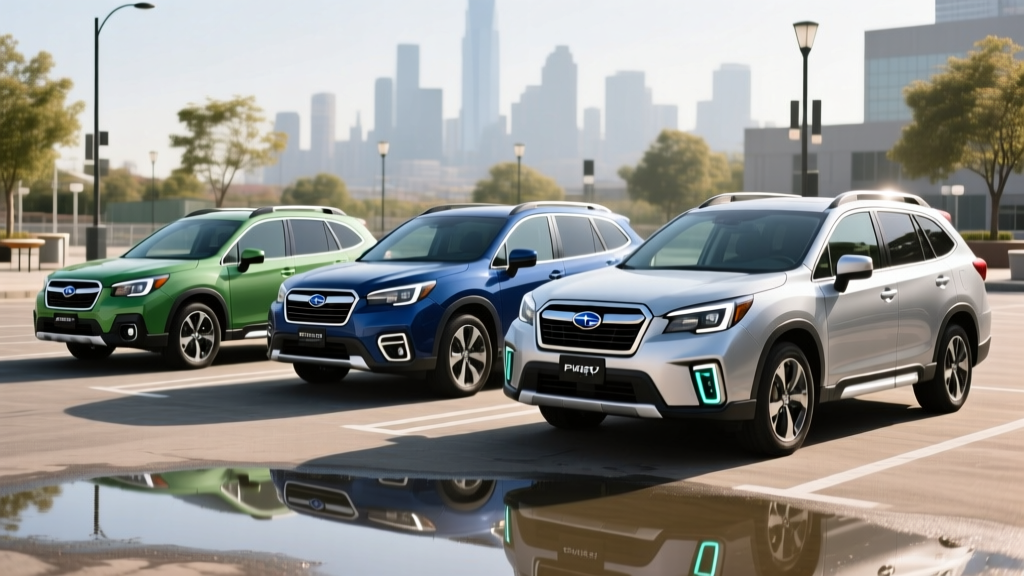
If you are searching for a Subaru hybrid car in 2026, the automaker now offers three distinct electrified options spanning conventional hybrid (HEV) and plug-in hybrid (PHEV) powertrains. Subaru's hybrid strategy leans heavily on its signature symmetrical all-wheel drive and boxer-engine layout, pairing them with electric motors for measurable efficiency gains without sacrificing the brand's rugged identity. This guide breaks down every current Subaru hybrid with exact EPA figures, real-world expectations, battery specs, and ownership costs so you can decide which one fits your driving life.
Subaru's 2026 Hybrid Lineup at a Glance
Subaru currently sells two conventional hybrids and one plug-in hybrid in the US market. The distinction matters: a conventional hybrid (HEV) charges its small battery through regenerative braking and the gas engine — you never plug it in. A plug-in hybrid (PHEV) has a larger battery you charge from a wall outlet or public charger, giving you a meaningful electric-only range before the gas engine kicks in.
HEV vs PHEV — How Subaru's Hybrids Differ
| Feature | Conventional Hybrid (HEV) | Plug-in Hybrid (PHEV) |
|---|---|---|
| Plug-in charging | No — self-charging via regen + engine | Yes — plug in for electric-only miles |
| Battery size | ~1.1 kWh (small buffer) | ~20 kWh (usable) |
| Electric-only range | Less than 1 mile at low speed | ~35-42 miles EPA |
| Federal tax credit | Not eligible under §30D | Eligible — up to $7,500 (rules apply) |
| Best for | Drivers without home charging access | Drivers with home charging and short commutes |
2026 Subaru Crosstrek Hybrid (HEV)
The Crosstrek Hybrid is Subaru's entry-point hybrid, pairing the familiar 2.0-liter boxer four-cylinder with an integrated electric motor-generator. It uses a compact lithium-ion battery pack mounted under the rear cargo floor. Total system output reaches 194 horsepower — a meaningful bump over the gas-only Crosstrek's 152 hp — and the electric motor fills in torque at low RPMs, making city driving noticeably more responsive.
| Specification | 2026 Crosstrek Hybrid |
|---|---|
| Powertrain | 2.0L boxer-4 + electric motor-generator |
| Combined horsepower | 194 hp |
| Drivetrain | Symmetrical AWD (standard) |
| Battery | ~1.1 kWh lithium-ion |
| Plug-in required | No (HEV) |
| 0-60 mph | ~7.8 seconds |
| Cargo volume | 20.1 cu ft (rear seats up) |
| Base MSRP | $31,995 |
| EPA Fuel Economy | MPG |
|---|---|
| City | 38 MPG |
| Highway | 35 MPG |
| Combined | 36 MPG |
Real-world MPG note: Subaru hybrids, like most HEVs, tend to match or slightly exceed their EPA city rating in stop-and-go driving thanks to aggressive regenerative braking. On the highway at sustained 75 mph, expect closer to 32-33 MPG. In cold weather (below 30°F), the engine runs more frequently for cabin heat, dropping city efficiency to roughly 33-34 MPG. Source: fueleconomy.gov.
2026 Subaru Forester Hybrid (HEV)
The redesigned Forester Hybrid applies the same hybrid architecture to Subaru's best-selling compact SUV. The larger 2.5-liter boxer four-cylinder pairs with a more powerful electric motor for 210 combined horsepower. The extra displacement and torque make this the more capable hybrid for towing (1,500 lbs rated) and mountain-pass driving, where the electric motor's instant torque reduces the transmission hunting common in the gas-only model.
| Specification | 2026 Forester Hybrid |
|---|---|
| Powertrain | 2.5L boxer-4 + electric motor-generator |
| Combined horsepower | 210 hp |
| Drivetrain | Symmetrical AWD (standard) |
| Battery | ~1.1 kWh lithium-ion |
| Plug-in required | No (HEV) |
| 0-60 mph | ~7.2 seconds |
| Cargo volume | 28.9 cu ft (rear seats up) |
| Towing capacity | 1,500 lbs |
| Base MSRP | $36,495 |
| EPA Fuel Economy | MPG |
|---|---|
| City | 35 MPG |
| Highway | 33 MPG |
| Combined | 34 MPG |
Real-world MPG note: The Forester Hybrid's boxy shape and AWD system create more aerodynamic drag and drivetrain loss than the Crosstrek. Expect 36-37 MPG in city driving under mild conditions, but highway cruising at 75+ mph will return 30-31 MPG. Owners in hilly terrain report that the hybrid system's regen on descents partially offsets the uphill fuel penalty, keeping combined real-world numbers close to the EPA sticker.
2026 Subaru Outback PHEV (Plug-in Hybrid)
The Outback PHEV is Subaru's only plug-in hybrid for 2026, replacing the discontinued Crosstrek PHEV. It pairs a 2.5-liter boxer engine with a larger electric motor and a 20.4 kWh (total) lithium-ion battery pack, of which approximately 16.5 kWh is usable. This gives the Outback PHEV an EPA-rated 38 miles of electric-only range — enough to cover most daily commutes without burning a drop of gasoline. Once the battery depletes, the vehicle operates as a conventional hybrid, returning an estimated 30 MPG combined.
| Specification | 2026 Outback PHEV |
|---|---|
| Powertrain | 2.5L boxer-4 + electric motor |
| Combined horsepower | 230 hp |
| Drivetrain | Symmetrical AWD (standard) |
| Battery (total / usable) | 20.4 kWh / ~16.5 kWh |
| Electric-only range (EPA) | 38 miles |
| Total combined range | ~520 miles |
| Level 2 charge time (0-100%) | ~3.5 hours at 6.6 kW |
| DC fast charging | Not supported |
| Charge port | J1772 (Level 1/2) |
| 0-60 mph | ~6.8 seconds |
| Cargo volume | 28.2 cu ft (rear seats up) |
| Towing capacity | 2,000 lbs |
| Base MSRP | $44,995 |
| EPA Efficiency | Rating |
|---|---|
| Electric-only (MPGe) | 90 MPGe combined |
| Gas-only (hybrid mode) city | 30 MPG |
| Gas-only (hybrid mode) highway | 29 MPG |
| Gas-only (hybrid mode) combined | 30 MPG |
Real-world electric range: The 38-mile EPA electric range assumes moderate temperatures and mixed driving. In practice, expect 32-35 miles on a full charge at highway speeds (55-65 mph), and as low as 25-28 miles in sub-freezing temperatures when the battery heater and cabin climate system draw additional power. Preconditioning the cabin while plugged in helps preserve range by warming the interior from grid power rather than the battery. The Outback PHEV does not support DC fast charging — this is a Level 2 (J1772) vehicle only, which is typical for PHEVs in this class.
Federal Tax Credits and Pricing for Subaru Hybrids
Tax credit eligibility is one of the sharpest dividing lines between Subaru's HEV and PHEV models. Under IRS §30D rules for 2026, only plug-in hybrids with sufficient battery capacity and compliant battery-mineral sourcing qualify for the federal clean vehicle credit. Conventional hybrids do not qualify.
- Crosstrek Hybrid (HEV): Not eligible for §30D federal tax credit.
- Forester Hybrid (HEV): Not eligible for §30D federal tax credit.
- Outback PHEV: Potentially eligible for up to $7,500, subject to the following requirements:
- Buyer adjusted gross income must not exceed $150,000 (single) / $300,000 (joint) — per IRS §30D guidelines
- Vehicle MSRP must be under $80,000 (SUVs/vans/pickups) — Outback PHEV qualifies at $44,995 base
- Battery critical minerals and component sourcing must meet 2026 phase-in thresholds
- Credit can be transferred to the dealer at point of sale as a purchase-price reduction
Critical caveat: Battery sourcing requirements tighten each year. A PHEV that qualifies for the full $7,500 in early 2026 may see a partial reduction if its battery minerals fail the annual critical-minerals threshold. Always verify the specific VIN's eligibility on fueleconomy.gov before purchase, and consult a tax professional for your personal situation.
Battery Warranty, Reliability, and Replacement Costs
Subaru Hybrid Battery Warranty Coverage
| Model | Hybrid Battery Warranty | Powertrain Warranty |
|---|---|---|
| Crosstrek Hybrid (HEV) | 8 years / 100,000 miles | 5 years / 60,000 miles |
| Forester Hybrid (HEV) | 8 years / 100,000 miles | 5 years / 60,000 miles |
| Outback PHEV | 8 years / 100,000 miles (capacity retention ≥70%) | 5 years / 60,000 miles |
Subaru's hybrid battery warranty aligns with the industry standard of 8 years or 100,000 miles, whichever comes first. For the PHEV, the warranty guarantees the battery will retain at least 70% of its original capacity during the coverage period. If degradation exceeds that threshold, Subaru will repair or replace the battery pack at no cost.
Reliability track record: Subaru's hybrid systems are relatively mature, with the HEV architecture carried over from the previous-generation Crosstrek and Forester models. The boxer-engine layout adds complexity compared to inline-four competitors, but the hybrid components (motor-generator, inverter, battery) have shown strong durability in field data. The Outback PHEV's larger battery pack is sourced from Panasonic, a supplier with extensive automotive-grade experience.
Out-of-warranty replacement cost: If a hybrid battery fails after the 8-year/100,000-mile window, expect the following approximate replacement costs at a Subaru dealer:
- HEV battery (Crosstrek/Forester): $2,500 - $4,000 (small pack, simpler replacement)
- PHEV battery (Outback): $8,000 - $12,000 (larger pack, more labor-intensive)
These are ballpark figures; actual costs vary by region and dealer. Third-party hybrid battery refurbishers may offer savings of 30-50%, though availability for newer Subaru packs is still limited.
Subaru Hybrid vs PHEV vs Full EV: Which Fits You?
Choose Based on Your Charging Access and Driving Pattern
| Your Situation | Best Subaru Choice | Why |
|---|---|---|
| No home charging, mostly city driving | Crosstrek Hybrid (HEV) | No plug needed; 38 MPG city; lowest entry price at ~$32K |
| No home charging, need cargo space | Forester Hybrid (HEV) | 28.9 cu ft cargo; 35 MPG city; self-charging convenience |
| Home Level 2 charger, commute under 35 miles | Outback PHEV | 38-mile electric range covers commute; rarely burns gas; potential $7,500 credit |
| Home charger, commute over 50 miles, want zero gas | Consider a full EV (e.g., Subaru Solterra or Tesla Model Y) | PHEV electric range won't cover full commute; a 300+ mile BEV eliminates gas entirely |
| Frequent long road trips, no charging patience | Forester Hybrid or Outback PHEV | Both offer 500+ mile total range; HEV never needs a plug; PHEV reverts to hybrid mode seamlessly |
If your daily round-trip commute falls within the Outback PHEV's 38-mile electric range and you can install a Level 2 home charger (typically $500-$1,500 for a 240V circuit and quality EVSE), you will drive the majority of your miles on electricity at roughly $0.04-$0.06 per mile (depending on your local electricity rate) versus $0.12-$0.16 per mile on gasoline. That math shifts dramatically if you lack home charging — public Level 2 charging costs $0.15-$0.25 per mile equivalent, erasing much of the PHEV's cost advantage. In that scenario, a conventional HEV is the smarter financial choice.
Pros and Cons of Subaru's Hybrid Lineup
Pros
- Standard symmetrical AWD on every hybrid model — no FWD-only trims
- HEV models require zero charging infrastructure
- Outback PHEV's 38-mile electric range covers most commutes
- Hybrid motor-generator adds low-end torque for better off-road crawl and city responsiveness
- 8-year/100,000-mile hybrid battery warranty across the lineup
- Outback PHEV eligible for up to $7,500 federal tax credit (subject to IRS rules)
- Subaru's EyeSight driver-assist suite (adaptive cruise, lane-keep, pre-collision) standard on all trims
Cons
- No DC fast charging on Outback PHEV — Level 2 only
- HEV models (Crosstrek, Forester) ineligible for federal tax credit
- Outback PHEV base MSRP of $44,995 is a significant premium over gas-only Outback (~$32,000)
- Boxer engine adds maintenance complexity vs. inline-four competitors (e.g., Toyota RAV4 Hybrid)
- HEV battery is small (~1.1 kWh) — electric-only assist is minimal, not true electric driving
- Cargo space slightly reduced on Outback PHEV due to battery pack placement
- Fewer Subaru hybrid trims available vs. Toyota/Honda hybrid lineups
Frequently Asked Questions
How many MPG does a Subaru hybrid car get?
The 2026 Subaru Crosstrek Hybrid achieves an EPA-estimated 36 MPG combined (38 city / 35 highway). The Forester Hybrid returns 34 MPG combined (35 city / 33 highway). The Outback PHEV operates at 90 MPGe combined on electric power and 30 MPG combined in hybrid mode after the battery depletes. Real-world city MPG for the HEV models often matches or slightly exceeds EPA estimates due to regenerative braking, while highway MPG at sustained high speeds typically runs 2-3 MPG below the sticker.
How far can the Subaru Outback PHEV go on electric only?
The EPA rates the 2026 Outback PHEV at 38 miles of electric-only range. In real-world conditions, expect 32-35 miles at highway speeds and 25-28 miles in freezing temperatures. The total combined range (electric + gas tank) is approximately 520 miles, making it a viable road-trip vehicle without range anxiety.
Does the Subaru hybrid car qualify for a tax credit?
Only the Outback PHEV qualifies for a federal tax credit under IRS §30D — potentially up to $7,500, subject to buyer income caps ($150K single / $300K joint), MSRP limits (under $80K for SUVs), and battery critical-mineral sourcing requirements. The Crosstrek Hybrid and Forester Hybrid are conventional HEVs and do not qualify for the federal clean vehicle credit. Some states offer additional rebates for PHEVs — check your state energy office for current programs. Consult a tax professional to confirm personal eligibility.
Is the Subaru hybrid battery reliable, and what does replacement cost?
Subaru covers all hybrid batteries with an 8-year / 100,000-mile warranty. The HEV batteries (~1.1 kWh) are small, relatively simple, and cost approximately $2,500-$4,000 to replace out of warranty. The Outback PHEV's larger 20.4 kWh pack costs roughly $8,000-$12,000 to replace. Subaru's hybrid components have demonstrated strong durability in early field data, and the boxer-engine hybrid pairing has been in production since the prior generation. Long-term (15+ year) degradation data is still accumulating, as these specific powertrains are relatively new.
Can I plug in the Crosstrek Hybrid or Forester Hybrid?
No. The Crosstrek Hybrid and Forester Hybrid are conventional hybrids (HEVs). They charge their small battery packs exclusively through regenerative braking and the gasoline engine. There is no plug, no charge port, and no electric-only driving range to speak of. Only the Outback PHEV has a charge port (J1772) and meaningful electric-only range.
Should I buy a Subaru hybrid or a full EV?
If you have reliable home charging and your daily driving stays under 40 miles, the Outback PHEV lets you drive electric daily while keeping a gas engine for road trips — a practical bridge. If your commute exceeds 50 miles or you want to eliminate gasoline entirely, a full EV like the Subaru Solterra (228-mile EPA range) or a competitor such as the Hyundai Ioniq 5 (303+ miles) makes more sense. If you cannot charge at home at all, a Subaru HEV is the right call — you get 34-36 MPG with zero behavior change.
Sources: EPA fuel economy data via fueleconomy.gov; IRS clean vehicle credit rules via irs.gov; Subaru of America official specifications. All pricing and specifications reflect 2026 model year data available at time of publication and are subject to change.